

Key Takeaways
- The digital pharmacy market is growing rapidly as patients prefer technology-driven medication management and home delivery.
- Amazon Pharmacy demonstrates how combining prescription fulfillment, telepharmacy support, subscription models, and logistics creates a scalable healthcare ecosystem.
- Successful pharmacy care platforms rely on automated refills, adherence tools, insurance integration, tracking, and pharmacist access to improve retention.
- For businesses, building a platform like Amazon Pharmacy requires compliance, secure data management, fulfillment networks, and engagement to drive growth.
- How Idea Usher can help businesses build pharmacy care platforms like Amazon through healthcare integrations and telepharmacy features.
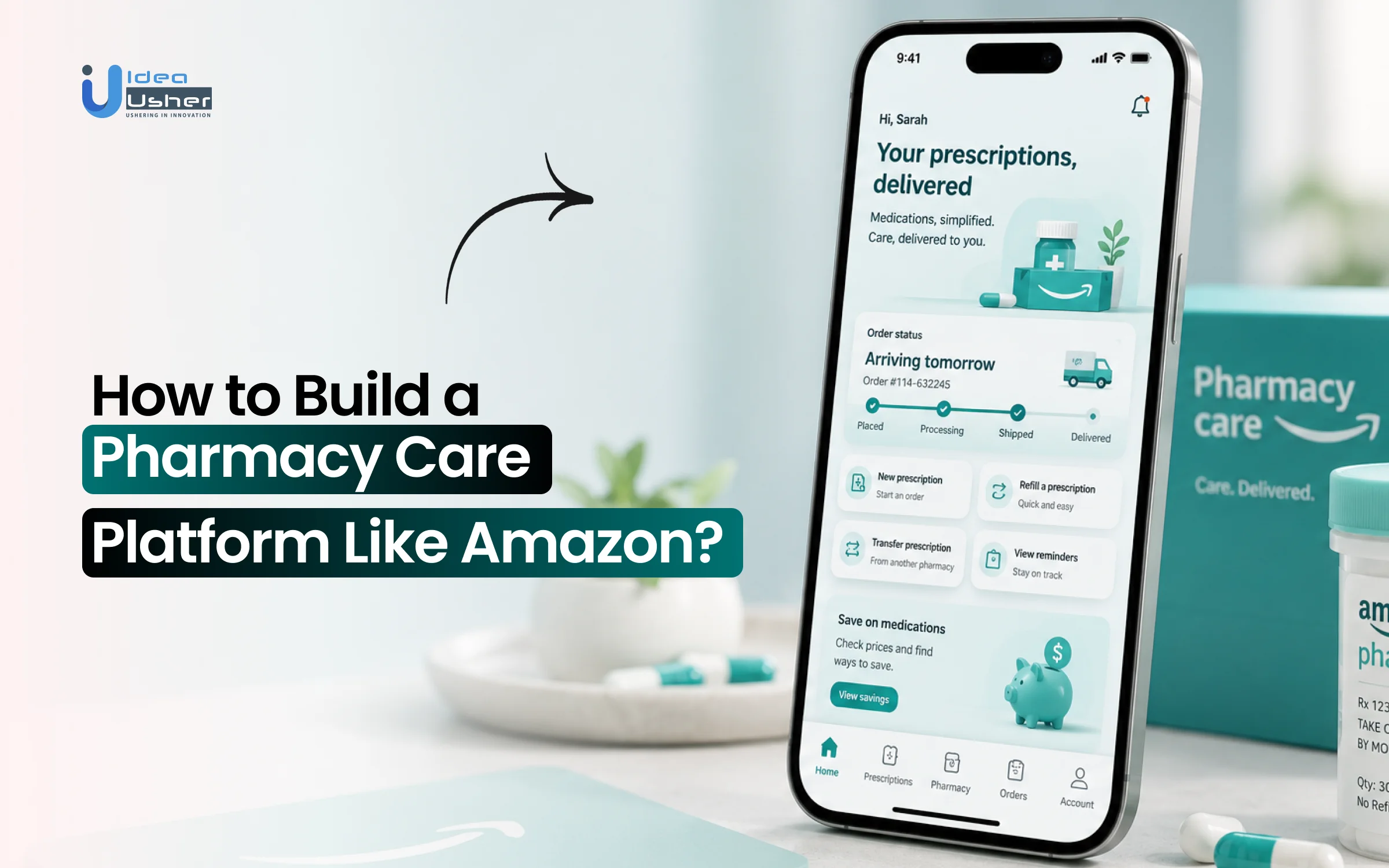
Healthcare is becoming more digital, and patients now expect easier ways to manage their medications. Pharmacy care platforms are growing in popularity because they bring prescriptions, medication tracking, and patient support into one convenient experience. The best platforms go beyond basic prescription management. They help patients stay engaged with their treatment and make it easier for providers to monitor progress. To deliver that experience at scale, businesses need a secure and compliant platform built around patient care.
Over the past decade, we’ve developed numerous pharmacy care solutions that leverage e-prescription management systems and medication adherence tracking technologies to deliver seamless and patient-focused pharmacy experiences. Using this expertise, we’re writing this blog to explore how to build a pharmacy care platform like Amazon. Let’s start!
Why Are Pharmacy Care Platforms Booming?
According to Market Research Future, the pharmaceutical digital platform market is expected to grow from $7.42 billion in 2025 to $65.64 billion by 2035, reflecting strong demand for digital healthcare solutions. This growth highlights the increasing shift toward online pharmacy services that make medication management more convenient and efficient. As healthcare becomes more digital, pharmacy care platforms are emerging as an attractive business opportunity with significant potential for long-term growth and market expansion.
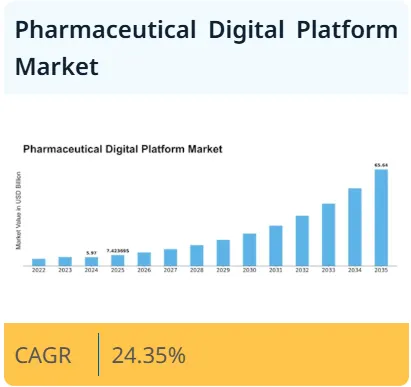
Source: Market Research Future
Demand for Convenient Access
Consumer expectations have permanently shifted. Modern patients want their healthcare to match the frictionless convenience of digital banking or e-commerce. Waiting in long lines at physical stores to drop off or pick up a prescription is rapidly becoming an obsolete practice. Digital pharmacy platforms eliminate these friction points entirely:
- Seamless Onboarding: Patients upload prescriptions via an app in seconds.
- Automated Management: Automatic refills and digital insurance verification take the friction out of renewal cycles.
- Home Delivery: Integrated courier networks bring medications directly to the patient’s doorstep.
A prime validation of this demand is Capsule, a digital pharmacy platform that built its entire value proposition around free, same-day prescription delivery and text-based pharmacist access. By eliminating the physical retail storefront, Capsule scaled its operations efficiently and expanded across major US markets, capturing a valuation of 1 billion dollars and generating an estimated annual revenue exceeding 100 million dollars.
For an investor, this shift lowers customer acquisition costs over time. Digital retention naturally outpaces traditional retail loyalty because the platform treats patient convenience as a core metric.
Growth of Telepharmacy
Telepharmacy helps complete the virtual care journey by allowing patients to receive medications and professional guidance without visiting a physical pharmacy. Modern platforms connect users with licensed pharmacists through chat or video, making it easier to address medication questions and improve treatment adherence. For businesses, this creates opportunities to build stronger patient relationships while expanding revenue through subscriptions, telehealth partnerships, and value-added healthcare services.
Focus on Medication Adherence
Medication non-adherence is one of the most expensive problems in healthcare. When patients fail to take chronic medications, it leads to preventable hospital readmissions and billions of dollars in wasted medical spend. Payers, insurance providers, and employers actively search for technology that solves this problem. Modern platforms solve this issue through smart, automated interventions. Instead of relying on manual tracking, these systems use data-driven features to keep patients on track:
- Predictive Refill Alerts: The platform calculates when a patient is running low and prompts action early.
- Targeted Micro-Education: Short digital content helps patients understand their treatment, reducing drop-off rates.
- Proactive Clinical Outreach: Systems flag skipped doses for a quick check-in from a remote pharmacist.
Consider the success of Alto Pharmacy, which integrated courier logistics with proprietary backend software to directly tackle adherence. By helping patients manage complex, chronic medications and automatically applying insurance discounts, Alto achieved a 30 percent better medication adherence rate than the industry average. This focus on outcomes allowed Alto to scale aggressively, crossing the major milestone of 1 billion dollars in annual revenue.

How Amazon Built Its Pharmacy Business?
Amazon’s entry into healthcare reshaped the digital pharmacy market by showing how technology, logistics, and healthcare services can work together at scale. Through Amazon Pharmacy, the company went beyond medication delivery and built a connected healthcare ecosystem backed by strong infrastructure and a trusted consumer platform. For entrepreneurs and investors, it highlights how strategic expansion can create lasting competitive advantages in the growing digital health sector.
Amazon’s Bet on PillPack
Building a digital pharmacy requires navigating strict regulations, licensing requirements, and complex medication fulfillment processes. Amazon accelerated its entry into the market by acquiring PillPack, gaining an established pharmacy operation along with the infrastructure needed to manage prescriptions and deliveries. This acquisition cost Amazon between 750 million dollars and 1 billion dollars, but it secured three critical assets instantly:
- Pre-existing mail-order licenses across all fifty states
- A proven automated fulfillment system
- A unique multi-dose packaging model that consumers already loved
This move proved that the fastest way to dominate digital health is to buy existing compliance and scale it with capital.
Launching Amazon Pharmacy
After rebranding PillPack into Amazon Pharmacy, Amazon expanded beyond a specialized medication service and created a pharmacy platform designed for a much broader consumer market. The business generates revenue through prescription fulfillment, insurance reimbursements, and direct medication purchases, giving it multiple ways to monetize its growing customer base.
The launch of RxPass strengthened this model by offering eligible Prime members access to many generic medications for just $5 per month. This subscription approach creates predictable recurring revenue while improving customer retention. It also aligns with Amazon’s wider subscription business, which generates more than $12 billion in quarterly revenue, demonstrating the long-term value of membership-driven healthcare services.
Expanding Into a Full Healthcare Ecosystem
Medication delivery was just the first phase. Amazon is actively connecting pharmacy services with primary medical care. Buying One Medical for nearly four billion dollars secured the clinical front-end of their strategy. The ecosystem now connects the dots for patients seamlessly:
- Virtual Doctor Visit: A patient consults a doctor online.
- Instant Prescription: The doctor routes the order to the internal pharmacy system.
- Rapid Delivery: Courier networks deliver the medication directly to the patient within hours.
Amazon is scaling this same-day delivery to roughly 4,500 cities and towns. However, scaling a network of this size has brought structural updates. To support this massive healthcare push, Amazon has optimized its physical retail strategy, recording over 600 million dollars in asset impairments and charges primarily related to restructuring its older physical store and clinic footprints.
How Amazon Pharmacy Simplifies Medication Management?
Managing multiple prescriptions is a major pain point for chronic care patients. Amazon Pharmacy tackles this operational mess by simplifying the entire user journey. Understanding how this compliance problem is solved reveals how to build a highly sticky healthcare platform that retains users for years.
1. Automated Refills and Reminders
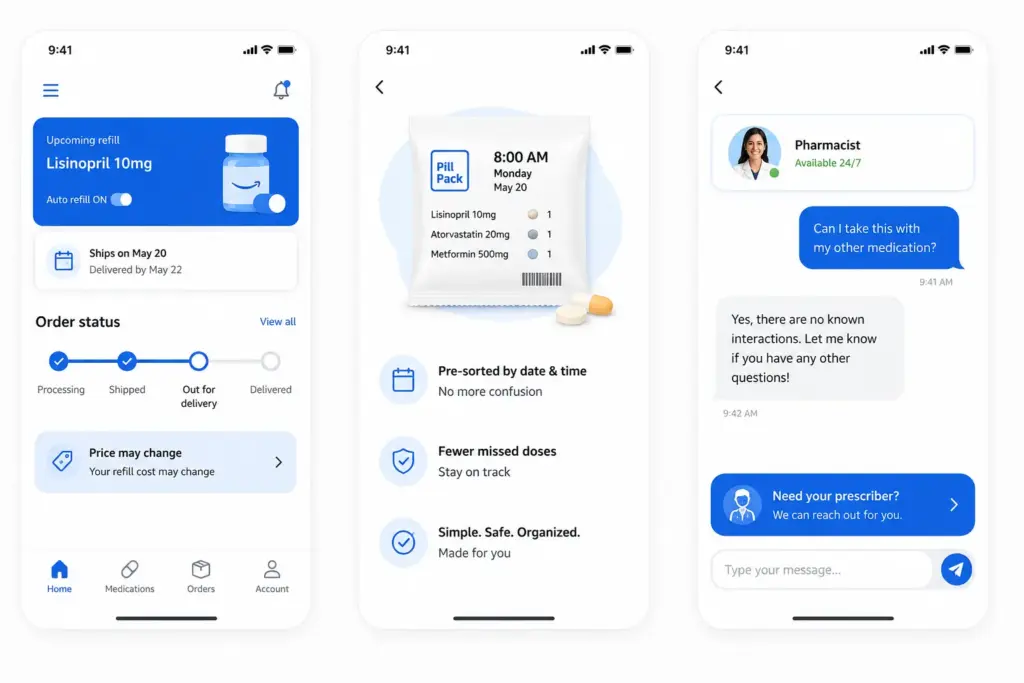
The easiest way to lose a pharmacy customer is to let them run out of medication. When a patient forgets to renew, the supply chain breaks and revenue stops. Amazon eliminates this gap by automating the renewal cycle directly within the user interface. Through the Dashboard view, patients manage their treatment pipeline seamlessly:
- Automatic Refills Toggle: A simple interactive switch that allows users to opt-in for automated shipping after their initial prescription fill.
- Order Status Tracker: A real-time visual progress bar tracking orders from processing to delivery.
- Price Prediction Alert: Digital UI notifications that warn users if the insurance or cash price of an upcoming refill changes significantly.
By removing manual steps, the system drives up medication adherence. For the business, this creates highly predictable, recurring prescription revenue.
2. PillPack’s Organized Experience
For patients taking multiple pills a day, managing bottles is confusing and dangerous. Amazon uses the PillPack service line to turn a chaotic medicine cabinet into a streamlined retail product. Instead of sending loose bottles, the pharmacy dispenses pre-sorted, individualized packets. Each packet is clearly printed with the exact date and time it should be taken. This physical innovation completely eliminates guesswork, dramatically lowers the risk of missed doses, and turns a complex clinical schedule into a simple daily habit.
3. 24/7 Pharmacist Digital Access
A digital platform cannot succeed without human trust. Amazon bridges the gap between technology and clinical care by embedding ongoing medical guidance directly into the core app infrastructure. Under the Contact a Pharmacist portal, the UI enables dual communication options:
- 24/7 Live Chat: A direct text interface for non-emergency clinical guidance, drug interaction checks, and side effect reporting.
- Prescriber Portal Link: A dedicated backend pipeline that allows the pharmacy team to contact the patient’s doctor directly to manage renewal issues without forcing the patient to act as a middleman.
This combination of professional guidance and digital autonomy builds immense user trust, ensuring patients stay loyal to the platform for their long-term care needs.
Key Features of a Pharmacy Care Platform Like Amazon
To compete with legacy retail networks, modern pharmacy care platforms must deliver an intuitive, features-first application layer. Amazon Pharmacy handles massive scale by turning complicated clinical regulations into simple, user-driven digital actions. Replicating this success requires building specific, high-utility features directly into the software architecture.
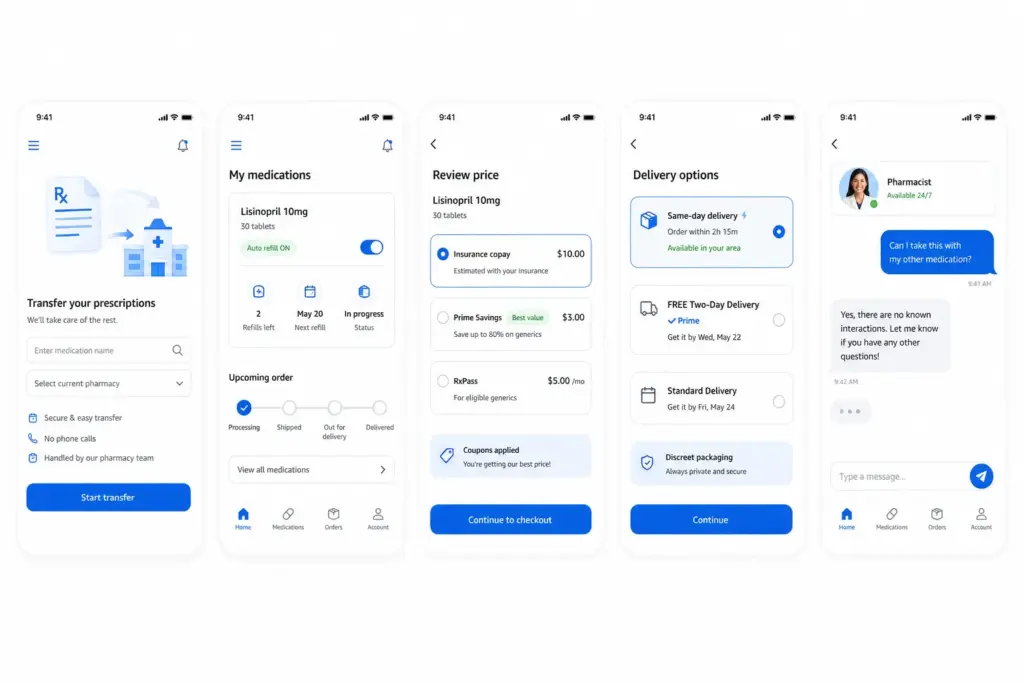
1. Digital Prescription Transfer
The onboarding phase is the most critical hurdle for user retention. Amazon Pharmacy minimizes this initial friction by allowing users to migrate their active scripts within the application interface with minimal data entry. To use this feature, an Amazon Pharmacy patient simply types the name of their current medication and selects their existing retail pharmacy from a dropdown menu. The backend system takes over, contacting the old pharmacy and executing the legal transfer without forcing the user to make a single phone call.
2. Prescription Refill Management
Legacy pharmacy chains often require patients to call automated phone lines or visit a store to authorize a refill. Amazon Pharmacy moves this entire workflow to a single self-service hub. Within the Amazon Pharmacy customer dashboard, users view their active refills, check how many allocations remain on their current prescription, and track the processing state of upcoming shipments. The system also includes an automated refill toggle, enabling patients to authorize continuous fulfillment cycles that align directly with their insurance timelines.
3. Insurance and Savings Programs
Understanding medication costs before placing an order helps patients make informed decisions and avoid unexpected expenses. To make pricing more transparent, Amazon Pharmacy allows users to add insurance and healthcare payment information, then view available pricing options during checkout so they can choose the most cost-effective way to purchase their medications.
| Pricing Option | Cost Structure | Ideal For |
| Insurance Copay | Variable based on plan coverage | Standard insured patients |
| Prime Savings | Up to 80% off generics, 40% off brands | Underinsured or cash-pay users |
| RxPass Subscription | Flat $5 monthly fee for eligible generics | Chronic care patients taking multiple generics |
The Amazon Pharmacy interface also pulls and applies manufacturer coupons automatically at checkout, ensuring the patient always receives the lowest available price.
4. Delivery and Same-Day Fulfillment
Fast and reliable medication delivery is one of the biggest advantages of modern digital pharmacies, especially for patients who need ongoing treatment. To support this convenience, Amazon Pharmacy offers multiple delivery options, including free two-day shipping for eligible Prime members and same-day delivery in many locations, helping users receive medications without visiting a physical pharmacy.
5. 24/7 Pharmacist Consultation
Digital self-service must always be backed by professional clinical oversight to maintain patient safety and regulatory compliance. Amazon Pharmacy implements this by embedding direct clinical access into its core communication layer. Through a dedicated portal labeled Contact a Pharmacist, users initiate secure chat sessions or request direct phone calls at any hour of the day or night. This feature allows patients to ask immediate questions regarding side effects, missing doses, or complex drug interactions without needing to schedule a formal appointment.
6. Order Tracking and Visibility
Knowing exactly when medications will arrive helps patients plan their treatment with confidence and reduces the stress of waiting for important prescriptions. To support this, Amazon Pharmacy provides real-time order tracking and timely updates throughout the fulfillment process, giving users better visibility and control over their medication deliveries.
7. Secure Profiles and Health Records
A strong digital pharmacy experience depends on having all patient information organized in one secure place. Through its profile system, Amazon Pharmacy allows users to store important health details, manage prescriptions more easily, and receive medications without repeatedly providing the same information. This creates a smoother experience for both patients and healthcare providers while supporting more personalized care.
How to Build a Pharmacy Care Platform Like Amazon?
Building a world-class pharmacy care platform requires balancing complex healthcare laws with a frictionless user experience. It takes more than just standard software development. You need a dedicated technical partner who understands healthcare workflows. We design, build, and scale these complex ecosystems to ensure your digital pharmacy functions seamlessly.
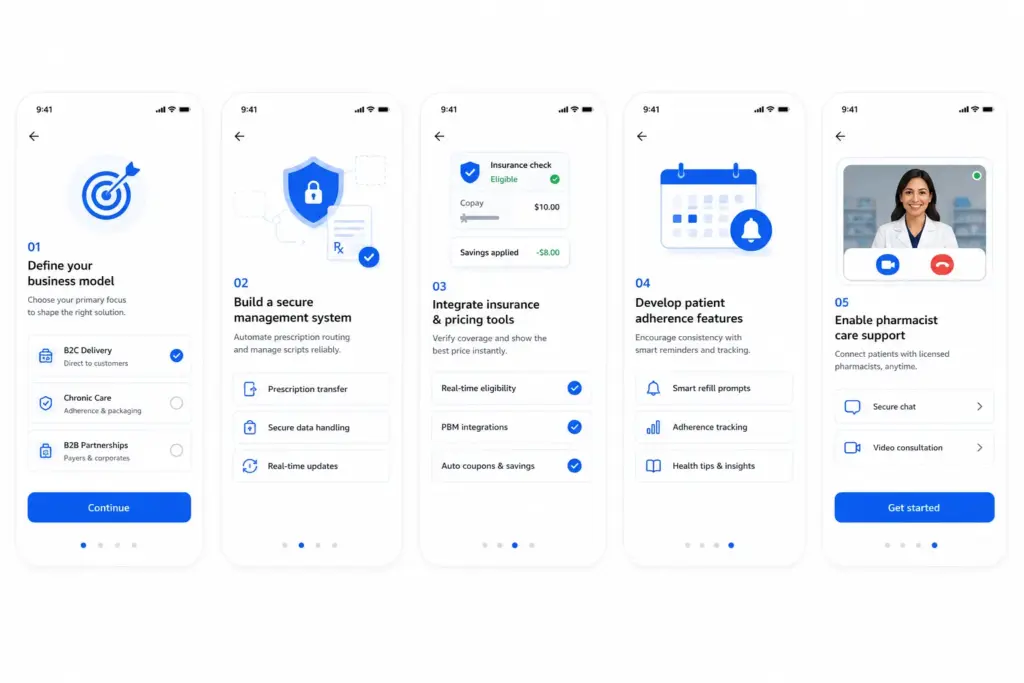
1. Define Your Business Model First
Before writing a single line of code, we map out your core operational strategy. Deciding your primary focus shapes the entire software architecture:
- B2C Delivery Focus: Emphasizes local courier integrations and automated retail checkout.
- Chronic Care Management: Requires deep integrations with multi-dose packaging hardware and adherence monitoring.
- B2B Institutional Partnerships: Focuses on secure portals for insurance payers and corporate wellness clients.
We work alongside you to clarify this blueprint. By identifying your exact revenue drivers early, we help you avoid expensive mid-development re-engineering.
2. Build a Secure Management System
The absolute core of your app is how it handles prescriptions. We build intelligent backend pipelines that simplify clinical documentation for both patients and providers. Our engineering teams prioritize building a robust routing engine. When a patient requests a transfer, our software automates the legacy outbound query. This infrastructure handles thousands of concurrent script updates without dropping data, creating a reliable backbone for your daily operations.
3. Integrate Insurance and Pricing Tools
Hidden costs lead directly to abandoned shopping carts. We prevent this by integrating advanced real-time eligibility check engines directly into your checkout funnel. We connect your application with major Pharmacy Benefit Managers and insurance databases. This allows the system to instantly calculate exact co-pays and deductibles. We also build custom logic modules that scan for manufacturer discounts automatically, ensuring patients see transparent pricing instantly.
4. Develop Patient Adherence Features
Customer lifetime value in healthcare depends entirely on consistent compliance. We design data-driven systems that gently guide patients through their daily medical routines. Instead of generic alerts, we develop smart, event-driven notification systems:
- Smart Refill Prompts: Triggers alerts based on real-time consumption calculations.
- Interactive Compliance Logs: Gamifies daily pill tracking within the user interface to encourage retention.
- Educational Micro-Portals: Delivers brief, rich-text insights explaining the importance of keeping up with a treatment plan.
These features keep users highly engaged, converting occasional shoppers into long-term platform subscribers.
5. Enable Pharmacist Care Support
Digital automation must be balanced with human expertise to earn true clinical trust. We build secure communication pathways that let users connect with medical experts instantly. We integrate encrypted chat protocols and high-definition video tools right into the user dashboard. Patients can launch a consultation with a licensed pharmacist with a single tap. This turns a simple utility app into a trusted virtual clinic.
6. Create a Scalable Fulfillment Network
Fulfillment logistics can make or break a digital pharmacy business. We build custom inventory tracking software that syncs your digital storefront directly with physical warehouses. We design these systems to integrate with your fulfillment partners, ensuring complete transparency from the warehouse shelf to the patient’s doorstep.
| Logistics Layer | Core Software Functionality | Operational Impact |
| Inventory Sync | Real-time shelf-count tracking across multiple hubs | Prevents stockouts of critical drugs |
| Route Optimization | Smart batching for local third-party couriers | Powers cost-effective same-day delivery |
| Cold-Chain Safety | Sensor monitoring for temperature-sensitive items | Ensures strict compliance during shipping |
7. Ensure Compliance and Security
Healthcare software requires absolute data security. We build rigorous protection mechanisms directly into the foundation of your platform from day one. We sign Business Associate Agreements and implement end-to-end data encryption. Every single transaction and data access request leaves a permanent, unalterable digital audit trail. By handling the heavy technical compliance work, we protect your business from legal risks and give you a secure, market-ready platform.
Cost of Developing a Pharmacy Care Platform Like Amazon
Allocating capital for a pharmacy care platform requires a clear financial roadmap. The total budget depends on your target market size, your chosen features, and regional compliance factors. We help you optimize your development spend by focusing engineering resources on high-ROI systems, helping you build efficiently without wasting capital on unneeded infrastructure.
MVP Cost for Market Validation
Launching a Minimum Viable Product lets you test the market with real users while protecting your capital. This phase focuses purely on core features like basic prescription uploads, secure payments, and standard delivery tracking. We design your MVP with a modular architecture. This means the early software foundation can easily scale into an enterprise-grade platform later without requiring an expensive, full system rewrite from scratch.
| Development Component | Estimated Cost |
| UI/UX Design | $4,000 – $8,000 |
| Patient Mobile App (iOS & Android) | $10,000 – $20,000 |
| Admin Dashboard | $4,000 – $8,000 |
| Prescription Upload & Management | $5,000 – $12,000 |
| Drug Database Integration | $3,000 – $8,000 |
| Payment Gateway Integration | $2,000 – $5,000 |
| Order & Delivery Tracking | $4,000 – $10,000 |
| Security & HIPAA-Ready Infrastructure | $4,000 – $10,000 |
| QA Testing & Deployment | $4,000 – $9,000 |
| Total Estimated Cost | $40,000 – $100,000 |
.
Enterprise Development Investment
To match a market leader like Amazon Pharmacy, you must transition from a simple delivery app to a fully integrated digital health ecosystem. This involves deploying deep automation, predictive analytics, and advanced backend systems. An enterprise-tier platform handles nationwide operations, links directly with primary care clinics, and provides instant insurance processing.
| Development Component | Estimated Cost |
| Advanced UI/UX Design | $10,000 – $25,000 |
| Multi-Platform Applications | $25,000 – $70,000 |
| Insurance Verification & Claims Engine | $15,000 – $50,000 |
| Telepharmacy Chat & Video Consultations | $10,000 – $40,000 |
| AI Medication Adherence System | $15,000 – $60,000 |
| EHR/EMR Integrations | $10,000 – $40,000 |
| Pharmacy Workflow Automation | $15,000 – $50,000 |
| Warehouse & Logistics Management | $20,000 – $80,000 |
| Analytics & Reporting Platform | $10,000 – $30,000 |
| Cloud Infrastructure & Security Compliance | $10,000 – $35,000 |
| QA Testing & Performance Optimization | $10,000 – $20,000 |
| Total Estimated Cost | $150,000 – $500,000 |
Cost Influencing Factors
Every integration and security layer impacts your final development timeline and budget. Understanding where your capital goes helps you make smarter business decisions. We manage these cost drivers through pre-built compliance modules and established integration blueprints. This approach reduces overall development hours, allowing us to deliver your platform quickly and securely while keeping your budget perfectly predictable.
| Development Factor | Estimated Cost Impact | Primary Drivers |
| Healthcare Compliance (HIPAA) | 15,000 to 45,000 dollars | End-to-end data encryption, access controls, unalterable audit logs |
| EHR and Clinic Integrations | 10,000 to 35,000 dollars | Connecting with third-party medical records and provider systems |
| Logistics and Warehouse Software | 8,000 to 25,000 dollars | Custom inventory tracking, barcode systems, route optimization |
| Telepharmacy Communication | 5,000 to 18,000 dollars | Secure, encrypted video portals and real-time chat tools |
D2C vs B2B Pharmacy Care Platform Models
Choosing the right business framework determines how a platform will scale, process payments, and capture long-term market share. Both Direct-to-Consumer and Business-to-Business architectures offer highly lucrative pathways, but they require entirely different product features and software design strategies.
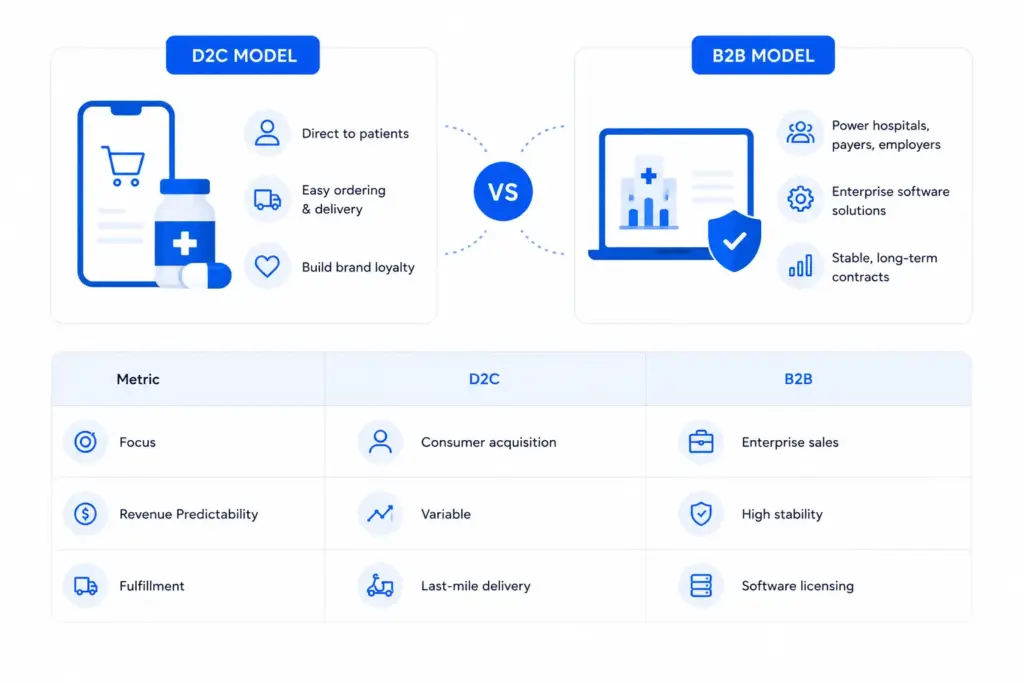
1. D2C Pharmacy Platforms
D2C platforms connect with patients directly, focusing heavily on modern user interfaces, retail convenience, and immediate brand loyalty. This framework prioritizes high patient acquisition rates and smooth checkout systems to secure reliable, recurring retail revenue. A clear example of this model in action is Ro, a direct-to-consumer digital health platform that combines virtual clinics with its own proprietary pharmacy fulfillment.
By streamlining patient intake and delivering custom lifestyle and maintenance medications straight to consumer homes, Ro built a massive recurring base, scaling its annualized revenue to approximately 598 million dollars.
2. B2B Pharmacy Solutions
B2B platforms bypass the open consumer market entirely, licensing their specialized software directly to hospital networks, corporate employers, insurance payers, or established retail pharmacy chains. This enterprise model swaps out high-volume consumer marketing for highly stable corporate contracts and predictable multi-year software subscriptions.
Consider GoodRx, which established a powerful B2B footprint by integrating its pricing engines and discount data directly into provider workflows and insurance frameworks. Through these enterprise connections and pharma manufacturer marketing solutions, GoodRx acts as a major software infrastructure layer, generating an annual revenue of nearly 797 million dollars.
When engineering B2B solutions, the development focus shifts to systemic integration and deep data capability:
- Robust Custom API Layers: Allow external hospital databases to transfer clinical data smoothly without lag.
- Enterprise Multi-Tenant Portals: Gives corporate partners distinct, secure admin dashboards to monitor usage.
- Predictive Bulk Analytics: Aggregates health outcomes data to demonstrate clear return on investment to institutional buyers.
Which Model Offers Better Growth Potential?
The choice between D2C and B2B models comes down to the capital structure and target growth timeline of the venture. D2C frameworks typically scale much faster because they respond directly to consumer marketing and urgent patient needs. On the flip side, B2B platforms provide immense stability, boasting massive contract values and significantly higher customer lifetime value.
| Business Metric | D2C Framework | B2B Framework |
| Capital Allocation Focus | Consumer acquisition and digital brand marketing | Enterprise sales cycles and deep custom integrations |
| Revenue Predictability | Variable based on monthly churn and retail ordering | Highly stable through multi-year enterprise SaaS contracts |
| Fulfillment Dependency | Requires heavy last-mile local courier coordination | Relies on backend software licensing and infrastructure |
How Amazon Pharmacy Uses Ecosystem Expansion to Increase Profitability?
Building a profitable digital pharmacy requires more than simply delivering medications. To create stronger long-term value, Amazon Pharmacy is integrated with broader healthcare and membership services, allowing the company to support patients across multiple stages of their healthcare journey while generating revenue from a wider range of services.
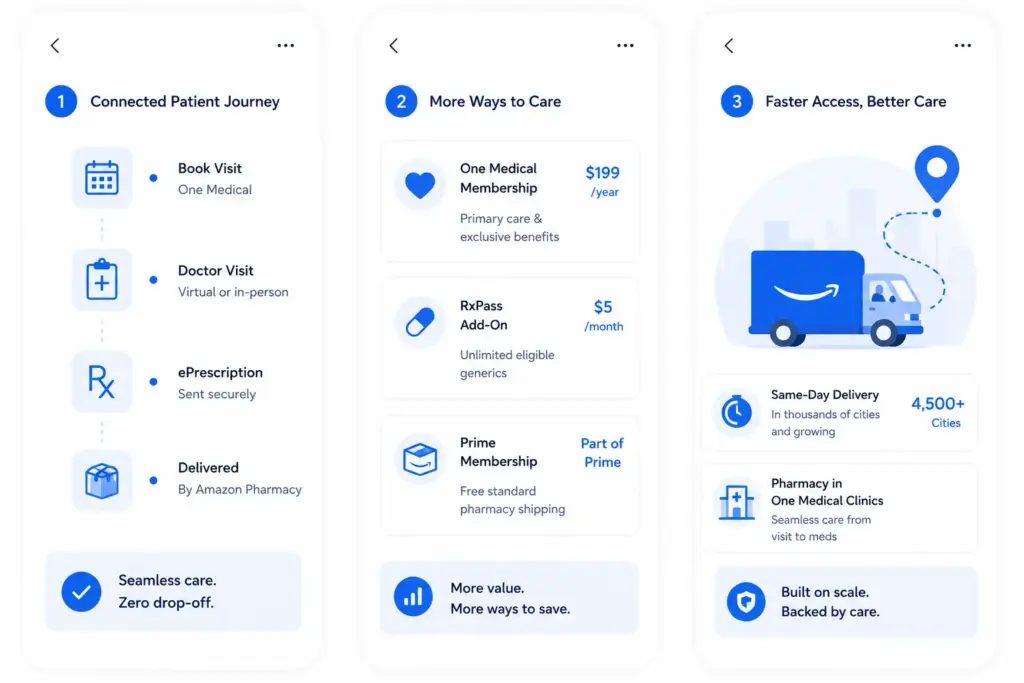
1. Connecting the Patient Journey
Amazon no longer operates healthcare services as separate business divisions. Instead, the infrastructure links medical clinics, virtual care, and distribution networks into a single loop. A patient books a virtual or in-person consultation through One Medical. The doctor issues an electronic script, which routes straight to Amazon Pharmacy. By handling the clinical and fulfillment steps within a single interface, user drop-off is practically eliminated, driving up overall customer lifetime value.
2. Expanding Beyond Prescription Sales
Prescription delivery alone often offers limited profit margins, which is why successful digital pharmacies expand into additional healthcare services. To increase customer value over time, Amazon Pharmacy combines medication fulfillment with subscription-based programs and specialized care offerings, creating a more comprehensive healthcare experience while generating recurring revenue beyond prescription sales.
| Health Ecosystem Layer | Pricing and Fee Structure | Strategic Contribution |
| One Medical Subscriptions | Approximately 199 dollars annually per user | Secure upfront cash flow and primary care patient acquisition |
| RxPass Subscription Add-On | Flat 5-dollar monthly fee for unlimited eligible generics | High-margin baseline revenue from chronic care patients |
| Prime Subscription Baseline | Component of the 49.6 billion dollar global subscription pool | Drives ecosystem loyalty and provides free standard medication shipping |
3. Using Logistics and Care Moats
Fast medication access has become a major competitive advantage in digital healthcare. Amazon has expanded its prescription delivery network to support same-day delivery across nearly 4,500 cities and towns, while extending services to 2,000 additional communities. This helps patients receive important medications more quickly and conveniently.
To further improve accessibility, Amazon is also integrating pharmacy services into One Medical clinics. This approach creates a smoother patient experience by connecting medical consultations with prescription fulfillment, reducing delays between diagnosis and treatment.
CAC vs Lifetime Value in Digital Pharmacy Businesses
Balancing customer acquisition costs against long-term patient value is the defining economic challenge for digital pharmacies. Because healthcare requires intense trust, getting a user through the door is expensive. Survival depends on keeping those users active for years to offset that initial marketing spend.
Why Adherence Creates Higher Value
Unlike standard retail shops where buying is unpredictable, digital pharmacies thrive on predictable repeat orders. When a patient manages a lifelong condition, they need their prescriptions filled every single month. A great example of this is Hims and Hers Health. By focusing heavily on automated recurring subscriptions for maintenance conditions, they keep patients on their platform long-term. This high retention strategy helped scale their annualized revenue to over 2.3 billion dollars.
Features like automatic shipments and smartphone alerts ensure patients do not miss doses. For the business, this steady behavior transforms an occasional shopper into a predictable source of multi-year revenue.
The Real Cost of Acquiring Customers
Acquiring a healthcare user is a costly endeavor. Marketing restrictions, strict compliance rules, and the battle for consumer trust drive up marketing budgets quickly. Consider Capsule, a digital pharmacy that grew rapidly by offering free delivery and direct coordination with doctors. To win users away from corner drugstores, Capsule spent heavily on localized marketing and tech integrations, building a business that has grown to over $ 86 million in reported software and service revenue.
Startups must spend heavily on digital ads, build networks with local doctors, and engineer complex insurance tools just to secure a first-time order. If a business focuses only on growth without tracking these upfront costs, it can run out of capital before those users become profitable.
Building a Sustainable Ratio
The golden rule for health tech platforms is maintaining an optimal ratio between lifetime value and acquisition costs. Investors look for a metric where the long-term value of the user is at least 3 times higher than the price paid to acquire them. To evaluate this health metric, platforms track a simple unit economics calculator:
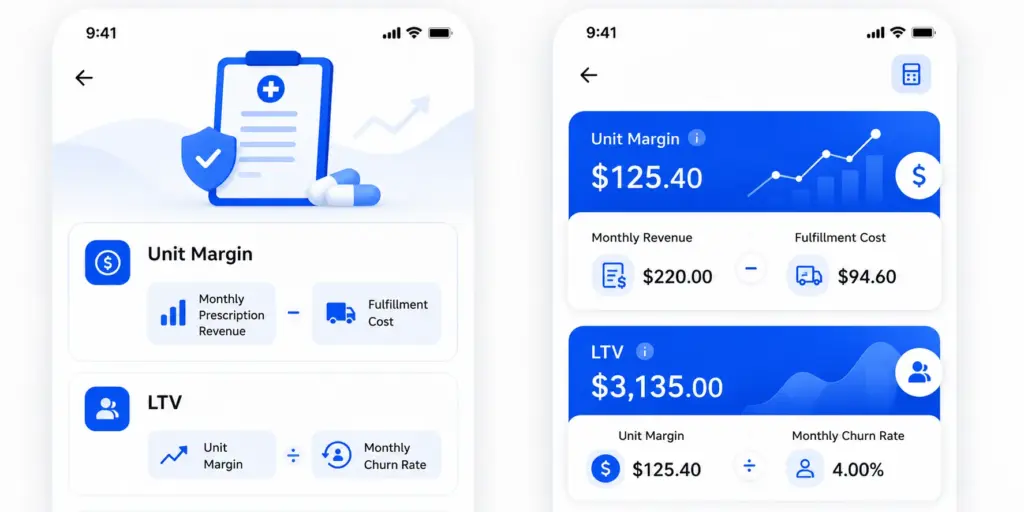
| Platform Strategy | Economic Benefit | Impact on Unit Economics |
| Ecosystem Bundling | Cross-sells services like medical consults | Lowers overall acquisition spend per user |
| Subscription Add-Ons | Creates fixed cash flow alongside insurance | Maximizes monthly revenue stability |
| Automated Retention | Reduces user churn through tech alerts | Boosts the overall lifetime value number |
Amazon Pharmacy hits this healthy balance by utilizing the global Prime network to lower acquisition costs while using the 5 dollar RxPass subscription to secure steady margins. For any growing pharmacy startup, fine-tuning software features to keep current patients active is always more profitable than pouring capital into endless ad campaigns.
Build a Pharmacy Care Platform with Idea Usher
Launching a digital healthcare application requires a balance of deep clinical security and premium consumer design. Idea Usher brings the exact engineering depth needed to build these complex systems. With over 500,000 hours of coding experience, our team of ex-FAANG developers knows how to take your pharmacy concept and scale it into a secure market leader.
Turn Your Vision Into Product
We do not just write code. We work directly with you to map out your entire platform strategy before development ever begins. Our product team helps you clarify compliance pathways, select the right feature sets, and design highly sticky retention tools. This careful initial planning ensures your engineering budget is spent entirely on high-value systems that drive real business growth.
Platforms Built for Scale
Pharmacy applications handle highly sensitive personal medical records. We build secure software architectures designed from day one to safeguard user data and pass rigorous clinical audits.
- Absolute Compliance: Built-in end-to-end data encryption to meet strict global healthcare data safety regulations.
- Seamless Integrations: Custom software pipelines that connect easily with major electronic health record networks and insurance engines.
- Cloud Architecture: Highly stable server frameworks that remain fast even during sudden user traffic spikes.
This technical foundation protects your healthcare business from expensive regulatory issues while providing a lightning-fast checkout experience for your patients.
Launch Faster With Our Team
We provide a complete development cycle from the first design sketch to final server deployment and long-term tech support. By combining our deep healthcare industry knowledge with top-tier FAANG engineering experience, we significantly cut down your development timeline. We remove structural risks early, allowing you to launch a premium digital pharmacy platform quickly and confidently.
| Development Phase | What We Deliver | Time to Market Impact |
| Product Discovery | Technical blueprints and feature roadmap | Prevents costly mid-development code rewrites |
| UX/UI Design | High-fidelity medical app prototypes | Drives early patient trust and fast checkout |
| Testing and QA | Extreme load testing and security vulnerability scans | Ensures a bug-free marketplace debut |
Conclusion
Building a pharmacy care platform like Amazon starts with understanding what patients value most: convenience, reliability, and easy access to healthcare services. A successful platform should make it simple to manage prescriptions, receive medications on time, and connect with healthcare professionals when needed. As demand for digital healthcare continues to grow, businesses that deliver a smooth and trustworthy patient experience will be well positioned for long-term success.
Things to Know About Pharmacy Care Platforms
Q1: How do pharmacy care platforms make money?
A1: Most platforms generate revenue through prescription fulfillment fees, insurance reimbursements, medication delivery services, subscription programs, telepharmacy consultations, enterprise licensing, and partnerships with healthcare providers or insurers. Many leading platforms also increase revenue through chronic care management and recurring medication programs that drive long-term customer retention.
Q2: What features are essential for a pharmacy care platform?
A2: Core features include prescription uploads, refill management, medication reminders, pharmacist consultations, insurance verification, secure payments, delivery tracking, patient dashboards, and compliance management tools. Advanced platforms also include AI-powered adherence monitoring and chronic care programs. The most successful platforms combine convenience, automation, and clinical support to improve patient outcomes.
Q3: Are pharmacy care platforms legally compliant?
A3: Yes, but they must comply with healthcare regulations such as HIPAA, e-prescription requirements, pharmacy licensing rules, and data privacy standards. Compliance requirements vary by country and region, making regulatory planning a critical part of development. Businesses should incorporate compliance measures early in the development process to avoid costly regulatory issues later.
Q4: Why are investors interested in digital pharmacy businesses?
A4: Digital pharmacies benefit from recurring prescription revenue, growing telehealth adoption, and strong customer retention driven by medication adherence programs. The global e-pharmacy market is projected to grow substantially over the next decade, creating attractive opportunities for startups and healthcare innovators. Investors are particularly attracted to businesses that demonstrate strong retention metrics and scalable unit economics.