


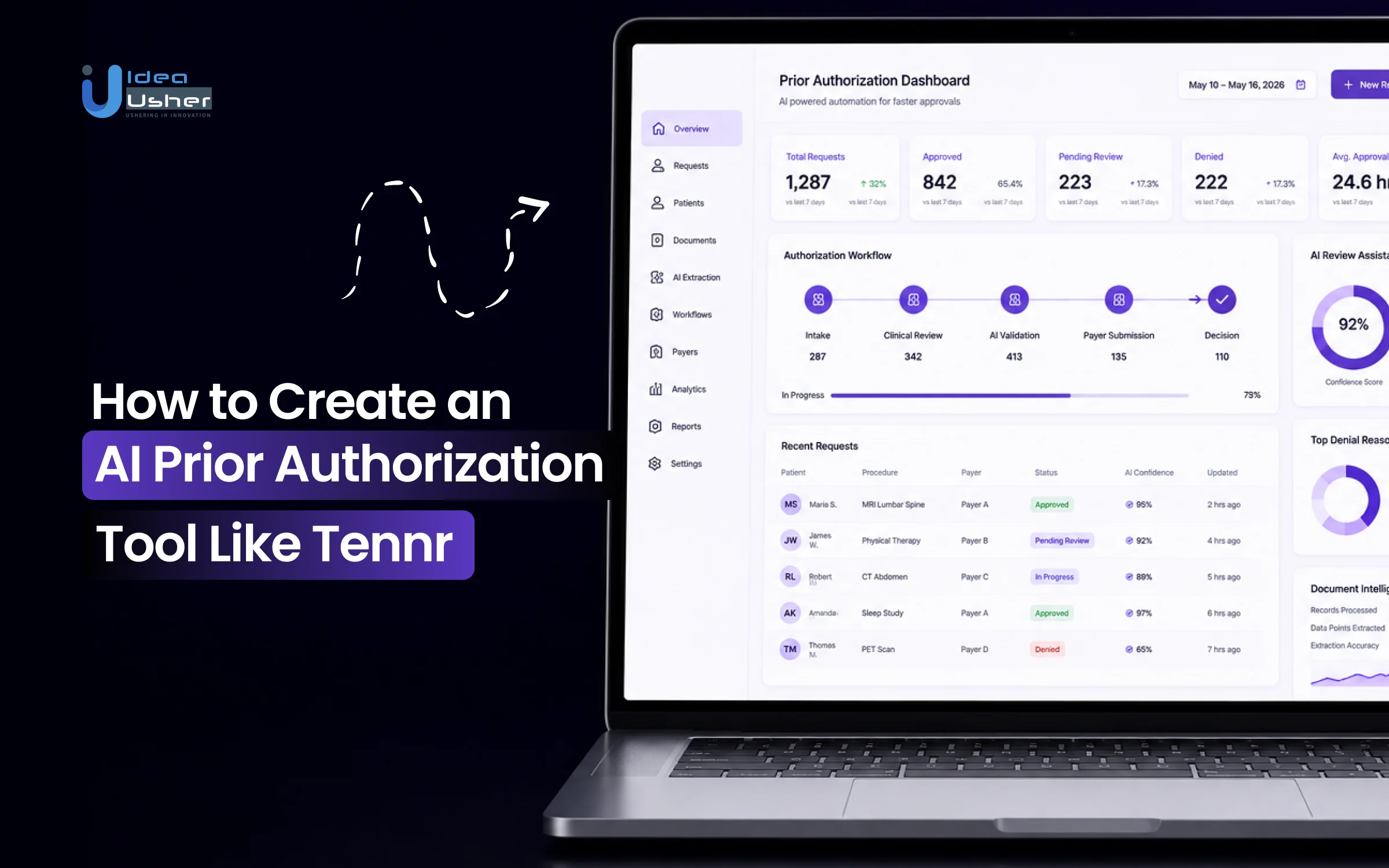
Key Takeaways
- AI prior authorization platforms automate referrals, eligibility checks and payer approvals to accelerate patient access to care.
- Core capabilities include AI document understanding, payer rule mapping, workflow orchestration, EHR integration and intelligent follow-ups.
- Healthcare AI reduces authorization delays, improves first-pass approvals and minimizes administrative burden through end-to-end automation.
- Agentic AI, healthcare interoperability and HIPAA-compliant architecture are essential for building scalable prior authorization platforms.
- How Idea Usher can help you build AI prior authorization platform like Tennr with healthcare AI, workflow automation and enterprise-grade EHR integrations.
The next generation of healthcare operations will be defined by orchestration rather than automation. This change is increasing demand among healthcare enterprises for the AI prior authorization tool as providers build systems that interpret clinical documents, apply payer policies and coordinate patient journeys with minimal human intervention.
Traditional prior authorization relied on manual reviews, fax-based referrals, and fragmented insurance workflows that delayed treatment. Modern providers increasingly require AI-powered prior authorization, referral automation, intelligent intake, eligibility verification, benefits investigation, payer criteria mapping, automated document understanding, patient scheduling, EHR integration, and agentic orchestration to improve first-pass approvals, reduce administrative burden, and accelerate patient access to care.
In this blog, we’ll explore how to build an AI prior authorization tool like Tennr, covering its core features, AI architecture, technology stack, and workflow automation, and how IdeaUsher can help build enterprise-grade patient prior authorization platforms that intelligently orchestrate clinical documents, payer rules, and authorization workflows.
Why AI Is Replacing Traditional Prior Authorization
Traditional prior authorization (PA) workflows are a major healthcare bottleneck. Friction among manual processes, outdated software, and complex clinical care has driven rapid demand for AI-powered automation.
Reflecting this shift, the global AI-powered prior authorization automation market is valued at $1.47 billion and is projected to reach $10.31 billion by 2035, growing at a 21.50% CAGR. As a result, healthcare organizations are rapidly replacing legacy approaches with purpose-built AI platforms capable of processing complex clinical data at scale.

This deployment velocity is fueled by an urgent need for operational relief. Research shows a striking 94% of healthcare payers have already implemented AI into core operations, prioritizing prior authorization for immediate cost containment.
On the provider side, the performance shift is dramatic: major health systems deploying advanced AI tools have achieved a 96% first-pass approval rate across more than 200,000 annual authorizations, virtually eliminating manual back-and-forth and preventing clinical delays.
A. The Hidden Cost of Manual Prior Authorization Workflows
Many healthcare organizations view prior authorization as an administrative expense, but its true cost extends far beyond processing fees. According to the 2024 CAQH Index, a manual prior authorization costs providers $10.97 in direct administrative processing. Once clinical rework, denials, peer reviews, delayed reimbursement, and patient leakage are included, the total operational cost rises to $60–$90 per request.
The financial burden is driven by three major inefficiencies:
- Time Penalties: Providers spend an average of 24 minutes processing each manual prior authorization through phone, fax, or email. Complex specialties such as cardiology and oncology often require even more time.
- FTE Drain: The American Medical Association (AMA) estimates prior authorization consumes 12–14 hours per physician each week or approximately 624 hours annually, equivalent to nearly 30% of a full-time employee dedicated to administrative work.
- Downstream Friction: Manual workflows still involve an 80% human-touch rate, leading to frequent data entry errors across fragmented payer portals. As a result, nearly 35% of initial requests are denied, primarily because of missing EHR documentation or coding errors rather than medical necessity.
B. Why Rule-Based Automation No Longer Works
Healthcare organizations adopted electronic prior authorization (ePA) and Robotic Process Automation (RPA) to reduce manual tasks. However, these rigid systems cannot interpret clinical context, process unstructured documents, or adapt to changing payer policies. Consequently, only 35% of prior authorization transactions are fully electronic, highlighting the limitations of legacy automation.
Rule-based systems fail because they are rigid:
- Custom Payer Portals: The top U.S. payers frequently update portal layouts and medical policies. Even small interface or terminology changes can break rigid automation, while providers still spend 16 minutes per portal-based authorization on average.
- Unstructured Clinical Documentation: More than 50% of EHR information exists as unstructured clinical notes, reports, and imaging records, making rule-based bots ineffective at understanding medical necessity or extracting clinical context.
- High Maintenance Costs: Every payer update requires rule revisions, testing, and ongoing maintenance. With only 35% of prior authorizations fully electronic, organizations continue investing heavily in maintaining brittle automation workflows.
Ultimately, first-generation automation acts merely as a digital fax machine. It accelerates the speed at which a request is sent, but does nothing to solve the underlying problem: matching complex patient data to nuanced payer policies.
C. Why Are Enterprises Investing in AI Prior Authorization?
The migration toward Generative AI and advanced machine learning platforms is driven by a compounding macro-crisis in the healthcare ecosystem: severe staffing shortages, soaring patient volumes, and strict new federal timelines.
Healthcare organizations are anchoring their operational budgets around AI platforms due to direct, quantifiable ROI drivers:
| Metric / Operational Vector | Traditional / Legacy Method | AI-Driven PA Platform |
| Direct Administrative Cost | ~$10.97 per manual request, driven by repetitive data entry, document reviews, and staff intervention. | ~$0.05 per automated request, using AI-powered workflow automation and electronic processing. |
| Average Turnaround Time | 12 to 14 business days, often delayed by manual reviews, payer follow-ups, and incomplete documentation. | Hours or minutes, with AI automating document validation, routing, and authorization workflows in near real time. |
| First-Pass Authorization Yield | ~65% approval rate, with roughly 35% requiring rework due to missing information or documentation errors. | 90%+ automated first-pass approvals, supported by AI-driven document intelligence and payer rule validation. |
| Workflow Step Elimination | 0% automation, as staff manually verify eligibility, review documents, submit requests, and track approvals. | 50% to 75% of manual steps automated, reducing administrative workload while improving operational efficiency. |
D. The Underlying Catalysts Driving Adoption
Growing regulatory pressure, rising authorization volumes, and workforce shortages are accelerating adoption of AI-powered prior authorization platforms. Healthcare organizations are automating workflows to reduce administrative costs, improve compliance, and deliver faster patient care.
- Payer Complexity & Rising Volumes: More than 65% of providers report significant growth in prior authorization requests over the past three years. As payers expand PA requirements for advanced imaging, specialty drugs, and outpatient procedures, AI helps manage growing administrative workloads.
- Regulatory Deadlines (CMS Interoperability Rules): CMS mandates standardized FHIR APIs and strict turnaround times, including 72 hours for urgent cases. AI integrated with EHRs enables Straight-Through Processing (STP) by automatically handling routine authorization requests.
- Staff Burnout & Workforce Retention: With 95% of physicians citing prior authorization as a major source of burnout, AI-powered NLP extracts clinical data, assembles supporting documentation, and pre-populates submissions, allowing staff to focus on patient care.
The Enterprise Takeaway: Manual prior authorization workflows can no longer meet modern healthcare demands. Ambient AI, intelligent document processing, and deep EHR integration transform authorization into a scalable, compliant workflow that reduces revenue risk, eases administrative burden, and accelerates patient access to care.

What is AI Prior Authorization Tennr and What Makes it Different
Tennr is an AI-powered patient orchestration and prior authorization platform that automates referrals, patient intake, insurance verification, prior authorizations, and scheduling. Instead of operating as a standalone authorization tool, it uses AI to coordinate the entire pre-visit patient journey, reducing administrative delays, minimizing denials, and accelerating access to care.
The platform acts as an agentic patient orchestration system, processing referrals, faxes, medical records, and insurance forms to extract clinical data, identify gaps, verify eligibility, complete prior authorizations, and route patients to the right care setting. Its proprietary RaeLM™ healthcare language model is trained on clinical documentation and payer requirements, enabling accurate document understanding and workflow automation.
A. How RaeLM™ Understands Clinical Context Beyond OCR
Standard prior authorization software relies heavily on Optical Character Recognition (OCR) to convert scanned documents into machine-readable text. However, OCR is fundamentally blind to context; it can scan a word, but it cannot understand what that word means in a clinical setting.
Tennr bypasses these limitations through RaeLM™, its proprietary vision-language model purpose-built for healthcare documentation.
- Trained on Real-World Healthcare Data: RaeLM™ is trained on 100M+ anonymized healthcare documents, 2.3B data fields, 8,000 page classifications, and 2B checkboxes, enabling accurate interpretation of complex clinical records, handwritten notes, and low-quality faxes.
- Advanced Clinical Document Reasoning: Beyond data extraction, RaeLM™ understands the clinical context within unstructured records, including multi-page physician notes, to identify treatment rationale and patient history.
- Proactive Documentation Gap Detection: RaeLM™ reviews clinical records against payer-specific requirements, identifying missing documents, lab values, or treatment evidence before prior authorization submission.
B. Why Agentic AI Outperforms Traditional Workflow Automation
Traditional electronic prior authorization (ePA) tools rely on static, rule-based paths. If a workflow encounters a missing document, a mismatched plan name, or an uncooperative payer portal, the automation stops entirely and requires manual human intervention.
Tennr replaces these rigid scripts with Agentic AI, deploying specialized digital agents that own entire operational processes end-to-end.

Step 1: Autonomous Ingestion & Triage
Tennr’s agents automatically ingest patient data from any incoming source whether it arrives via fax, email, internal EHR orders, or direct portal uploads. The system uses clinical and operational context to classify the order and instantly route it to the correct workflow path.
Step 2: Active Care Coordination & Follow-Up
When missing documentation or clinical evidence is flagged, the agent does not just create an alert. It coordinates communications across patients, providers, and referring clinics, autonomously generating targeted requests to gather the precise information needed to complete the file.
Step 3: Dynamic Payer Interaction
The AI agents handle the time-consuming tasks of checking real-time eligibility, logging into fragmented payer portals, submitting the authorization packets, and tracking the application status through approval.
Step 4: Autopilot & Human-in-the-Loop
Routine, high-confidence prior authorizations move through a quality-controlled autopilot loop with zero human intervention. If a complex edge case or an unexpected denial occurs, the agent packages the full clinical context and hands it off seamlessly to a human team member for clinical review.
C. How Service-to-Payer Intelligence Improves First-Pass Approvals
Denial management is typically a reactive process: a provider submits a claim, a payer rejects it, and staff spend weeks fixing the errors. Tennr shifts this dynamic by building its entire platform around a library of service-to-payer criteria mappings.
This localized intelligence works proactively to secure clean, first-pass approvals before a submission is sent.
| Operational Vector | Standard Prior Auth Platforms | Tennr Service-to-Payer Intelligence |
| Payer Rule Alignment | Relies on human staff to look up shifting payer-specific portals and PDF guidelines. | Automatically maps clinical data directly against thousands of dynamic payer rules in real time. |
| Medical Necessity Verification | Checks basic ICD-10/CPT code eligibility matches but misses narrative proof. | Cross-references the entire clinical note to ensure the narrative text actually supports the target criteria. |
| Error Handling | Reacts after the fact, forcing teams to manage denials manually after weeks of delay. | Flags missing elements pre-submission, completely avoiding preventable administrative rejections. |
By turning vast, highly complex insurance policies into automated operational decisions, Tennr ensures that every single authorization packet is perfectly tailored to the specific health plan’s rules. This eliminates back-and-forth communication, stabilizes provider cash flow, and protects patients from dangerous delays in their care timelines.
Core Features of an AI Prior Authorization Platform
Building an AI prior authorization platform requires more than automating insurance approvals. It should intelligently orchestrate referrals, documentation, payer workflows, patient routing, and operational decisions using healthcare-specific AI, enabling providers to reduce delays, improve first-pass approvals, and deliver faster patient care with minimal administrative effort.

1. AI Referral Intake & Document Understanding
This feature enables AI to process referrals, faxes, medical records, and insurance documents using OCR and natural language processing (NLP). It automatically extracts structured clinical data, classifies documents, identifies referral intent, and initiates downstream workflows, eliminating manual intake delays while improving operational accuracy.
2. Eligibility & Benefits Investigation Automation
Real-time eligibility verification and benefits investigation ensure patients meet payer requirements before treatment. The platform should automatically validate coverage, deductibles, authorization needs, and payer-specific policies, reducing administrative workload, preventing claim denials, and accelerating patient access to care.
3. AI Prior Authorization & Payer Automation
AI should automate prior authorization by gathering clinical evidence, completing payer-specific forms, validating medical necessity, submitting requests, and tracking approval status. Automated payer interactions reduce manual processing, improve first-pass authorization rates, shorten approval cycles, and minimize revenue leakage across healthcare organizations.
4. Service-to-Payer Criteria Mapping
The platform should intelligently compare clinical documentation against payer-specific authorization criteria and medical policies. AI identifies missing evidence, validates documentation quality, and recommends corrective actions before submission, increasing approval accuracy while reducing denials caused by incomplete or non-compliant authorization requests.
5. Missing Information Detection & Intelligent Follow-Ups
AI continuously analyzes referrals and authorization packets to detect missing clinical documents, signatures, or patient information. It automatically initiates provider and patient follow-ups, ensuring required documentation is completed quickly while preventing delays, referral backlogs, and unnecessary authorization rework.
6. Intelligent Patient Routing & Care Navigation
The platform should intelligently match patients with the appropriate specialist, facility, or care pathway based on referral details, payer rules, clinical requirements, and provider availability. Smart routing improves scheduling efficiency, reduces unnecessary transfers, and creates a seamless patient care journey.
7. Agentic Workflow Orchestration
Agentic AI coordinates multiple operational tasks across referral intake, eligibility verification, prior authorization, scheduling, and exception handling without constant human intervention. Intelligent agents execute sequential workflows, escalate complex cases when necessary, and streamline healthcare operations while maintaining accuracy and compliance.
8. Real-Time Patient Flow Control Tower
A centralized operational dashboard provides end-to-end visibility across referrals, authorizations, patient scheduling, and workflow performance. Real-time monitoring helps healthcare teams identify bottlenecks, track service-level metrics, optimize resource utilization, and make faster operational decisions that improve patient throughput.
How to Create an AI Prior Authorization Tool Like Tennr
Developing an AI prior authorization platform requires a structured approach that combines healthcare expertise, AI engineering, workflow automation, and secure integrations. Following the right development process ensures the platform delivers accurate decisions, scalable operations, regulatory compliance, and a seamless experience for providers, payers, and patients.
1. Define Clinical Workflows & Target Specialties
We begin by identifying medical specialties, payer requirements, referral workflows, and operational challenges the platform will support. This helps us design AI workflows around real healthcare processes, ensuring the solution addresses practical business and clinical needs from day one.
- Specialty Mapping Strategy: Identifies high-volume specialties and aligns workflows with payer-specific authorization requirements and clinical pathways.
- Workflow Gap Analysis: Evaluates existing referral and authorization processes to uncover inefficiencies, delays, and manual intervention points.
- Stakeholder Requirement Alignment: Gathers inputs from providers, payers, and administrators to ensure workflows meet operational and compliance expectations.
- Use Case Prioritization Framework: Defines high-impact automation opportunities based on volume, complexity, and potential cost or time savings.
2. Design the AI Authorization Architecture
Next, our team designs a scalable architecture connecting applications, AI services, workflow engines, integrations, and cloud infrastructure. A well-planned architecture ensures secure data flow, high availability, and seamless communication between every system component.
The table below outlines key architecture layers, their purposes, and recommended technologies to help guide development decisions and implementation strategies effectively.
| Architecture Layer | Purpose | Recommended Technologies |
| User Applications & Provider Portal | Manages referrals, prior authorizations, appointments, and workflow visibility across web and mobile apps. | React, Next.js, Flutter, Swift, Kotlin |
| AI Orchestration & Workflow Engine | Automates referral intake, eligibility checks, prior authorizations, scheduling, payer communication, and AI-driven workflows. | LangGraph, Temporal, CrewAI, Prefect, Apache Airflow |
| Document Intelligence & AI Processing | Extracts and structures clinical data from referrals, insurance forms, faxes, and medical records. | AWS Textract, Google Document AI, Amazon Comprehend Medical, GPT-4, Claude |
| Integration Layer (EHRs, Payers & Clearinghouses) | Connects EHRs, payers, FHIR/HL7 systems, clearinghouses, scheduling platforms, and communication services. | Epic APIs, Cerner APIs, FHIR, HL7, Change Healthcare APIs, Twilio |
| Cloud Infrastructure Security | Delivers scalable infrastructure, encrypted storage, monitoring, disaster recovery, and HIPAA-compliant security. | AWS, Microsoft Azure, Google Cloud, Kubernetes, Docker, OAuth 2.0, PostgreSQL |
3. Choosing the Right AI Models for Prior Authorization Automation
We carefully select AI models for document processing, clinical reasoning, workflow orchestration, and predictive analytics. Choosing the right AI stack improves automation accuracy, reduces processing time, and supports reliable healthcare decision-making.
The table highlights essential AI models, their roles, and technologies, helping streamline automation, improve accuracy, and enhance prior authorization efficiency.
| AI Model | Role in the Platform | Recommended AI |
| OCR & Intelligent Document Processing | Converts referrals, insurance forms, lab reports, medical records, and faxes into structured, machine-readable data. | AWS Textract, Google Document AI, Tesseract + LayoutLM |
| Clinical NLP & Medical Entity Extraction | Extracts diagnoses, procedures, medications, providers, insurance details, CPT codes, ICD-10 codes, and other clinical entities from unstructured records. | Amazon Comprehend Medical, Google Healthcare NLP, BioBERT, ClinicalBERT |
| Healthcare LLMs for Authorization Reasoning | Evaluates medical necessity, interprets clinical context, generates authorization responses, and aligns cases with payer-specific policies. | GPT-4, Claude, Med-PaLM, Llama 3 (healthcare fine-tuned) |
| Retrieval-Augmented Generation (RAG) | Retrieves current payer policies, clinical guidelines, and internal knowledge to generate accurate, evidence-backed responses. | LangChain, LlamaIndex, Pinecone, Weaviate, FAISS |
| AI Agents for Workflow Orchestration | Automates referral intake, eligibility verification, prior authorization, scheduling, follow-ups, and exception handling across workflows. | LangGraph, CrewAI, AutoGen, Temporal, Prefect |
| Predictive Analytics Models | Predicts authorization outcomes, detects denial risks, and recommends corrective actions using historical approval data. | XGBoost, LightGBM, TensorFlow, PyTorch, Scikit-learn |
Note: Combining these AI models creates a robust, scalable system that improves accuracy, reduces administrative burden, accelerates approvals, and ensures compliance with evolving payer policies and healthcare regulations.
4. Build Healthcare AI & Document Intelligence
Our developers build AI capabilities for document understanding, clinical data extraction, and payer rule interpretation. This intelligence layer transforms complex medical documentation into structured insights that power automated prior authorization workflows.
- Document Processing Automation: Converts unstructured medical documents into structured data using OCR, NLP, and healthcare-specific AI models.
- Clinical Data Extraction Accuracy: Ensures precise identification of diagnoses, procedures, and patient details for reliable authorization decisions.
- Payer Rule Interpretation Engine: Maps extracted clinical data against payer-specific guidelines to determine eligibility and authorization requirements.
- Continuous Model Improvement Strategy: Uses feedback loops and real-world data to enhance AI accuracy and adapt to changing healthcare policies.
5. Develop End-to-End Workflow Automation
We automate referral intake, insurance verification, prior authorization, scheduling, notifications, and exception handling workflows. This creates a connected operational ecosystem that minimizes manual work while improving efficiency and patient throughput.
- Workflow Orchestration Framework: Automates multi-step processes across referral intake, verification, authorization, and scheduling with minimal manual intervention.
- Exception Handling Mechanism: Identifies and routes complex or incomplete cases to human reviewers for faster resolution and reduced delays.
- Real-Time Status Tracking: Provides visibility into authorization progress, enabling proactive follow-ups and improved communication across stakeholders.
- Notification and Alert System: Sends automated updates to providers, staff, and patients regarding approvals, denials, and required actions.
6. Integrate EHRs, Payers & Healthcare Systems
Our team integrates the platform with EHRs, payer systems, clearinghouses, scheduling tools, and communication services using healthcare interoperability standards. These integrations enable secure data exchange and ensure workflows operate seamlessly across the healthcare ecosystem.
- Interoperability Standards Implementation: Uses FHIR, HL7, and APIs to enable seamless data exchange across healthcare systems and platforms.
- Payer System Connectivity: Integrates with payer APIs and clearinghouses to automate eligibility checks and authorization submissions efficiently.
- EHR Synchronization Strategy: Ensures real-time data consistency between the platform and electronic health record systems for accurate workflows.
- Secure Data Exchange Protocols: Implements encryption, authentication, and compliance measures to protect sensitive healthcare information during integrations.
7. Test, Deploy & Continuously Optimize
Before launch, we thoroughly validate AI accuracy, workflow performance, security, and regulatory compliance. After deployment, we continuously monitor platform performance, refine AI models, optimize workflows, and adapt to evolving payer policies to ensure long-term reliability and scalability.
- Comprehensive Testing Framework: Validates AI accuracy, workflow reliability, system performance, and compliance before production deployment.
- Performance Monitoring and Analytics: Tracks system usage, processing times, and error rates to identify optimization opportunities.
- Continuous Improvement Cycle: Refines AI models and workflows based on real-world data, feedback, and evolving payer requirements.
- Scalable Deployment Strategy: Ensures the platform can handle increasing workloads while maintaining performance, security, and compliance standards.
Cost to Build an AI Prior Authorization Tool Like Tennr
The cost of building an AI prior authorization platform depends on its AI capabilities, workflow complexity, integrations, compliance requirements, and scalability goals. Understanding how the budget is distributed across development phases helps businesses prioritize investments, reduce risks, and plan product roadmaps more effectively.
A. Development Cost Breakdown by Phase
The table below estimates the investment required for each development phase, showing a cost range where the lower value represents an MVP-level implementation and the higher value reflects an enterprise-grade AI prior authorization tool like Tennr platform.
| Development Phase | Estimated Cost (MVP → Enterprise) | What the Phase Covers |
| Discovery & Workflow Planning | $5,000 – $12,000 | Defines specialties, payer workflows, business requirements, user journeys, compliance scope, and technical roadmap for development. |
| UI/UX Design & Product Prototyping | $8,000 – $20,000 | Designs provider dashboards, patient interfaces, workflow screens, user experience, wireframes, and interactive prototypes. |
| Architecture & Backend Development | $15,000 – $60,000 | Builds scalable backend services, databases, APIs, cloud infrastructure, authentication, and workflow orchestration foundation. |
| Healthcare AI & Document Intelligence | $20,000 – $80,000 | Develops OCR, NLP, healthcare LLMs, document understanding, clinical extraction, and AI reasoning capabilities. |
| Workflow Automation & Business Logic | $12,000 – $50,000 | Implements referral automation, eligibility verification, prior authorization workflows, scheduling, notifications, and operational orchestration. |
| Healthcare Integrations | $10,000 – $45,000 | Integrates EHRs, payer APIs, FHIR, HL7, clearinghouses, scheduling systems, and third-party healthcare services. |
| Testing, Security & Deployment | $5,000 – $30,000 | Performs quality assurance, HIPAA compliance validation, performance optimization, cloud deployment, monitoring, and production launch. |
| Total Estimated Cost | $75,000 – $330,000+ | Combined estimated investment across all development phases aligned with platform-level ranges. |
Note: These estimates represent typical development costs for custom healthcare software. Actual investment varies depending on AI sophistication, integration complexity, compliance scope, infrastructure, and long-term product requirements.
B. Development Cost by Platform Level
Different business goals require different platform capabilities. The table below provides an estimated AI prior authorization tool like Tennr investment based on the level of functionality, AI maturity, and enterprise readiness you plan to build.
| Platform Level | Estimated Cost | What Features Include in That Platform Level |
| MVP | $75,000 – $150,000 | AI referral intake, OCR, eligibility verification, basic prior authorization workflows, provider dashboard, limited EHR integration, and essential reporting. |
| Mid-Level Platform | $150,000 – $270,000 | Advanced document intelligence, workflow automation, payer integrations, scheduling, AI-assisted authorization, analytics dashboard, notifications, and scalable cloud infrastructure. |
| Enterprise Platform | $270,000 – $330,000+ | Agentic AI orchestration, healthcare LLMs, RAG, predictive analytics, multi-EHR integrations, enterprise security, advanced analytics, multi-tenant architecture, and high-volume workflow automation. |
Note: Enterprise AI prior authorization tool like Tennr are typically developed in phases. Launching with an MVP allows organizations to validate workflows, gather user feedback, and expand AI capabilities as operational demands and business objectives evolve.
C. Are You Overbuilding AI Too Early in Prior Auth Platforms?
One of the most overlooked cost drivers in AI healthcare products is overengineering the AI layer during the early stages. Many teams attempt to build advanced agentic AI systems, predictive analytics, and multi-model orchestration before validating whether simpler automation can already solve 70–80% of the problem.
In reality, most prior authorization workflows initially benefit more from structured automation, rule-based logic, and basic document intelligence rather than highly complex AI systems.
- Early-stage mistake: Investing heavily in advanced LLM pipelines, RAG systems, and predictive models before achieving workflow-market fit.
- Smarter approach: Start with OCR, rule-based workflows, and limited AI assistance to validate operational efficiency and user adoption.
- Cost impact: Overbuilding AI early can inflate development costs by 30–50% without delivering proportional business value.
- Strategic advantage: Gradually layering AI capabilities based on real-world data and workflow gaps leads to better ROI and more scalable architecture.
This approach ensures that your investment aligns with actual operational needs rather than assumptions, helping you build a more efficient, cost-effective, and scalable AI prior authorization platform.
D. Factors That Influence Development Budget
Several technical and business decisions directly impact the overall AI prior authorization tool like Tennr development cost. Understanding these factors helps organizations define realistic budgets while prioritizing features that deliver the greatest operational and financial value.
- Number of EHR & Payer Integrations: Each additional EHR or payer API requires custom mapping, testing, and maintenance, typically adding $3,000–$10,000 per integration.
- Document Volume & Complexity: Processing large volumes of referrals, faxes, and medical records across multiple formats requires scalable AI pipelines, increasing costs by $5,000–$20,000.
- Workflow Customization: Tailoring workflows for specialties, providers, and payer rules demands additional engineering, adding approximately $10,000–$40,000.
- Data Quality & Standardization: Inconsistent healthcare data requires preprocessing, validation, and normalization, increasing development costs by $5,000–$15,000.
- Real-Time Processing: Instant eligibility checks, authorization decisions, and scheduling updates require advanced infrastructure, adding $10,000–$30,000.
- Testing & Validation: Validating workflows across specialties, payer rules, and edge cases requires extensive testing, increasing costs by $8,000–$25,000.
Complex Challenges in Building an AI Prior Authorization Tool
Building an AI prior authorization tool like Tennr is far more complex than handling basic development challenges. It requires solving deeply rooted inefficiencies in healthcare operations, dealing with high-stakes clinical decisions, and navigating a fragmented ecosystem where errors can directly impact patient care and revenue cycles.
1. Clinical Context Interpretation in Healthcare Data
Challenge: AI must interpret clinical intent, medical necessity, and context across fragmented records, not just extract structured data from documents accurately.
Solution: Our developers build advanced AI systems using clinical NLP, contextual reasoning, and domain-trained models to interpret medical narratives, correlate patient history, and ensure accurate, context-aware authorization decisions across fragmented healthcare data.
2. Authorization Workflow Edge Cases and Exceptions
Challenge: Authorization workflows include missing documents, conflicting data, urgent cases, and payer-specific exceptions that rigid automation systems cannot effectively handle.
Solution: We design adaptive AI workflows with human-in-the-loop validation, intelligent exception handling pipelines, and escalation mechanisms, enabling our developers to manage complex cases efficiently without disrupting automation or compromising decision accuracy.
3. High Accuracy Requirements in Healthcare Authorization
Challenge: Minor errors in authorization can cause claim denials, treatment delays, or compliance risks, requiring extremely high accuracy alongside fast processing speeds.
Solution: Our developers implement multi-layer validation, confidence scoring, continuous monitoring, and feedback loops to ensure AI outputs remain accurate, auditable, compliant, and efficient while minimizing risks in high-stakes healthcare environments.
Why Partner With Idea Usher for an AI Prior Authorization Tool
IdeaUsher leverages 11+ years of industry mastery to build high-capacity enterprise platforms from scratch across 50+ countries. Fueled by 250+ niche experts, a portfolio of 1,000+ deployed assets, and a 4.9/5 Clutch credential, we launch disruptive, compliant software ecosystems.
We skip generic templates to handcraft premium, AI-native prior authorization engines optimized with automated EHR write-back, multi-format medical document ingestion, and real-time clinical policy matching to securely maximize operational capacity and capture undisputed market dominance.
Why Enterprises Choose Us
Healthcare systems, MSOs, and digital health providers choose us to build automated prior authorization frameworks because we transform highly fragmented, manual document sorting into seamless, zero-error clinical workflows.
- Unstructured Data Parsing & Document Processing: Our developers use advanced OCR and AI models to extract data from insurance portals, scanned faxes, and medical records while automatically matching required clinical documents to payer requirements.
- Bi-Directional FHIR & EHR Integration: We implement secure HL7 and FHIR integrations to synchronize patient records and automatically update authorization statuses across EHR systems.
- Real-Time Payer Policy Intelligence: Our AI continuously evaluates insurer policies, allowing us to identify missing documentation, diagnosis codes, or required clinical evidence before submission.
- Zero Vendor Lock-In Delivery: We deliver clean, well-documented source code and open architecture after AI prior authorization tool like Tennr development, ensuring complete software ownership, flexibility, and long-term scalability.
Ready to eliminate clinical documentation delays and slash denial rates with an intelligent AI prior authorization engine? Partner with Idea Usher’s principal healthcare technology and AI software architects to map out your infrastructure build today.
Conclusion
The future of prior authorization lies in intelligent automation that connects referrals, payer requirements, clinical documentation, and patient workflows into a unified ecosystem. Organizations investing in AI prior authorization tool like Tennr can reduce administrative burden, improve approval rates, and deliver faster patient care while strengthening operational efficiency. Whether you’re planning an MVP or an enterprise-grade solution, partnering with an experienced healthcare AI development team ensures your platform is scalable, compliant, and designed to meet the evolving needs of providers, payers, and patients.
FAQs
A.1. An AI prior authorization tool like Tennr should include referral intake, document intelligence, eligibility verification, payer automation, workflow orchestration, patient routing, EHR integration, and real-time operational visibility to automate end-to-end healthcare authorization processes.
A.2. Yes. A well-designed AI prior authorization tool like Tennr supports specialty-specific workflows, payer rules, authorization requirements, and healthcare integrations, enabling organizations to expand across departments without rebuilding the underlying AI and workflow infrastructure.
A.3. The AI prior authorization tool like Tennr development cost typically ranges from $75,000 to $330,000+, depending on AI capabilities, healthcare integrations, workflow complexity, compliance requirements, scalability, and whether the platform is built as an MVP or enterprise solution.
A.4. Yes. HIPAA compliance protects sensitive patient information through encryption, access controls, audit logging, secure data storage, and continuous monitoring, ensuring the platform meets healthcare security and regulatory requirements.


