


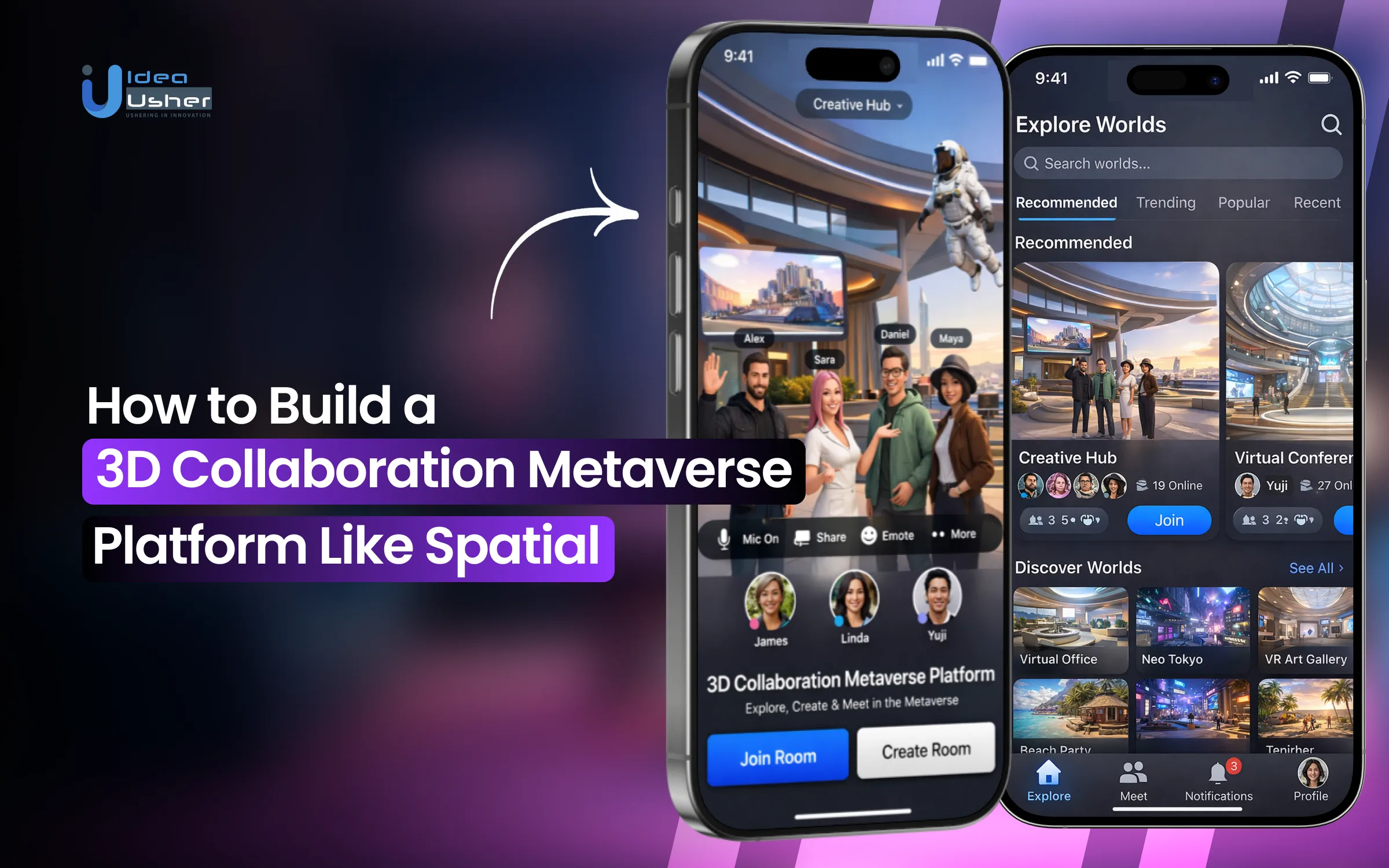
In most virtual meetings, participation tends to drop because the setup feels passive and slightly disconnected. People often keep cameras off and may stay muted, so collaboration becomes limited and one-directional. You might notice that attention gradually shifts away when there is no spatial or visual engagement. The popularity of metaverse collaboration platforms has started increasing because teams now need a deeper presence and more interactive workflows.
3D environments can place users in a shared digital space where they actively move and interact in real time, potentially improving focus. This structure could naturally distribute involvement across the group instead of relying on a few voices.
Over the years, we have developed several 3D collaboration platforms that leverage technologies such as cloud streaming and real-time 3D rendering. With this expertise, we are sharing this blog to walk through the key steps to develop a platform like Spatial.
Why Businesses Are Investing in 3D Collaboration Now?
According to Polaris Market Research, the metaverse market size stood at USD 156.07 billion in 2025. It is expected to register a CAGR of 46.3% from 2026 to 2034. Advancements in AR/VR, blockchain, and 5G boost industry growth. The growing demand for immersive experiences and remote collaboration is driving this rapid market expansion.

Source: Polaris Market Research
Modern enterprises are moving beyond the limitations of the 2D cloud. The shift to “spatial presence” solves the engagement friction inherent in traditional remote work, reclaiming the nuance and spontaneous innovation lost on flat screens.
3D collaboration serves as a force multiplier. By working within high-fidelity digital twins, teams collapse the distance between concept and execution, drastically reducing the margin for error found in fragmented, screen-shared workflows.
From Video Calls to Immersive Spaces
Traditional video conferencing creates cognitive fatigue by stripping away spatial context. 3D workspaces restore essential sensory inputs like depth and peripheral awareness, allowing for a more natural and productive digital presence.
- Spatial Context: Natural interaction via directional focus and spatial audio.
- Persistent Assets: Digital war rooms where blueprints and models remain in place.
- Cognitive Efficiency: Reduced mental effort in decoding complex 2D data.
Platforms like Microsoft Mesh are leading this transition. By embedding immersive spaces into tools like Teams, they allow organizations to adopt 3D workflows without the barrier of specialized hardware.
Use Cases Driving Real ROI
3D collaboration is an operational necessity where precision impacts profit. In Architecture, walking clients through photorealistic renderings secures funding faster and identifies costly structural flaws before ground is even broken.
In Manufacturing, ROI is realized through accelerated prototyping. Using platforms like NVIDIA Omniverse, global engineering teams collaborate on a single “Digital Twin” in real-time, cutting development cycles by nearly 40%.
In High-Stakes Training, these environments provide a zero-risk sandbox. From surgery to aerospace, professionals rehearse emergency protocols with 99% accuracy, significantly lowering training costs while improving safety outcomes.
The Early Adopter Advantage
The first-mover advantage is about building operational maturity. Companies investing now are developing proprietary “spatial intelligence” that will be difficult for competitors to replicate as the technology becomes standard.
These firms attract elite talent by offering sophisticated, flexible work environments. They are also creating “Data Moats” by analyzing spatial interaction data to optimize workflows and identify efficiency bottlenecks.
As hardware becomes more ergonomic, the barrier to entry will rise. Those who integrate 3D workflows today will operate at a velocity that legacy firms simply cannot match.

What Makes Platforms Like Spatial So Addictive?
Modern enterprises are moving beyond the 2D cloud. Platforms like Spatial have redefined this landscape, turning a standard web link into a portal for immersive interaction. This shift replaces flat video feeds with shared, three-dimensional environments.
Decision-makers are investing in this space to solve the engagement friction of remote work. By using Spatial for high-fidelity meetings and virtual galleries, businesses maintain a level of culture that traditional tools cannot replicate.
3D collaboration acts as a force multiplier. Working within digital twins allows teams to collapse the distance between concept and execution, reducing the errors common in fragmented, screen-shared workflows.
From Video Calls to Immersive Spaces
Traditional video conferencing causes fatigue by stripping away spatial context. 3D workspaces restore sensory inputs like depth and peripheral awareness, enabling a more natural digital presence.
- Spatial Context: Uses directional focus and spatial audio for natural interaction.
- Persistent Assets: Digital rooms keep blueprints and models exactly where they were left.
- Cognitive Efficiency: Reduces the mental effort required to decode complex 2D data.
Platforms like Microsoft Mesh lead this transition. By embedding immersive spaces into Teams, they allow organizations to adopt 3D workflows without requiring specialized hardware.
Use Cases Driving Real ROI
3D collaboration is a necessity where precision impacts profit. In Architecture, walking clients through renderings secures funding faster and identifies structural flaws before construction begins.
In Manufacturing, ROI comes from accelerated prototyping. Using NVIDIA Omniverse, engineers collaborate on a single Digital Twin in real-time, cutting development cycles by nearly 40%.
In High-Stakes Training, these environments offer a zero-risk sandbox. Professionals in surgery or aerospace rehearse protocols with 99% accuracy, lowering costs and improving safety.
The Early Adopter Advantage
The first-mover advantage is about building operational maturity. Companies investing now develop proprietary spatial intelligence that will be difficult for late-coming competitors to replicate.
These firms attract elite talent by offering sophisticated, flexible environments. They also create Data Moats by analyzing spatial interaction data to optimize workflows and identify efficiency bottlenecks.
As hardware improves, the barrier to entry will rise. Those integrating 3D workflows today will operate at a velocity that legacy firms simply cannot match.
Key Features Users Expect in a 3D Collaboration Platform
Building a market-ready solution requires a deep understanding of functional expectations. This is especially true as 3D metaverse collaboration platforms become the new standard for enterprise interaction.
Users no longer settle for static environments. They demand dynamic hubs that mirror real-world movement. These features determine whether a platform becomes an essential daily tool or a discarded experiment.
1. Avatars with Spatial Interaction
Modern users require a digital identity that feels intuitive. A robust system must incorporate high-fidelity movement and directional audio to mimic physical proximity.
For instance, VRChat has set a high bar by supporting advanced lip-syncing and full-body tracking. When a user perceives where a colleague is standing based on sound alone, the interface becomes a living social space.
2. Custom Spaces and Builders
Retention is driven by the ability to personalize one’s surroundings. Platforms must offer toolsets that allow teams to design unique rooms for specific workflows, from boardrooms to industrial facilities.
Roblox demonstrates this power through Roblox Studio, where non-technical users can build complex 3D environments. This sense of ownership ensures the digital workspace evolves alongside actual business needs.
3. Live Streaming and Collaboration
A platform must function as a high-capacity venue for real-time engagement. This involves the seamless integration of external media feeds and collaborative tools within the 3D space.
Fortnite has pioneered the live event model, hosting massive virtual concerts and streams. In these environments, users expect to share data and interact with live content without breaking the immersion.
4. NFT and Digital Asset Integration
As digital ownership becomes standardized, the ability to display and trade unique assets is a major draw. Integration with secure ledgers allows users to prove the authenticity of virtual property.
The Sandbox is a leader in this area, allowing creators to monetize work through a blockchain-based economy. This adds tangible economic value and prestige to the digital ecosystem.
5. Cross-Platform Sync
Accessibility is the primary hurdle for widespread enterprise adoption. A successful platform must ensure a unified experience across headsets, mobile devices, and browsers.
Decentraland achieves this by prioritizing web-browser access alongside immersive features. Real-time synchronization keeps all participants in the same state, maintaining the integrity of the shared experience.
Advanced Features That Differentiate Your Platform
To capture sophisticated interest, 3D metaverse collaboration platforms must offer technical “moats,” which are proprietary advantages that solve complex enterprise problems. These features move the needle from simple meeting spaces to robust ecosystems with long-term commercial value.
1. AI Avatars and Smart Interaction
The next generation of collaboration is defined by intelligent presence. By integrating Large Language Models and computer vision, avatars now act as 24/7 digital concierges or administrative assistants.
Inworld AI is a prime example of this technology, providing digital characters with complex personalities. For an enterprise platform, this means AI avatars can summarize meetings or onboard users, ensuring productivity even when human moderators are offline.
2. Scalable Multiplayer Architecture
For large-scale events, the underlying architecture must handle thousands of concurrent users without latency. This technical hurdle separates infrastructure from simple social tools.
Platforms like Hadean provide the distributed cloud power necessary for high concurrency. By implementing spatial partitioning, your platform ensures users only process data for their immediate vicinity, allowing for stable social clusters that mirror real-world density.
3. Economy and Monetization Systems
A sustainable platform must provide a clear path to revenue. This involves building a secure pipeline for the exchange of services, digital goods, and access rights.
Zepeto has mastered this with a marketplace where creators design and sell digital items. For an enterprise platform, this translates to a marketplace for 3D office templates or training modules, creating a self-sustaining ecosystem that locks users into your platform’s economy.
4. Analytics and Engagement Tracking
Data is the ultimate currency for business decision makers. To justify 3D collaboration, leaders need granular metrics on how their spaces are actually being utilized.
Unlike 2D platforms, 3D analytics provide heatmaps of user movement and dwell time. Tools like Metalitix allow platform owners to visualize these spatial data points, which is invaluable for optimizing layouts, measuring training effectiveness, and proving the ROI of digital activations.
How to Build a 3D Collaboration Metaverse Platform Like Spatial?
Building a 3D collaboration metaverse platform like Spatial may involve setting up a real-time 3D engine with Unity or WebGL and connecting it to a scalable backend for avatars and spatial sync. It can also include WebRTC for voice and cloud systems, so users can interact smoothly in persistent virtual environments.

We have built several 3D collaboration metaverse platforms like Spatial, and here is how the process usually works.
1. Define Niche and Journeys
We begin by identifying the exact problem your platform needs to solve. Whether you require a high-end virtual showroom or a complex engineering sandbox, we map out every user touchpoint. This strategic foundation ensures we build only the features that drive value for your specific industry.
2. Plan Concurrency Limits
We architect your platform to handle your expected user load without lag. By defining concurrency limits early, we select the optimal networking frameworks to support anything from intimate executive sessions to massive global summits. This ensures a stable, high-fidelity experience for every participant.
3. Design Immersive UX
Our team moves away from clunky 2D menus to create intuitive, spatial interactions. We design “diegetic” interfaces that live within the 3D world, allowing users to interact with objects and data naturally. This approach maximizes immersion and makes the digital environment feel like a physical destination.
4. Build Scalable Backend
We deploy a robust backend capable of synchronizing movements and asset changes across the globe in real time. By leveraging scalable cloud infrastructure, we ensure your platform remains responsive as your user base grows. This technical backbone guarantees that every user sees the same “source of truth” instantly.
5. Integrate Avatars and Audio
We bridge the emotional gap of remote work by integrating expressive avatar systems and spatial audio. By mimicking how sound travels in the real world, we allow for natural “breakout” conversations. Our avatar solutions support the gestures and presence needed for genuine human connection in a digital space.
6. Launch MVP and Iterate
We believe in getting your product to market quickly with a focused Minimum Viable Product. By launching a stable, core version of your platform, we can gather real-world user data and feedback. This allows us to iterate rapidly, adding advanced features based on what your users actually need.
Cost to Build a 3D Collaboration Metaverse Platform Like Spatial
Investing in 3D metaverse collaboration platforms requires a clear understanding of the financial landscape. Because these environments blend high-fidelity graphics with real-time networking, the development costs are higher than traditional web applications. Below is a breakdown of the investment required to bring a custom 3D world to life.

Cost by Feature Complexity
The total budget is primarily driven by the fidelity and interactivity of the space. A minimalist meeting room is a far different financial undertaking than a persistent industrial simulation.
- Core 3D Environment ($30,000 – $80,000): Covers world-building, lighting, and physics. Higher costs apply for photorealistic textures.
- Networking & Sync ($25,000 – $60,000): Backend for real-time multiplayer. This ensures every user sees object changes instantly.
- Avatar Systems ($15,000 – $40,000): Integration of customizable personas, lip-syncing, and skeletal animations.
- Spatial Audio ($10,000 – $25,000): Logic for 3D sound that fades based on a user’s position relative to others.
MVP vs Full-Scale Investment
Most successful founders start with a lean version of their vision before scaling to a massive ecosystem.
| Version | Target Use Case | Investment Range |
| Simple MVP | Concept validation, small teams | $40,000 – $90,000 |
| Mid-Level Platform | Corporate training, galleries | $100,000 – $250,000 |
| Enterprise Suite | Global events, AI-driven | $300,000 – $750,000+ |
Hidden Costs to Consider
The sticker price of development rarely covers the long-term operational reality of a 3D platform.
Maintenance & Updates: Expect to spend 15% to 20% of your initial build cost annually. This covers server hosting, security patches, and hardware SDK updates.
Infrastructure Scalability: A 3D space consumes massive bandwidth. Monthly server costs can range from $2,000 to $10,000, depending on traffic. Additionally, specialized QA testing for VR comfort and performance can add another 20% to the production budget.
Timeline Estimates by Scope
Building a 3D world is a marathon. The complexity of spatial logic and asset optimization means longer cycles than traditional software.
- Discovery & Prototype (4–6 Weeks): Defining the niche and building a low-fidelity “gray-box” version of the space.
- MVP Development (3–5 Months): Coding the multiplayer backend and launching a functional, invite-only environment.
- Full Feature Integration (6–12+ Months): Adding advanced tools like AI concierges and cross-platform optimization.
Must-Have Integrations for a 3D Collaboration Metaverse Platform
To build high-performance 3D metaverse collaboration platforms, the technical stack must connect with the tools users already rely on. Seamless integration ensures the virtual world is not an island, but a functional extension of an existing professional workflow.
Payment Systems
Frictionless gateways allow for instant transactions within the 3D environment. This is essential for selling digital assets or ticketing for virtual events.
- Digital Wallets: Connecting verified identity and payment credentials for “Log in and Pay” functionality.
- In-World Checkout: Custom UI that allows users to purchase upgrades or goods without leaving the immersion.
- Subscription Logic: Recurring billing for premium space access or exclusive membership tiers.
NFT and Blockchain
Digital ownership is a cornerstone of the modern virtual economy. Secure ledger connections verify and trade unique assets.
| Component | Strategic Use Case | Benefit |
| Asset Minting | Converting 3D models into tradeable NFTs. | Verifiable scarcity & ownership. |
| Smart Contracts | Automating royalties for creators. | Transparent, trustless revenue. |
| Layer-2 Scaling | Using networks like Polygon or Solana. | Low gas fees and fast trades. |
Third-Party Tools
A platform should host a user’s toolkit rather than replace it. API connections bridge the gap between 2D productivity and 3D space.
Data Interoperability: Connections to cloud CAD tools and PLM systems allow engineering teams to review live 3D models and annotations directly within the virtual environment.
Beyond design, live streaming protocols for real-time video feeds and whiteboarding apps are integrated. This ensures a team can host high-stakes presentations or brainstorming sessions with all external data synced perfectly in the 3D world.
How to Design Spaces That Keep Users Engaged Longer?
Success for 3D metaverse collaboration platforms depends on how long a space can hold a user’s attention. By moving beyond functional utility into the realm of environmental psychology and social engineering, a platform becomes a destination users return to daily.

Environmental Design Psychology
The human brain processes 3D space differently than 2D windows, triggering mirror neurons and a sense of “place.” To maximize engagement, design must prioritize spatial presence. For example, Arthur leverages professional, high-fidelity environments specifically designed to reduce cognitive load during long corporate strategy sessions.
- Vastness vs. Intimacy: Alternating between expansive views and cozy breakout areas prevents spatial fatigue.
- Biophilic Elements: Integrating virtual nature, such as moving water or shifting light, keeps the mind refreshed.
- Consistent Audio: Directional sound ensures the brain accepts the environment as “real,” making interactions feel like physical meetings.
Social Interaction Loops
Retention is driven by relational lock-in. When a platform fosters deep social connections, users return. Glue excels here by focusing on presence-centric collaboration, where high-quality avatars and fluid animations make remote teams feel truly together in a shared physical context.
Spatial Proximity:
In a well-designed loop, users who walk toward each other trigger private voice channels. This rewards exploration and creates the serendipity missing from scheduled video conferences.
By layering social presence, platforms create a sense of belonging. Features like synchronized emotes and shared virtual whiteboards ensure that every interaction feels responsive and rewarding.
Gamification for Session Time
Gamification in professional 3D spaces uses discovery-based rewards to keep users active. Incorporating subtle mechanics transforms a passive viewing experience into an active journey.
| Element | Professional Application | Impact |
| Progress Tracking | Visual meters for completed training modules. | Increases task completion rates. |
| Discovery Rewards | Hidden information nodes or “Easter eggs.” | Drives exploration of the full space. |
| Scenario Challenges | Interactive 3D roleplay for sales or safety. | Boosts knowledge retention and dwell time. |
These elements tap into the dopamine-reward system. By providing immediate feedback, such as a visual transformation of a room once a team goal is met, the platform satisfies the need for achievement, naturally extending session length.
Go-To-Market Strategy for 3D Collaboration Metaverse Platforms
Launching 3D metaverse collaboration platforms requires more than a standard software rollout. Because these spaces depend on active participation, the go-to-market strategy must prioritize community density and immediate utility to overcome the “empty room” problem.

1. Targeting Early Adopters
Successful launches focus on high-value niches where 3D adds undeniable efficiency. Identifying these “power users” early allows for a more focused development cycle.
For instance, Arthur has successfully targeted large-scale enterprises by providing high-end virtual offices that specifically solve the problem of remote team fragmentation.
- Architecture & Design: Teams needing to walk through 1:1 scale models.
- Education & Training: Universities conducting high-stakes simulations.
- Virtual Event Organizers: Agencies looking for immersive alternatives to standard webinars.
By dominating a specific sector first, a platform builds a reputation for reliability. This beachhead strategy provides the necessary revenue and user feedback to eventually scale into broader markets.
2. Launch Strategies for Creators
Creators are the lifeblood of any persistent world. If a platform is easy to build on, the community will generate the content that keeps users coming back.
The Sandbox illustrates this perfectly by providing robust no-code tools that allow brands and individual creators to build and monetize their own interactive environments without deep technical knowledge.
| Launch Tactic | Execution Method | Expected Outcome |
| Creator Grants | Funding top 3D artists to build hero spaces. | High-quality initial environments. |
| No-Code Tooling | Drag-and-drop assets for non-technical users. | Lower barrier to entry for brands. |
| Early Access Beta | Gated entry for influential digital architects. | Buzz and exclusive community feel. |
Brands are attracted to platforms where the audience is already engaged. By incentivizing creators to build unique galleries or hubs, the platform effectively outsources its content creation, ensuring the world feels lived-in from day one.
3. Building Network Effects
A platform becomes more valuable with every new participant. Building this momentum from the start is the only way to ensure long-term growth.
The Referral Loop:
Implementing “Invite to Space” links allows guests to enter a 3D room instantly through a browser without downloading software. Each guest becomes a potential new user, creating a low-friction viral loop.
To strengthen these effects, focus on interoperability. When users can bring their existing digital assets or identities from other spaces into yours, the friction of switching platforms disappears. This open-border policy encourages larger communities to migrate and settle in the new environment.
Why Choose IdeaUsher for 3D Collaboration Metaverse Platforms?
Choosing the right partner is vital for launching 3D metaverse collaboration platforms. IdeaUsher blends technical mastery with strategic vision to turn complex virtual concepts into stable, high-performance business solutions.
Real-Time 3D Expertise
With over 500,000 hours of coding experience, our team of ex-MAANG/FAANG developers excels in spatial computing. We master low-latency networking and high-fidelity rendering to ensure your virtual world operates seamlessly across all devices.
End-to-End Development
We manage the entire lifecycle, from 3D world-building to global scaling. Our process includes asset optimization, backend design, and rigorous QA. This holistic approach ensures a fluid transition from a basic MVP to an enterprise-grade ecosystem.
Business-Driven Solutions
We build tools that drive measurable results rather than just digital novelties. By aligning features with your commercial goals, we ensure your investment translates into higher engagement and new revenue. Our strategy maximizes ROI while maintaining a competitive digital edge.
Conclusion
Building a 3D collaboration metaverse platform like Spatial requires a strategic blend of high-performance engineering and intuitive spatial design. By prioritizing scalable backend architecture, immersive social loops, and seamless third-party integrations, businesses can move beyond traditional video conferencing into a new era of digital presence. Success lies in starting with a focused, high-utility MVP and iterating based on real-world user data to build a sustainable, ROI-driven virtual ecosystem.
FAQs
A1: Building a platform involves a multi-stage process starting with a clear definition of the use case, such as virtual offices or industrial training. Developers select a robust engine like Unity or Unreal and build a scalable backend to handle real-time synchronization. The journey concludes with creating interactive 3D assets, implementing spatial audio, and conducting stress tests to ensure the environment supports multiple concurrent users.
A2: 3D content is typically crafted using professional software like Blender, Maya, or 3ds Max to create characters and environments. For the metaverse, these assets must be optimized with low polygon counts and efficient textures to ensure smooth performance across various devices. Once modeled, assets are exported in interoperable formats like glTF or USDZ and integrated into the platform’s engine to be rendered in real-time.
A3: A functional platform includes persistent 3D environments, customizable digital avatars, and spatial audio that mimics real-life sound proximity. Key professional features often include interactive whiteboards, screen sharing, and the ability to import 3D models for real-time review. Additionally, secure identity management and integrated marketplaces for virtual goods help create a self-sustaining digital economy.
A4: These platforms operate by converging virtual reality, real-time networking, and spatial computing into a unified experience. A central server synchronizes the state of the world, ensuring every user sees the same movements and changes instantly. By using WebRTC for communication and cloud hosting for scalability, the platform creates a persistent digital space where users can interact with each other as if they were physically present.


