



Key Takeaways
- Microservices replace monolithic systems with independent services, enabling faster updates, scalability, and resilience while supporting zero downtime
- The shift toward microservices is driven by agility and cloud-native infrastructure, allowing businesses to scale components and lower costs
- Unlike monoliths, microservices solve scaling challenges by decentralizing development and enabling parallel innovation across teams
- While microservices offer advantages, they introduce complexity and costs, making them ideal for growing applications over a monolithic architecture
- How IdeaUsher helps design and scale microservices architecture with expert teams and faster deployment without disrupting operations
What if the real bottleneck is not your infrastructure, but how tightly your system is built? Monolithic architectures made sense when releases were slower, and user expectations were predictable. That model no longer fits a market where users expect continuous updates, seamless performance, and zero downtime, while businesses are pressured to ship faster without compromising stability.
Microservices change this equation by breaking applications into independent services that can be developed, deployed, and scaled separately. This gives teams more flexibility, reduces system-wide risks, and aligns software architecture with the speed modern digital products now require. Faster iteration, stronger resilience, and scalable growth are no longer trade-offs but part of the foundation itself.
Over the years, we’ve helped businesses build scalable digital systems designed for rapid growth and continuous deployment. In this blog, we break down what microservices are, how microservice architecture works, and why modern teams are moving away from tightly coupled systems to build more flexible and resilient applications.
Rising Market Demand for Microservices Architecture
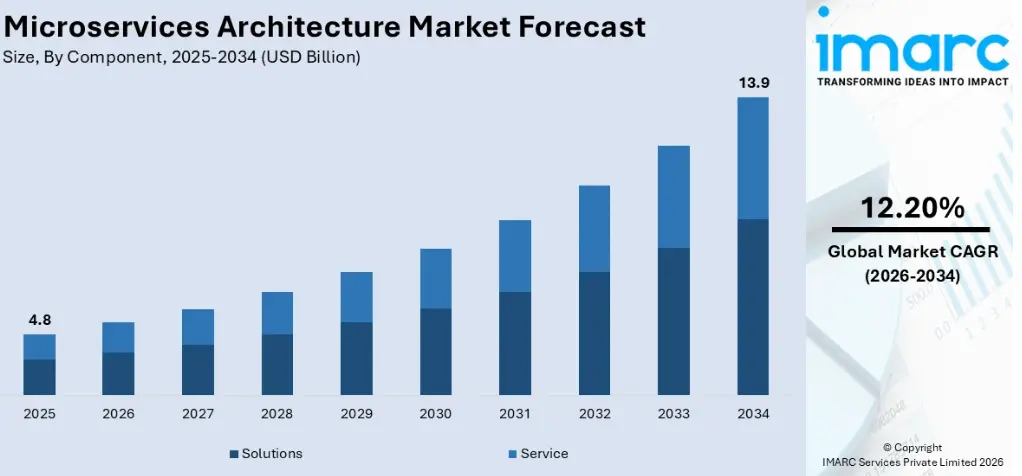
Source: Imarc Group
For the modern investor, these figures signal a fundamental shift in how digital value is built. The rigid nature of traditional software acts as a bottleneck to capital efficiency. Microservices solve this by breaking down complex platforms into independent services. This modularity ensures that a failure in one module does not paralyze the entire ecosystem.
The Shift to Microservices
The current enterprise migration is fueled by the demand for Continuous Delivery. In a monolithic setup, updating one feature requires redeploying the entire application, which introduces risk and downtime.
For large-scale enterprises, this lack of velocity is a liability. By adopting microservices, organizations empower autonomous teams to develop and deploy specific functionalities without waiting for the entire system’s release cycle.
Strategic advantages include:
- Technological Heterogeneity: Teams can choose the most efficient language for a specific task, such as using Python for AI modules while utilizing Go for high-speed messaging.
- Faster Time to Market: Decoupled services allow businesses to launch features in weeks rather than months, capturing market share before competitors can pivot.
- Seamless Third-Party Integration: A fintech platform can run its core ledger on a private microservice while connecting to a specialized KYC service via API, allowing for rapid expansion.
- Resource Optimization: Organizations can scale only the service under pressure, significantly reducing infrastructure overhead and cloud expenditure.
Growth of Cloud-Native Systems
The proliferation of cloud native environments leveraging technologies like Kubernetes and Docker has provided the essential infrastructure for microservices. We are seeing a move toward Cloud First development. In this paradigm, applications are designed specifically for distributed environments. This utilizes the elasticity of the cloud to manage fluctuating workloads. For an investor, this represents a move toward high-availability assets.
When a platform is distributed across multiple nodes and regions, it becomes inherently more robust. Consider a global streaming service that uses microservices for video encoding, user profiles, and billing. If the billing service undergoes maintenance, users can still stream content uninterrupted. The maturation of Service Mesh technologies has also simplified service discovery, making this model more manageable for mid-sized enterprises.
Scalable and Resilient Apps
Resilience is the cornerstone of brand trust in the digital economy. In a microservices architecture, the concept of graceful degradation is a primary goal. This prevents minor technical glitches from turning into catastrophic revenue losses. If a recommendation engine fails in an e-commerce platform, the user can still browse and complete a purchase. Scalability in this context is both precise and cost-effective for the business owner. As your user base grows, a microservices-based platform allows for:
- Targeted Scaling: If a platform experiences a surge in login requests, you can replicate the Identity Service without wasting budget on scaling unused modules.
- Composable Innovation: Entrepreneurs can leverage third-party APIs and integrate them with minimal friction, allowing the platform to evolve into a comprehensive ecosystem.
- Operational Flexibility: A ride-sharing application can scale its driver-matching service during peak hours without increasing capacity for its User Rating services.
- Long-term Maintainability: Small and focused codebases help avoid technical debt. This ensures the software remains a valuable asset rather than a legacy burden requiring a total rebuild.
What is Microservice architecture?
Microservice architecture is a development pattern that includes multiple independent and loosely coupled services. Each service has a separate codebase, which small developer teams can manage well. Developers can deploy all these services independently, providing a faster and easier application development. The application in this architecture can be developed as smaller, independent parts. Moreover, the architecture provides a framework to develop, deploy, and maintain services independently. You can know more about this architecture by understanding its characteristics.

Why Do Monolithic Apps Break as Products Scale?
A monolithic architecture is essentially a single, unified unit. While this works for early-stage startups needing a quick prototype, it eventually becomes a ball of mud that stifles growth. For an investor, a monolith represents a growing liability where every new line of code increases the risk of total system failure. As the codebase expands, the interconnected nature of the components makes it nearly impossible to isolate issues. What began as a cost-effective solution evolves into a rigid structure that consumes more capital in maintenance than it generates in new value.
1. Tight Coupling Slows Releases
In a monolithic system, all components are tightly coupled. This means that even a minor change to the payment gateway might inadvertently break the user profile section. Because everything is entwined, developers must conduct exhaustive regression testing for the entire application before any update.
The Scalability Paradox:
- Dependency Hell: A change in one library or database schema forces an update across the entire application.
- Longer QA Cycles: Testing takes weeks instead of hours because the impact of a single bug is unpredictable.
- Deployment Bottlenecks: Only one team can deploy at a time, creating a queue that delays critical market entries.
For a decision maker, this translates to a lost opportunity. While your competitors are pushing daily updates, your team is stuck in a month-long release cycle to ensure the system does not collapse.
2. Scaling Waste and Inefficiency
Monoliths lack granular control over resources. If your platform’s video processing service is under heavy load, you cannot scale it independently. You are forced to replicate the entire application across multiple servers, even the parts that are sitting idle.
Technical Debt Alert: Scaling a monolith is like renting a whole hotel because you need one extra bed. It is an inefficient use of cloud budget and leads to massive over-provisioning costs.
Consider an e-commerce platform during a flash sale. The search engine might be the only component struggling with traffic. In a monolithic setup, you must pay to scale the image gallery, the checkout system, and the blog section simultaneously. This leads to a bloated infrastructure bill that eats directly into your profit margins.
3. Growing Downtime Risks
The most significant risk for any large-scale platform is the Single Point of Failure. In a monolith, a memory leak in a minor background task can consume all available resources, crashing the entire site. This lack of fault isolation is why large scale platforms eventually reach a breaking point.
| Risk Factor | Monolithic Impact | Business Consequence |
| Bug in Code | Can crash the entire process. | Total service outage. |
| Database Lock | Freezes all functions. | Zero transactions processed. |
| Security Patch | Requires a full reboot. | Planned downtime and lost revenue. |
Characteristics of microservice architecture
The Microservice has the following characteristics:
- Each service can be tested in isolation.
- Each microservice has a separate codebase.
- Microservices require the management of the data storage for each service.
- Microservices allow the use of different tech stacks for other services.
- Each service focuses on solving specific problems.
- Each component of a microservice can be developed, operated, and scaled without affecting the functionality of other services.
- For communication between the services, there is no need for services to share their code with other services. The communication can be done via API.
- Microservices are suitable for developing cloud applications.
- Microservices allow the flexibility to use different programming languages and frameworks to build other microservices.
In addition to separate services, the microservices have the following components.
Components of Microservice Architecture
Investing in a microservice architecture is a move toward long-term agility and technical resilience. Unlike monolithic structures, where a single failure can paralyze the entire system, this architectural style deconstructs the application into independent functional units. This translates to reduced technical debt and the ability to scale specific features without overhauling the entire codebase.
To build a robust ecosystem, one must focus on the core infrastructure components that ensure these disparate services communicate and operate seamlessly.
1. API Gateways and Routing
The API Gateway serves as the singular entry point for all client requests, acting as the front door to your ecosystem. From a strategic perspective, the gateway is not merely a router. It is a critical layer for security, rate limiting, and protocol translation. By centralizing these functions, you ensure that individual microservices remain lean and focused solely on their business logic rather than being bogged down by authentication or traffic management.
Effective request routing involves several sophisticated mechanisms:
- Load Balancing: Distributing incoming traffic across multiple instances of a service to ensure high availability and prevent any single node from becoming a bottleneck.
- Security Enforcement: Implementing OAuth2, JWT validation, or TLS termination at the edge to protect internal services from external threats.
- Service Discovery Integration: Automatically identifying the network location of a service instance, which is vital in dynamic cloud environments where IP addresses change frequently.
A high-performance API gateway provides the telemetry needed to understand user behavior and system performance at the perimeter, allowing for data-driven decisions on where to allocate further development resources.
2. Containers and Orchestration
In a microservices environment, consistency across development, testing, and production is paramount. Containers provide a lightweight, isolated environment that packages the service with its dependencies, ensuring it runs the same way regardless of the underlying infrastructure. However, managing hundreds of containers manually is impossible. This is where Kubernetes (K8s) becomes the industry standard for orchestration.
Kubernetes offers specific business advantages that safeguard your capital:
- Self-Healing: If a container crashes, Kubernetes automatically restarts or replaces it, maintaining 99.9% uptime without manual intervention.
- Horizontal Scaling: It can automatically spin up additional service instances during peak traffic and scale down during lulls, optimizing your cloud infrastructure costs.
- Resource Bin Packing: K8s efficiently schedules containers onto your server cluster to maximize hardware utilization, ensuring you are not paying for idle compute power.
By adopting a containerized strategy, your platform gains the portability to move between cloud providers without a total re-architecture, protecting you from vendor lock-in.
3. CI/CD for Deployment
The primary competitive advantage of microservices is speed to market. Continuous Integration and Continuous Deployment (CI/CD) pipelines are the automated engines that make this speed possible. A well-engineered pipeline allows your engineering team to push code updates multiple times a day with high confidence rather than waiting for big bang releases that carry significant risk.
A mature CI/CD process shifts the focus from avoiding change to mastering change. This means your product can evolve based on real-time market feedback faster than a competitor stuck in a manual release cycle.
The pipeline typically follows a rigorous automated sequence:
- Build and Test: Automated unit and integration tests run immediately upon code submission.
- Vulnerability Scanning: Security checks are integrated directly into the flow to identify flaws before deployment.
- Automated Deployment: Once validated, the code is deployed to staging or production using Blue-Green or Canary release strategies to minimize user impact in case of errors.
4. Monitoring and Observability
As the complexity of your system increases, traditional monitoring is no longer sufficient. You need observability, which provides deep insights into the why behind system behavior, not just the what. This data is the pulse of the business. It tells you if users are experiencing friction, where latency is costing you conversions, and how the system is holding up under load.
A comprehensive observability suite focuses on three pillars:
- Metrics: High-level data such as CPU usage, error rates, and request volume that provide a bird’s-eye view of system health.
- Logging: Detailed records of specific events that help developers perform forensic analysis when an edge case occurs.
- Distributed Tracing: Perhaps the most critical for microservices, tracing allows you to follow a single user request as it travels through multiple services, identifying exactly where a delay or failure originated.
How Microservices Architecture Actually Works?
Transitioning from a monolithic structure to a microservice architecture involves a fundamental shift in how logic and data are managed. In a legacy system, every function shares the same memory and database, creating a fragile web of dependencies. In a modern platform, the architecture functions more like a city composed of specialized districts.
Each service operates independently with its own rules, yet they all remain connected through a high-speed infrastructure. This modularity ensures that the failure of one service, such as a notification engine, does not bring down the entire commerce engine.
1. Service Communication
In a distributed system, services must talk to one another to complete complex business transactions. This communication typically happens via two primary methods. The efficiency of this interaction directly impacts system speed, reliability, and user experience across the platform. Poorly managed communication patterns can quickly introduce latency and operational bottlenecks as the system scales.
- REST and gRPC (Synchronous): One service calls another and waits for a response. It is ideal for immediate needs, like a checkout service requesting a real-time price validation.
- Message Brokers (Asynchronous): A service sends a message to a queue and moves on to the next task. This is vital for background processes like sending an email after a purchase is completed.
Relying solely on synchronous calls can lead to a cascading failure where one slow service causes a backup across the entire platform. High-performance systems prioritize asynchronous communication to maintain a snappy, responsive user experience even under heavy load.
2. Database Management
The most significant departure from traditional development is the Database per Service pattern. In this model, each microservice owns its own data. If the Inventory Service needs to store stock levels, it uses its own dedicated database that no other service can access directly.
| Database Type | Best Use Case | Business Benefit |
| Relational (SQL) | Financial transactions | Ensures data integrity. |
| NoSQL (Document) | Product catalogs | Offers flexible schemas and high speed. |
| Key-Value Store | Session management | Reduces latency for temporary data. |
By decoupling data, you eliminate the single point of failure inherent in a massive shared database. It also allows your engineering team to choose the specific database technology that best fits the task at hand.
3. Event-Driven Workflows
Modern platforms rely on event-driven architecture to achieve massive scale. Instead of services calling each other directly, they emit events when something significant happens. For example, when a user places an order, the Order Service simply broadcasts an OrderCreated event.
The Workflow Sequence:
- Inventory Service hears the event and automatically reserves the items.
- Payment Service hears the event and initiates the credit card charge.
- Shipping Service hears the event and begins the logistics process.
This model is exceptionally powerful because it allows you to add new features simply by having a new service listen to the existing event. You can expand your platform capabilities without ever touching the original order processing code.
4. Traffic Management
As your platform grows, managing how traffic flows through the system becomes the difference between a seamless experience and a site crash. Load balancing acts as the traffic cop, ensuring that no single server or service instance is overwhelmed by requests. To maintain high availability, traffic management must be intelligent:
- Health Checks: The load balancer constantly pings each service instance. If one goes offline, traffic is instantly rerouted to healthy nodes.
- Canary Deployments: You can route a small percentage of your traffic to a new version of a service to test its stability before a full rollout.
- Circuit Breakers: If a service starts failing, a circuit breaker trips to prevent the rest of the system from wasting resources on a dead service.
What Problems Do Microservices Actually Solve?
Microservices are more than a technical trend. They are a solution to the financial friction that occurs as a platform matures. When a product grows, the objective is to maintain momentum. Microservices solve the problem of diminishing returns. They ensure that as the system expands, the cost of adding features does not grow exponentially. By partitioning a platform into distinct business domains, you eliminate the central bottleneck of a shared codebase.
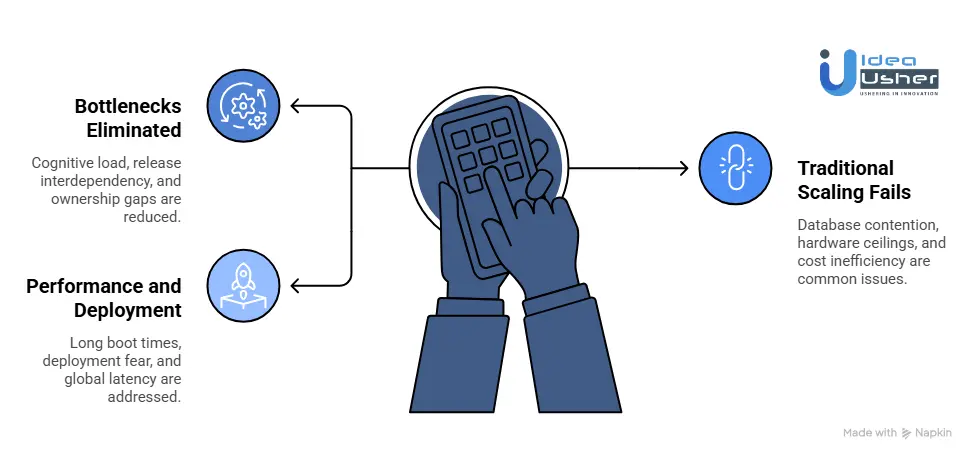
This allows the business to scale operations and technical infrastructure in parallel. Technology remains an enabler of growth rather than a constraint.
1. Bottlenecks in Growing Apps
As applications grow, the most significant bottleneck is often human. When dozens of developers work on one monolithic codebase, they spend more time resolving conflicts than writing code. This is the coordination tax.
Key Bottlenecks Eliminated:
- Cognitive Load: Developers only need to understand their specific service rather than a multi-million line system.
- Release Interdependency: A delay in a shipping module no longer holds up the launch of a loyalty program.
- Ownership Gaps: Teams become directly accountable for the performance of specific business functions.
Consider how a massive social media platform manages its news feed. By using microservices, the team responsible for the Ad Engine can update its algorithms without touching the code that handles User Notifications. This allows for simultaneous innovation across different product wings without cross-department delays.
2. Why Traditional Scaling Fails
Scaling in traditional systems usually fails because it is an all-or-nothing proposition. If one feature, like real-time analytics, becomes popular, a traditional system forces you to overallocate resources across the entire stack. Traditional scaling is a blunt instrument. It fails due to:
- Database Contention: A single, massive database becomes a choke point as processes compete for the same connections.
- Hardware Ceilings: Eventually, you cannot buy a large enough server to handle a monolith’s needs, forcing an expensive re-architecture.
- Cost Inefficiency: You pay for a high-performance CPU for parts of the application that are rarely used.
Major retail giants have mastered this by moving away from monolithic web stores. During peak shopping holidays, they can scale their Payment Processing and Inventory Check services to handle millions of requests per second. At the same time, they can leave the Customer Reviews service at a lower capacity to save on cloud costs.
3. Performance and Deployment
In high-stakes environments, performance is measured in milliseconds, and deployment success is measured in zero downtime. Traditional systems struggle here because a single slow query can drag down the entire site. Deployments become high-pressure events often scheduled for the middle of the night.
| Challenge | Business Impact | Microservices Solution |
| Long Boot Times | Slow recovery after crashes. | Services start in seconds. |
| Deployment Fear | Teams avoid frequent updates. | Low risk, automated canary releases. |
| Global Latency | Poor experience for distant users. | Deploy services closer to the user. |
Microservices allow for independent optimization. If a high-frequency trading service needs to be ultra-fast, it can be written in a low-level language and deployed on specialized hardware. The rest of the platform stays in a flexible language. This granular control keeps platforms performant under extreme load.
Advantages of microservice architecture
These are the following advantages of using microservices:
1. Reduced development times
Small independent teams can take responsibility for building-specific services. Having a complete focus on a single service helps developer teams build services more easily and quickly. This ultimately helps organizations reduce the time required for software development.
2. Easy scaling
It is easy to scale each service in microservices independently. Easy scaling helps the development team to add and improve features in specific services without disturbing the entire infrastructure of the application.
3. No restriction on tool selection
Each service is independent; developers are free to choose the best development tool for solving specific problems. Having the freedom to select any development tool helps developers to improve the services’ features and solve problems in their preferred way.
4. Faster deployment
Microservices provide a faster deployment through which developers can initiate the process of installing, updating, and configuring applications quickly. Moreover, microservices allow consistent app compiling, allowing developers to try new things in specific services. Microservices remove the risk of crashing the whole app. Suppose something goes wrong with the code source of specific services(during adding and improving new features). Only that service will be affected by the failed source code.
5. Reusable code
The architecture enables developers to write code once and use it multiple times in different services. Reusing of code helps developers to avoid writing the same code for improving or adding new features to various services.
6. Excellent resistance to service failure
The independent nature of microservices makes the applications resistant to any failure in the system. While in the case of monolithic architecture, the failure of any components can disturb the infrastructure of an entire application. Also, there is a high possibility that you might face a few challenges at the time of implementing the architecture of microservices in your development project.
How Microservices Architecture Works Step by Step?
Building a platform using microservice architectures is an exercise in strategic decomposition. Instead of building one massive engine, you build a fleet of specialized units. Each unit is responsible for exactly one business capability. This process requires a shift in mindset from technical layers to business outcomes. When executed correctly, the architecture mirrors your organizational goals. This allows for a plug-and-play approach to business expansion.
1. Identifying Service Boundaries
The first step is defining where one service ends and another begins. Engineers often use a strategy called Bounded Context. This involves mapping out the different functional areas of your business to ensure services are truly independent.
The Discovery Process:
- Domain Analysis: Grouping related tasks like payment, shipping, and inventory into their own silos.
- Data Sovereignty: Each service must own its own database. No two services should reach into the same data table.
- Verifying Independence: If you can update the Shipping service without affecting the Inventory service, you have found a correct boundary.
Expert Insight: Identifying boundaries is the most critical phase for an investor. Incorrect boundaries lead to a distributed monolith. This combines the complexity of microservices with the rigidity of a monolith.
2. How Services Communicate via APIs
Once services are separated, they must talk to each other. This is primarily done through Application Programming Interfaces or APIs. Most systems use REST or gRPC for these interactions. When a user clicks a button, the request hits an API Gateway. This gateway acts as a single entry point and routes the request to the appropriate microservice.
The Request Flow:
- Client Request: A user requests their order history.
- API Gateway: The gateway authenticates the user and directs the call to the Order Service.
- Service Interaction: The Order Service might briefly call the User Service to verify shipping details.
- Response: The final data is packaged and sent back to the user.
This synchronous communication is fast and efficient for simple tasks. However, it requires both services to be online at the same time to work.
3. Event-Driven Flows via Async Messaging
To achieve true resilience, large-scale platforms use event-driven architecture. Instead of services calling each other directly and waiting for an answer, they emit events. This is handled by a message broker like Kafka or RabbitMQ. This approach ensures that if one part of your system is slow or offline, the rest of the platform continues to function.
| Action | Direct API Call (Sync) | Event Driven (Async) |
| Coupling | High. Both services must be up. | Low. Services work independently. |
| User Experience | User waits for a response. | User gets instant confirmation. |
| Reliability | Fails if the receiver is busy. | Messages are queued and processed later. |
Practical Example:
In a high-volume e-commerce platform, when a customer places an order, the Order Service publishes an event called Order Created. The Inventory Service, the Shipping Service, and the Email Service all hear this event and start their work simultaneously. They do not need to wait for each other. This parallel processing is what allows platforms to handle massive bursts of traffic without slowing down.
Microservices vs Monolithic Architecture
The debate between these two models is a foundational business decision that dictates long-term operational costs. A monolith is a single unit where all business logic is combined. In contrast, microservice architectures are a collection of loosely coupled services designed for agility.
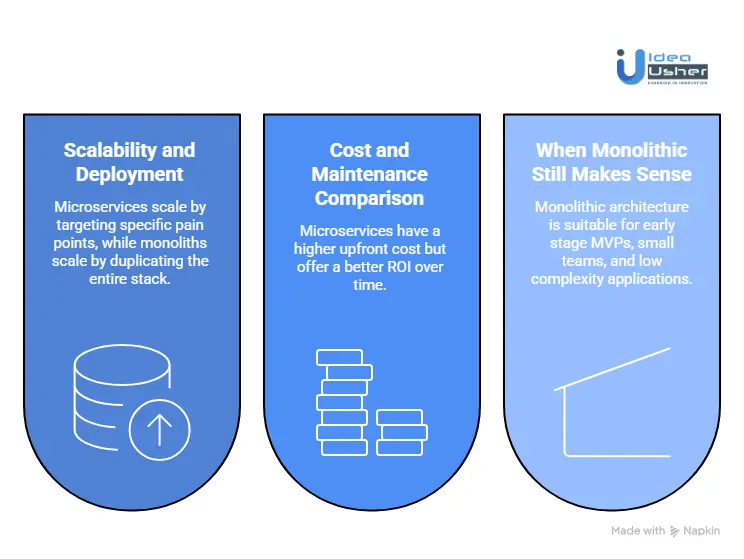
For an investor, the choice is between simplicity today and scalability tomorrow. While a monolith is easier to launch, microservices are built to survive the pressures of a growing market and complex user requirements.
1. Scalability and Deployment
The primary difference lies in how these systems handle growth. Monoliths scale by duplicating the entire stack. Microservices scale by targeting specific pain points.
A Comparison of Velocity:
- Monolithic Deployment: Every change requires a full system rebuild. This creates a high-risk environment where a single error can take the entire platform offline.
- Microservices Deployment: You can update the search engine ten times a day while the payment system remains untouched. This allows for rapid experimentation and a much higher release frequency.
- Infrastructure Efficiency: Microservices allow you to allocate expensive cloud resources only to the services that need them. This prevents the waste of paying for high-performance hardware to run idle background tasks.
2. Cost and Maintenance Comparison
The financial profile of these architectures differs significantly over the lifecycle of the product.
| Financial Metric | Monolithic Architecture | Microservices Architecture |
| Initial Cost | Lower. Faster to build and deploy. | Higher. Requires complex setup. |
| Maintenance | Costly at scale. Hard to fix bugs. | Efficient. Small, isolated codebases. |
| Cloud Spend | Inefficient. Hard to optimize. | Optimized. Pay only for what you use. |
| Hiring Needs | Generalists. Easy to source. | Specialists. Requires expert talent. |
While microservices have a higher upfront cost due to the need for containerization and service orchestration, they offer a better ROI as the user base grows. They prevent the technical debt that usually forces a total platform rewrite after a few years of operation.
3. When Monolithic Still Makes Sense
Despite the advantages of microservices, the monolith is not obsolete. There are specific business scenarios where a unified architecture is the more responsible investment.
The Case for the Monolith:
- Early Stage MVPs: If you are testing a new market and need to launch in weeks, a monolith is faster and cheaper.
- Small Teams: If you have fewer than five developers, the overhead of managing multiple services will slow you down rather than speed you up.
- Low Complexity: If your application is a simple tool with limited features, the complexity of a distributed system is unnecessary.
Smart entrepreneurs often start with a modular monolith. This is a well-structured single application that can be easily broken into microservices once the product finds market fit and the need for independent scaling arises.
How To Implement Microservices Architecture Successfully?
Shifting to a microservice architecture requires more than just technical changes. It demands a cultural and organizational pivot. Success depends on how well the technology aligns with business goals and human workflows. Without a clear roadmap, the complexity of a distributed system can quickly outweigh its benefits. To ensure a high return on investment, the transition must be methodical, focusing on modularity and clear ownership from the first line of code.
1. Align Services With Teams
One of the most effective ways to design a system is to mirror your organizational structure. When services are built around specific team responsibilities, you eliminate the friction of cross-departmental bottlenecks. This approach, often based on Domain Driven Design, ensures that the team owning the payment logic is not slowed down by the team managing the user interface.
- Autonomy: Teams can deploy updates to their specific services without needing approval from the entire engineering department.
- Accountability: Clear ownership means bugs are identified and fixed faster because the responsible party is easily defined.
- Specialization: Developers become deep experts in their specific business domain, leading to more robust and innovative feature sets.
2. Avoid Accidental Monoliths
Scaling a platform often leads to a common trap called the distributed monolith. This occurs when services become so tightly coupled that you cannot change one without updating ten others. To protect your technical assets, you must enforce strict boundaries between services.
- Strict Interface Contracts: Use well-defined schemas so that services only interact through official channels.
- Independent Deployability: If Service A requires Service B to be updated at the exact same time, you have a dependency problem.
- No Shared Databases: Sharing a database between services is the fastest way to create a hidden monolith that is impossible to untangle later.
By maintaining these boundaries, you ensure that the platform remains agile as it grows, allowing for localized scaling and rapid iteration.
3. Refactor Legacy Structures
For those transitioning from an existing platform, the goal is to extract logic into service objects. This is not a process of deleting the old system and starting over. Instead, it is a strategic migration where functional components are pulled out of the main codebase one by one.
Migration Strategy: Identify the most independent or most frequently changed part of your application. Turn that specific logic into a standalone service object. Once it is stable and communicating via an API, you can safely remove the legacy code.
This incremental approach reduces risk. It allows the business to continue generating revenue and serving users while the underlying infrastructure is modernized in the background.
4. Build Smart Endpoints and Lean APIs
In a successful microservices ecosystem, the intelligence should live at the endpoints, not in the communication layer. Avoid using complex middleware that tries to process or transform data as it travels between services. Instead, use lightweight APIs that simply transport information.
- Dumb Pipes: The network should only be responsible for moving data from point A to point B.
- Smart Endpoints: The services themselves should handle the business logic, data validation, and error processing.
- Standardized Protocols: Use simple, widely supported formats like JSON or Protocol Buffers to ensure every part of your stack can talk to every other part without a translator.
How To Deploy Microservices Architecture Efficiently?
Executing a successful deployment within a microservice architecture requires a shift from manual oversight to automated precision. The goal is to create an environment where software is released frequently, safely, and with minimal human intervention. For a growing platform, efficiency is measured by the time it takes for a conceptual feature to become a live, revenue-generating tool. By leveraging modern infrastructure and governance, you can ensure that the system scales alongside your user base without a linear increase in operational costs.
1. Scalable Cloud Infrastructure
The cloud provides the elastic foundation necessary for a distributed system. Attempting to manage microservices on static, on-premise hardware often leads to wasted resources and slow response times. Cloud providers offer the ability to provision compute power on demand, which is essential for a platform experiencing fluctuating traffic.
- Elasticity: Automatically expand server capacity during marketing campaigns and shrink it during downtime to save costs.
- Global Reach: Deploy services in multiple geographic regions to reduce latency for international users.
- Managed Services: Offload the maintenance of databases and message brokers to the cloud provider, allowing your team to focus on building proprietary features.
2. Resilient Service Design
In a system with dozens of moving parts, a single service failure is an eventual certainty rather than a possibility. A resilient architecture accepts this reality and prevents local errors from becoming global outages. This is achieved through defensive programming and structural safeguards.
| Strategy | Action | Result |
| Circuit Breaking | Stop calling a failing service. | Prevents system wide slowdowns. |
| Retries | Automatically attempt a request again. | Fixes temporary network glitches. |
| Graceful Degradation | Show a simplified version of a feature. | Keeps the platform functional. |
3. Decentralized Data Management
Efficient deployment also involves how data is governed. In a microservices model, each service should have its own data store and schema. This decentralization allows teams to update their database structures without coordinating with every other department in the company.
Centralized databases often become a bottleneck that prevents rapid deployment. By adopting a decentralized approach, you allow each service to use the specific type of database that best suits its needs, whether that is a high-speed cache for session data or a robust relational database for financial records.
4. Distributed Team Ownership
Governance in a microservices environment should be about setting standards, not controlling every decision. When teams have ownership over the entire lifecycle of their service, from design to deployment, they move faster and take greater pride in the stability of their code.
Empower teams to choose their own programming languages or frameworks as long as they adhere to the platform’s global communication and security standards. This flexibility attracts top-tier talent and allows for the use of the best tool for every specific job.
5. Automated Orchestration
Automation is the engine of a modern platform. Manual deployments are prone to human error and are impossible to manage at scale. By integrating CI/CD pipelines with Kubernetes, you create a self-sustaining ecosystem. This approach enables faster releases while maintaining consistency, reliability, and operational stability across deployments.
- Code Submission: A developer pushes an update.
- Automated Testing: The system runs thousands of checks to ensure the new code does not break existing features.
- Containerization: The update is packaged into a container.
- Orchestration: Kubernetes deploys the container, monitors its health, and routes traffic to it automatically.
6. Continuous Troubleshooting
Deployment is not the final step. To maintain a high-performing platform, you must have real-time visibility into how every service is interacting. Without continuous observability, even minor service disruptions can quickly escalate into larger performance issues across the platform. Monitoring in a microservices world focuses on the health of the entire request flow rather than just individual servers.
- Log Aggregation: Collect logs from every service into a single searchable dashboard to find errors instantly.
- Performance Metrics: Track response times and error rates to identify bottlenecks before they affect the user experience.
- Alerting: Set up automated notifications that inform the engineering team of anomalies the moment they occur.
Best Ways To Deploy Microservices Architecture
Strategic deployment is the bridge between a well-designed microservice architecture and a profitable, functioning platform. The choice of deployment strategy directly affects operational overhead, server costs, and the speed at which your team can push updates. While the ultimate goal for most high-scale platforms is a distributed cloud environment, the path to that point involves selecting the right tool for the current stage of your business growth.
1. Single Machine Deployment
For early-stage startups or internal prototypes, deploying multiple microservices on a single high-performance machine can be a cost-effective way to validate a concept. This approach minimizes network complexity and reduces the immediate need for expensive orchestration tools.
- When to use: During the initial development phase or for low-traffic Minimum Viable Products.
- The Risk: You create a single point of failure. If the hardware fails, the entire platform goes dark.
- The Benefit: Significant savings on cloud fees and a simpler environment for a small engineering team to manage.
2. Multi-Server Scaling
As traffic increases, you must distribute your services across a cluster of servers. This creates redundancy and ensures that the platform can handle thousands of concurrent users. By spreading the load, you ensure that a surge in activity on one service—such as a promotional event hitting the marketing service—does not starve other services of computing power.
Horizontal scaling allows you to add more servers to the pool rather than just buying a bigger, more expensive single server. This modularity is a core financial advantage of the microservices model, as it allows for precise resource allocation based on real time demand.
3. Container-Based Deployment
Containers are the gold standard for modern software delivery. By isolating each service within its own lightweight environment, you eliminate the portability problems that often plague software teams. This consistency allows developers to move applications seamlessly across development, testing, and production environments without unexpected compatibility issues.
- Portability: Move services between your local data center and the public cloud without changing a line of code.
- Efficiency: Containers share the host operating system, making them much faster and lighter than traditional virtual machines.
- Consistency: Every deployment is identical, which drastically reduces the risk of environment-related bugs during production releases.
4. Kubernetes Orchestration
As your platform expands to dozens or hundreds of services, manual management becomes impossible. Kubernetes acts as the operating system for your data center, automatically handling the placement and scaling of your containers. It also ensures that applications remain highly available by continuously monitoring and recovering unhealthy workloads automatically.
| Feature | Business Impact |
| Auto-Scaling | Reduces costs by only using the server power you need. |
| Self-Healing | Minimizes downtime by replacing crashed services. |
| Safe Rollouts | Allows for testing new features with easy reversals. |
Using an orchestrator ensures that your technical infrastructure remains an asset rather than a liability, providing the stability required for enterprise-grade applications.
5. Serverless Event Functions
Serverless computing represents the pinnacle of operational efficiency for specific types of workloads. In this model, you do not manage servers at all. Instead, you upload your code as functions that only execute in response to specific events, such as an image upload or a database change.
This is a pay-as-you-go model that is perfect for event-driven tasks. You are not billed for idle time. You only pay for the millisecond the code is actually running. Integrating serverless functions into your architecture allows you to handle unpredictable spikes in traffic without over-provisioning your main server clusters, keeping your margins healthy as the platform.
How To Monitor Microservices Effectively?
Operating a microservice architecture without deep visibility is like flying a plane without a cockpit. As the number of moving parts increases, the chance of silent failures grows. Effective monitoring is not just about knowing when a server is down. It is about understanding the health of the entire business transaction as it hops across various services.
For a high-capital platform, observability acts as an insurance policy, ensuring that performance bottlenecks are identified and resolved before they impact revenue or user retention.
1. Principles of Effective Monitoring
The complexity of distributed systems requires a multi-layered approach to visibility. You cannot rely on a single metric to tell the whole story. Different services, containers, and network layers often expose different types of performance issues that must be analyzed together. A complete observability strategy helps engineering teams detect hidden bottlenecks before they impact the overall platform experience.
Monitor Containers and Internal Processes
Since microservices live inside containers, you must monitor the health of the container itself. This includes tracking container restarts, memory limits, and process-level crashes. If a container is stuck in a boot loop, your monitoring system should flag it immediately, even if the rest of the cluster is functioning normally.
Focus on Service-Level Performance
It is vital to monitor how services interact with one another. A service might be “up” but performing so slowly that it causes a timeout in a dependent service. Tracking latency between services helps identify which specific link in the chain is degrading the overall user experience.
Track Distributed Services
Modern platforms often span multiple cloud regions or data centers. Your monitoring strategy must account for network latency between these locations. Global tracking ensures that users in Europe are receiving the same high-quality experience as users in North America.
Monitor API Reliability
The API is the lifeline of your architecture. You must track the success rates of your API calls. If your gateway starts returning 500-level errors, it indicates a critical failure in the business logic or the infrastructure that requires immediate intervention.
2. Key Metrics for Platform Health
To maintain a competitive edge, your technical team should focus on data that correlates directly with the user experience and infrastructure costs. Monitoring the right metrics allows businesses to optimize performance without unnecessarily increasing operational spending. It also helps teams make faster scaling decisions based on real-time platform behavior and customer demand.
Performance and Health Metrics
- Error Rate: The percentage of requests that result in a failure.
- Response Time: The duration it takes for a service to process a request.
- Availability: The percentage of time a service is operational and reachable.
Resource and Infrastructure Metrics
Managing cloud costs requires monitoring resource utilization. If your services are using only 10% of their allocated CPU, you are over-provisioning and wasting capital. Conversely, hitting 90% utilization consistently suggests an imminent crash unless the system scales up. Maintaining balanced resource consumption is essential for both platform stability and long-term infrastructure efficiency.
Golden Signals for Observability
Most high-performing engineering teams rely on the four Golden Signals:
- Latency: The time it takes to service a request.
- Traffic: A measure of how much demand is being placed on the system.
- Errors: The rate of requests that fail.
- Saturation: How “full” your service is, indicating the most constrained resources.
3. Top Monitoring and Observability Tools
Selecting the right toolset depends on your internal engineering capabilities and the scale of your investment. Smaller teams may prioritize simplicity and faster deployment, while enterprise platforms often require deeper analytics and advanced automation features. The ideal monitoring stack should align with both your operational complexity and long-term scalability goals.
Open-Source: Prometheus and Grafana
Prometheus is excellent for collecting time-series data, while Grafana provides world-class visualization. This combination is highly flexible but requires a skilled DevOps team to maintain and scale the monitoring infrastructure itself.
Enterprise: Datadog and New Relic
For platforms that require a “single pane of glass” without the overhead of managing the monitoring tools, enterprise SaaS solutions are the standard. They offer out-of-the-box integration for almost every cloud service and provide deep insights into application performance with minimal configuration.
Logging: The ELK Stack
Elasticsearch, Logstash, and Kibana (ELK) allow you to aggregate millions of log lines into a searchable database. When an obscure bug occurs, ELK allows your developers to perform forensic analysis to find the exact root cause in seconds.
Kubernetes: Sysdig and Istio
If your platform runs on Kubernetes, you need specialized tools. Sysdig provides deep security and performance data at the container level, while Istio—a service mesh—offers unparalleled visibility into how services communicate with each other.
AI-Powered: Dynatrace and AppDynamics
As systems become too complex for humans to monitor manually, AI-powered tools use machine learning to detect anomalies. These platforms can automatically identify “normal” behavior and only alert your team when a true deviation occurs, drastically reducing alert fatigue and noise.
Real Use Cases of Microservices Architecture
The decision to adopt a microservice architecture is often driven by the need to solve high-stakes business challenges. While a monolith might suffice for a local application, global platforms with high transactional throughput require a more sophisticated structure. By examining how industry leaders utilize this architecture, you can better understand how to position your own technology as a market leader. These applications demonstrate how modularity supports massive user growth and operational reliability.
1. Fintech and Transactions
In the financial sector, precision and security are non-negotiable. Fintech platforms use microservices to isolate sensitive functions like identity verification, ledger management, and fraud detection. This isolation ensures that a high volume of balance inquiries does not slow down the critical path of a fund transfer.
- Auditability: Each service maintains its own immutable log, making regulatory compliance easier to manage.
- Security: Vulnerabilities in a single service, such as currency conversion, can be patched without taking down the entire banking portal.
- Scalability: During market volatility, the trading engine scales independently of the user profile service.
2. Healthcare Data Management
Healthcare platforms must balance rapid data access with strict privacy regulations. Microservices allow developers to create a dedicated data vault for Protected Health Information while keeping less sensitive features, like appointment scheduling or wellness blogs, in separate environments. By decoupling the data, healthcare providers can implement different encryption standards for different services. This ensures that the most sensitive patient records are protected by the highest level of security without impacting the performance of non-critical features.
3. E-commerce Global Scaling
Global retail giants move away from monoliths to handle the extreme seasonality of shopping events. A microservices architecture allows an e-commerce platform to treat the storefront, inventory, and payment gateway as distinct entities. This separation ensures that sudden spikes in customer activity do not overwhelm critical checkout or payment operations during peak sales periods.
The Peak Traffic Scenario:
- Search Service: Receives 100x traffic and scales up instantly to maintain speed.
- Checkout Service: Maintains steady performance to ensure revenue is captured without interruption.
- Inventory Service: Updates stock levels in real time across multiple warehouses without lag.
4. OTT and Streaming Traffic
Streaming services must deliver high-definition content to millions of devices simultaneously while managing complex subscription models and personalized recommendations. Even minor latency or buffering issues can significantly impact user retention and viewing satisfaction at scale. Microservices help these platforms distribute workloads efficiently while maintaining uninterrupted playback across global audiences.
| Service Area | Function | Technical Benefit |
| Video Encoding | Processes raw files into various formats. | Offloaded to specialized hardware. |
| Recommendation | Uses AI to suggest content. | Updates occur without affecting playback. |
| User Rights | Validates active subscriptions. | Prevents unauthorized access at the edge. |
5. Ride-Hailing Dispatch
Ride-hailing apps are complex distributed systems. They process a constant stream of GPS data from both drivers and passengers while running real-time pricing algorithms. These platforms utilize specialized services for geospatial mapping, driver matching, and payment processing. Because these are separate units, the platform can update its surge pricing algorithm in one region without affecting app functionality in another.
6. Food Delivery Processing
Food delivery platforms manage a three-sided marketplace of customers, restaurants, and couriers. Processing millions of orders requires a highly coordinated event-driven flow. Every stage of the workflow must operate in real time to prevent delays, missed deliveries, or order conflicts. Microservices architecture helps these platforms scale individual operations independently during peak meal hours and high-demand periods.
- Order Intake: Captures the customer request and processes payment instantly.
- Restaurant Dashboard: Notifies the kitchen to begin preparation immediately.
- Logistics Engine: Calculates the most efficient route for the courier based on live traffic.
Challenges in using microservice architecture
Knowing the challenges of applying microservices architecture helps you to decide whether this architecture will be suitable for your business or not.
1. Maintenance of microservices
Microservices require many programming tools and efforts to maintain each service. Each service has a different technology base and can use other languages for programming. The variation in programming language and development tools for each service can increase the maintenance cost in a microservices architecture.
2. Complexity in operating microservices
As microservices applications are a set of independent services, managing each service requires extreme effort to avoid the application’s failure. The development team must coordinate all the individual components to maintain issue-free operation within microservices. If any component fails in microservices, the developer must ensure that the other components are resistant to failure and work properly. Use API management tools to avoid component failure, provide proper communication between components, and maintain all the essential factors to overcome these challenges.
3. Security risks
Since the data is distributed and separated for different services, it becomes hard to maintain all the data at once. Moreover, providing access control to individual services can also compromise security and increase the chances of cyber-attacks. Also, it becomes hard for developers to check the security within the system, as each microservice communicates with others through different infrastructure layers.
4. Debugging issues
Trying to figure out the compilation issue in a microservices architecture is hard. It’s because microservices are independent, and developers require perfect coordination between all components to maintain a flawless operation. Consider using an application performance management tool to log easily within the components.
5. Requires testing & monitoring
Each independent service within the microservices architecture requires close monitoring for checking and improving the performance of services during their downtime. There is also a high possibility that the service may require additional testing and monitoring methods, which can pose a great challenge for the development team. However, you can work on drawbacks by using a centralized logging and monitoring system. However, you can overcome these challenges by following the best practices for implementing a microservice.
What Breaks First in Poor Microservices Design?
Adopting microservice architectures without a strategic plan is a recipe for operational failure. The model promises agility, but a fragmented design can lead to a fragile system. These failures usually involve how services are partitioned and how they interact.
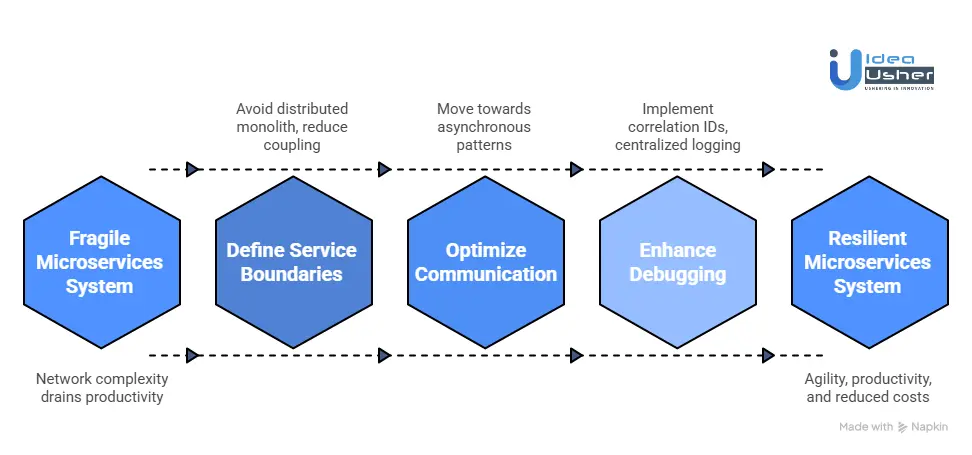
When the design is poor, the complexity of the network becomes a tax. This drains developer productivity and increases costs. Recognizing these red flags early is essential for maintaining the value of the technical asset.
1. Service Boundaries Creating Chaos
The most common failure is the creation of a distributed monolith. This happens when services are too tightly coupled. One cannot function or be deployed without the other. If your Order Service waits for the User Service to approve every minor step, you have not built microservices. You have just put a network cable in the middle of your old application.
Symptoms of Poor Boundaries:
- Chatty Services: Frequent and tiny requests between services that slow down the entire system.
- Shared Databases: Multiple services reaching into the same data tables, which causes record locks.
- Cyclic Dependencies: Service A depends on Service B, which depends on Service A, making updates a nightmare.
Poorly defined boundaries lead to cascading failures. A minor bug in a non-essential service can trigger a domino effect. This takes down the entire platform because the dependencies are too rigid.
2. Hidden Latency in Communication
In a monolith, components talk to each other in memory. This takes nanoseconds. In a microservices environment, every interaction happens over a network. This introduces network latency. If a single user request requires ten services to talk to each other in a chain, those milliseconds add up quickly.
| Interaction Type | Latency Impact | Resulting Risk |
| Sync Chains | High. Each service adds delay. | Slow page loads and frustrated users. |
| Large Payloads | Moderate. Heavy data transfers. | Increased cloud bandwidth costs. |
| No Caching | Very High. Repeated lookups. | Database exhaustion and timeout errors. |
High-performance platforms move toward asynchronous patterns. Instead of waiting for a response, a service sends a message and moves on. If your architecture relies solely on waiting for responses across the network, performance will inevitably degrade as the system scales.
3. Debugging Distributed Systems
The hardest part of a fragmented architecture is finding out what went wrong when a transaction fails. In a traditional app, you look at one log file. In a microservices system, a single click might involve six different services and three different databases. Without advanced tools, engineers spend hours playing detective.
Strategic Needs for Debugging:
- Correlation IDs: A unique tag that follows a request through every service it touches.
- Centralized Logging: One dashboard to view the health of all services simultaneously.
- Observability: Understanding internal health and performance in real time rather than just knowing if a service is up.
Without these investments, the cost of maintenance will skyrocket. Your team will spend more time investigating ghost bugs than building new features that drive business growth.
Best practices for implementing a microservice architecture
Following the best practices for implementing microservices can overcome the challenges in applying microservices architecture. Let’s check some best practices that you can implement at the time of software development:
1. Check how microservices architecture will fit your project
Before using a microservices architecture, it would be better for you to decide whether the architecture will suit your project or not. You can confirm by checking the application’s capability to subdivide into multiple independent services. If the applications’ components can be divided into multiple independent services, then you can implement the architecture of microservices on your development project. Also, ensure that you are choosing the right methodology for your project.
2. Design loosely coupled services
Designing loosely coupled services within microservices helps them to minimise their dependency on other services. Moreover, loosely coupled services will help you to scale each service independently. Independent scaling can help you to modify or make changes in each service without affecting the nearby services.
3. Use APIs and events for service communication
Make sure to use the API for efficient communication between the services. Moreover, the API will help you to make changes and improvements within the services. An API gateway provides an easy redirection for your traffic to the updated version of services within your application.
4. Use virtual machines
Providing a consistent development environment across all the systems can help the developers to avoid any unnecessary issues that can happen due to variations in performance within different systems. Therefore, it will be better for your development team to use a virtual machine for building applications in a microservices architecture.
5. Include a separate database
Using a separate database for each microservice helps you customise each microservice’s storage requirements. Moreover, a separate database will help you maintain each service independently in a microservices architecture.
6. Isolate each microservice
You must deploy services separately, which saves time during the coordination of multiple teams (at the time of maintaining and upgrading services). The independent deployment of each service can be done by using dedicated infrastructure for each service in a microservices architecture.
7. Use containers
Using containerized microservices can help you deploy services independently. Moreover, the container will also provide independence from a platform for each service, which helps you to achieve the primary goal of microservices architecture.
8. Use a centralized logging and monitoring system.
Centralised logging will help each microservice perform faster error handling and root cause analysis. Also, centralised monitoring helps improve the security within the microservices architecture for each component and helps monitor resource availability efficiently. Moreover, you can use the following tools to build microservices in an efficient way or you can hire expert developers for your project.
When Should You Choose Microservices?
Deciding to implement Microservice architectures is a major pivot for any organization. It is not a goal to be reached but a tool to be used when specific growth pains occur. Moving too early can bankrupt a startup with complexity, while moving too late can let competitors with faster release cycles dominate the market.
The ideal time to transition is when the limitations of your current system begin to hinder your business objectives. If your technology is no longer an asset but a bottleneck, it is time to reconsider your structure.
1. Signs Your Product is Ready
Technical signals usually appear before business ones. If your development team is frustrated and your deployment cycles are slowing down the system is likely outgrowing its monolithic roots.
Watch for these red flags:
- The Deployment Train: You have to wait for five other teams to finish their features before you can launch yours.
- The Fear of Change: Developers are afraid to touch certain parts of the code because they do not know what might break.
- Scaling Inequality: One specific feature, like an image processor, is costing a fortune to run because it forces the whole app to scale.
2. Best Business Scenarios
Certain business models are naturally suited for a decentralized approach. These models often involve high complexity and the need for constant updates across different departments.
- Multi-Tenant Platforms: SaaS products that serve different industries and require high customization for each client.
- Global Apps: Platforms that need to comply with different data laws and performance needs in different countries.
- Complex Ecosystems: Products that involve hardware and software integration, like smart home systems or industrial automation.
Decision Framework: If you are building a platform where different features evolve at different speeds, you need microservices. For example, a banking app might update its user interface every week but only update its core ledger once a year.
When They Are Unnecessary
Many companies waste millions of dollars on Microservice architectures they do not actually need. Complexity is a cost that must be justified by a significant return on agility.
| Factor | Stay Monolithic | Move to Microservices |
| Team Size | Under 10 developers. | Multiple autonomous teams. |
| User Base | Steady or predictable. | Massive and volatile spikes. |
| Market Stage | Validating an MVP. | Dominating a proven market. |
| System Complexity | Low to moderate. | High with many integrations. |
If you are a small team trying to find a market fit, stay monolithic. The overhead of managing service discovery and network communication will kill your speed. A well-structured monolith is much easier to manage until you hit the scale where the benefits of decentralization finally outweigh the costs.
How to Validate a Microservices Architecture Plan?
Success with Microservice architectures depends on preparation rather than just coding. A poor plan creates a distributed mess that is harder to manage than any monolith. You must treat your architecture as a financial strategy. Every service you create adds a layer of operational cost that must be justified by a specific business outcome.
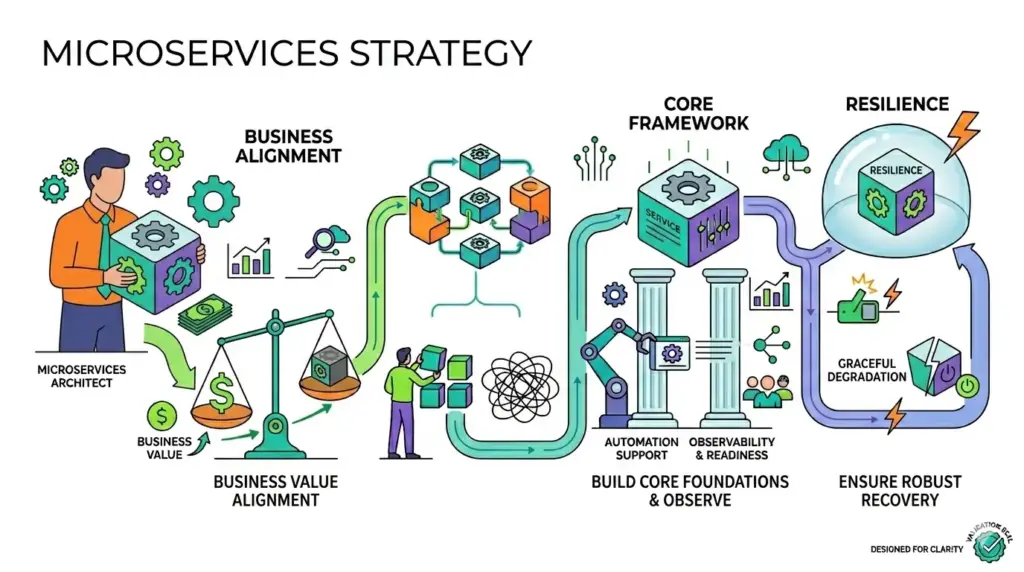
Validation ensures that you are not just following a trend. It confirms that your team can actually support the infrastructure you are about to build. Without this check, you risk spending your budget on technical overhead instead of product innovation.
1. Questions Before Development
Before writing the first line of code, your leadership and engineering teams must be in total agreement. If you cannot answer these questions clearly, your plan is likely premature.
- Can we define the business value for every service? Each unit should solve a specific market need.
- Do we have the automation to handle this? If you cannot deploy and test, you are not automatically ready for multiple services.
- How will we handle data integrity? You must have a strategy for when one service fails, but others succeed.
Risk Assessment: If your reason for moving to microservices is simply that your code is messy, you are making a mistake. Microservices do not fix bad code. They only make it harder to find. Fix the code first, then split the system.
2. Aligning Tech with Business Goals
Every technical decision must map back to a business objective. If the business needs to launch features in days, then a decentralized system makes sense. If the business needs to keep operational costs at an absolute minimum, then the monolith might be better.
The Alignment Check:
- Agility Goals: If the marketing team needs to run weekly experiments, the architecture must allow for independent deployments.
- Scalability Needs: If you expect a massive surge in users for a specific feature, ensure that the feature is its own isolated service.
- Team Structure: Your software should look like your organization. If you have three separate departments, they should probably own three separate services.
3. Avoiding Costly Redesigns
The most expensive mistake in software is having to rewrite your entire system two years after launch. You can avoid this by building with a modular mindset from day one. Even if you start with a monolith, ensure the boundaries are clean so they can be snapped apart later.
Strategies for Long-Term Success:
Avoid the trap of the nano-service. This happens when you break things down too small. Managing fifty tiny services for a simple app is a waste of resources. Focus on large business domains first.
Invest in observability early. You cannot fix what you cannot see. By setting up tracking and logging at the start you prevent the ghost bugs that lead to expensive emergency redesigns. Finally ensure your team is trained. The biggest hidden cost in this transition is the learning curve. A team that understands the network is a team that builds a resilient product.
How Companies Migrate to Microservices?
Migrating to Microservice architectures is like replacing the engines of an airplane while it is mid-flight. You cannot simply turn off your business for six months to rebuild from scratch. Instead, you must adopt a surgical approach that maintains service continuity while slowly dismantling the old system.
The goal is to move from a single, heavy core to a light, distributed network. This transition requires a shift in how your team handles data, testing, and deployment. Done right, the migration feels invisible to your users but revolutionary for your developers.
1. Breaking Down the Monolith
The best way to start is by identifying the most congested part of your application. You do not want to split the whole system at once. Instead, find a feature that is either too slow, too expensive, or changes too frequently.
The Extraction Logic:
- Identify the seams: Look for logical gaps in your code where one function rarely talks to another.
- Isolate the data: Move the specific data tables related to that feature into a new, private database.
- Redirect the traffic: Use an API gateway to send requests to the new service instead of the old monolith.
Pro Tip: Never start with your most critical service. Begin with a secondary feature like a notification engine or a PDF generator. This allows your team to practice the migration process with lower stakes.
2. Gradual vs Full Migration
There are two main schools of thought when it comes to the timeline of a migration. Most successful companies choose a gradual path to minimize risk.
- The Strangler Pattern: You slowly build new services around the edges of the monolith. Over time, the new services grow and the monolith shrinks until it finally disappears.
- The Big Bang: You rebuild the entire system in a separate environment and switch over all at once. This is extremely risky and usually only works for very small applications.
The Strangler Pattern is the gold standard for high-volume platforms. It allows you to deliver new business value during the migration rather than freezing all feature development for a total rewrite.
3. Tools for a Safe Transition
A safe transition relies on high-quality tooling and automated safety nets. Without these, you are just moving your problems from one server to many.
The Migration Toolbox:
- Service Mesh: A dedicated layer to handle service-to-service communication and security.
- Feature Flags: Toggles that allow you to turn the new service on for 1% of users to test stability before a full rollout.
- CI/CD Pipelines: Automated systems that test and deploy each service independently every time code is changed.
Modern cloud providers offer these tools as managed services. This lowers the barrier to entry for smaller companies. By using a combination of automated testing and gradual traffic shifting, you can move to Microservice architectures with zero downtime and total confidence.
Best tools for building microservices
Check out the top best tools you can use for building microservices on all levels.
A. API management & testing
- Sauce Labs
- Tyk
- Postman
B. Service monitoring
- Apache Kafka
- Google Cloud Pub/Sub
C. Component messaging
- Logstash
- Graylog
D. Orchestration
- Conduktor
E. Kube development
- Minikube
- Istio
- Kubernetes
- Telepresence
F. Programming language
- Spring Boot
- Elixir
G. ToolKits
- Seneca
- fabric8
- Google Cloud Functions
H. Architectural frameworks
- Kong
- Goa
I. Serverless tools
- Kubeless
- Apache Openwhisk
- Claudia
- Aws Lambda
- OpenFaas
- Microsoft Azure Functions
- Iron Functions
Also, you can check the top application development frameworks for your project.
Many developers use a monolithic architecture for software development. Monolithic architecture can resist system upgradability for adding and improving the components within the application. Adopting the microservices architecture can remove the resistance to system upgradeability.
Hidden Costs of Microservices You Must Know
Microservice architectures save money at scale but have a high entry price. Many teams forget the overhead required to manage a distributed system. You no longer pay for one server. You pay for an entire ecosystem.
These costs appear as monthly line items that spiral without discipline. You must manage them to keep the technical asset profitable.
1. Ignored Infrastructure Overhead
Splitting a monolith duplicates your environment. Each service needs its own container and load balancer.
The Price of Fragmentation:
- Redundant Resources: A monolith might use 8GB of RAM. Ten services might need 2GB each to boot. This totals 20GB.
- Database Licensing: Paying for ten small database instances is more expensive than one large one.
- Network Egress: Data moving between services costs money. Internal chatter can raise monthly data fees from $100 to $2,000.
2. DevOps and Monitoring Impact
Your DevOps team is an expensive asset. You cannot manage twenty services manually. You need complex automation.
Monthly Operational Estimates:
- Tooling: Logging and tracing tools like Datadog can cost $50 to $200 per host monthly.
- Specialized Talent: Engineers who manage Kubernetes clusters often earn 20% more than standard developers.
- Build Costs: Running ten different test pipelines adds hundreds of dollars to build server costs.
Investing in observability tools early prevents losing thousands in developer downtime. Your team needs to see the whole system to fix bugs quickly.
3. Cost and Performance Trade-offs
Speed in a monolith is free because calls happen in memory. In microservices, every millisecond requires better hardware or better networking.
| Priority | Technical Need | Cost Impact |
| Low Latency | High speed gRPC. | High. Requires experts. |
| Availability | Multiple regions. | Double or triple the bill. |
| Consistency | Transaction managers. | High CPU and slower speed. |
Microservices are a trade. You trade money for the ability to scale. For a small app making $5,000 a month, a $2,000 bill is a disaster. For a platform making $500,000 a month, that bill is a small price for 99.9% uptime.
Why replace monolithic architecture with microservice architecture?
Having dependent components in a monolithic architecture creates complexity in adding or improving features in monolithic applications. Therefore, Monolithic architecture limits the addition and improvement of applications’ components.
In monolithic architecture, all the components are coupled tightly to each other and run as single services. If any of the processors needs scaling, it is necessary to scale all the processors within the monolithic architecture. You can read the table below to compare both these architectures in detail.
| Monolithic Architecture | Microservice Architecture | |
| Basic | Built as a small independent service with a separate code base | Can be done quickly |
| Scalability | Not easy to scale | Easy to scale |
| Database | Shared database | Separate database |
| Deployment | Takes more time | Can be done fastly |
| Upgradability | Difficult to make changes | Easy to make changes |
Therefore, using the architecture of microservices instead of monolithic architecture excludes the limitations of improving and adding new application features. Let’s move to the blog conclusion.
Build vs Hire for Microservices Development
The choice between building an in-house team or hiring experts like IdeaUsher for microservice architectures is a decision between long term capability and immediate velocity. Both paths require a significant investment in specialized skills.
A monolith can often be managed by generalists. Microservices demand a deeper understanding of distributed networking and cloud infrastructure. Your choice should align with whether software is your primary product or a tool to support your business.
1. In-House Team vs External Experts
Maintaining an internal team offers the highest level of control and deep institutional knowledge. Your developers live and breathe your product every day. However, finding and keeping microservices talent is expensive and difficult.
In-House Considerations:
- Culture and Ownership: Internal teams have a stronger sense of long-term accountability for the system’s health.
- Knowledge Retention: The logic behind your service boundaries stays within your company.
- Hiring Difficulty: It can take three to six months to find a senior engineer with the right distributed systems experience.
External Expert Considerations:
- Immediate Seniority: You gain instant access to architects who have built and scaled dozens of systems before.
- Proven Frameworks: Agencies often bring pre-built deployment pipelines and monitoring templates.
- Resource Flexibility: You can scale the team up for a major migration and scale back down once the platform is stable.
2. Time to Market Comparison
Speed is often the deciding factor. If a competitor is gaining ground, you cannot afford a six-month recruiting cycle.
The Timeline Gap:
- In-House Setup: Requires months for recruiting, onboarding, and training on your specific tech stack.
- External Onboarding: A specialized agency can usually begin delivering code within two to four weeks.
- Execution Velocity: External experts move fast because they use established processes. Internal teams may move slower as they learn the nuances of service-to-service communication on the fly.
Strategic Note: Many successful companies use a hybrid model. They hire experts to build the core architecture and then transition the daily maintenance to a smaller in-house team.
3. Cost and Scalability Factors
The financial commitment for these two models follows very different patterns. You must look beyond just the hourly rate or the base salary.
The In-House Cost Model:
You carry the full weight of salaries, benefits, and taxes regardless of the workload. For a senior microservices developer in a major tech hub, this can exceed $250,000 per year. You also pay for the idle time between major feature launches.
The External Cost Model:
You pay a higher hourly rate, but the cost is project-based. You avoid the long-term overhead of healthcare, office space, and specialized tool licenses. In some regions, you can find high-tier talent for $60 to $120 per hour.
Long-Term Scalability:
If your roadmap involves constant expansion for years, building internal muscle is a strong investment. If you are modernizing a legacy system or launching an MVP, hiring IdeaUsher prevents you from being locked into a high permanent payroll before your product is proven in the market.
Contact Idea Usher to build a microservice app.
It can be better for you to divide your entire application into multiple independent services for making changes in your application without affecting its functionality. Converting the monolithic architecture into microservices for your application development can provide ease. Contact Idea Usher and hire expert developers if you want to implement microservice architecture in your application to make changes and improvements without disturbing its entire infrastructure.
Conclusion
Microservice architectures are a modern approach to software development where a single, large application is built as a suite of small, independent services. Each service runs its own unique process and communicates through lightweight protocols, typically an HTTP-based API. This structure allows individual components to be developed, deployed, and scaled without affecting the rest of the system, providing businesses with the agility to update specific features rapidly and maintain high system resilience.
FAQs
A1: A monolith is a single, unified software unit where all business logic is tightly coupled in one codebase and database. If one part fails, the entire system can crash. In contrast, microservices break the application into small, independent units that communicate via APIs. This modularity allows you to scale, update, and deploy specific features without impacting the rest of the platform, offering superior resilience and business agility.
A2: The initial development cost of microservices is typically higher due to the complexity of setting up infrastructure like API gateways, container orchestration, and automated pipelines. However, it offers a higher long-term return on investment. By enabling localized scaling and reducing technical debt, you avoid the massive costs and risks associated with overhauling an outdated monolith as your user base grows.
A3: Services interact through lightweight protocols, most commonly REST APIs or gRPC for immediate requests. To handle high volumes and ensure system stability, many platforms also use asynchronous messaging via brokers like RabbitMQ or Kafka. This allows services to emit events and trigger actions in other parts of the system without being forced to wait for a response, maintaining a fast and responsive user experience.
A4: A move to microservices is justified when a monolithic platform becomes a bottleneck for growth. If your engineering team is slowing down because of complex dependencies, or if you are overpaying for cloud resources to scale a single feature, it is time to transition. This architecture is designed for platforms that require high availability, global reach, and the ability to pivot or add features rapidly based on market feedback.