


If you are wondering how to make a crypto trading bot, then you have come to the right place. In this guide, we cover everything there is to know about a crypto bot. In the last couple of years, the use of cryptocurrencies has been authorized by several nations. Instead of fading out, crypto is being gradually accepted as an alternative form of currency. The features offered by blockchain technology make cryptocurrencies secure.
This, paired with their volatility, has resulted in people trading crypto daily. Before we learn how to build a crypto bot, let us discuss why crypto trading is getting so popular.
Why crypto trading bots are gaining serious traction
Crypto trading bots are no longer niche tools used by a small group of traders. They are becoming a core part of how both retail and institutional participants operate in the market. The shift is being driven by the need for speed, consistency, and the ability to handle continuous market activity.
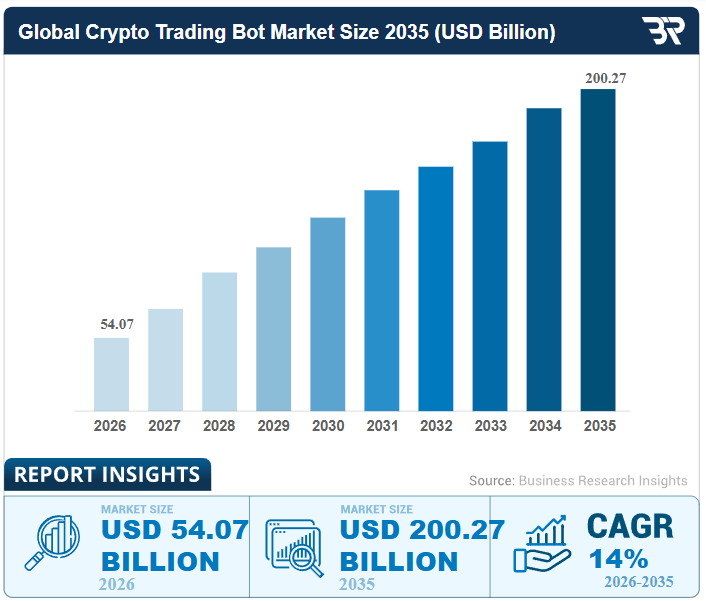
A major reason behind this growth is the increasing reliance on automation. Around 42% of traders already prefer using bots because they eliminate emotional decision making and execute trades with higher precision.At the same time, AI-driven trading is accelerating adoption even further. The AI crypto trading bot segment alone is expected to grow at a 37% CAGR, indicating rapid investment in intelligent automation systems.
Performance is another key driver. AI-powered trading systems can process market data up to 1000 times faster than manual traders, allowing them to capture short-lived opportunities that humans simply cannot react to in time.Institutional interest is also rising quickly. More than 60% of institutional investors are already exploring or using automated trading solutions, which shows that bots are moving beyond retail use cases into large-scale financial operations.
Another important factor is market structure. Crypto markets operate 24 by 7 with high volatility, making manual trading inefficient. Bots solve this by continuously monitoring price movements, executing trades instantly, and maintaining consistency regardless of market conditions.Taken together, these factors explain why crypto trading bots are becoming a foundational layer in modern trading infrastructure rather than just an optional tool.
How crypto trading bots actually work
Understanding how crypto trading bots function step by step makes it easier to design and build a reliable system.
Step 1: Connecting to exchange APIs
The bot connects to one or more crypto exchanges using API keys. These APIs allow the bot to fetch market data and execute trades without manual intervention. Permissions are restricted to ensure security.
Step 2: Collecting real-time market data
The system continuously pulls data such as price, volume, order book depth, and recent trades. This data acts as the input for all trading decisions and must be processed with minimal delay.
Step 3: Processing strategy logic
The bot applies predefined trading strategies to the incoming data. This can include indicators, price thresholds, or complex models that determine whether to buy, sell, or hold.
Step 4: Executing trades automatically
Once conditions are met, the bot sends orders to the exchange. Execution speed is critical, especially in volatile markets where price changes rapidly.
Step 5: Managing risk and positions
The bot continuously monitors open positions and applies risk controls such as stop loss, take profit, and position limits. This prevents large losses and stabilizes performance.
Step 6: Tracking performance and logs
All trades and actions are recorded for analysis. This helps in evaluating strategy performance and identifying areas for improvement.
Step 7: Continuous monitoring and optimization
The bot runs continuously and adapts based on market conditions or updated strategies. Regular monitoring ensures the system performs as expected in live environments.
Types of crypto trading bots you can build
Different bots serve different trading goals, and choosing the right type is critical before development begins.
Arbitrage bots
These bots exploit price differences across exchanges. They buy an asset on one exchange where the price is lower and sell it on another where the price is higher. Speed and execution latency are critical in this model.
Market making bots
Market making bots place buy and sell orders around the current price to profit from the spread. They provide liquidity and require careful inventory management to avoid losses.
Trend following bots
These bots analyze market trends using indicators and execute trades in the direction of the trend. They work best in markets with clear upward or downward momentum.
Grid trading bots
Grid bots place multiple buy and sell orders at predefined intervals. They profit from market volatility without needing to predict direction.
AI-driven trading bots
These bots use machine learning models to analyze historical data and predict future price movements. They require large datasets and continuous training to remain effective.
Step-by-step development process for a crypto bot
Step 1: Define strategy and trading logic
Start by defining what your bot is supposed to do. This includes selecting indicators, entry and exit conditions, position sizing, and risk parameters. A clear strategy is the foundation of the entire system.
Step 2: Choose exchanges and API integrations
Select the exchanges your bot will connect to and study their API limitations, rate limits, and order types. Build secure connections using API keys with restricted permissions.
Step 3: Design system architecture
Structure your system into modules such as data ingestion, strategy engine, execution engine, and analytics. A modular architecture makes it easier to scale and update individual components.
Step 4: Develop the trading engine
Build the core logic that processes market data and triggers trades. This engine must be optimized for speed and accuracy, especially in volatile market conditions.
Step 5: Implement risk management systems
Add safeguards such as stop loss, take profit, maximum drawdown limits, and position caps. Risk management is essential to prevent large losses during unexpected market movements.
Step 6: Backtest and simulate strategies
Test your bot using historical data to evaluate performance. Run simulations under different market conditions to identify weaknesses and refine your strategy.
Step 7: Deploy and monitor performance
Launch the bot in a controlled environment and monitor its performance closely. Use logs, alerts, and analytics to track behavior and make adjustments as needed.
Key features that make a crypto bot competitive
A successful crypto bot is not just about executing trades. It must provide reliability, transparency, and flexibility.
- Real-time market data processing
- Multi-exchange integration
- Strategy customization and configuration
- Automated risk management controls
- Performance analytics and reporting
- Secure API key handling
- Notification and alert systems
Technology stack required for crypto bot development
Choosing the right technology stack impacts performance and scalability. Backend development can be handled using Node.js or Python depending on the complexity of the strategy and data processing needs. Python is often preferred for AI and data-heavy applications.
Databases such as PostgreSQL or MongoDB are used to store trade history, logs, and analytics. For real-time data, in-memory databases like Redis can improve speed. Cloud platforms such as AWS or Google Cloud provide scalability and uptime. Containerization using Docker helps in managing deployments efficiently.
Cost to develop a crypto trading bot
The cost of building a crypto bot varies based on complexity and features.
Basic bot cost
A simple bot with one strategy and limited exchange integration can cost between 10000 to 25000 USD. This version focuses on core functionality without advanced analytics.
Advanced bot cost
A full-featured bot with multiple strategies, AI capabilities, and multi-exchange support can cost between 40000 to 120000 USD or more.
Cost breakdown sheet
| Component | Estimated Cost (USD) | Timeline |
|---|---|---|
| Strategy Development | 3000 – 8000 | 2 – 4 weeks |
| Backend Development | 8000 – 25000 | 4 – 8 weeks |
| API Integrations | 5000 – 15000 | 2 – 4 weeks |
| UI Dashboard | 5000 – 12000 | 3 – 6 weeks |
| Testing and QA | 3000 – 8000 | 2 – 4 weeks |
Challenges in crypto bot development
Building a crypto bot comes with several challenges that must be addressed early.
Market volatility can lead to unexpected losses if strategies are not robust. API limitations and downtime from exchanges can disrupt execution. Security risks such as API key leaks can result in financial loss.
Handling these challenges requires strong architecture, monitoring systems, and continuous improvement of strategies.
Why is crypto trading gaining traction?
Cryptocurrencies are volatile. In a matter of minutes, cryptocurrencies can jump double digits. Their dynamic nature has garnered the interest of both short and long-term investors from all over the world.
People who are involved in daily trading are sometimes able to profit enormously. Since cryptocurrencies sometimes change within a fraction of seconds, we humans have started using crypto trading bots to automate the process.
What exactly is a crypto trading bot, and how do crypto bots work?

If you are unfamiliar with cryptocurrency trading, you might have a question: What are trading bots? In layman terms, they are a set of programs that help you buy or sell cryptocurrencies according to your preferences. Here are some ways crypto bots can help you record more profits:
- Crypto bots can help with portfolio management
- Set profit and loss margins
- Analyze and interpret market statistics
- Calculate potential market risk
- Buy and sell cryptocurrency assets
Also Read: How to create a cryptocurrency?
Various cryptocurrency bot strategies
Not every crypto bot is the same. Although there are several types of crypto trading bots available on the internet, here are the most popular crypto bot trading strategies:
1. Trend trading
These crypto trading bots are the simplest of the lot. These bots directly respond to any changes in the market. Trend trading bots do not make use of any complex algorithms such as predictive analysis. It is useful when you want to implement stop-loss or take-profit to prevent losses or gain sweet profits.
2. Arbitrage bots
This model compares the difference in prices between various crypto exchanges in the world. Since every exchange has a slightly different crypto price, the arbitrage model makes use of the exploit. If you want to know how to build a crypto arbitrage bot, read on.
For example, if we compare South Korea and US-based crypto exchanges, we can see that South Korean exchanges offer significantly higher prices than their US counterparts. One can gain sizable profits by exploiting the price difference.
3. Coin lending bots
If you want to loan your crypto assets at certain interest rates with limited risk, coin lending bots can help you. They automate the entire process and help you record profits.
4. Market making bots
This bitcoin trading bot algorithm lets you buy and sell cryptocurrency in high volumes. The profit you get is from the difference between the buying and the selling price. If you want to trade high volumes, a cryptocurrency market making bot is your only friend.
Also Read: How to create a crypto wallet app?
Advantages of using a crypto bot
Why use a crypto bot in the first place, you might ask. The answer to the question lies in the stock market.
Here are some advantages trading bots offer over their human counterparts:
1. Preset goals
It is said that more than half of the investors lose profits due to a combination of factors, most of which include emotions and decisions made based on emotions. Crypto bots can help you set goals, thus eliminating human interaction.
This systematic approach will help you maximize profits since these bots will automatically execute actions once the goal is met.
2. Faster than humans
The cryptocurrency market is volatile. A cryptocurrency might shoot up by 25% in a matter of minutes and come crashing the minute after. Users might miss on those profits if they are doing it manually since it takes some time.
This is where trading crypto bots help the most. Once you start using trading bots to book profits, you will rarely miss out on profits. It is the reason why many people on Wall Street have resorted to using crypto bots for daily trading.
3. Back testing
If you use bots, you can perform paper trading and backtesting and make use of historical data to check if a pricing model or strategy is profitable or not. It doesn’t matter if you are a veteran or a beginner, everyone has something to gain from these simulators. When paired with backtesting, Prediction can help traders understand if the approach you want to use will help you book handsome profits.
4. Confined to predetermined trading rules
Panic is another reason why many people in the stock market lose money. For example, if the crypto you invest in crashes, you might panic and sell it without a second thought. Bots are immune to such rash decisions made by us humans.
If you pre-define rules for selling and buying, then bots will help you in the long term. It is beneficial in volatile markets like crypto trading.
Why using an open-source crypto bot a bad idea?
You can also develop a customized crypto bot by downloading and building on an open-source bot. The installation is relatively easy and requires little to no technical knowledge. You can probably make yourself a crypto bot alone, but it isn’t worth the risk.
You will need to develop features and the bot itself, which will prove to be quite tedious in the long run. Moreover, if you encounter any security issues or any bug fixes, you will need to hire a programmer to fix them for you. Moreover, since the bot is already built, you will find it harder to build unique features. All-in-all, while it might sound plausible, creating and using an existing open-source bot can prove to be painful in the long run.
Having said that, Gello and Zenbot are two examples of excellent open-sourced crypto trading bots.
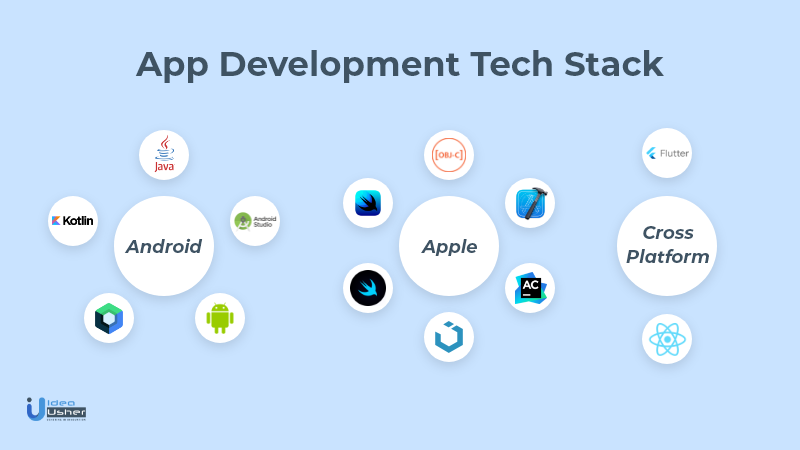
Tech Stack: Crypto trading bot
5. Determine the architecture of the crypto trading bot
The architecture will determine the success of your crypto bot. Make sure that the algorithm you are using for your bot has a solid foundation. Otherwise, you might lose some money. The process involves deciding what type of data you want your bot to work on. Some examples include historical trends, market analysis, and determining market inefficiencies.
6. Coding
Coding is undoubtedly the most crucial part of the process. Communicate with your development team and let them know your expectations and what technology you want to use. An experienced team of developers will help you with everything, right from the algorithmic complications to UI creation.
7. Testing
Once you are done with the coding part, make sure to test your bot before deploying it. The process involves two functions.
Make sure that your bot works as intended and does not falter or encounter any bugs. Test if your trading bot can handle complex data. The first stage involves evaluating ‘overfitting’ and ‘risk vs. reward function.’
Fine-tune the performance of your cryptocurrency bot. Optimize your bot by adjusting the parameters according to your preferences.
8. Deployment process
The final stage of making a crypto bot is deployment. An excellent mobile app development company provides support for some time, even after the app is released. This allows the business to migrate smoothly. Sometimes, enterprises encounter an error or a bug after the app is launched.
The deployment process helps fix any errors or bugs that might have crept in during the testing phases. It also helps the company understand the product better so they won’t encounter issues when taking charge of the maintenance process.
Also read: How to build a cryptocurrency exchange website?
How can Idea Usher help you build the best cryptocurrency bot?
Idea Usher focuses on building production-ready crypto bots that are designed for performance, security, and long-term scalability. Instead of using generic templates, the development process is aligned with your specific trading strategy, target users, and business model.
Strategy-first development approach
The process starts with defining and validating your trading strategy. Whether it is arbitrage, grid trading, or AI-based models, the system is designed around the logic that drives results. This ensures the bot is not just functional but aligned with real trading outcomes.
Robust and scalable architecture
The backend is built to handle real-time data processing, high-frequency execution, and multi-exchange integrations. This ensures the bot performs reliably even during high market volatility when execution speed matters the most.
Secure exchange and wallet integrations
Security is a critical part of crypto bot development. The system is designed with encrypted API handling, restricted permissions, and secure transaction flows to protect user funds and data.
Advanced risk management systems
The bot includes built-in controls such as stop loss, drawdown limits, and position sizing. These safeguards help minimize losses and maintain stable performance across different market conditions.
Custom dashboards and analytics
A complete crypto bot is not just about execution. Idea Usher builds dashboards that allow users to track performance, monitor trades, and adjust strategies in real time. This adds transparency and control to the system.
End-to-end development and scaling support
From initial planning to deployment and post-launch optimization, the entire lifecycle is handled with a focus on scalability. Whether you are building a single trading bot or a full SaaS platform, the system is designed to grow with your business.

Frequently Asked Questions
Is crypto bot trading legal?
The legality depends on the country and regulations governing crypto trading. In most regions, using trading bots is allowed as long as it complies with exchange and financial regulations.
Can crypto bots guarantee profits?
No trading bot can guarantee profits. Performance depends on strategy, market conditions, and risk management.
How much capital is needed to start?
The required capital depends on the strategy and risk tolerance. Some bots can operate with small amounts, while others require larger capital for meaningful returns.
Do crypto bots work in all market conditions?
Different bots perform differently in various market conditions. Some are designed for trending markets, while others perform better in sideways markets.