


Key Takeaways
- Stablecoin treasury platforms automate enterprise treasury operations with secure custody, real-time liquidity management and cross-border payments.
- Core capabilities include multi-chain wallet management, treasury automation, MPC security and ERP integrations.
- Real-time visibility, compliance automation and liquidity optimization help enterprises improve capital efficiency and financial control.
- Enterprise-grade governance, security and blockchain connectivity are essential for scalable digital treasury infrastructure.
- How Idea Usher can help you build stablecoin treasury management platform with treasury automation, institutional security and enterprise blockchain integrations.
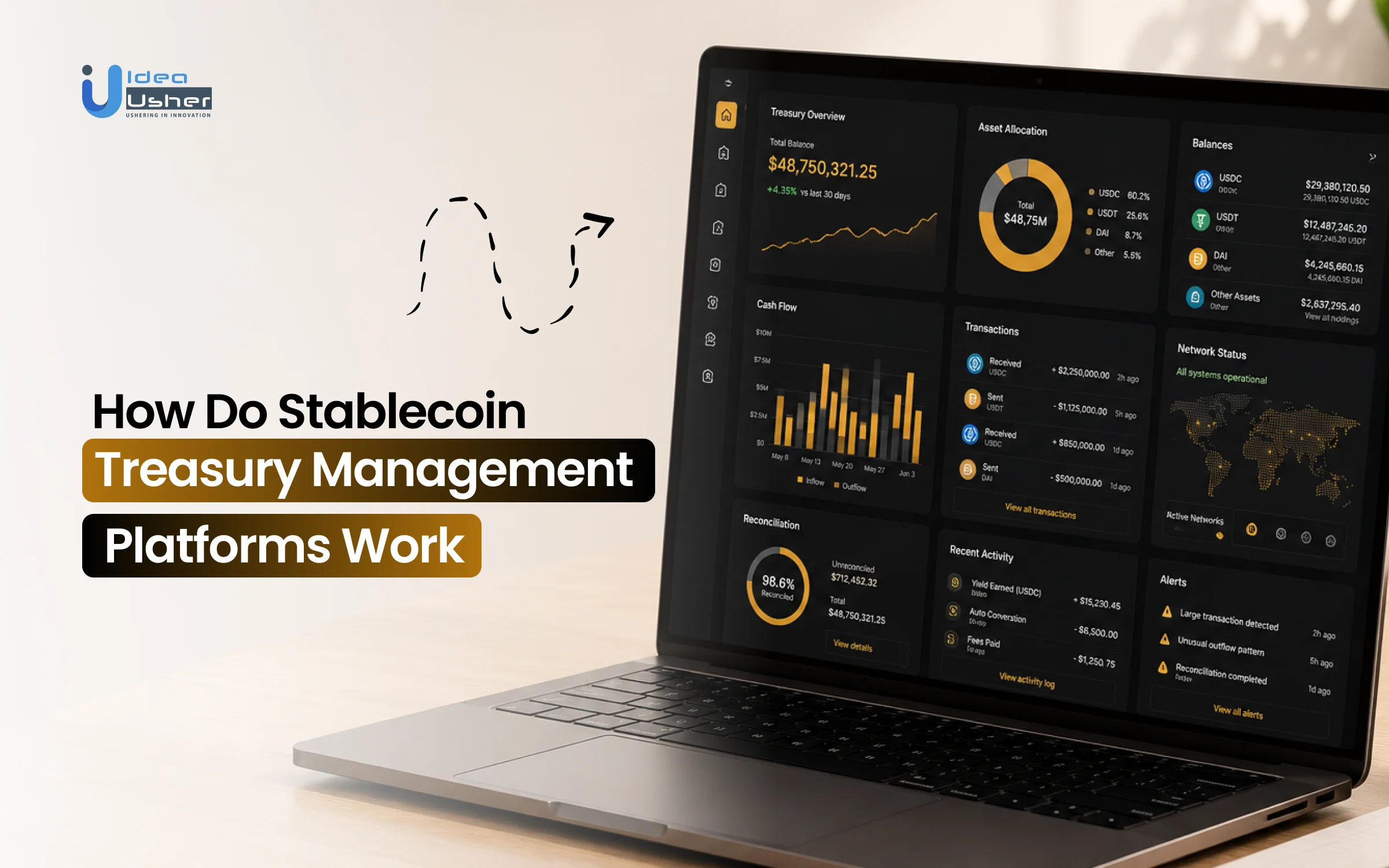
Treasury management is increasingly becoming a real-time capital allocation challenge rather than a back-office finance function. This shift is driving demand for stablecoin treasury management platforms as fintechs, exchanges and global enterprises adopt digital asset infrastructure to improve liquidity, automate treasury operations and manage capital across blockchain and traditional financial networks.
Traditional treasury systems relied on fragmented banking relationships, manual reconciliation, and delayed settlements that reduced visibility and capital efficiency. Today, organizations require multi-chain wallet management, MPC-based custody, treasury automation, liquidity optimization, policy-based governance, cross-border settlement, automated reconciliation, ERP integrations, real-time portfolio visibility, and institutional compliance to build programmable treasury infrastructure that improves control, liquidity, and operational efficiency.
In this blog, we’ll explore how stablecoin treasury management platforms work, covering core features, treasury architecture, automation workflows, security requirements, technology stack, and how IdeaUsher builds enterprise-grade stablecoin treasury management platform for blockchain-native treasury operations with automated, transparent, and optimized financial workflows.
Why Enterprises Are Replacing Traditional Treasury Systems
Corporate treasury management is shifting toward blockchain-native infrastructure. The global crypto and digital asset treasury management market was valued at $1.78 billion in 2026 and is projected to reach $12.34 billion by 2034, growing at a 27.6% CAGR.

This transition reflects changing treasury priorities. As real-time global commerce replaces traditional banking cycles, organizations are seeking greater liquidity, automation, and capital efficiency. 80% of enterprises have initiated or completed an ROI analysis for stablecoin treasury platforms, while 41% report 10%+ cost savings on outbound vendor payments after adoption.
Institutional confidence continues to grow, with 87% of finance executives believing on-chain treasury platforms provide a long-term competitive advantage. As a result, enterprises are replacing fragmented, paper-based treasury processes with automated, real-time treasury infrastructure.
A. The Operational Gaps in Legacy Treasury Infrastructure
Traditional Treasury Management Systems (TMS) were built around batch-based banking networks, manual reconciliation, and fixed operating hours, creating costly inefficiencies for global treasury operations.
- The Inflight Settlement Void: According to Financial Stability Board (FSB) data, only 50.6% of wholesale cross-border payments settle within one hour. Many remain delayed for 3–5 business days, tying up working capital.
- The Shared Intermediary Tax: Cross-border fiat transfers rely on multiple correspondent banks, adding an estimated $120 billion in annual deadweight costs through processing and intermediary fees.
- The Manual Audit Burnout: Because TMS, ERP, and banking systems remain disconnected, finance teams spend 15–19 hours per week on manual reconciliation, statement matching, and administrative data entry.
B. Why Stablecoins Are Becoming Treasury Assets
Stablecoins have evolved from trading instruments into strategic corporate treasury assets. Supported by the GENIUS Act, which introduced 1:1 reserve requirements, the global stablecoin market capitalization has reached $312 billion, accelerating enterprise adoption.
Corporate finance teams are shifting their cash management strategies toward dollar-pegged digital assets due to distinct structural advantages:
- Unprecedented B2B Payment Velocity: Business stablecoin payments grew 733% year over year, reaching $226 billion in annualized volume and accounting for 60% of utility-driven on-chain payment activity.
- Continuous Liquidity Access: Operating 24/7/365, stablecoin infrastructure removes banking cut-off times, enabling cross-border vendor settlements in minutes instead of days.
- The On-Chain Treasury Yield Engine: Yield-bearing stablecoins and tokenized real-world assets (RWAs) now exceed $20 billion, offering 3.5%–5% APY. Products like BlackRock’s BUIDL provide government-backed yield with T+0 redemption, replacing traditional T+1 settlement delays.
C. Businesses Driving Demand for Treasury Platforms
The intense corporate push for real-time liquidity tracking has created a massive wave of adoption across multiple high-velocity sectors. Organizations navigating cross-border supply chains or remote operations are aggressively replacing their standard banking setups with unified digital asset platforms.
Large-scale corporate finance and payment infrastructure analyses highlight the primary industry sectors driving this baseline demand:
| Industry Segment | Primary Operational Driver | Key Economic Metric |
| Multinational Enterprise B2B | Replaces high-cost international wire fees and correspondent bank FX markups with flat, automated software pipelines. | Brings overall cross-border transaction costs below 1.0%. |
| Cross-Border Marketplaces | Optimizes split-vendor cash flows; manages secure, digital automated escrow states across diverse regions simultaneously. | Saves up to 3.0% to 4.0% by bypassing traditional international credit card rails. |
| Regulated Fintechs & PSPs | Embeds programmatic, digital-dollar settlement wallets directly into local, user-facing electronic banking portals. | Achieves an average 95%+ phase processing accuracy over legacy networks. |
The Institutional Shift: Stablecoin treasury adoption is rapidly moving into the mainstream. 13% of enterprises and financial institutions already use stablecoins, while 54% of non-users expect to adopt them within a year. By consolidating fragmented banking workflows into an automated API-driven treasury layer, organizations transform idle capital into liquid, yield-generating assets operating 24/7.

What Is a Stablecoin Treasury Management Platform?
A Stablecoin Treasury Management Platform is an enterprise-grade platform that secures, manages, transfers, and reconciles USDC, USDT, and other stablecoin assets alongside traditional banking infrastructure.
Serving as a centralized treasury layer, it connects blockchain networks like Solana, Base, and Ethereum with ERP systems and multi-currency banking platforms. This enables finance teams to leverage 24/7 on-chain settlement while maintaining corporate accounting, compliance, and audit standards.
A. Core Purpose of a Treasury Management Platform
The primary objective of a stablecoin treasury platform is day-to-day capital optimization. It moves digital assets out of static storage and transforms them into active operational liquidity.
To understand its role in enterprise finance, it is important to distinguish a Stablecoin Treasury Management Platform from basic crypto wallets and custody solutions, as each serves a different purpose within the digital asset stack.

Instead of just holding funds, an enterprise platform automates high-volume mass disbursements, builds multi-chain routing pathways, and executes instant international vendor settlements. By providing a single dashboard for real-time visibility over globally distributed asset pools, it enables finance teams to maximize overnight yields on tokenized real-world assets (RWAs) and prevent the capital-drag associated with traditional multi-day banking settlement floats.
B. Stablecoin Treasury Platform vs. Wallet vs. Custodian Difference
Enterprises often confuse crypto wallets, custodians, and treasury platforms despite their distinct roles. The table below outlines the key differences across functionality, governance, compliance, integrations, and financial outcomes to simplify platform evaluation.
| Feature Dimension | Standard Crypto Wallet (e.g., MetaMask, Phantom) | Digital Asset Custodian (e.g., Fireblocks, BitGo) | Stablecoin Treasury Platform |
| Core Architecture Focus | Single-signature wallet for manual digital asset storage and transfers. | MPC and cold-storage infrastructure for institutional asset custody. | API-driven treasury engine for routing, liquidity management, and capital optimization. |
| User Governance & Controls | Seed phrase or private key provides full asset control. | Multi-user approvals and institutional custody controls. | Policy-based permissions, multi-signature approvals, transaction limits, and treasury governance. |
| Transactional Velocity | Fast manual transfers requiring user approval. | Security-first approvals with slower settlement workflows. | 24/7 automated payments, cross-border settlements, and high-volume treasury operations. |
| Accounting & ERP Integration | Manual exports for accounting and reconciliation. | Statement exports for reconciliation and audit reporting. | Native ERP integrations, webhooks, and real-time reconciliation. |
| Built-In Compliance | Manual wallet verification and transaction checks. | Institutional compliance monitoring and audit support. | Automated AML, KYC, sanctions screening, and policy enforcement. |
| Primary Financial Outcome | Retail asset management and Web3 transactions. | Secure institutional custody of digital assets. | Treasury automation, liquidity optimization, sub-1% B2B transfers, and yield generation. |
C. Where It Fits in Enterprise Finance Operations
A stablecoin treasury platform acts as an intelligent routing engine that connects corporate financial policies with digital asset networks. Partnerships like Kyriba’s integration with regulated platform Merge demonstrate that stablecoins are no longer managed through isolated tools but are increasingly embedded into core enterprise financial workflows.
The functional alignment across an enterprise infrastructure framework highlights this distinct positioning:
| Financial Capability | Traditional Treasury Systems (Legacy TMS / ERPs) | Stablecoin Treasury Management Platform | Direct Operational Impact |
| Operational Control Hub | Manual bank tokens, spreadsheet uploads, and localized banking portals. | Rule-based user roles, multi-sig approvals, and programmatic APIs. | 90% reduction in manual transfer errors and wire authorization backlogs. |
| Data & ERP Syncing | Static, end-of-day MT940 statement downloads with manual matching. | Continuous cryptographic ledger data streams flowing via real-time webhooks. | Eliminates accounting data re-entry, saving teams 15 to 19 hours per week. |
| Compliance Guardrails | Manual post-transaction compliance and internal legal audits. | Built-in, real-time automated AML, KYC, and address sanctions screening. | Flags high-risk addresses automatically before a transfer is executed. |
| Capital Yield Trajectory | Low-yield traditional cash accounts with T+1 or T+2 settlement friction. | Direct access to tokenized U.S. Treasuries with T+0 instant settlement. | Maximizes corporate working capital, generating secure 3.5% to 5.0% APY yields. |
The Structural Reality: A Stablecoin Treasury Management Platform integrates with existing financial systems through a specialized API layer rather than replacing them. This enables finance teams to execute 24/7 cross-border B2B payments while maintaining real-time visibility, compliance, and reconciliation within their existing corporate ledger.
How Do Stablecoin Treasury Management Platforms Work
Stablecoin Treasury Management Platforms bridge traditional corporate finance (TradFi) and decentralized finance (DeFi). They allow enterprises, institutions, and web3 startups to hold, manage, optimize, and deploy dollar-pegged digital assets (like USDC, USDT, or PYUSD) for everyday cash operations.
Instead of dealing with legacy banking hours, T+2 settlement windows, and steep wire fees, corporate treasuries use these specialized platforms to handle capital with 24/7 liquidity and instant settlement.
At a high level, these platforms combine institutional custody, treasury automation, banking integrations, compliance controls, and blockchain infrastructure into a unified operating system for enterprise finance. Here is a breakdown of how these platforms work under the hood.
1. Secure Infrastructure (The Core)
At the base level, these platforms replace a traditional corporate bank account with an institutional-grade digital wallet architecture. This architecture significantly reduces key management risks while giving enterprises institutional-grade protection for large digital asset holdings. They typically use one of two security models:
- Multi-Party Computation (MPC): Instead of a single private key that can be lost or stolen, the cryptographic key is split into multiple “shards” distributed among different parties (e.g., executives and the platform). Transactions are signed without the full key ever being assembled in one place.
- Multi-Signature (Multisig): Requires a predefined number of approvals (e.g., 3 out of 5 designated corporate officers) to authorize any outward movement of funds.
2. Smart Contract Automation & Programmability
Unlike fiat money sitting passively in a bank ledger, stablecoins are programmable tokenized assets. Treasury platforms leverage smart contracts to automate complex financial workflows that would otherwise require manual intervention and banking intermediaries:
- Liquidity Sweeping: Platforms can be configured to automatically “sweep” excess stablecoin balances from global subsidiaries into a centralized corporate treasury wallet at the end of every day.
- Milestone Payments: Payouts to international suppliers or contractors can be locked in a smart contract and released automatically once specific data conditions or milestones are met.
3. Fiat On/Off-Ramps
A treasury platform is only useful if it connects back to a company’s primary fiat operations. These platforms integrate with Over-The-Counter (OTC) desks, prime brokers, and banking partners to handle conversions:
- On-Ramp: A company sends USD or EUR via ACH/FedWire to the platform’s partner bank; the platform mints or buys the equivalent stablecoin and deposits it into the company’s digital wallet.
- Off-Ramp: When the company needs local currency for tax or operational costs, the platform burns or sells the stablecoins, sending fiat back to a traditional corporate bank account.
4. Yield Generation & Optimization
Idle cash in a standard corporate checking account often earns minimal interest. Stablecoin treasury platforms allow finance teams to securely deploy “dry powder” to generate yield through a couple of main avenues:
- Tokenized Real-World Assets (RWAs): Allocating stablecoins directly into tokenized U.S. Treasury bills or money market funds, allowing them to earn low-risk, yield-bearing interest entirely on-chain.
- Institutional DeFi Protocols: Connecting to regulated lending pools (like Aave or Compound) where institutions can lend out stablecoins to pre-vetted borrowers, earning dynamic APYs.
5. TradFi Integration (ERPs & Accounting)
For enterprises to adopt stablecoins, the activity must play nicely with legacy financial software. Modern platforms use API connectors to sync on-chain transaction data with Enterprise Resource Planning (ERP) systems like SAP, NetSuite, or Oracle, as well as standard Treasury Management Systems (TMS) like Kyriba. Every gas fee, token transfer, and yield payout is instantly converted into a clean line-item for automated reconciliation and accounting audits.
6. Compliance and Risk Controls
Because compliance is non-negotiable for enterprise finance, these platforms layer strict internal and external guardrails over blockchain transactions:
- Transaction Monitoring: Automatic screening of wallet addresses using tools like Chainlink or Elliptic to ensure funds are not interacting with sanctioned, high-risk, or fraudulent addresses (KYT—Know Your Transaction).
- Approval Hierarchies: Mirroring traditional corporate banking permissions (e.g., an analyst can initiate a $5,000 transaction, but anything over $50,000 requires CFO approval).
Core Components Behind the Platform Architecture
A stablecoin payments infrastructure platform consists of several interconnected components that ensure secure, compliant, and efficient payment operations. The table below highlights the core architectural components and explains how each contributes to payment processing, treasury management, liquidity optimization, and enterprise financial workflows.
| Core Component | Purpose Within the Platform |
| Multi-Chain Wallet Infrastructure | Enables businesses to securely manage stablecoin assets across multiple blockchain networks such as Ethereum, Solana, Base, Polygon, Arbitrum, and others from a unified interface. |
| MPC Custody and Key Management | Protects institutional funds using Multi-Party Computation (MPC), eliminating single points of failure while enabling enterprise-grade asset custody. |
| Treasury Automation Engine | Automates recurring treasury operations such as fund allocation, payment scheduling, liquidity transfers, approval workflows, and settlement execution based on predefined business rules. |
| Liquidity Orchestration Layer | Continuously monitors and reallocates stablecoin balances across wallets, exchanges, banking partners, and DeFi protocols to maintain optimal liquidity and capital efficiency. |
| Compliance and Risk Engine | Performs AML, KYC, KYT, sanctions screening, transaction monitoring, policy enforcement, and risk assessments to ensure every transaction meets regulatory requirements. |
| Banking and ERP Integration Layer | Connects the platform with enterprise banking systems, payment providers, Treasury Management Systems (TMS), and ERP solutions like SAP, Oracle, and NetSuite for automated reconciliation and financial reporting. |
| Analytics and Reporting Dashboard | Provides real-time visibility into treasury balances, cash flows, transaction history, yield performance, liquidity positions, and audit-ready reports through centralized dashboards and customizable analytics. |
Key Features of Stablecoin Treasury Management Platform
A Stablecoin Treasury Management Platform delivers far more than secure asset storage. It combines treasury automation, institutional security, payment infrastructure, compliance, and financial integrations into a unified ecosystem that enables businesses to efficiently manage, move, and optimize stablecoin reserves across global operations.
1. Unified Multi-Chain Asset Management
Unified multi-chain asset management enables organizations to manage stablecoin holdings across Ethereum, Solana, Base, Polygon, Arbitrum, Avalanche, and other blockchain networks from a single dashboard. It improves asset visibility, simplifies treasury operations, eliminates fragmented wallet management, and supports efficient cross-chain liquidity management.
2. Policy-Based Governance & Approval Workflows
Policy-based governance gives enterprises complete control over treasury operations through configurable approval workflows, role-based access controls (RBAC), spending limits, and transaction policies. It reduces operational risk, prevents unauthorized transfers, strengthens internal controls, and ensures treasury activities align with corporate governance requirements.
3. Cross-Border Stablecoin Payment Automation
Cross-border payment automation enables businesses to send supplier payments, payroll, and B2B settlements globally using stablecoins with near-instant settlement. Automated payment workflows reduce processing delays, lower transaction costs, improve operational efficiency, and support always-on international treasury operations without banking hour limitations.
4. Institutional Custody & MPC Wallet Security
Institutional custody protects enterprise digital assets through Multi-Party Computation (MPC), multi-signature authorization, and secure key management. These security mechanisms eliminate single points of failure, safeguard treasury reserves, strengthen transaction security, and provide institutional-grade protection required for large-value financial operations.
5. Automated Treasury & Liquidity Orchestration
Treasury and liquidity orchestration automates fund allocation, liquidity rebalancing, wallet sweeping, and capital deployment across banking partners, exchanges, and DeFi protocols. This improves capital efficiency, minimizes idle assets, maintains optimal liquidity, and supports data-driven treasury decision-making across multiple financial ecosystems.
6. Real-Time Portfolio & Treasury Visibility
Real-time portfolio visibility provides finance teams with centralized dashboards displaying wallet balances, treasury positions, transaction activity, liquidity status, and asset performance. Continuous monitoring enables faster financial decisions, improves operational transparency, and helps organizations proactively manage enterprise treasury operations.
7. Exchange, Custodian & DeFi Connectivity
Seamless connectivity with exchanges, custodians, OTC providers, and DeFi protocols allows enterprises to access liquidity, execute trades, deploy capital, and optimize treasury strategies from one platform. Integrated financial connectivity simplifies operations while expanding institutional access to digital asset markets.
8. Audit-Ready Reporting & Financial Reconciliation
Audit-ready reporting automatically records treasury activities, reconciles blockchain transactions, and generates accurate financial records for accounting and compliance. Comprehensive audit trails, reconciliation tools, and standardized reporting simplify financial reviews while improving transparency across enterprise treasury operations.
9. ERP, Banking & API Integrations
Enterprise integrations connect the treasury platform with ERP systems, banking infrastructure, Treasury Management Systems (TMS), accounting software, and business applications via secure APIs. Automated data synchronization removes manual reconciliation, streamlines workflows, and keeps treasury operations aligned with existing enterprise systems.
What Does It Cost to Build a Stablecoin Treasury Management Platform?
The cost of building a Stablecoin Treasury Management Platform depends on security architecture, blockchain integrations, automation capabilities, compliance requirements, and enterprise connectivity. Instead of fixed estimates, businesses should assess costs based on development phases, platform scope, and feature complexity.
A. Estimated Development Cost by Project Phase
The following table outlines key development phases involved in building a stablecoin treasury management platform, along with their scope and estimated costs to help businesses understand investment distribution across stages.
| Development Phase | Estimated Cost (MVP → Enterprise | What This Phase Covers |
| Discovery & Planning | $5,000–$15,000 | Business requirement analysis, treasury workflow mapping, stakeholder alignment, feasibility assessment, compliance considerations, and project roadmap. |
| Solution Architecture & Technical Design | $8,000–$25,000 | System architecture design, blockchain selection, custody model planning (MPC/multisig), API structure, data flow design, and infrastructure planning. |
| UI/UX Design | $7,000–$20,000 | Dashboard design, treasury interfaces, wallet management screens, reporting layouts, user journeys, and responsive enterprise-grade UI design. |
| Backend & Core Platform Development | $25,000–$150,000 | Treasury engine, wallet orchestration, payment automation, liquidity management, governance modules, APIs, and backend services. |
| Blockchain & Custody Integration | $15,000–$120,000 | Multi-chain connectivity, MPC or multisig wallet integration, transaction signing, smart contract integration, and blockchain interaction layers. |
| Compliance & Enterprise Integrations | $10,000–$100,000 | AML/KYC/KYT integrations, sanctions screening, ERP and banking integrations, exchange connectivity, audit logging, and reconciliation systems. |
| Testing, Security Audits & Deployment | $10,000–$70,000 | Functional testing, performance testing, security audits, vulnerability assessments, cloud deployment, monitoring setup, and go-live support. |
| Total Estimated Cost | $80,000–$600,000+ | Combined cost across all development phases based on MVP to enterprise-level scope and complexity. |
Note: Estimated total development cost varies widely based on platform complexity, security requirements, integrations, and compliance needs. Businesses should assess scope carefully to determine accurate investment and long-term scalability requirements.
B. Estimated Cost by Platform Scope
Development costs vary based on platform capabilities, security requirements, and integration complexity. The following table outlines estimated investment ranges across different platform scopes to help businesses plan budgets effectively.
| Platform Scope | Estimated Cost | Typical Capabilities |
| MVP Platform | $80,000–$150,000 | Multi-chain wallet management, secure custody, basic payment automation, approval workflows, dashboard, and essential reporting. |
| Mid-Market Platform | $150,000–$300,000 | Advanced treasury automation, liquidity management, ERP integration, compliance modules, exchange connectivity, and analytics dashboards. |
| Enterprise Platform | $300,000–$600,000+ | End-to-end treasury infrastructure with MPC custody, multi-chain support, banking integrations, policy engine, global payment automation, institutional compliance, advanced reporting, and API ecosystem. |
Note: These estimates are indicative and may vary based on vendor expertise, geographic location, customization needs, and evolving regulatory requirements. A detailed technical assessment is recommended before finalizing project budgets and timelines.
C. Factors That Influence Development Cost
The overall investment varies based on the platform’s architecture, regulatory requirements, security standards, integration complexity, and operational scale. The following factors have the greatest impact on development effort, implementation timelines, and overall project cost.
- Security Architecture (MPC, Multisig & HSM): Implementing MPC, multisig, and HSM-based key management adds $20,000–$60,000 due to advanced cryptography, secure key storage, and transaction authorization.
- Blockchain Network Support: Supporting additional blockchains increases development costs by $10,000–$30,000 per network for integrations, node management, transaction processing, and protocol compatibility.
- Treasury Automation & Workflow Complexity: Custom approval workflows, fund allocation, automated payments, and rule engines add $15,000–$40,000, depending on workflow complexity and role-based controls.
- AML, KYC, KYT & Sanctions Integrations: Compliance integrations typically cost $10,000–$35,000, covering third-party APIs, real-time monitoring, and regulatory reporting.
- ERP, Banking & Accounting Integrations: Connecting ERP systems, banks, and accounting software adds $15,000–$50,000 for custom connectors, data mapping, and automated reconciliation.
Challenges in Building a Stablecoin Treasury Management Platform
Building a Stablecoin Treasury Management Platform requires more than blockchain expertise. Developers must balance institutional security, seamless financial integrations, and regulatory compliance while ensuring the platform remains scalable, reliable, and capable of supporting high-value treasury operations across multiple blockchain ecosystems.
1. Institutional Digital Asset Security
Challenge: Designing a custody system that protects high-value treasury assets while preventing single points of failure, unauthorized access, and private key compromise across distributed enterprise environments.
Solution: Our developers implement institutional-grade MPC and multisignature custody architectures, encrypted key management, role-based access controls, and comprehensive security audits to protect digital assets while ensuring secure, policy-driven transaction authorization.
2. Integration of Financial and Blockchain Systems
Challenge: Connecting blockchain networks, banking infrastructure, ERP systems, exchanges, custodians, and payment providers into one reliable treasury platform without creating operational silos or inconsistent financial data.
Solution: We build API-first integration layers with standardized data mapping, secure middleware, automated synchronization, and resilient workflows that ensure seamless communication between blockchain infrastructure and existing enterprise financial systems.
3. Enterprise Compliance Across Jurisdictions
Challenge: Maintaining compliance with evolving AML, KYC, KYT, sanctions screening, audit, and financial reporting requirements across multiple countries without slowing treasury operations or increasing manual workload.
Solution: Our developers integrate automated compliance engines, real-time transaction monitoring, audit-ready reporting, configurable governance policies, and regulatory APIs that help enterprises satisfy compliance requirements while maintaining efficient treasury operations.
Leading Stablecoin Treasury Management Platforms
As stablecoin adoption grows, businesses need reliable platforms to manage digital asset treasuries efficiently. The following stablecoin treasury management platforms provide secure custody, liquidity management, treasury automation, compliance tools, and operational controls that help organizations streamline stablecoin treasury operations.
1. Fireblocks

Fireblocks provides enterprise-grade stablecoin treasury infrastructure with MPC (Multi-Party Computation) wallets, automated treasury workflows, and policy-based governance. It enables secure custody, liquidity management, cross-chain transfers, and institutional connectivity while integrating compliance controls for managing stablecoin reserves across multiple blockchain networks.
2. BVNK

BVNK offers a unified platform for managing fiat and stablecoin treasuries. It supports treasury automation, multi-currency accounts, liquidity management, instant stablecoin settlement, and regulated fiat on/off ramps. With wallet infrastructure and real-time reconciliation, businesses can optimize cash flow and streamline global treasury operations.
3. Bridge.xyz

Bridge.xyz delivers API-first stablecoin treasury infrastructure connecting traditional finance with blockchain networks. Businesses can automate treasury funding, manage stablecoin balances, perform fiat-to-stablecoin conversions, and streamline cross-border settlements through programmable financial workflows and automated treasury reconciliation.
4. Circle Mint

Circle Mint is an enterprise treasury platform for USDC issuance and redemption. Organizations can mint or redeem USDC, manage corporate stablecoin reserves, and move liquidity between fiat and digital assets. Its reserve-backed model and regulatory compliance support secure treasury management and efficient capital deployment.
5. Sesame Vault

Sesame Vault helps stablecoin issuers manage treasury reserves, governance, and compliance. It provides reserve visibility, treasury dashboards, automated reporting, risk monitoring, and reconciliation tools, enabling transparent, secure, and compliant treasury operations.
Why Choose Idea Usher for Stablecoin Treasury Management Platform
With 11+ years of experience, 250+ specialized developers, 1,000+ delivered projects across 50+ countries, and a 4.9/5 Clutch rating, IdeaUsher builds enterprise-grade blockchain and digital asset platforms tailored to complex financial ecosystems.
We engineer custom stablecoin treasury management platforms with real-time proof-of-reserves, cross-chain treasury automation, yield optimization, and Multi-Party Computation (MPC) security. Our solutions integrate seamlessly with enterprise financial systems to deliver secure, scalable, and compliant treasury operations.
Why Enterprises Partner With Us
Corporate networks and fintech innovators choose us to deploy corporate treasury infrastructure because we turn complex multi-chain liquidity routing into secure, automated balance sheets.
- Dynamic Yield Optimization Routers: We build automated treasury layers that allocate idle stablecoin balances to tokenized U.S. Treasuries and trusted DeFi protocols, maximizing yield while maintaining controlled risk.
- Automated Real-Time Proof of Reserves: We develop on-chain monitoring systems that connect with banks and custodians, delivering continuous proof-of-reserves and transparent asset verification.
- Multi-Signature Corporate Governance Controls: We implement multi-signature approval workflows and role-based permissions to secure high-value treasury transactions and prevent unauthorized fund movements.
- Multi-Chain Asset Aggregation Hubs: We build unified treasury dashboards that monitor, bridge, and consolidate stablecoin assets across Layer-1 and Layer-2 blockchains, providing a single view of enterprise liquidity.
Ready to maximize your corporate capital with a secure, automated stablecoin treasury management platform? Partner with IdeaUsher’s principal blockchain and financial architects to map out your product build today.
Conclusion
Stablecoin Treasury Management Platforms are becoming an essential part of modern enterprise finance by combining secure custody, treasury automation, liquidity management, compliance, and cross-border payments into a unified ecosystem. As organizations increasingly adopt stablecoins for global financial operations, choosing the right platform architecture becomes critical for long-term scalability and security. At IdeaUsher, our blockchain and fintech experts help businesses design enterprise-grade treasury platforms tailored to their operational goals, compliance requirements, and future growth, ensuring a secure, scalable, and efficient digital treasury infrastructure.
FAQs
A.1. Fintech companies, payment providers, crypto exchanges, Web3 businesses, global enterprises, and treasury-intensive organizations benefit from these platforms by streamlining digital asset management, cross-border payments, liquidity optimization, and institutional treasury operations.
A.2. Essential features include multi-chain wallet management, MPC custody, treasury automation, liquidity management, policy-based approvals, compliance monitoring, cross-border payment automation, ERP integrations, audit-ready reporting, and real-time treasury visibility.
A.3. The development cost typically ranges from $80,000 to $600,000+, depending on platform scope, security architecture, blockchain integrations, compliance requirements, treasury automation capabilities, enterprise integrations, and the level of customization required.
A.4. Yes. Modern platforms support multiple blockchain networks, enabling businesses to manage stablecoins across ecosystems from one dashboard while improving liquidity management, operational flexibility, and cross-chain treasury visibility.


