


Key Takeaways
- Patients can spread medical costs into affordable installments through healthcare financing apps like Scratchpay, while providers receive faster payments.
- Flexible payment solutions offered by healthcare financing apps like Scratchpay help patients afford treatment while improving provider cash flow.
- By enabling healthcare financing apps like Scratchpay, patients can access affordable installment plans, and providers can receive payments more quickly.
- Patients gain easier access to care through healthcare financing apps like Scratchpay, which offer flexible installments and faster provider payouts.
- How Idea Usher can help businesses build apps like Scratchpay with secure fintech architecture, compliance-ready systems, healthcare integrations, and end-to-end product development.
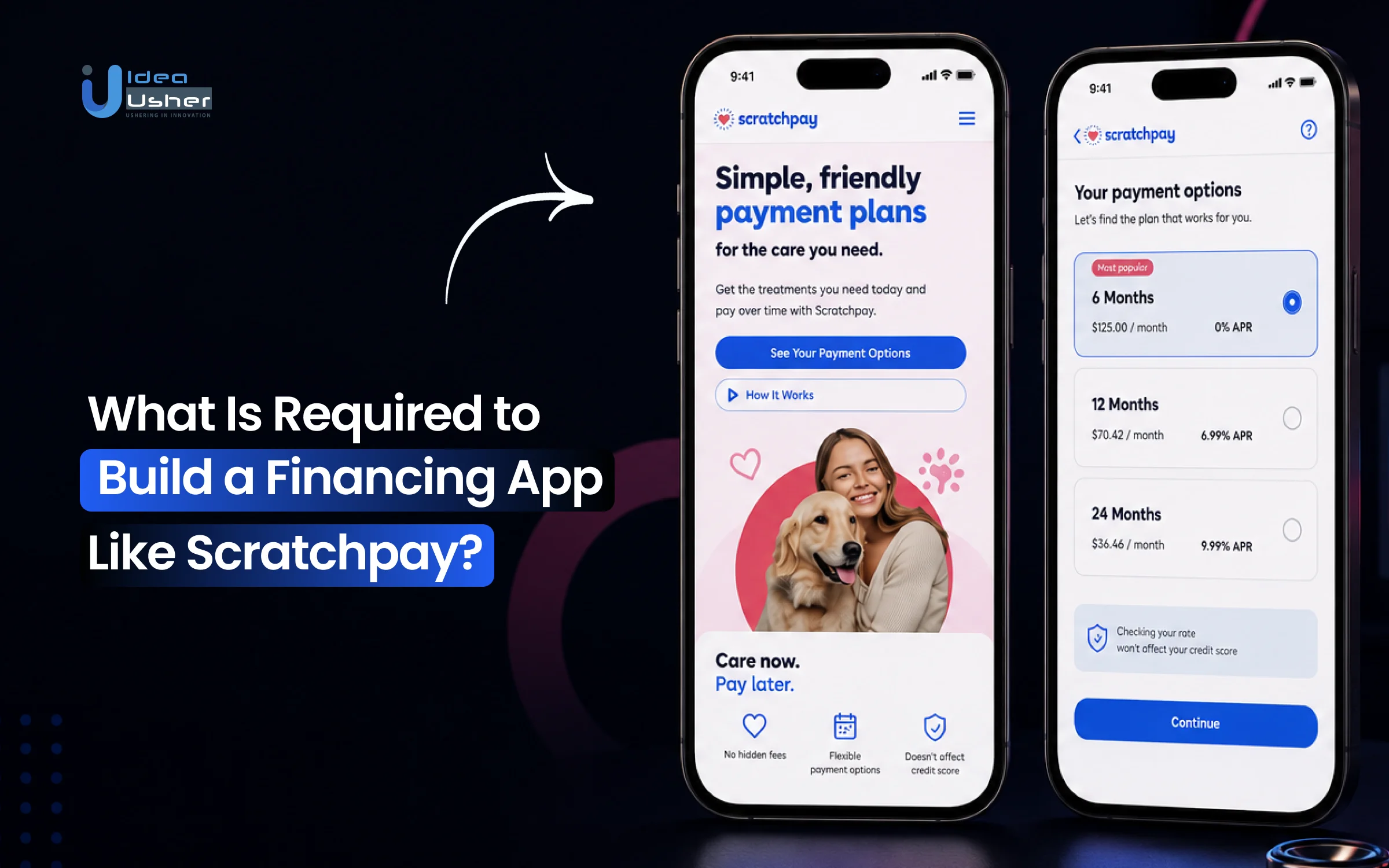
As healthcare costs continue to rise, more patients are looking for providers that offer flexible payment options instead of asking for the full amount upfront. This is one of the biggest reasons financing apps like Scratchpay have become so popular. They help patients get the care they need without putting treatment on hold because of immediate costs, while providers benefit from faster payments and fewer missed opportunities. If you’re planning to build a similar platform, success depends on much more than offering installment plans. You’ll need a reliable financing system that delivers quick approvals, protects sensitive health and financial data, and creates a payment experience that feels simple, secure, and trustworthy.
We’ve built several healthcare financing solutions powered by AI-driven underwriting engines and secure payment orchestration systems that simplify medical payments for both patients and healthcare providers. Drawing on this experience, we’re writing this blog to explain what it takes to build a financing app like Scratchpay, including the key features, technologies, and development considerations behind a successful platform.
Market Demand for Healthcare Financing Apps
According to Databridge Market Research, the global healthcare finance solutions market was valued at USD 141.19 billion in 2025 and is expected to reach USD 269.17 billion by 2033, growing at a CAGR of 8.40%. This growth reflects a simple reality: healthcare has become more expensive, and many patients need flexible payment options to afford treatment. Instead of postponing care, they are turning to financing platforms that spread costs over time. For businesses, this creates a strong opportunity to build solutions that improve access to healthcare while meeting a rapidly growing market demand.

Source: Databridge Market Research
BNPL Transformed Patient Payments
Buy Now, Pay Later models have moved far beyond retail. They are now reshaping clinical operations. Medical practices across various specialties face a common challenge: patients walking away from recommended treatment plans due to sticker shock. By integrating point-of-sale financing, providers can close these deals immediately.
This model is seeing rapid adoption across diverse healthcare sectors:
- Dental and Cosmetic Practices: High-value elective procedures that are rarely covered by traditional insurance.
- Veterinary Clinics: Unexpected emergency care where pet owners need immediate liquidity.
- Specialty Medical Centers: Outpatient surgeries and diagnostic testing that carry heavy upfront costs.
Platforms like Cherry have capitalized on this shift by focusing specifically on the medical and aesthetic space, offering fast point-of-sale approvals without hard credit checks. Deploying a similar BNPL infrastructure tailored for healthcare allows new platforms to capture transaction fees while providing critical liquidity to clinics. The risk is managed through sophisticated underwriting, while the reward is a sticky, high-volume ecosystem of merchants and patients.
Better Revenue for Providers
Healthcare providers are businesses that suffer from severe cash flow inefficiencies. Traditional medical billing is plagued by delayed insurance payouts, complex paperwork, and the administrative nightmare of chasing patient bad debt. Doctors want to focus on medicine, not collections. Investing in a financing platform solves these core operational pain points for the provider.
| Provider Pain Point | Platform Solution | Business Impact |
| Delayed Cash Flow | Immediate Upfront Payouts | Improved Working Capital |
| Treatment Refusals | Flexible Monthly Installments | Higher Case Acceptance |
| Collection Overhead | Automated Billing & Underwriting | Lower Administrative Costs |

What Problem Does Scratchpay Solve?
Scratchpay is a specialized point-of-sale financing platform built to bridge the financial gap between healthcare providers and patients who need immediate medical care. Operating heavily within the veterinary and dental sectors, the company functions as a Care Now, Pay Later ecosystem. It removes the friction of upfront payments by offering structured, transparent installment plans at the point of care.
The platform has demonstrated significant financial scale, generating over $12 million in annual recurring revenue. Investors have backed its specialized risk-modeling and underwriting capabilities with more than $108 million in total funding. This includes a prominent $35 million Series C round led by Norwest Venture Partners, alongside backing from the pet-care focused Companion Fund. The platform solves a fundamental problem: aligning patient affordability with provider cash flow needs.
High Upfront Costs Delay Care
Many patients struggle to pay large medical bills when unexpected treatments arise, often delaying care because of the upfront cost. Scratchpay addresses this problem by allowing patients to split expenses into manageable bi-weekly or monthly payments, with options for interest-free short-term plans or longer-term financing. This makes healthcare more affordable, helps patients receive treatment without delay, and gives providers a better chance of converting treatment recommendations into completed procedures.
Legacy Financing Lacks Speed
Many patients need treatment immediately but do not have enough money to pay the full cost upfront. Traditional financing options are often slow, expensive, or difficult to qualify for, making them a poor fit for medical situations. This is why modern healthcare financing platforms focus on fast approvals, simple applications, and flexible payment plans that help patients receive care without unnecessary delays.
Scratchpay fundamentally changes the application experience through a streamlined, digital-first approach:
- Soft Credit Checks Only: Patients can check their eligibility in seconds without hurting their credit profile.
- Higher Approval Metrics: By using risk data tailored specifically to the animal health and medical industries, the platform approves a wider range of borrowers than traditional banks.
- Instant Point-of-Sale Decisions: Approvals happen on a mobile device or desktop within moments, allowing care to proceed immediately.
Better Cash Flow for Clinics
Healthcare and veterinary practices operate on tight business margins. When patients cannot afford treatment plans, clinics lose revenue and experience lower case acceptance rates. Chasing unpaid medical bills creates a massive administrative burden, requires dedicated collection staff, and frequently results in uncollectible bad debt.
| Clinic Financial Pain Point | Scratchpay Platform Solution |
| Low Treatment Acceptance Rates | Point-of-sale financing choices increase patient conversions |
| Delayed or Missing Cash Flow | The platform pays the clinic upfront via direct deposit |
| Administrative Collection Costs | Scratchpay manages all billing, collections, and credit risks |
Scratchpay’s Patient Financing Process
The user experience of a healthcare financing app determines its market adoption. Scratchpay has optimized this flow to eliminate point-of-sale friction, allowing patients to transition from application to treatment authorization in less than two minutes. By designing a digital-first pathway, the platform maximizes application completion rates and drives consistent transaction volume.

Apply Online for Instant Eligibility
The patient onboarding experience begins with a simple digital form accessible via a smartphone, tablet, or clinic desktop. Patients input basic personal and income information to initiate a real-time underwriting check. Because the system runs a soft credit inquiry, users can check their lending options without damaging their credit score.
This frictionless entry point removes the anxiety typically associated with medical credit applications. Behind this rapid decision engine lies a highly scalable risk infrastructure funded by substantial capital investments, including Scratchpay’s massive Series C equity round. This financial backing allows the platform to process millions of dollars in loan volume through automated risk modeling.
Choose a Plan and Receive Care
Once the system approves the applicant, it presents a transparent menu of personalized repayment options. The borrower can compare different structures side by side to find a plan that aligns with their monthly cash flow. After the patient selects their preferred plan, the platform handles the backend logistics automatically:
- Digital Sign-off: The borrower signs the loan agreement electronically within the app interface.
- Direct Provider Payout: Scratchpay deposits the full treatment amount directly into the healthcare provider’s bank account.
- Immediate Treatment: With payment guaranteed, the clinic schedules and performs the medical or veterinary procedure without delay.
Repay Through Flexible Installments
Borrowers manage their active loans through a dedicated mobile app or online dashboard. Payments are scheduled automatically according to the chosen terms, helping to reduce manual management and lower default rates. This flexible repayment structure sustains Scratchpay’s financial ecosystem, contributing heavily to its multi-million dollar annual recurring revenue.
| Plan Type | Interest Structure | Ideal For |
| Take 5 | 0% APR split into 5 payments | Small, predictable medical or dental bills |
| Take 12 | 0% APR promotions available | Mid-tier treatments and emergency vet care |
| Extended Plans | Interest-bearing up to 24+ months | Major surgeries and complex medical procedures |
Key Features of a Healthcare Financing App Like Scratchpay
Building a platform that mirrors Scratchpay requires a feature set that balances patient convenience with enterprise-grade utility for medical providers. The entire ecosystem must function as a synchronized, digital-first experience. By analyzing Scratchpay’s specific features, investors can understand the core software infrastructure required to build a highly competitive and valuable fintech product.

1. Instant Eligibility Check
Scratchpay keeps the financing process fast and simple by letting patients check their eligibility through a short online application that takes only a few minutes to complete. The platform uses a soft credit check, so users can explore their financing options without affecting their credit score.
Behind the scenes, Scratchpay’s automated underwriting system quickly evaluates applications and provides near-instant decisions, creating a smooth experience that keeps patients moving forward with their treatment instead of getting stuck in paperwork.
2. Flexible Payment Plan Selection
Once approved, Scratchpay users navigate a clear, transparent menu of personalized payment structures. The platform presents multiple options ranging from short-term interest-free structures to longer amortizing loans. Patients select the specific balance of APR and monthly installment that matches their personal cash flow.
- Take 5: A popular Scratchpay option splitting smaller bills into five bi-weekly installments at 0% APR.
- Standard Installments: Fixed interest-bearing terms extending from 12 to 24 months for larger procedures.
- Promotional Plans: Fixed interest-free periods that defer interest charges if the principal is paid off early.
This flexibility drives Scratchpay’s transaction volume. By accommodating different risk profiles and budgets, the app captures a wide demographic of borrowers, helping push Scratchpay’s annual recurring revenue past the $12 million mark.
3. Digital Application & Approval
Scratchpay completes the entire financing process in less than two minutes, allowing patients to apply, receive a decision, and sign their agreement directly from a smartphone or tablet. Everything happens digitally, so there is no paperwork or lengthy approval process. This fast, seamless experience reduces delays at the clinic and helps patients move ahead with treatment as easily as completing an online checkout. .
4. Provider Payment & Settlement
For healthcare clinics, the core value of Scratchpay lies in its automated backend settlement engine. The moment a user approves their chosen payment plan, Scratchpay initiates an electronic fund transfer directly to the medical or veterinary practice.This immediate liquidity system is a primary reason why thousands of practices integrate Scratchpay.
| Transaction Stage | Patient Experience | Provider Benefit |
| Loan Activation | Confirms plan selection in app | Receives instant confirmation |
| Funding Settlement | Commences treatment immediately | Direct deposit initiated within 24-48 hours |
| Long-Term Cycle | Repays Scratchpay over time | Zero exposure to patient non-payment risk |
The clinic gets paid upfront, while Scratchpay takes on the default risk. This seamless capital allocation infrastructure is backed by Scratchpay’s $108 million in total funding, providing the necessary balance sheet strength to fund high volumes of upfront provider payouts.
5. Loan Management Dashboard
After securing care, the Scratchpay user relies on a centralized borrower dashboard to oversee their financial obligations. This interface provides real-time transparency into the active loan lifecycle, minimizing support tickets and improving the user experience. Through this dashboard, patients can easily check:
- Remaining principal balances and active repayment schedules.
- Historical payment statements and downloadable tax documents.
- Projected interest savings from potential early payoffs.
6. Autopay & Reminders
To maintain low default rates and protect its loan portfolio, Scratchpay integrates automated repayment features directly into the consumer application. Users can enroll in one-click autopay during the initial setup, allowing the system to securely deduct scheduled monthly installments from a linked bank account or debit card.
The app also utilizes smart notification loops:
- Predictive SMS Alerts: Notifying the user days before an upcoming deduction to prevent overdrafts.
- Push Notifications: Alerting users to promotional deadlines, such as the end of a 0% interest window.
- Early Repayment Paths: Allowing borrowers to pay off balances early via the app with zero prepayment penalties.
These automated touchpoints ensure high repayment rates, which keeps the platform’s portfolio healthy and drives predictable operational cash flow.
7. Healthcare Provider Partner Portal
Scratchpay also offers a dedicated portal for healthcare providers and veterinary clinics to manage patient financing in one place. Clinics can send financing links, track approvals, monitor payouts, and view reports that show how financing affects treatment acceptance. By giving providers better visibility into patient payments and business performance, Scratchpay becomes more than a payment solution. It becomes a valuable operational tool that supports everyday clinic management.
How to Build a Financing App Like Scratchpay?
Scratchpay has demonstrated the growing demand for point-of-sale healthcare financing by making medical payments more accessible for patients and providers. At IdeaUsher, we help businesses build similar healthcare financing apps with secure payment infrastructure, automated lending workflows, and scalable architectures.
1. Validate Market and Define Niche
Launching a financing platform begins with finding a specific, underserved market. Trying to cover all of healthcare at once dilutes your marketing focus and complicates your initial underwriting models. Scratchpay succeeded because it initially focused almost entirely on veterinary clinics, where out-of-pocket costs are high, and insurance adoption is low. When we partner with entrepreneurs, we help analyze the unique dynamics of specific medical verticals:
- High-Value Elective Care: Cosmetic surgery, fertility treatments, and premium dental procedures.
- Emergency Medical Fields: Urgent veterinary medicine and outpatient surgical centers.
- Chronic and Long-Term Care: Physical therapy, chiropractic networks, and audiology.
2. Design Secure Financing Journey
A simple application experience is one of the biggest factors behind higher approval and completion rates. We design mobile-first financing journeys that let patients check their eligibility quickly through a soft credit check without affecting their credit score. By keeping every step clear and easy to follow, we help reduce drop-offs, improve user confidence, and create a smoother experience for both patients and healthcare providers. e.
3. Build Core Platform Modules
A complete point-of-sale lending platform requires two distinct interfaces working together in real time. We build dedicated, secure modules for both the consumer and the business partner to ensure smooth operations. Our engineering team builds these modules to handle complex data streams simultaneously.
| Platform Module | Core Functionality | System Benefit |
| Patient Dashboard | Loan tracking, digital sign-off, payment portal | High engagement and low friction |
| Provider Portal | Application generation, settlement tracking, analytics | B2B loyalty and consistent use |
| Admin Panel | Portfolio management, underwriting control, risk settings | Complete operational oversight |
4. Integrate Essential Lending APIs
The speed of a financing app depends on its underlying API integrations. We connect your application to top-tier financial service providers to automate onboarding, risk assessment, and capital distribution. Our team implements reliable third-party integrations to handle the heavy lifting:
- Identity Verification: Connecting to KYC and AML APIs to instantly verify user identities and prevent fraud.
- Credit Analysis: Integrating with credit bureaus to perform fast, automated soft credit checks.
- Payment Processing: Linking with robust gateways like Stripe or Plaid to manage direct deposits to clinics and automate monthly customer autopays.
These automated connection loops reduce the need for manual review teams. This operational efficiency is key to scaling a credit platform, helping specialized fintech apps grow their recurring revenue rapidly.
5. Implement Strict Data Security
Healthcare financial technology requires strict adherence to security laws. Because your platform handles both medical data and financial applications, security must be built directly into the foundation of your software architecture. We build platforms using a security-first approach:
- Data Protection: Implementing advanced encryption for all personal data, both while sitting on servers and while moving through APIs.
- Regulatory Readiness: Creating frameworks that align with HIPAA requirements to protect patient privacy.
- Financial Compliance: Following PCI DSS standards for secure payment card processing and building audit logs for regulatory reviews.
6. Launch MVP and Use Analytics
A successful healthcare financing platform does not need every advanced feature on day one. We help founders launch focused MVPs with the core lending capabilities required to start serving patients and providers quickly. After launch, we analyze real user behavior and platform performance to identify the features that deliver the greatest impact, allowing your product to scale based on data instead of assumptions.
7. Scale with AI and Automation
As your application gains traction and processes more transaction history, we help you implement machine learning and automation to protect your portfolio margins. We integrate specialized AI models to make your platform smarter over time:
- Custom Risk Analysis: Using historical platform loan performance to optimize credit decisions and safely expand approvals.
- Smart Collections: Utilizing predictive models to anticipate potential missed payments and trigger automated reminders.
- Fraud Prevention: Deploying machine learning to catch unusual application behavior and block identity theft.
Cost to Build a Healthcare Financing App Like Scratchpay
Developing a point-of-sale medical lending app requires carefully balancing initial capital deployment with system security. Industry leader At IdeaUsher, we guide entrepreneurs through the financial and technical planning phases of software creation. Understanding your development costs helps you allocate capital efficiently to build a highly scalable fintech asset.
MVP Cost for a Healthcare Financing App
An MVP is the fastest way to validate a healthcare financing platform before investing in a full-featured product. Instead of building every advanced capability at once, founders can focus on the core experience, including patient onboarding, eligibility checks, financing approvals, provider payouts, and simple dashboards. This approach reduces development costs while providing valuable feedback from real users.
An enterprise-grade MVP for a financing app like Scratchpay typically costs between $45,000 and $85,000. With a functional product in place, businesses can validate their lending model, demonstrate market demand, and build confidence among investors and financial partners before expanding the platform with more advanced features.
Factors That Influence Development Cost
The final cost of building your platform depends heavily on your feature roadmap, regional regulatory needs, and automated infrastructure requirements. Moving from a basic lending tool to an automated fintech application changes your development timeline and engineering budget. Several critical components drive the overall development budget:
- Security and Compliance: Storing health data requires built-in HIPAA compliance, while managing credit card transactions requires rigid PCI DSS data architecture.
- Automated Risk Scoring: Replacing manual credit reviews with automated AI risk engines that predict default rates increases development complexity but lowers long-term overhead.
- API Integrations: Connecting third-party tools for instant identity verification, bank account linking, and credit bureau reporting requires specialized custom backend development.
The geographic location of your software development team also impacts your budget. Working with onshore developers in North America often costs $150 to $250 per hour. Partnering with our experienced offshore engineering teams allows you to secure identical, enterprise-grade software quality at a highly optimized rate of $35 to $75 per hour.
Cost Breakdown by Development Stage
To help you plan your capital allocation, we break down the budget across the primary phases of the software development lifecycle. A successful launch requires assigning dedicated resources to discovery, architecture design, security engineering, and post-launch maintenance.
| Development Phase | Key Deliverables | Estimated Cost Range |
| Product Discovery & Architecture | Technical blueprints, API mapping, compliance planning | $5,000 – $10,000 |
| UI/UX Design | Mobile-first wireframes, clickable patient & provider prototypes | $7,000 – $12,000 |
| Backend & API Engineering | Underwriting engine, core ledger, banking API connections | $20,000 – $35,000 |
| Frontend App Development | Responsive web apps for patients, providers, and admins | $15,000 – $25,000 |
| Security & Compliance | Data encryption, HIPAA safeguards, PCI DSS controls | $8,000 – $15,000 |
| QA Testing & Deployment | Automated security testing, vulnerability audits, cloud launch | $5,000 – $10,000 |
| Total Estimated Budget | Ready-for-Market Financing Platform | $60,000 – $117,000 |
Beyond the initial launch, you should budget 15% to 20% of your initial development cost annually for cloud infrastructure, security updates, and software updates.
Why Investors Are Backing Healthcare Fintech Startups?
Healthcare financing continues to attract investors because the need for flexible medical payments is growing every year. As patients take on a larger share of healthcare costs, financing platforms help make treatment more affordable while ensuring providers receive timely payments. This combination of strong consumer demand and a recurring business model makes medical point-of-sale lending an appealing long-term investment opportunity.
Funding Rounds Validate Market
A wave of massive institutional capital injections and credit facilities has firmly validated the healthcare point-of-sale lending model. These financial milestones prove that top-tier investors see immense scalability and strong portfolio health in specialized medical underwriting engines. Recent market activity highlights this strong institutional confidence:
PayZen:
Scaled its AI-driven patient billing software by securing a $32 million Series B equity round alongside a massive $200 million credit warehouse facility. This financial depth helps support its operational expansion, pushing its estimated annual revenue run rate into the $50 million to $100 million range.
PatientFi:
Closed a pivotal Series C funding round to expand its footprint across elective healthcare sectors like plastics, fertility, and ophthalmology. The company has raised $114 million to date, allowing it to sustain an impressive annual revenue run rate of approximately $140 million.
iCreditWorks:
Raised a $60 million capital round led by Comvest Partners and Barings to expand its Platform-as-a-Service model. The business has achieved an annual revenue tier of over $380 million by delivering instant digital dental loans at the point of care.
These numbers demonstrate that healthcare fintech handles billions of dollars in transaction volume. This volume makes it highly attractive to debt partners and equity investors alike.
Build a Healthcare Financing App Like Scratchpay with Idea Usher
Developing a point-of-sale medical lending platform is highly strategic for investors. With over 500,000 hours of coding experience, our team of ex-MAANG/FAANG developers at IdeaUsher translates complex financial logic into highly secure software assets. We build enterprise systems engineered to process medical transactions safely.

Build a Secure, Compliant Platform
Medical financial applications require rigid security. Because your software handles protected health data and credit details, compliance must be engineered into its foundation. IdeaUsher designs secure architectures to safeguard data while supporting your scaling goals. A resilient lending platform relies on three core pillars:
- Frictionless Onboarding: Mobile web forms that gather applicant data and execute instant identity checks via automated APIs.
- Clinic Portals: Simple interfaces for staff to send payment links, verify approvals, and monitor upfront direct deposits.
- Admin Dashboards: Enterprise tools to manage loan portfolios, tweak underwriting models, and audit compliance metrics.
Launch Faster with Deep Expertise
Navigating financial and medical software laws can cause expensive timeline overruns. Building blindly without industry expertise leads to security flaws and integration bottlenecks. IdeaUsher combines proven fintech components with specialized medical engineering to accelerate your market launch. Our execution framework minimizes development risks:
- Technical Discovery: Mapping out compliance paths, database architecture, and required API integrations prior to development.
- Focused MVP Construction: Engineering the critical transaction loop first, to test the market early.
- Verified API Connections: Integrating secure KYC, credit reporting bureaus, and direct banking pipelines to keep point-of-sale operations fast.
Scale with AI and Automation
Once your core application is validated in active clinics, advanced automation will maximize your operating margins. IdeaUsher integrates machine learning tools to transform your standard payment app into an intelligent financial engine. Machine learning models evaluate risk profiles in seconds, cutting down on manual review costs and preventing identity fraud.
| Scale Component | System Automation | Business Advantage |
| AI Underwriting | Non-traditional risk profiling | Maximizes approval rates safely |
| System Integration | Direct Electronic Health Record links | Locks in deep clinical B2B loyalty |
| Automated Loops | Predictive text alerts & smart autopay | Lowers internal collection overhead |
Conclusion
A successful app like Scratchpay brings together digital lending, secure payment processing, automated approvals, and an intuitive user experience in a single platform. Beyond the technology, success depends on building a solution that patients can use with confidence and that healthcare providers can easily integrate into their daily workflows.
Things to Know About Healthcare Financing Apps
A1: Healthcare financing apps help patients split medical, dental, veterinary, or elective treatment costs into affordable monthly installments instead of paying the full amount upfront. Users complete a short digital application, receive a financing decision within minutes, and choose a repayment plan that fits their budget. Once approved, the financing provider pays the healthcare provider directly, while the patient repays the loan over time.
A2: Many healthcare financing platforms allow users to check their eligibility through a soft credit inquiry, which does not impact their credit score. If a user accepts a financing offer, some lenders may perform a hard credit inquiry depending on the financing product and lending partner. Most platforms also provide transparent repayment terms and monthly payment schedules before users commit.
A3: Healthcare financing apps support a wide range of services, including dental procedures, cosmetic treatments, fertility care, vision correction, veterinary services, behavioral health, and elective surgeries. Many platforms also integrate directly with clinics and hospitals, allowing patients to apply for financing at the point of care.
A4: Healthcare providers receive payment soon after financing is approved, reducing collection efforts and improving cash flow. Flexible payment options also increase treatment acceptance because patients are more likely to proceed with recommended care when affordable installment plans are available.


