

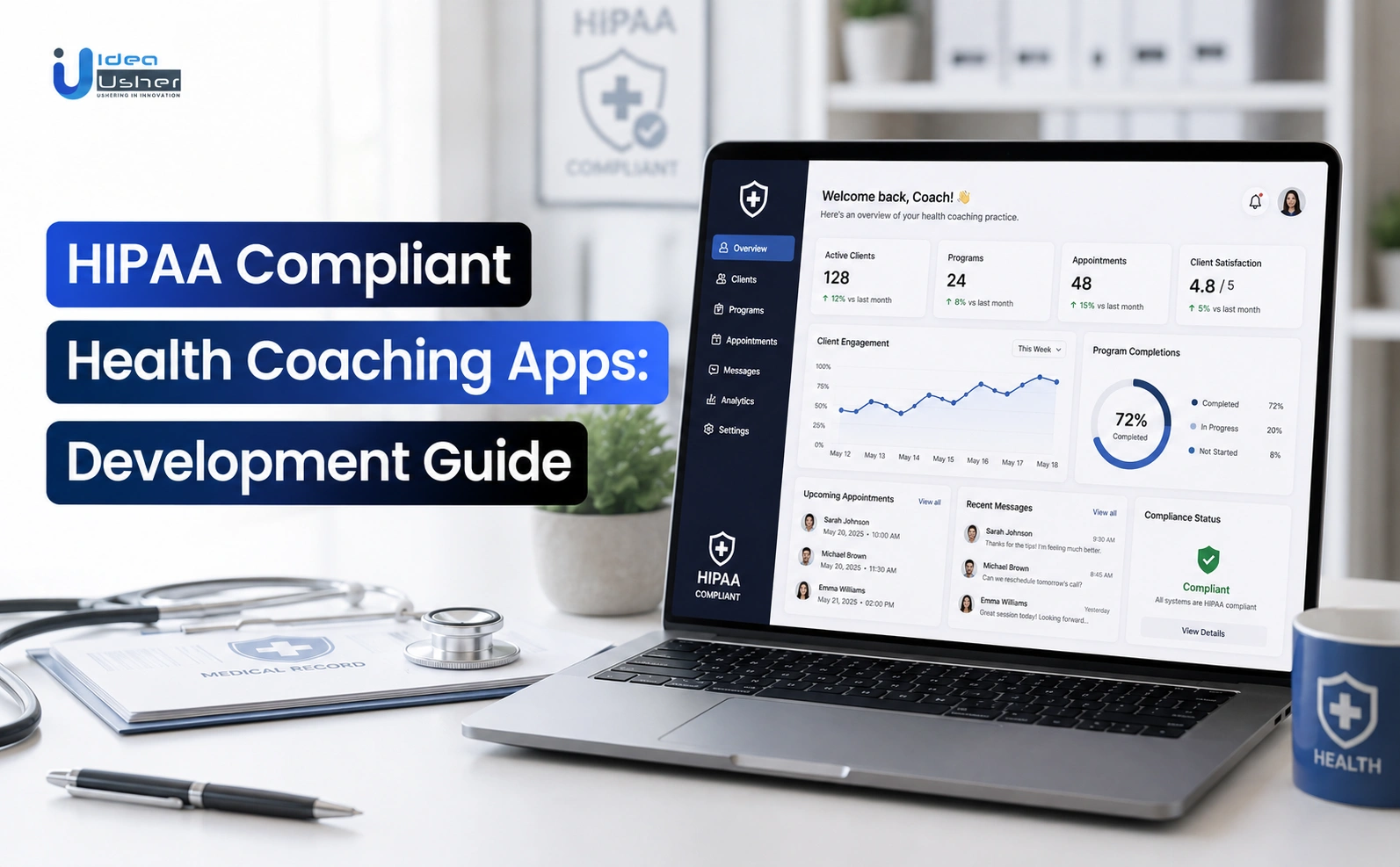
Key Takeaways
- HIPAA compliant health coaching apps combine personalized wellness support with secure handling of sensitive health information.
- Core features include secure messaging, health assessments, goal tracking and virtual coaching sessions.
- Strong compliance requires encryption, audit logs, access controls and Business Associate Agreements (BAAs).
- Healthcare providers adopt these platforms to improve preventive care, patient engagement and chronic disease management.
- How IdeaUsher can help you build HIPAA compliant health coaching apps with secure architecture, AI capabilities and healthcare-grade integrations.
Healthcare is moving beyond episodic care toward continuous engagement, where patients expect guidance, accountability and support between clinical visits. This shift is accelerating demand for HIPAA compliant health coaching apps that can deliver personalized wellness experiences while protecting sensitive health information and meeting strict regulatory requirements.
Traditional health coaching solutions often relied on manual communication, disconnected tools and limited visibility into patient progress. Modern users expect real-time coaching, personalized wellness plans, behavioral insights, secure messaging, wearable integrations and continuous health tracking within a single digital experience. At the same time, healthcare providers and wellness organizations must ensure every interaction, data exchange and recommendation complies with privacy and security standards.
In this blog, we will talk about core features, compliance requirements, security considerations, development costs and how Idea Usher can help you build your HIPAA compliant health coaching apps, with a secure digital health ecosystem where engagement, personalization and compliance work together seamlessly.
What Is a HIPAA Compliant Health Coaching App?
A HIPAA compliant health coaching app is a specialized digital platform designed to provide lifestyle, nutrition, or behavioral coaching while strictly adhering to the security and privacy regulations of the Health Insurance Portability and Accountability Act (HIPAA).
Unlike standard fitness trackers, these applications feature robust technical infrastructure, data encryption, and access controls. This ensures that any individually identifiable health data shared between a client and their coach remains strictly confidential and protected against data breaches.
A. Understanding Digital Health Coaching Platforms
Digital health coaching platforms are transforming how individuals manage wellness, chronic conditions, and lifestyle goals. Understanding their role, regulatory requirements, and real-world applications is essential for businesses building healthcare-focused digital solutions.
1. Health Coaching vs Telehealth vs Wellness Apps
While these three categories frequently overlap in functionality, they serve completely different roles within the digital ecosystem and carry distinct regulatory burdens:
| Feature / Criteria | Wellness Apps | Telehealth Platforms | Health Coaching Apps |
| Primary Focus | General health tracking, fitness, calorie counting, and meditation. | Remote medical diagnosis, clinical treatment, and prescriptions. | Behavioral changes, lifestyle adjustment, nutrition, and habit tracking. |
| Target Audience | Direct-to-consumer (general public). | Patients requiring clinical care from licensed professionals. | Individuals looking for structured guidance to bridge wellness and clinical care. |
| Typical Users | Everyday consumers managing personal fitness goals. | Licensed clinical professionals (doctors, psychologists, physical therapists). | Certified health coaches, nutritionists, or care managers. |
| HIPAA Jurisdiction | Generally Exempt. Users voluntarily input data outside of a medical directive or insurance plan. | Strictly Mandated. They function as fundamental medical infrastructure. | Conditional. Exempt if used independently for general wellness; mandatory if integrated into a clinical care plan or used by providers. |
Key Takeaway: The line between an unregulated wellness tool and a strictly regulated healthcare platform depends entirely on intent and integration. The moment a tool connects to a clinical care plan or a healthcare provider’s ecosystem, it crosses into HIPAA territory.
2. Common Use Cases Across Healthcare and Wellness Sectors
Digital health coaching platforms are highly versatile and are regularly deployed across multiple sectors:
- Chronic Disease Management: Helping patients manage conditions like Type 2 diabetes, hypertension, or obesity through daily dietary guidance and lifestyle adjustment.
- Post-Operative Recovery: Assisting patients transitioning from hospital care to home environments by tracking physical activity and adherence to recovery protocols.
- Corporate Wellness Programs: Providing enterprise-level coaching to employees to improve overall mental and physical health, reducing corporate healthcare insurance premiums.
- Specialized Nutritional/Fitness Programs: Offering professional guidance from certified nutritionists or sports coaches who work alongside a client’s clinical team.
B. Why Health Coaching Apps Handle Protected Health Information (PHI)
Many digital health coaching apps inadvertently or intentionally handle Protected Health Information (PHI) which is any individually identifiable health data linked to a person’s identity. If an app collects, stores, or transmits any of the following data points within a healthcare context, that data is legally classified as electronic PHI (ePHI):
- Health Assessments: Digital onboarding questionnaires, metabolic profiles, lifestyle risk evaluations, and subjective symptom logs.
- Goal Tracking: Specific targeted metrics such as biometric data (blood pressure, fasting blood glucose levels, heart rate variations) and weight management milestones.
- Medical History Inputs: User-submitted records regarding past diagnoses, current prescription medications, known allergies, and inherited familial health risks.
- Progress Monitoring: Ongoing logs tracking daily caloric intake, physical therapy exercise completion, and sleep cycles when linked to a clinical treatment plan.
- Communication between Coaches and Users: Direct chat messages, voice notes, video consultation recordings, and shared files containing personalized medical advice or progress updates.
C. How HIPAA Applies to Health Coaching Applications
Determining whether a health coaching app must legally comply with HIPAA depends entirely on who is providing the service and how the data flows, rather than the technology itself.
1. Covered Entities
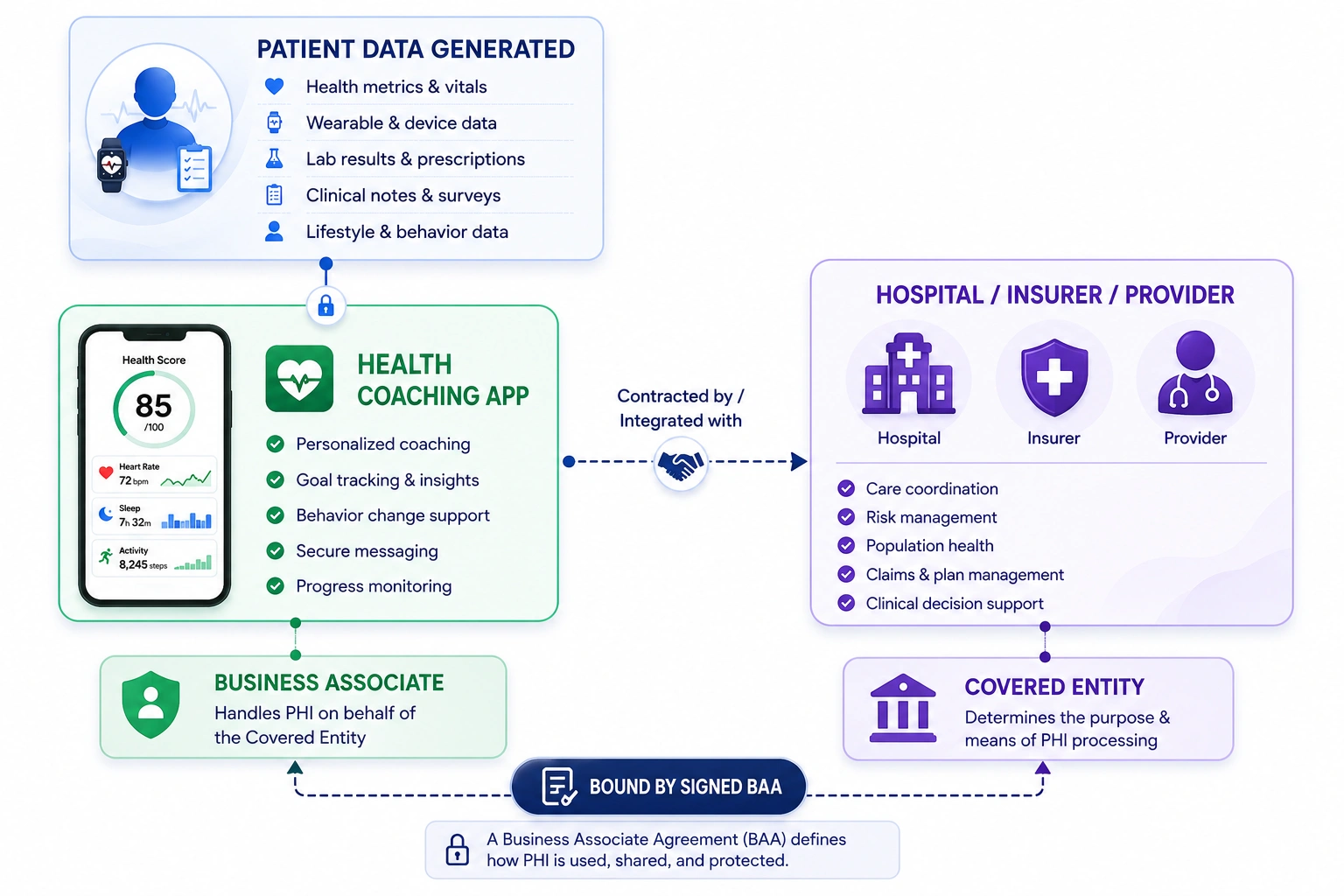
A Covered Entity (CE) is any organization that directly delivers healthcare, processes health payments, or manages health insurance plans. This includes doctors, clinics, hospitals, pharmacies, and health insurance providers. If a hospital launches its own internal health coaching app for its patients, the app is directly bound by HIPAA because it is managed by a Covered Entity.
2. Business Associates
A Business Associate (BA) is an external individual or company that provides services to a Covered Entity that involves handling, hosting, or transmitting PHI.
If a health coaching app company sells its platform to a hospital network, or if an independent coach contracts with a primary care clinic to provide lifestyle coaching to their patients, the app company legally becomes a Business Associate.
The Legal Requirement: Before any PHI can touch the application, the app developer and the Covered Entity must execute a legally binding contract known as a Business Associate Agreement (BAA). This agreement officially shifts direct legal and financial liability for safeguarding that data onto the app provider.
3. Data Privacy Responsibilities
To maintain compliance, health coaching platforms acting as Business Associates must implement strict safeguards across three core areas:
- Administrative Safeguards: Conducting mandatory annual risk assessments to identify security vulnerabilities, enforcing workforce training on data privacy, and establishing clear protocols for reporting data breaches.
- Physical Safeguards: Securing physical data servers, restricting access to office locations where data is managed, and enforcing secure device disposal practices.
- Technical Safeguards: Deploying AES-256 and SSL/TLS encryption, implementing multi-factor or biometric authentication, and maintaining immutable audit logs to track all PHI access and modifications.
Why Healthcare Providers Invest in HIPAA Health Coaching Apps
Healthcare systems are transitioning away from episodic, reactive care. Driven by the financial realities of value-based care and escalating operational expenses, healthcare networks are investing heavily in HIPAA compliant health coaching apps.
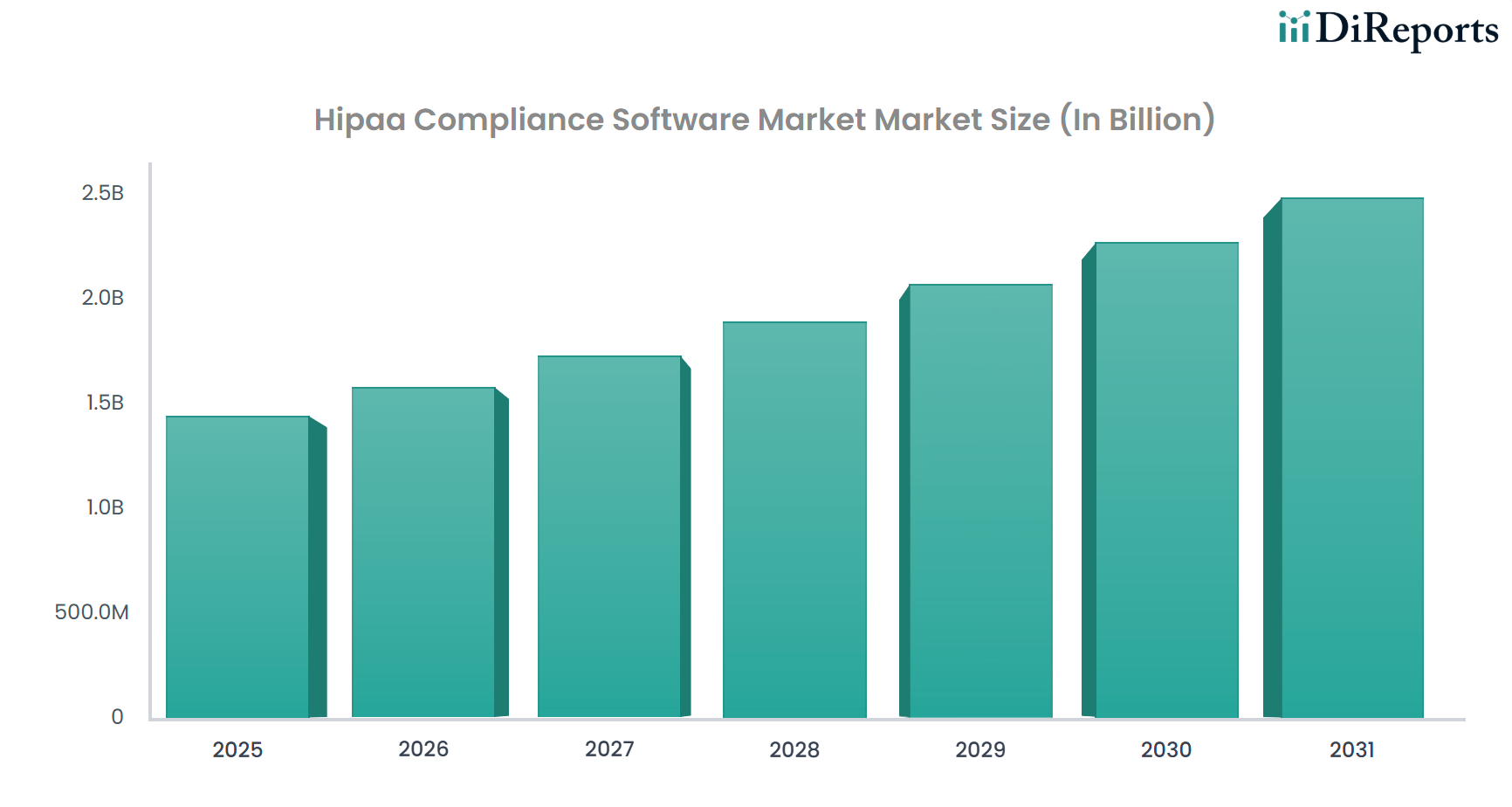
The HIPAA compliance software market, valued at $1.44 billion in 2024, is projected to grow to $2.71 billion by 2030, expanding at a compound annual growth rate (CAGR) of 9.5%, driven by rapid digital transformation across healthcare and increasingly stringent regulatory requirements.
A. Rising Demand for Personalized Preventive Healthcare
The focus of global medicine has shifted dramatically from late-stage intervention to early detection and proactive lifestyle modification.
- Market Expansion: The global preventive medicine market is projected to grow from $420 billion in 2025 to $915.18 billion by 2035, expanding at a compound annual growth rate (CAGR) of 8.10%.
- Consumer Motivation: Driven by a surge in consumer health awareness, smart wearable shipments reached massive volumes, with Apple alone shipping 58 million Apple Watches in 2025 where 64% of buyers explicitly cited health monitoring as their primary purchase driver.
- Corporate Integration: Employers are scaling up investment to mitigate corporate insurance risks; 68% of U.S. companies with more than 500 employees included biometric screenings in their 2025 employee benefit packages, creating an immediate onboarding pipeline for digital preventive coaching platforms.
B. Growth of Virtual Health Coaching Programs
Asynchronous and remote care modalities are rapidly outpacing traditional brick-and-mortar provider interactions due to lower administrative burdens and greater patient reach.
- Sector Velocity: The digital health coaching market size reached $15.29 billion in 2026 and is accelerating at a CAGR of 15.3%, on track to hit $26.7 billion by 2030.
- Delivery Channel Shift: Within the preventive health tech sector, virtual and remote service delivery channels are expanding at a rapid 14.89% annual growth rate, vastly outperforming traditional in-person preventive care visits, which are growing at just 7.56% over the same horizon.
C. Focus on Chronic Disease Management
Managing non-communicable chronic conditions (NCDs) like hypertension, pre-diabetes, and heart failure represents the single largest financial drain on modern healthcare infrastructure.
Digital lifestyle coaching for pre-diabetic patients costs approximately $400 annually per member. This is significantly lower than the $9,600/patient yearly cost required to treat advanced, unmanaged diabetes involving clinical complications.
Data published in the Journal of the American Medical Association (JAMA) reveals that integrating comprehensive remote patient care and digital monitoring correlates with 87% fewer hospitalizations, 77% fewer deaths, and an average per-patient cost savings of $11,472 compared to standard, non-digital care.
D. Boosting Patient Engagement with Digital Coaching
Consistent, daily patient touchpoints between clinical checkups prevent acute health crises and maintain high compliance with care plans.
Enterprise healthcare providers, such as the University of Pittsburgh Medical Center, successfully reduced the risk of hospital readmissions by 76% through the deployment of dedicated remote care tracking and digital outreach tools.
Surveys show 73% of healthcare executives report positive ROI from digital monitoring. Additionally, provider data demonstrates a 15% boost in blood pressure control and a 90% patient retention rate within virtual care management programs.
E. Revenue Growth Through Wellness Subscriptions
Beyond saving costs through clinical risk reduction, HIPAA compliant health coaching apps unlock entirely new, highly predictable recurring revenue streams for medical practices.
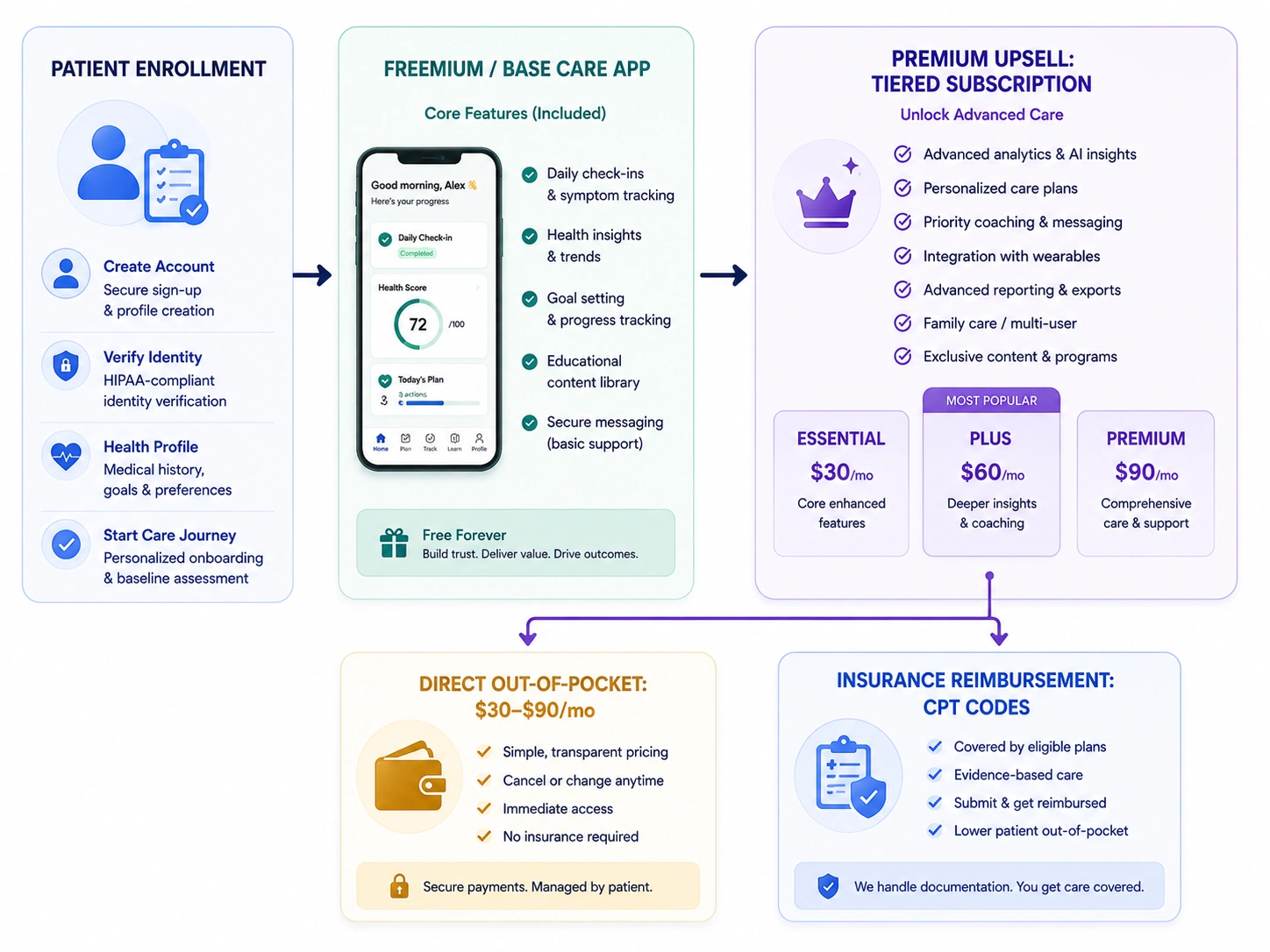
Market analysis indicates that the freemium model with paid upgrades (where basic medical tracking features are bundled into standard care, but continuous, specialized coaching requires a premium fee) captured the single largest revenue share in the digital coaching space.
Consumers increasingly invest out-of-pocket in premium health interfaces. For example, Dexcom’s Stelo metabolic sensor, for instance, achieved $180 million in sales within nine months, supported by users paying a $89 monthly subscription for automated insights.
Healthcare networks utilize these applications to secure steady monthly insurance reimbursements. By integrating digital coaching into Remote Physiological Monitoring (RPM) and Principal Care Management (PCM) systems, providers can bill for ongoing care using standard CPT codes.
Key HIPAA Requirements Every Health Coaching App Must Meet
Building or deploying a digital health coaching app requires strict adherence to federal standards. Under the Department of Health and Human Services (HHS) framework, ensuring compliance means implementing targeted safeguards across your administrative, physical, and technical infrastructures.
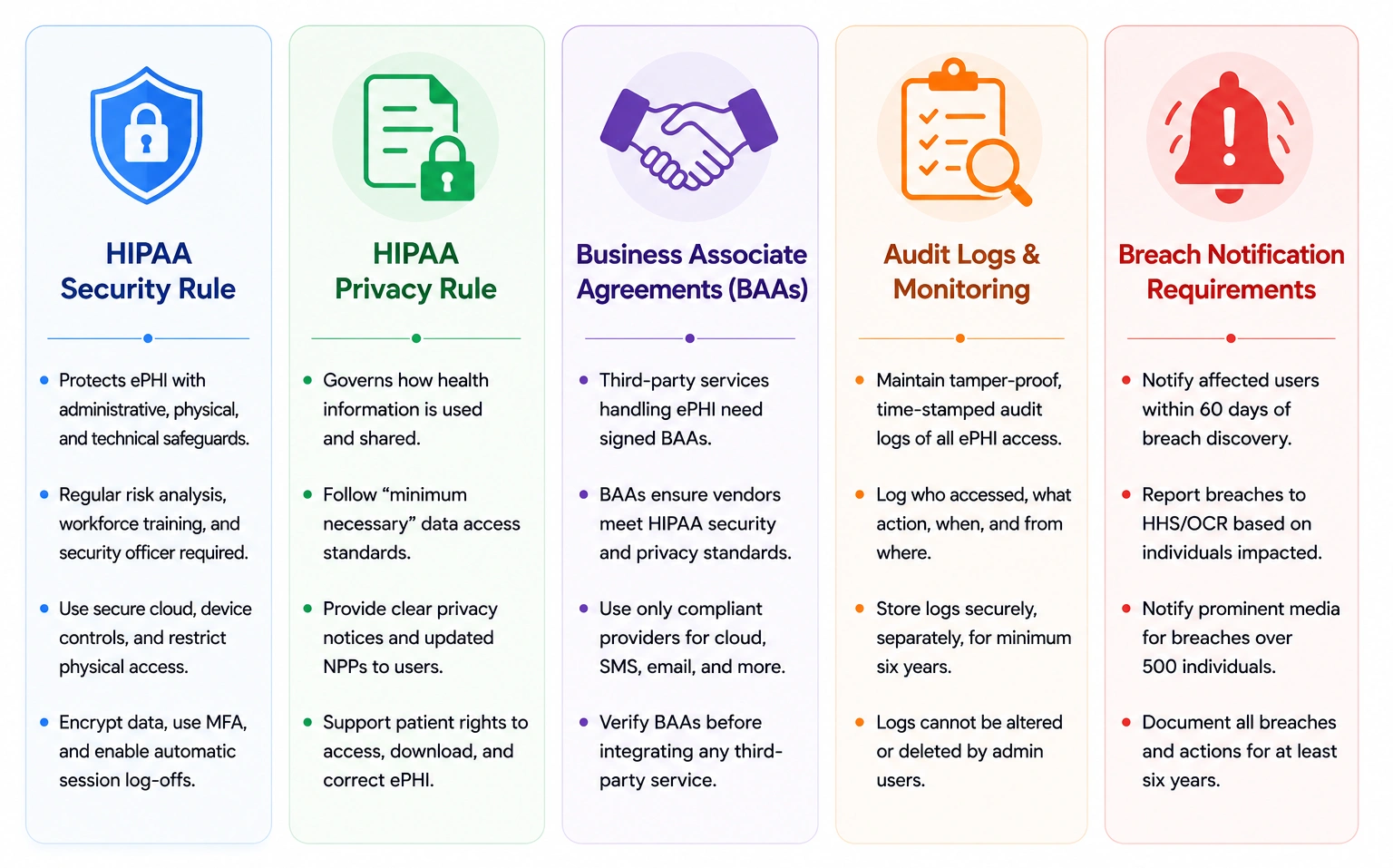
A. The Three Pillars of the HIPAA Security Rule
The HIPAA Security Rule focuses explicitly on safeguarding Electronic Protected Health Information (ePHI). To keep your app audit-ready, you must implement all three tiers of safeguards:
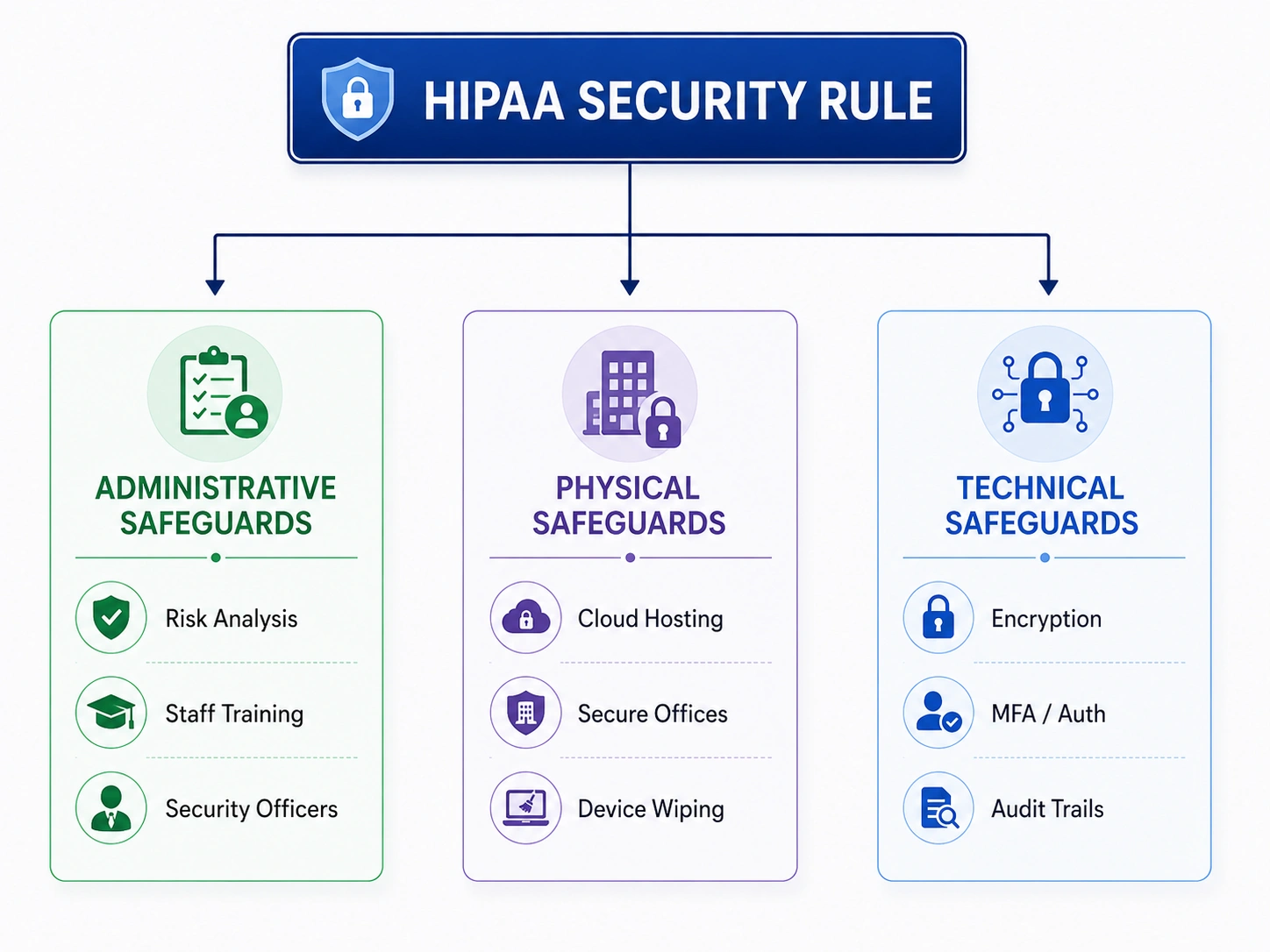
1. Administrative Safeguards
These are the operational policies, documentation, and personnel management frameworks of HIPAA compliant health coaching apps that govern how your company treats health data.
- Annual Security Risk Analysis: You must run a formal, documented assessment at least once a year to find vulnerabilities in how your app collects, processes, and stores data.
- Workforce Training: Every employee, developer, and contractor touching the code or infrastructure must undergo documented security awareness training to prevent phishing, social engineering, and accidental leaks.
- Designated Security & Privacy Officers: You must officially appoint individuals to oversee the enforcement of your operational data privacy protocols.
2. Physical Safeguards
These rules protect the actual physical spaces, hardware, and infrastructure housing your data networks from unauthorized access.
- Secure Cloud Infrastructure: If you build on cloud platforms like AWS, Google Cloud, or Azure, you must utilize their dedicated, physically secure healthcare-compliant data centers.
- Workstation & Device Controls: If coaches or support reps access patient logs from laptops or mobile devices, you must implement Mobile Device Management (MDM) tools to enforce physical screen locks and enable immediate remote data wiping if a device is lost or stolen.
- Office Security: Restricting physical entry to code repositories, internal servers, or offices handling client-facing operations using secure keycard access.
3. Technical Safeguards
These are the architectural engineering controls written directly into your HIPAA compliant health coaching apps and network configurations.
- Mandatory End-to-End Encryption: You must use strong encryption protocols such as AES-256 for data at rest (stored in databases and backups) and SSL/TLS for data in transit (moving between the user’s mobile app and your servers).
- Identity and Access Management: Implementing unique login credentials for every user and coach, paired with mandatory Multi-Factor Authentication (MFA) to prevent credential stuffing attacks.
- Automatic Session Inactivity Log-Offs: The application must automatically terminate user and coach sessions after a brief period of inactivity to prevent data exposure on unattended devices.
B. HIPAA Privacy Rule Requirements
While the Security Rule focuses on tech infrastructure, the Privacy Rule governs how and when health data can be shared or utilized.
Important Regulatory Alignment: Health coaching applications handling sensitive health information must ensure their privacy notices accurately reflect the strict federal confidentiality standards governing data sharing and care coordination.
- The “Minimum Necessary” Standard: Your app’s backend architecture must limit data exposure. Coaches and admins should only see the specific data points required to execute their immediate tasks. For example, a nutrition coach does not need to see a user’s complete past billing history or unrelated clinical diagnoses.
- Updated Notices of Privacy Practices (NPP): Your app must present users with a clear, plain-language document outlining exactly how their health information is collected, used, and disclosed.
- Patient Rights over ePHI: Your application workflows must accommodate patient requests to view, download, or request corrections to their recorded health histories.
C. Business Associate Agreements (BAAs)
A HIPAA compliant health coaching apps does not operate in a vacuum. It relies on third-party microservices such as push notification engines, database providers, email APIs, and customer support chats.
If any third-party service handles, processes, or stores your users’ ePHI, they are legally classified as a Business Associate. You cannot integrate their services until they sign a Business Associate Agreement (BAA).
| Compliant Infrastructure Stack (Signs BAAs) | Non-Compliant Stack (Will Not Sign BAAs) |
| AWS / Google Cloud Healthcare API | Standard Consumer Web Hosting |
| Twilio Programmable SMS (Healthcare Tier) | Standard Unencrypted SMS Protocols |
| SendGrid (HIPAA-Compliant Advanced Package) | Free/Basic Email Marketing Automation APIs |
D. Audit Logs and Activity Monitoring
To achieve true HIPAA compliance, your application must maintain a completely tamper-proof, time-stamped audit trail. Your database must track and log every single interaction with ePHI.
Every audit log entry must capture:
- Who accessed the data (the unique user ID of the coach, admin, or patient).
- What specific action was taken (data read, edited, deleted, or exported).
- When the action occurred (an unalterable server timestamp).
- Where the request originated (IP address and device identifier).
These logs must be securely backed up, stored for a minimum of six years, and must remain completely decoupled from standard application logs so they cannot be altered or cleared by administrative users.
E. Breach Notification Requirements
If your HIPAA compliant health coaching apps experience a security incident or an unauthorized exposure of unsecured health data, you must execute the federal Breach Notification Rule protocols without unreasonable delay:
- Individual Notifications: You must notify all affected users via first-class mail or secure electronic delivery within 60 calendar days of discovering the breach.
- HHS/OCR Notification:
- If a breach impacts fewer than 500 individuals, you must document it in your internal logs and report it to the HHS Office for Civil Rights (OCR) within 60 days of the end of the calendar year.
- If a breach compromises the data of 500 or more individuals, you must notify HHS concurrently with individual notifications and your internal response protocols must prioritize rapid mitigation.
- Media Notification: If a data breach affects more than 500 residents of a single state or jurisdiction, you must issue a formal press release to prominent regional media outlets to ensure public awareness.
Core Features of a HIPAA Compliant Health Coaching App
Building an enterprise-ready HIPAA compliant health coaching apps requires blending user-friendly design with strict federal data privacy. These core features ensure your application protects sensitive data while driving strong daily active user engagement.

1. Secure User Registration and Authentication
Secure login and identity verification protect sensitive health information from unauthorized access. This feature is essential for HIPAA compliance, user trust, account security, and preventing data breaches across the platform.
- Multi-Factor Authentication Layer: Adds an additional verification step through email, SMS, or authenticator apps before users can access personal health records.
- Biometric Identity Gateway: Utilizes secure face and fingerprint scanning to provide fast, encrypted access to user accounts.
- Automatic Session Protection: Logs users out after periods of inactivity to reduce risks associated with unattended devices.
- Encrypted Credential Storage: Secures passwords and authentication data using advanced encryption standards to prevent unauthorized access.
2. Personalized Health Assessments
Personalized health assessments help collect important user information during onboarding. They allow the platform to understand health conditions, lifestyle habits, wellness goals, and coaching requirements from day one.
- Smart Onboarding Questionnaires: Collect detailed health, lifestyle, and wellness information through adaptive assessment workflows.
- Health Risk Evaluation Engine: Identifies potential concerns and highlights areas that may require personalized coaching support.
- Goal Discovery Framework: Guides users in defining realistic, measurable, and achievable wellness objectives.
- Baseline Health Scoring System: Establishes a starting benchmark for tracking future progress and outcomes.
3. Goal Setting and Progress Tracking
Goal tracking keeps users motivated by showing measurable improvements over time. It helps coaches monitor performance, increase engagement, and deliver personalized guidance based on actual progress data.
- Custom Goal Management: Enables users to create personalized fitness, nutrition, wellness, and lifestyle objectives.
- Milestone Achievement Tracking: Highlights progress checkpoints to maintain motivation and encourage consistency.
- Interactive Progress Dashboards: Visualizes health improvements through charts, summaries, and performance indicators.
- Automated Outcome Reporting: Generates progress reports that help coaches refine recommendations and strategies.
4. Health Coaching Session Scheduling
An integrated scheduling system simplifies appointment management for both users and coaches. It reduces administrative work, improves attendance rates, and creates a smoother coaching experience.
- Real-Time Availability Management: Displays coach schedules dynamically to eliminate booking conflicts.
- Calendar Synchronization Hub: Connects appointments with external calendar and productivity platforms.
- Automated Reminder System: Sends timely notifications to reduce missed sessions and improve engagement.
- Integrated Payment Processing: Supports secure consultation payments directly within the application.
5. Secure Messaging and Communication
Secure communication allows coaches and users to exchange health-related information safely. It improves engagement, supports continuous coaching, and ensures privacy requirements are maintained throughout interactions.
- HIPAA-Compliant Messaging Center: Protects conversations and health-related communications through encrypted channels.
- Secure Document Exchange: Enables safe sharing of reports, wellness plans, and educational resources.
- Real-Time Communication Tools: Facilitates instant interactions between users and health coaches.
- Privacy-Safe Notifications: Delivers alerts without exposing sensitive health information on device screens.
6. Prescription Logging Assistance
Prescription management helps users maintain medication adherence and gives coaches better visibility into health routines. While health coaching apps typically do not prescribe medications, they can support users by organizing medication schedules and tracking adherence patterns.
- Medication Schedule Management: Allows users to record prescriptions, dosages, and intake schedules within a centralized dashboard.
- Smart Reminder System: Sends automated notifications to reduce missed doses and improve treatment adherence.
- Prescription History Tracking: Maintains historical medication records to support long-term wellness monitoring.
- Adherence Analytics: Identifies missed doses and recurring compliance challenges to improve coaching interventions.
7. Video Consultation Integration
Video consultations enable remote coaching sessions without requiring external platforms. This feature improves accessibility, increases convenience, and supports virtual healthcare delivery from any location.
- HIPAA-Compliant Video Conferencing: Supports secure virtual coaching sessions while protecting sensitive health information.
- One-Click Session Access: Simplifies appointment participation through frictionless meeting entry.
- Collaborative Screen Sharing: Allows coaches and users to review reports, goals, and wellness plans together.
- Adaptive Streaming Technology: Maintains stable video quality across varying internet connections.
8. Health Reports and Analytics Dashboard
Analytics dashboards transform health data into actionable insights for users and coaches. They support informed decision-making, progress evaluation, and personalized coaching strategies based on measurable outcomes.
- Visual Health Metrics Dashboard: Presents wellness data through intuitive charts and performance indicators.
- Trend Analysis Engine: Identifies long-term patterns and highlights areas requiring attention.
- Personalized Progress Reports: Summarizes coaching outcomes and health improvements in an easy-to-understand format.
- Data-Driven Coaching Insights: Helps coaches optimize recommendations using measurable user data.
9. Emergency Escalation Workflows
Emergency escalation workflows provide an additional layer of user safety by automatically initiating predefined response protocols when critical health thresholds or risk indicators are detected.
- Health Threshold Monitoring: Continuously evaluates connected health data against predefined safety parameters.
- Automated Wellness Check Alerts: Triggers notifications when unusual health patterns or inactivity are detected.
- Emergency Contact Notifications: Alerts designated family members, caregivers, or support contacts when escalation criteria are met.
- Risk Escalation Management: Routes high-risk situations through configurable workflows for timely intervention and follow-up.
10. Data Encryption and Secure Storage
Data encryption and secure storage are critical for protecting Protected Health Information. They help organizations meet HIPAA requirements while reducing risks associated with cyber threats and breaches.
- End-to-End Encryption Framework: Protects healthcare data during transmission and while stored within the platform.
- Secure Cloud Infrastructure: Provides compliant and scalable storage for sensitive health information.
- Automated Backup Protection: Prevents data loss through scheduled backups and recovery mechanisms.
- Advanced Security Controls: Strengthens defenses against unauthorized access, cyberattacks, and system vulnerabilities.
Advanced Features That Differentiate Modern Health Coaching Apps
To win significant market share in the digital wellness sector, your HIPAA compliant health coaching apps must move beyond basic manual logging. Integrating advanced, automation-driven features turns your application into a premium, highly defensible asset that attracts high-value corporate contracts and drives superior user lifetime value.

1. AI-Powered Personalized Health Recommendations
AI-powered recommendations analyze user behavior, health records, and wellness goals to deliver highly personalized guidance. This improves engagement, increases relevance, and helps users achieve better health outcomes.
- Intelligent Recommendation Engine: Analyzes health patterns and behaviors to generate personalized wellness suggestions.
- Dynamic Guidance Adaptation: Continuously updates recommendations based on changing goals and user activity.
- Personalized Coaching Insights: Delivers actionable suggestions tailored to individual health journeys.
- Behavior-Based Engagement Optimization: Improves retention through highly relevant and timely wellness guidance.
2. Conversational AI Health Coach
A conversational AI coach provides instant support between human coaching sessions. It improves accessibility, delivers continuous engagement, and helps users stay focused on their wellness journey.
- 24/7 Virtual Coaching Assistant: Provides immediate responses to wellness and health-related questions at any time.
- Automated Progress Check-Ins: Encourages accountability through regular follow-ups and status updates.
- Personalized Health Education: Delivers relevant content aligned with user goals and interests.
- Natural Language Interaction: Creates engaging conversations that feel intuitive and human-like.
3. Wearable Device and Health Data Integrations
Wearable integrations in HIPAA compliant health coaching apps automatically collect health data from connected devices. This creates a more accurate health profile and enables real-time coaching based on actual user activity.
- Smart Device Connectivity Hub: Integrates with smartwatches, fitness trackers, and health monitoring devices.
- Automated Activity Synchronization: Imports exercise, movement, and fitness data without manual entry.
- Sleep and Recovery Monitoring: Tracks sleep quality and recovery metrics to support holistic wellness coaching.
- Continuous Health Data Collection: Improves accuracy and personalization through real-time information streams.
4. Predictive Health Risk Detection
Predictive analytics helps identify potential health risks before they become serious. This allows coaches and users to take proactive actions and improve long-term wellness outcomes.
- AI-Powered Risk Scoring: Evaluates health data to identify emerging concerns at an early stage.
- Preventive Alert System: Notifies users and coaches when risk indicators exceed predefined thresholds.
- Behavioral Pattern Analysis: Detects habits and trends that may negatively impact health outcomes.
- Long-Term Health Forecasting: Provides predictive insights into future wellness risks and opportunities.
5. Remote Patient Monitoring Capabilities
Remote monitoring enables continuous tracking of important health metrics outside clinical settings. It supports proactive care, improves visibility, and strengthens ongoing coaching effectiveness.
- Real-Time Health Monitoring: Tracks critical wellness indicators continuously between coaching sessions.
- Connected Medical Device Integration: Collects data automatically from approved health monitoring devices.
- Proactive Intervention Support: Enables early action when concerning trends or anomalies are detected.
- Secure Provider Collaboration: Facilitates compliant data sharing between coaches and healthcare professionals.
6. Automated Wellness Plan Generation
Automated wellness planning uses AI to create personalized programs based on user goals, health conditions, and preferences. This improves scalability while reducing manual coaching workload.
- AI-Generated Nutrition Planning: Creates customized meal and dietary recommendations aligned with wellness objectives.
- Personalized Fitness Program Builder: Designs exercise plans tailored to individual capabilities and health conditions.
- Dynamic Plan Optimization: Adjusts wellness strategies automatically based on progress and performance data.
- Scalable Coaching Automation: Helps coaches deliver consistent, personalized guidance across larger user populations.
How to Develop a HIPAA Compliant Health Coaching App
Building a federally compliant HIPAA compliant health coaching apps requires merging premium consumer experiences with bulletproof data protection. Our structured engineering framework guides your digital asset through rigorous security staging to achieve full administrative, physical, and technical compliance.

1. Define Healthcare Use Case and Compliance
Our product strategists consult with you to understand your business goal and type of your health coach app to map user roles and data flows in the app, isolating exactly where protected health information travels to draw a clear legal boundary around your system’s compliance liabilities.
- Data Boundary Mapping: Identifies precisely which platform features process protected medical data to optimize backend security architecture costs.
- User Role Matrixing: Defines granular access rules separating general fitness app users from certified clinical health coaches.
- Liability Minimization Planning: Structures the app workflow to avoid collecting unnecessary medical records, reducing your overall compliance risk.
- Commercial Use-Case Blueprinting: Aligns your regulatory footprint directly with B2B corporate wellness procurement and healthcare insurance reimbursement models.
2. Conduct HIPAA Risk Assessment
Our cybersecurity specialists perform comprehensive data vulnerability scans, uncovering potential information security gaps across your cloud systems to construct an ironclad corporate risk management policy before writing code.
- Vulnerability Vector Discovery: Pinpoints hidden exposure risks within system databases, API bridges, and third-party file transport integrations.
- Threat Likelihood Scoring: Evaluates potential data breach entry points against rigorous federal administrative security standards and guidelines.
- Proactive Mitigation Architecture: Designs technical safety controls to neutralize infrastructure liabilities before launching development cycles.
- Audit Trail Documentation: Generates comprehensive, time-stamped risk reports required to satisfy federal compliance inspectors during legal reviews.
3. Design HIPAA-Compliant User Workflows
Our UI/UX designers map out frictionless front-end experiences, embedding mandatory privacy gates like automatic session logouts and masked notifications without compromising the app’s smooth daily usage.
- Masked Notification Loops: Routes push alerts to smartphones without exposing sensitive clinical data on locked user screens.
- Frictionless Re-Authentication Gates: Implements rapid biometric sign-ins to keep user accounts highly secure yet easily accessible.
- Idle Session Expiration: Triggers automatic system logouts after five minutes of inactivity to protect shared user hardware.
- Consent Disclosure Overlays: Integrates clear, plain-language authorization popups that explicitly detail how medical telemetry is securely handled.
4. Build Secure Application Infrastructure
Our backend architects deploy isolated, healthcare-restricted cloud environments, anchoring your system onto dedicated servers that feature automated file backups and enterprise-grade network firewalls.
- Dedicated Server Isolation: Segregates your health database onto physically independent cloud servers away from public network environments.
- Elastic Cloud Scaling: Deploys self-expanding server clusters to maintain high platform speeds during sudden enterprise traffic surges.
- Automated Mirror Backups: Configures hourly, encrypted data duplication routines across multiple geographic zones to prevent loss.
- Intrusion Detection Implementation: Embeds live network sniffing tools that instantly flag and block suspicious server traffic spikes.
5. Implement Security Controls and Encryption
Our security engineers write advanced cryptographic defense layers, wrapping all static files and active network messages in military-grade armor to make data completely unreadable to hackers.
- AES-256 Storage Armor: Scrambles user profile data and chat history using top-tier Advanced Encryption Standard algorithms.
- TLS Transit Shields: Secures moving data streams using strict Transport Layer Security protocols during internet network transfers.
- Decentralized Key Repositories: Stores database decryption codes on independent hardware chips to eliminate single master failure points.
- Immutable Transaction Logging: Hooks up unalterable background ledgers that track every single database view or profile modification.
6. Integrate Third-Party Healthcare Services
Our API specialists connect your HIPAA compliant health coaching apps to external electronic health records and pharmacy networks, verifying that every integrated tool signs legally binding business partner safety contracts.
- Verified BAA Procurement: Secures mandatory Business Associate Agreements from every external API vendor handling user health telemetry.
- FHIR Standard Interoperability: Implements modern Fast Healthcare Interoperability Resources protocols for flawless data syncing with medical networks.
- E-Pharmacy Pipeline Syncing: Bridges supplement tracking systems directly into certified fulfillment networks for automated, compliant user ordering.
- Sandboxed Telehealth Meeting: Encapsulates live video coaching calls inside encrypted peer-to-peer networks to guarantee complete conversational privacy.
7. Conduct Compliance Testing and Security Audits
Our quality assurance team launches aggressive, simulated cyberattacks and automated boundary tests, certifying that your codebase completely withstands real-world penetration attempts before going live.
- Adversarial Penetration Testing: Coordinates mock hacking campaigns against backend infrastructure to find and seal network cracks.
- Adherence Ledger Validation: Tests system event logs to confirm every data access action is recorded precisely.
- Edge-Case Crash Simulation: Floods system APIs with erratic biometric data packets to verify fail-safe data filtering mechanics.
- Regulatory Certification Review: Compiles an extensive compliance validation packet proving your app meets federal information security standards.
8. Launch and Continuously Monitor Compliance
Our DevOps engineers orchestrate a secure app store rollout, activating live metric dashboards that track infrastructure costs, network delays, and compliance health around the clock.
- App Store Guardrails: Manages launch workflows to ensure platform distribution adheres strictly to digital marketplace health rules.
- Live Latency Supervision: Tracks AI coach response times to ensure chat tools maintain quick, real-time consumer answers.
- Automated Patch Deployments: Installs immediate server security updates in the background without causing system downtime for users.
- Continuous Cloud Optimization: Tweaks server usage dynamically to lower data processing overhead while keeping digital infrastructure safe.
Cost to Build a HIPAA Compliant Health Coaching App
Developing HIPAA compliant health coaching apps requires investment in secure infrastructure, compliance measures, AI capabilities, and healthcare integrations. Costs vary based on feature complexity and scalability, with budgets typically evaluated by development stages or the overall sophistication of the platform.
To better understand the investment required, it’s helpful to look at development costs from two perspectives:
- Development phase-wise costs (planning, design, development, testing, deployment)
- Product complexity costs (MVP, mid-level platform, enterprise solution)
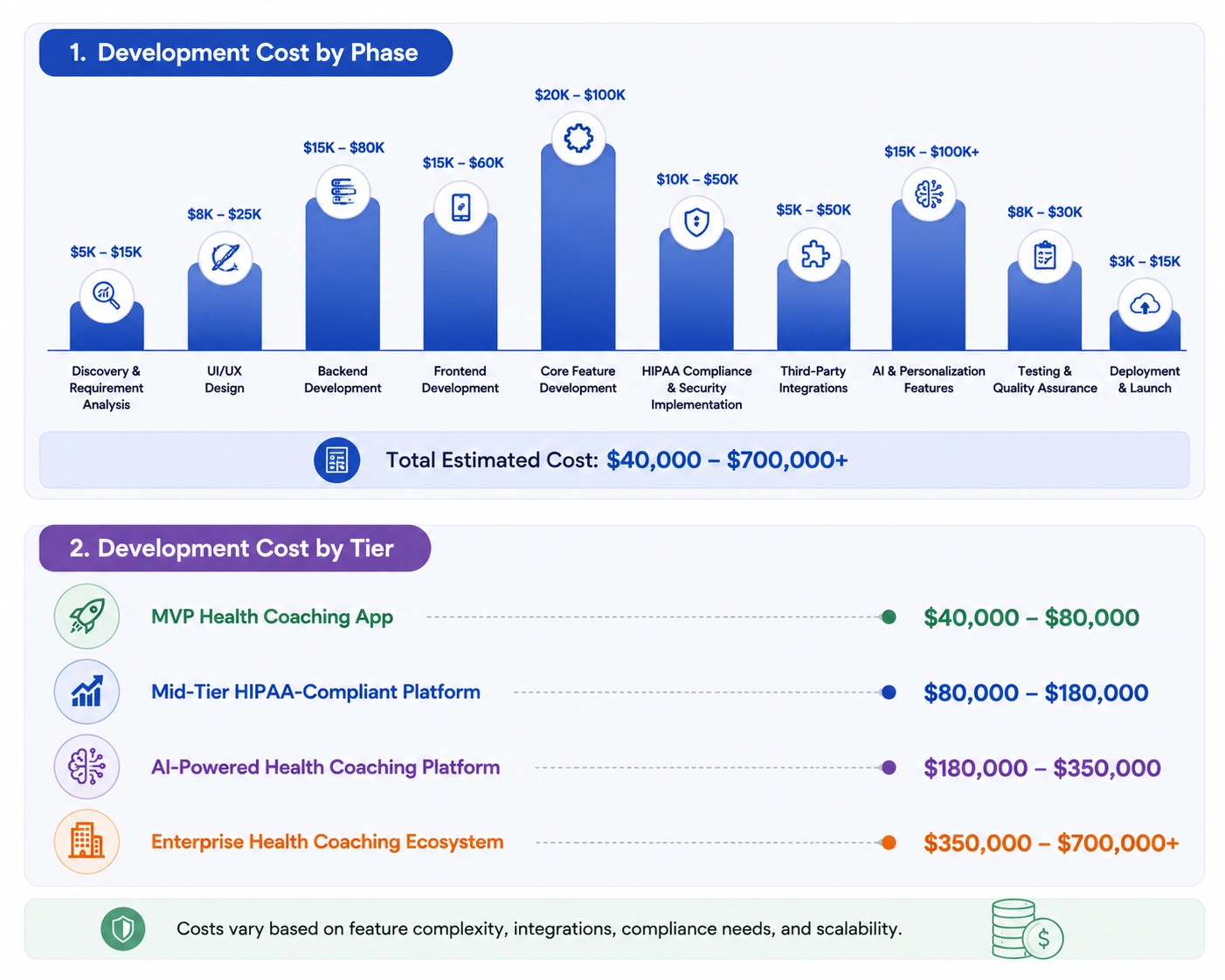
1. HIPAA-Compliant Health Coaching App Development Cost by Phase
The following table breaks down the estimated cost of developing a HIPAA-compliant health coaching app based on each stage of the development lifecycle.
| Development Phase | Estimated Cost (USD) | Key Activities |
| Discovery & Requirement Analysis | $5,000 – $15,000 | Market research, feature planning, compliance assessment, technical roadmap |
| UI/UX Design | $8,000 – $25,000 | User journey mapping, wireframes, prototypes, accessibility-focused healthcare design |
| Backend Development | $15,000 – $80,000 | Database architecture, APIs, user management, HIPAA-compliant infrastructure |
| Frontend Development | $15,000 – $60,000 | iOS, Android, or web application development |
| Core Feature Development | $20,000 – $100,000 | Health assessments, coaching modules, scheduling, messaging, progress tracking |
| HIPAA Compliance & Security Implementation | $10,000 – $50,000 | Encryption, audit logs, RBAC, consent management, secure storage |
| Third-Party Integrations | $5,000 – $50,000 | EHRs, telehealth APIs, payment gateways, wearable devices |
| AI & Personalization Features | $15,000 – $100,000+ | AI coaching, predictive analytics, recommendation engines |
| Testing & Quality Assurance | $8,000 – $30,000 | Functional testing, security testing, performance testing |
| Deployment & Launch | $3,000 – $15,000 | Cloud setup, app store deployment, production release |
| Total Estimated Cost | $40,000 – $700,000+ | Depending on scope, complexity, and compliance requirements |
2. HIPAA-Compliant Health Coaching App Development Cost by Tier
The following table provides estimated HIPAA compliant health coaching apps development costs based on feature scope, compliance requirements, and platform complexity.
| Development Tier | Estimated Cost | Typical Features |
| MVP Health Coaching App | $40,000 – $80,000 | Secure authentication, health assessments, goal tracking, appointment scheduling, secure messaging, basic reporting, HIPAA-ready infrastructure |
| Mid-Level HIPAA-Compliant Platform | $80,000 – $180,000 | Video consultations, wearable integrations, medication tracking, analytics dashboards, role-based access controls, audit logs, advanced reporting |
| AI-Powered Health Coaching Platform | $180,000 – $350,000 | AI recommendations, conversational AI coach, automated wellness plans, predictive analytics, advanced engagement features |
| Enterprise Health Coaching Ecosystem | $350,000 – $700,000+ | Remote patient monitoring, EHR integrations, enterprise analytics, multi-tenant architecture, population health management, advanced compliance systems |
3. Compliance and Security Cost Considerations
HIPAA compliance introduces development requirements that extend beyond standard application security. Organizations must invest in both technical safeguards and ongoing compliance processes.
| Compliance Investment Area | Estimated Cost Range |
| End-to-end encryption implementation | $5,000 – $15,000 |
| Secure cloud hosting infrastructure | $3,000 – $12,000 |
| Audit logging systems | $2,000 – $10,000 |
| Role-based access controls | $2,500 – $8,000 |
| Consent management workflows | $2,000 – $7,000 |
| Vulnerability assessments and penetration testing | $5,000 – $20,000 |
| HIPAA documentation and risk assessments | $3,000 – $15,000 |
| Business Associate Agreement (BAA) management | $1,000 – $5,000 |
These compliance requirements can account for approximately 15% to 30% of the total development budget depending on platform complexity.
4. Ongoing Maintenance and Compliance Expenses
Launching the application is only the beginning. HIPAA compliant health coaching apps require continuous maintenance, security monitoring, and regulatory updates to remain compliant and secure.
Typical ongoing expenses can vary based on platform scale and compliance requirements. The table below provides estimated annual costs:
| Expense Category | Estimated Annual Cost |
| Cloud Hosting & Infrastructure Management | $5,000 – $30,000 |
| Security Monitoring & Threat Detection | $3,000 – $15,000 |
| Compliance Audits & Assessments | $5,000 – $20,000 |
| Software Updates & Feature Enhancements | $10,000 – $50,000 |
| Third-Party API & Integration Maintenance | $2,000 – $15,000 |
| Technical Support & Bug Fixes | $5,000 – $25,000 |
Most organizations allocate approximately 15% to 25% of the initial development cost annually for maintenance, security, and compliance operations.
A HIPAA-compliant health coaching app is a valuable healthcare technology asset. Prioritizing scalable architecture, compliance, and engagement from the start lowers future costs while boosting growth and adoption.
HIPAA Compliant Third-Party Integrations to Consider
Building a digital health coaching app from scratch is highly inefficient. Instead of writing custom video protocols or device syncing engines, developers rely on third-party software development kits (SDKs) and application programming interfaces (APIs).
However, because these services process and transmit Protected Health Information (PHI), you must integrate vendor platforms that officially sign Business Associate Agreements (BAAs) and provide healthcare-grade security.

1. Video Consultation Platforms
Live interaction between coaches and users requires secure, high-definition audio and video feeds that prevent unauthorized data interception. Standard consumer video APIs will not suffice due to strict privacy regulations.
Top Compliant Solutions: CometChat (Telehealth Tier), Twilio Programmable Video, MirrorFly, and Pexip.
What to Look For: Real-time WebRTC architecture featuring end-to-end encryption (DTLS/SRTP), automated AI session transcription that securely parses medical notes, and built-in interactive tools like collaborative digital whiteboards.
2. Wearable and Fitness Device APIs
To drive automated progress monitoring and objective goal tracking, coaching apps must pull biometrics directly from physical consumer hardware.
Top Compliant Solutions: SpikeAPI, Rhythm360 (Cardiac RPM focus), Terra API, and Rofilm.
What to Look For: Single-point aggregation pipelines that safely normalize unstructured stream data from Apple HealthKit, Google Health Connect, Fitbit, and Garmin. Ensure the aggregator strips direct identifiers or processes the data within a BAA-protected cloud gateway.
3. EHR and EMR Integrations
If your health coaching app acts as an extension of a hospital network or clinical care team, it must securely sync data back into Electronic Health Records (EHR) and Electronic Medical Records (EMR).
Top Compliant Solutions: DoctorConnect AI Agent Gateway, Google Cloud Healthcare API, and Redox.
What to Look For: Native compatibility with modern HL7 FHIR (Fast Healthcare Interoperability Resources) data standards. These integrations enable bi-directional data syncing, allowing a coach’s lifestyle notes to appear directly within a patient’s primary care chart in enterprise systems like Epic or Cerner.
4. Secure Payment Gateways
Processing out-of-pocket wellness subscriptions or digital co-pays requires a system that insulates standard financial transactional data from private medical context.
Top Compliant Solutions: Stripe (Enterprise Tier with BAA execution) and PayPal (Healthcare Tier).
What to Look For: Clear separation of layers. The payment gateway must strictly process credit cards or insurance data using PCI-DSS standards, while completely masking any metadata fields that link the transaction to specific clinical treatments or diagnoses.
5. Health Data Aggregation Services
Beyond basic step counts, advanced apps require deep, historical patient health profiles, including comprehensive laboratory results, imaging summaries, and historical medication records.
Top Compliant Solutions: Human API, Particle Health, and 1upHealth.
What to Look For: OAuth 2.1 authentication flows that empower patients to securely grant your app temporary, read-only permission to fetch records from over tens of thousands of connected clinics, diagnostic labs, and national pharmacy networks.
6. Communication and Notification Services
Keeping users engaged requires pushing reminders for medication, appointments, or habit logging via text, email, or system notifications without leaking health data onto unsecured device lock screens.
Top Compliant Solutions: Twilio (Healthcare Tier), SendGrid (Advanced HIPAA Package), and OhMD.
What to Look For: Automated message scrubbing to strip out ePHI from standard SMS and push channels (e.g., sending “You have a new message from your coach” instead of “Your blood pressure reading of 140/90 requires review”). Ensure all underlying mail transfer servers (SMTP) utilize forced TLS encryption protocols.
Common HIPAA Compliance Mistakes That Delay Health App Launches
Many healthcare startups prioritize features over compliance, leading to launch delays, increased costs, and regulatory risks. Identifying common HIPAA compliance mistakes early helps businesses avoid costly rework and build secure, compliant health coaching apps more efficiently.
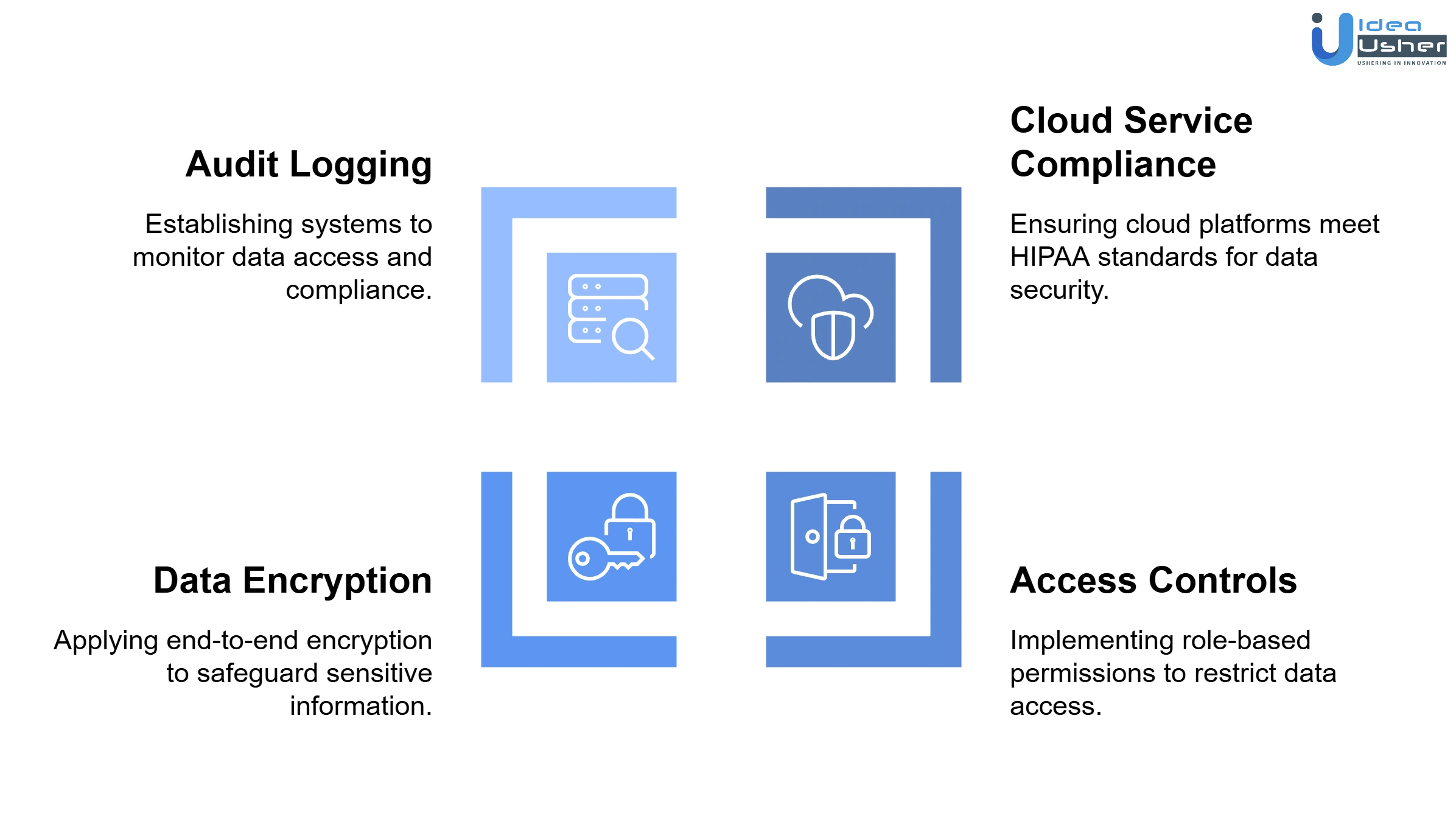
1. Choosing Non-Compliant Cloud Services
Challenge: Many healthcare apps are built on cloud platforms that lack HIPAA-ready infrastructure, exposing Protected Health Information to security and compliance risks.
Solution: Our developers evaluate cloud providers during project planning, implement HIPAA-compliant hosting environments, establish Business Associate Agreements (BAAs), and configure secure storage, backup, and access controls from the beginning.
2. Inadequate Access Controls
Challenge: Poor permission management allows unauthorized users, employees, or administrators to access sensitive patient information beyond their responsibilities.
Solution: We implement role-based access control frameworks that restrict data visibility according to user roles, ensuring only authorized individuals can access Protected Health Information throughout the platform.
3. Weak Data Encryption Practices
Challenge: Sensitive healthcare information remains vulnerable when encryption is improperly configured during storage, transmission, or third-party system integrations.
Solution: Our development team applies end-to-end encryption, secure API communication protocols, encrypted cloud storage, and industry-standard security practices to safeguard healthcare data across all environments.
4. Missing Audit Logging Systems
Challenge: Without audit trails, organizations cannot monitor data access, investigate incidents, or demonstrate HIPAA compliance during audits.
Solution: We build comprehensive audit logging systems that record user activity, data access events, modifications, and administrative actions, enabling ongoing compliance monitoring and security investigations.
Real-World Health Coaching App Examples Leading the Market
Leading health coaching platforms demonstrate how personalized care, AI-driven guidance, and HIPAA-compliant data management can improve engagement, outcomes, and trust while scaling healthcare services across diverse wellness and chronic care segments.
1. Vida Health
Vida Health combines AI-powered coaching, virtual care, chronic disease management, and mental health support within a HIPAA-compliant ecosystem. Secure data handling, personalized care plans, and integrated clinical services enable scalable, outcome-driven healthcare delivery.
Key Lesson Startups Can Learn: Vida Health shows the value of combining AI coaching with licensed healthcare professionals. Startups can learn to build hybrid care models that deliver personalized support while maintaining HIPAA compliance and improving patient outcomes.
2. Lark
Lark delivers 24/7 conversational AI coaching for diabetes, hypertension, and obesity management. Its HIPAA-compliant architecture protects sensitive health data while enabling automated interventions, continuous monitoring, and personalized preventive care.
Key Lesson Startups Can Learn: Lark demonstrates how conversational AI can scale health coaching without requiring large coaching teams. Startups can learn to leverage AI-driven automation to provide continuous engagement, personalized recommendations, and cost-efficient healthcare support.
3. Omada Health
Omada Health focuses on behavior change, weight management, and chronic care through connected devices, personalized coaching, and HIPAA-compliant health data management. Its evidence-based programs drive long-term engagement and measurable health outcomes.
Key Lesson Startups Can Learn: Omada Health highlights the importance of behavior-change programs backed by real health data. Startups can learn to integrate wearables, remote monitoring, and personalized coaching to improve user retention and demonstrate measurable results.
4. Wysa
Wysa offers AI-powered mental wellness coaching through CBT techniques, mood tracking, and guided self-care programs. HIPAA-compliant security safeguards behavioral health data while supporting accessible, stigma-free emotional wellbeing support.
Key Lesson Startups Can Learn: Wysa demonstrates how AI can make mental health support more accessible and scalable. Startups can learn to incorporate mental wellness features, privacy-first design, and evidence-based coaching methods to create a more holistic health coaching experience.
Partner with Idea Usher for Your AI Health Coach App Development
Idea Usher is a premier, enterprise-level digital product agency with over 11 years of proven experience delivering 1,000+ scalable solutions across 50+ countries.
Backed by a powerful team of 250+ niche engineering experts and an exceptional 95% client retention rate, this ISO-aligned development powerhouse excels at translating complex health concepts into robust, HIPAA compliant health coaching apps serving over 500 enterprise clients globally.
Why Enterprises Partner with Us
Navigating the intersection of strict medical compliance and advanced artificial intelligence requires deep domain expertise. We build robust, high-performance software systems designed specifically to optimize clinical outcomes and maximize digital health tech investments.
- Cutting-Edge AI Integration: We deploy advanced machine learning models, computer vision for pose estimation, and intelligent recommendation engines that adapt daily care protocols based on real-time biometric shifts.
- Flawless HIPAA Architecture: Our engineers implement bulletproof administrative, physical, and technical safeguards including AES-256 data encryption and tamper-proof audit trails ensuring your platform is fully compliant and audit-ready from day one.
- Unified Device Interoperability: We build custom data abstraction layers using universal aggregators like Apple HealthKit, Google Health Connect, and HL7 FHIR APIs to seamlessly normalize fractured data from multiple wearable streams.
- Proven Health Tech Portfolio: From custom EHR-integrated systems to enterprise lifestyle platforms like Vezita and BAM Labs, we deliver comprehensive, scalable blueprints tailored directly to your target clinical or wellness audience.
Ready to Build a Compliant AI Health Coach Application?
Don’t let regulatory complexity or technical hurdles delay your product launch. Contact Idea Usher today to schedule an expert project consultation and turn your advanced digital health vision into a secure, market-ready reality.
Conclusion
HIPAA compliant health coaching apps are transforming how organizations deliver personalized wellness support while maintaining strict healthcare data privacy standards. Success in this space requires balancing engaging user experiences with robust security, compliance, and scalability from the start. By incorporating the right features, compliance safeguards, and advanced technologies, businesses can build trusted digital health platforms that drive meaningful outcomes. Partnering with an experienced healthcare app development company like Idea Usher can help accelerate development, reduce compliance risks, and bring a secure, market-ready solution to life.
Things to Know
Q.1. What makes a health coaching app HIPAA compliant?
A.1. A health coaching app becomes HIPAA compliant when it implements safeguards that protect Protected Health Information (PHI), including encryption, secure access controls, audit logs, consent management, and compliant cloud infrastructure that meets healthcare data privacy requirements.
Q.2. How much does it cost to develop a HIPAA compliant health coaching app?
A.2. Development costs typically range from $40,000 for an MVP to over $700,000 for enterprise-grade platforms. The final budget depends on feature complexity, AI capabilities, third-party integrations, compliance requirements, and infrastructure scalability.
Q.3. What features are essential in a HIPAA compliant health coaching app?
A.3. Core features include secure authentication, health assessments, goal tracking, appointment scheduling, secure messaging, video consultations, analytics dashboards, data encryption, and compliance-focused controls such as audit logging and role-based access management.
Q.4. Can AI be integrated into a HIPAA compliant health coaching apps?
A.4. Yes, AI can be integrated while maintaining compliance when healthcare data is handled securely. Common AI features include personalized health recommendations, conversational coaching assistants, predictive risk analysis, and automated wellness plan generation.