

Key Takeaways
- Traditional procurement systems built on emails are becoming outdated. AI-native platforms like Omnea are replacing them with procurement orchestration.
- AI procurement platforms automate approvals, onboarding, risk assessment, and spend management using automation.
- Building these platforms requires ERP integrations, infrastructure, compliance systems, and supplier intelligence tools..
- The demand for procurement automation is creating opportunities for businesses developing solutions.
- How Idea Usher helps businesses develop AI procurement platforms like Omnea using pre-vetted developers, infrastructure, and enterprise AI expertise
Why are companies still managing procurement through emails, spreadsheets, and approval chains when modern business operations now run in real time? Traditional procurement systems were built for slower workflows, but today’s businesses handle hundreds of vendors, SaaS subscriptions, compliance checks, and cross-functional approvals simultaneously. What once worked as a control process is now becoming an operational bottleneck.
Platforms like Omnea are changing this by transforming procurement into an AI-driven orchestration layer that connects finance, legal, IT, security, and supplier management into one intelligent workflow. Businesses are no longer searching for static procurement tools. They want systems that reduce friction, automate decisions, and improve operational speed, creating a major opportunity for companies building the next generation of AI procurement platforms.
Over the years, we’ve built several AI procurement solutions powered by cloud computing infrastructure and workflow automation engines. With this experience, we’re sharing this blog to break down the key steps to develop an AI procurement platform like Omnea.
Why Are AI Procurement Platforms Growing Fast?
According to Precedent Research, the global AI in procurement market size was calculated at USD 3.32 billion in 2025 and is predicted to increase from USD 4.25 billion in 2026 to approximately USD 39.20 billion by 2035, expanding at a CAGR of 28.00% from 2026 to 2035. This explosive trajectory is not merely a result of general tech trends. It is a direct response to the critical need for operational resilience in an increasingly volatile global economy. For investors and entrepreneurs, these figures represent a fundamental shift in how corporate capital is managed, moving away from reactive accounting toward proactive, intelligent orchestration.
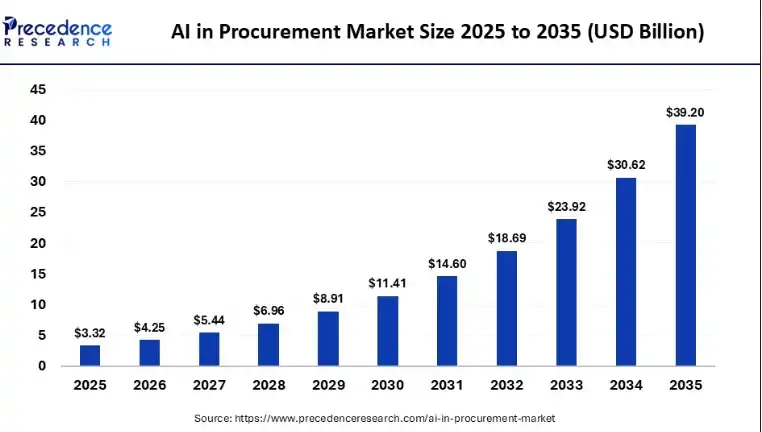
Source: Precedent Research
The growth is fueled by the realization that procurement is no longer a back-office administrative function but a strategic lever for EBITDA improvement. Modern platforms like Omnea and Zip are capturing this market by solving the fragmentation tax that has long plagued large organizations. As companies face mounting pressure to optimize margins and manage complex compliance requirements, the demand for high-integrity, automated procurement systems has transitioned from a luxury to a baseline requirement for enterprise scalability.
Replacing Legacy Procurement Tools
Legacy procurement systems were designed as digital filing cabinets. They were static repositories for contracts and invoices that required manual data entry and offered little to no predictive capability. These outdated systems often create more friction than they solve, leading to maverick spending where employees bypass official channels because the software is too difficult to navigate. Decision makers are now migrating to AI native solutions because legacy tools lack the interoperability required for the modern tech stack.
- User Friction and Adoption: Older tools lack intuitive interfaces, leading to poor internal compliance. AI platforms prioritize the user experience, ensuring that the procurement process feels like a consumer-grade application while maintaining rigorous backend controls.
- Data Silos: Legacy tools often fail to communicate with ERPs, legal databases, and security assessment tools. Modern orchestration layers break these silos, providing a single source of truth for every dollar committed.
- Inflexibility: Traditional software follows rigid, linear workflows that cannot adapt to the nuances of different spend categories. AI allows for dynamic routing based on risk profiles, department needs, and historical vendor performance.
How AI Reduces Bottlenecks
The primary bottleneck in procurement is the approval black hole, where requests sit idle in legal, security, or finance queues. AI procurement platforms eliminate these stalls by automating the triage process. Platforms such as Tropic demonstrate this by leveraging massive datasets to provide proactive recommendations and cost optimization, allowing human stakeholders to focus only on high-value exceptions rather than routine checks.
Strategic efficiency is achieved through:
- Automated Intake: Capturing spend requests at the point of inception and automatically gathering necessary documentation from stakeholders.
- Parallel Processing: Instead of a sequential approval chain, AI can trigger simultaneous reviews across departments, drastically reducing the request-to-order lifecycle.
- Predictive Risk Scoring: AI models analyze supplier data in real time, identifying potential financial instability or compliance breaches before a contract is even signed.
Industries Investing in AI
While the need for efficient spend management is universal, specific sectors are leading the investment charge due to their inherent complexity and high volume of third-party dependencies. Fintech and Healthcare, for instance, face stringent regulatory environments where procurement errors can lead to massive fines. For an investor, targeting these high-barrier-to-entry industries offers the most significant defensibility.
- Technology and SaaS Heavy Firms: These companies manage hundreds of vendors and require automated renewals and license optimization to prevent subscription bloat.
- Manufacturing and Logistics: Where supply chain transparency and just-in-time procurement are vital for maintaining production schedules.
- Financial Services: Heavily focused on vendor risk management and ensuring that every supplier meets rigorous data protection standards.
Trends Driving Automation
We are currently witnessing a shift from Systems of Record to Systems of Intelligence. The prevailing trend is the move toward Procurement Orchestration, where the platform acts as a conductor over various departmental tools. There is also an increasing emphasis on Autonomous Sourcing, where AI can identify alternative vendors or negotiate basic contract terms without human intervention, based on historical pricing data and market benchmarks.
Furthermore, the Green Procurement movement is driving automation. Large enterprises are now mandated to report on Scope 3 emissions, which are the carbon footprint of their suppliers. AI is the only viable way to track, analyze, and optimize these metrics across thousands of global vendors. For the strategic investor, the intersection of AI-driven efficiency and ESG compliance represents one of the most stable and high-growth niches within the current B2B software landscape.
Overview of Omnea Platform
Omnea is an AI-native procurement orchestration layer that centralizes corporate spend into a single, intelligent front door. By integrating deeply with an organization’s existing tech stack, it harmonizes the conflicting interests of finance, legal, and IT teams. For strategic investors, the platform value proposition lies in its ability to eliminate the hidden costs of business: wasted time, redundant software licenses, and unmanaged vendor risks.
1. Streamlining Operations
The traditional procurement lifecycle is notoriously fragmented. A single purchase often requires a dozen email threads, multiple manual document uploads, and endless follow-ups with different department heads. Omnea re-engineers this flow by centralizing the intake process and automating the routing of tasks.
- Unified Intake: Employees no longer need to guess who to contact for a new software purchase or a hardware upgrade. They enter a single portal that guides them through the necessary questions based on the nature of the request.
- Automated Triage: The platform automatically identifies which stakeholders need to be involved. If a vendor handles sensitive data, the security review is triggered instantly. If the contract exceeds a certain value, the CFO is notified.
- Real Time Visibility: Dashboard views allow department heads to see exactly where a request is stalled, removing the black hole effect that typically characterizes corporate buying.
2. Core AI Features
The true engine of the platform is its AI native architecture. While older platforms have tried to bolt on AI features, Omnea uses machine learning as a foundational element to drive proactive decision-making. The system continuously analyzes procurement patterns, approval behavior, supplier interactions, and operational bottlenecks to improve workflow efficiency over time.
Technical Insight: The platform utilizes high-fidelity data extraction to scan vendor contracts and security questionnaires. This allows the system to automatically flag non-compliant clauses or high-risk terms before a human lawyer even opens the file.
Key AI capabilities include:
- Contract Intelligence: AI models analyze renewals and price benchmarks, alerting finance teams if they are overpaying compared to market rates or if a renewal is approaching for a tool that has low internal usage.
- Smart Risk Assessment: By aggregating data from global risk databases, the AI provides a real-time risk score for every supplier, accounting for financial stability, cybersecurity posture, and geographic vulnerabilities.
- Natural Language Processing: This enables the platform to interact with users conversationally, turning complex procurement policies into simple, guided workflows.
Why Enterprises Adopt Omnea
The shift toward platforms like Omnea is driven by a need for spend agility. In an era where market conditions can change overnight, enterprises cannot afford to be locked into rigid, slow-moving procurement cycles. Decision makers are looking for solutions that offer both control and speed, a balance that legacy ERP systems rarely achieve.
| Challenge | Omnea Solution | Business Impact |
| Maverick Spend | Intuitive UX that employees actually want to use. | 100% visibility into all corporate outflows. |
| Vendor Bloat | Automated detection of overlapping software tools. | Significant reduction in redundant SaaS costs. |
| Audit Failures | Immutable digital trail of every approval and document. | Rapid, stress-free compliance and audit cycles. |
Core Features of an AI Procurement Platform
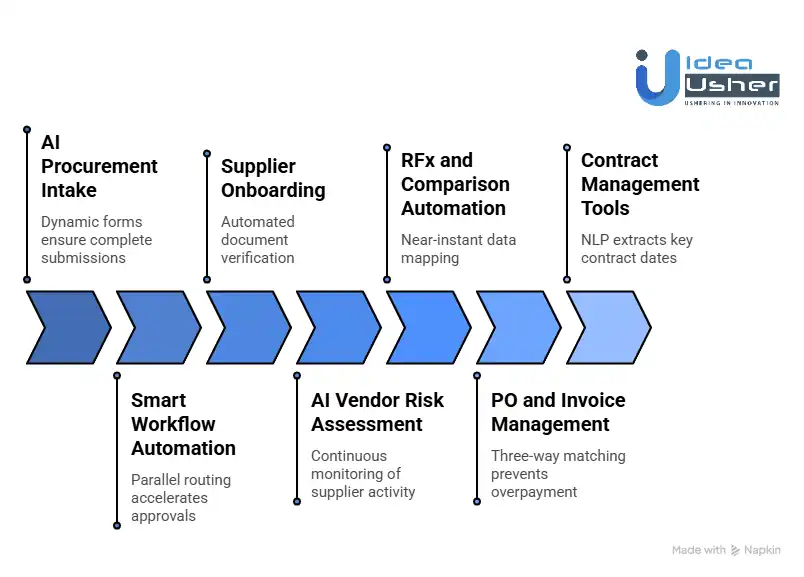
A robust AI procurement platform is a comprehensive ecosystem designed for the complexity of modern enterprise spending. The value lies in modularity and the ability to process high-volume data without human fatigue. These platforms transform procurement from disjointed tasks into a continuous data-driven cycle that protects margins and ensures compliance.
1. AI Procurement Intake
The intake system is the gateway to the platform. Traditional intake is often a messy collection of messages and emails that lead to missing information. An AI-powered intake system uses dynamic forms that adapt to user input. If an employee requests a new software tool, the system automatically asks for data privacy details.
Platforms like Zip have popularized this by providing a consumer-grade interface that guides users through complex requests. This ensures every submission is 100% complete and audit-ready before reaching an approver.
2. Smart Workflow Automation
Smart workflows eliminate the linear wait and see approach of legacy software. Instead of a request sitting in a generic inbox, the AI identifies the specific stakeholders required for finance, legal, IT, or security and routes the request to them simultaneously. This parallel routing significantly accelerates approvals while reducing unnecessary operational delays.
- Conditional Logic: The platform can auto-approve low-risk, low-cost items that fall within a pre-approved budget.
- Stakeholder Triage: Tonkean exemplifies this by using AI agents to orchestrate handoffs between different departments and systems autonomously.
- Bottleneck Detection: The system alerts administrators when a request stalls, providing data on where process friction exists.
3. Supplier Onboarding
Onboarding a new vendor is often a compliance nightmare involving tax forms and security certifications. AI platforms automate the collection and verification of these documents. Using Optical Character Recognition, the system reads uploaded files and verifies tax IDs against government databases.
Tools such as Oro Labs streamline this by creating an intelligent workflow that gathers supplier data while maintaining a clean, validated record across all integrated systems. This automation reduces the window for fraud and business email compromise by ensuring bank details match the corporate identity.
4. AI Vendor Risk Assessment
In the current regulatory climate, knowing your business partners is a legal mandate. AI risk assessment tools provide a continuous monitoring layer that manual checks cannot match. These systems continuously monitor supplier activity, cybersecurity ratings, financial signals, and compliance records across multiple external data sources..
Risk Strategy Note: High-performing platforms aggregate data from thousands of external sources, including news feeds and cybersecurity ratings. Ivalua stands out here by embedding AI risk agents that monitor global news and financial indicators to update supplier health scores in real time.
5. RFx and Comparison Automation
The Request for X process is notoriously labor-intensive. AI changes the game by automatically parsing vendor responses and mapping them against company requirements. It can quickly identify pricing inconsistencies, compliance gaps, and missing deliverables across multiple proposals without manual review. This allows procurement teams to compare vendors faster, make more data-driven decisions, and reduce sourcing cycle times significantly.
| Feature | Manual RFx | AI-Automated RFx |
| Response Analysis | Weeks of manual entry. | Near-instant data mapping. |
| Price Benchmarking | Guesses based on history. | Real-time market comparison. |
| Selection Criteria | Subjective and prone to bias. | Objective scoring on KPIs. |
Arkestro is a prime example of this innovation, using predictive pricing models to suggest optimal bid levels and automate the comparison of supplier proposals.
6. PO and Invoice Management
Once a vendor is selected, the platform manages financial execution. AI-driven Purchase Order systems ensure every invoice is matched against a valid PO and a delivery receipt. This three-way matching prevents overpayment and ensures the finance team only releases funds for approved goods and services.
Ramp has integrated these capabilities into a broader financial suite, using AI to detect duplicate invoices and flag discrepancies in pricing automatically. This level of oversight prevents budget erosion from invoice creep and human error.
7. Contract Management Tools
Contracts should be living documents rather than static files hidden in a folder. AI-driven management tools use Natural Language Processing to read every contract in the system. They automatically extract key dates, such as renewal deadlines and notice periods, and feed them into a centralized calendar.
Ironclad leads in this specialized niche, using AI to turn legal prose into searchable data points. This prevents auto-renewals of underused software and gives procurement teams the leverage to renegotiate terms well in advance of an expiration. This proactive oversight creates immediate and measurable ROI.
Advanced Features That Increase Enterprise Adoption
Enterprise adoption of AI procurement platforms hinges on the transition from automation to intelligence. While basic tools focus on digitizing paperwork, advanced platforms offer predictive capabilities that shift procurement from a cost center to a value driver. These features allow organizations to manage exponential growth in vendor counts without increasing operational overhead.
1. Autonomous Workflows
Autonomous workflows move beyond simple logic to handle complex, non-linear procurement events. These systems self-correct when data is missing or autonomously re-route requests if an approver is unavailable. For instance, if a vendor certification is nearing expiration, the system can contact the supplier for an update without human intervention.
Platforms like Glean integrate this autonomy by connecting internal knowledge bases with procurement actions. This ensures workflows are contextually aware of previous company decisions, making the process faster and more reliable.
2. AI Procurement Copilot
The AI Copilot serves as a real-time advisor, providing instant access to complex contract data and market intelligence. Instead of manually searching through thousands of PDFs, a user can ask a natural language question to get an immediate answer. This dramatically reduces research time while helping procurement teams make faster and more informed decisions.
- Scenario Modeling: The Copilot predicts the impact of price increases across specific categories.
- Negotiation Prep: It summarizes historical performance and highlights missed SLAs to provide leverage.
- Policy Guidance: It explains to employees why a purchase was flagged, improving internal compliance.
3. Fraud and Compliance Detection
Fraud in the supply chain is a multi-billion-dollar problem. Advanced AI platforms implement a zero-trust approach to financial transactions by analyzing patterns rather than just static data points. Machine learning models continuously evaluate vendor activity, payment behaviors, and approval anomalies to detect suspicious transactions in real time.
Strategic Edge: By using anomaly detection, the platform identifies split-invoicing where a vendor breaks a large payment into smaller amounts to bypass approval limits. It also monitors for ghost vendors or suspicious changes in banking details.
4. Global Intelligence Engine
A global intelligence engine aggregates data from millions of external sources to provide a 360-degree view of the supply chain. This goes beyond basic financial health to include geopolitical risks and labor practices. It continuously monitors global events, supplier ecosystems, and market disruptions to help enterprises make faster and more resilient procurement decisions.
| Intelligence Category | AI Capability | Business Value |
| Market Pricing | Aggregates real-time global benchmarks. | Prevents overpaying for services. |
| Risk Monitoring | Scans 24/7 for regional disasters. | Enables rapid pivoting to backups. |
| Sustainability | Tracks carbon footprint and ESG ratings. | Ensures compliance with green mandates. |
5. Multi-Language Support
For global enterprises, procurement spans dozens of countries. Advanced AI platforms use translation models to handle localized tax laws, regional compliance documents, and vendor communications. Platforms like Coupa have invested heavily here, ensuring a purchase order in Tokyo follows the same standards as one in London. This allows a centralized team to manage global spend without language barriers or regional silos.
6. Team Performance Benchmarking
Benchmarking allows companies to compare the performance of different departments or regional offices. The AI identifies high-performing teams that consistently negotiate better terms or maintain higher compliance rates. By surfacing these insights, leadership can standardize best practices.
If one department reduces SaaS waste by 20% through a specific review process, the AI suggests implementing that same workflow across the entire organization. This turns every department into a source of potential savings.
How AI Works Inside Procurement Platforms?
Modern AI procurement platforms function by creating a digital brain that sits atop raw business data. Instead of simply storing files, these systems process information through machine learning layers to provide actionable intelligence. This technical foundation allows the software to move beyond record-keeping into strategic decision support, transforming static data into a competitive advantage.
1. NLP for Intake Requests
Natural Language Processing allows the platform to understand human intent. When an employee types a request, the NLP engine parses the text to identify category, urgency, and specific requirements. These models continuously improve over time by learning from employee interactions, approval patterns, and procurement outcomes.
- Entity Extraction: The system pulls vendor names, dollar amounts, and contract terms from unstructured emails or chat messages automatically.
- Contextual Understanding: It recognizes the difference between a software renewal and a new implementation, routing each to the correct workflow.
- User Experience: Platforms like Omnea use this to provide a conversational interface, making procurement feel like a simple chat rather than a bureaucratic hurdle.
2. Supplier Risk Scoring
Risk scoring models use a combination of supervised and unsupervised learning to predict vendor failure. These models analyze thousands of variables, from credit ratings to geopolitical news, to generate a live risk profile. The AI continuously updates supplier risk scores as new financial, operational, or cybersecurity data becomes available.
Technical Insight: By using anomaly detection, the AI flags vendors whose behavior suddenly deviates from historical patterns. This includes sudden changes in banking jurisdictions or a flurry of legal filings. This proactive alerting allows companies to secure alternative sources before a supply chain break occurs.
3. Predictive Spend Forecasting
Predictive analytics shifts the focus from what was spent to what will be spent. By analyzing historical seasonality, growth trends, and market fluctuations, the platform creates high-accuracy financial models. These forecasting engines help enterprises optimize procurement planning while reducing unexpected budget overruns.
- Budget Drift Detection: The AI identifies departments likely to exceed their quarterly budget based on current request velocities.
- Renewal Forecasting: It flags upcoming contract expirations and predicts price increases based on inflationary data and market benchmarks.
- Cash Flow Optimization: By predicting when large invoices will hit, finance teams can better manage liquidity and capital allocation.
4. Intelligent Recommendations
Not every procurement request requires the same level of scrutiny. Intelligent recommendation engines assist approvers by providing a confidence score for each request based on historical data. These recommendation systems reduce decision fatigue by surfacing the most relevant insights automatically during the approval process.
| Feature | How the AI Thinks | Benefit to Approver |
| Policy Matching | Checks requests against 1,000+ internal rules. | Instantly flags non-compliant spend. |
| Price Validation | Compare bids against similar recent purchases. | Confirms if the price is fair market value. |
| Vendor Trust | Evaluates past performance and security. | High-trust vendors get fast-tracked. |
5. AI Insights Dashboards
The final layer of the AI stack is the visualization of complex data. Unlike static reports, AI-driven dashboards are dynamic and exploratory. They use explainable AI to show not just the numbers, but the reason behind them. If a dashboard shows a spike in IT spend, the AI can drill down automatically to show it was driven by a specific department hiring surge.
These insights allow leadership to make rapid, data-backed adjustments to corporate strategy. By turning vast oceans of procurement data into clear narratives, these platforms ensure every dollar spent aligns with broader enterprise goals.
How AI Simplifies Supplier Risk Management?
Modern AI procurement platforms have transformed supplier risk management from a reactive, point-in-time exercise into a proactive, continuous defense mechanism. In a global economy, the traditional annual review is dangerously insufficient for managing thousands of vendors. By automating data collection and high-level pattern recognition, these platforms allow enterprises to maintain a level of scrutiny previously reserved only for their most critical suppliers.
1. Background Verification
Manually verifying a new vendor involves tedious cross-referencing of business licenses, tax IDs, and ownership structures. AI platforms automate this process by instantly querying global databases the moment a vendor is invited to the platform. Automated verification workflows dramatically reduce onboarding delays while improving procurement accuracy and compliance consistency.
- Identity Resolution: The AI ensures a vendor is not a shell company or a sanctioned entity by checking international watchlists.
- Legal Standing: Platforms like Middesk integrate with these systems to verify tax registration in seconds rather than days.
- Conflict Detection: The system scans for overlapping addresses or shared ownership between vendors and employees to prevent fraud.
2. Continuous Monitoring
Static risk assessments expire the moment they are signed. Advanced AI models maintain a living risk profile for every supplier by monitoring external data feeds 24/7. This creates a safety net that protects the enterprise from unforeseen disruptions. Real-time monitoring allows procurement teams to respond proactively instead of reacting after operational damage has already occurred.
Expert Insight: Continuous monitoring uses sentiment analysis to scan news reports. If a key supplier is mentioned in a report regarding a labor strike or a warehouse fire, the AI flags the potential supply chain break before the vendor even notifies the company.
| Risk Vector | AI Monitoring Source | Proactive Action |
| Financial Health | Credit bureaus and public filings. | Alerts finance to seek backup vendors. |
| Cybersecurity | Dark web scans and security ratings. | Triggers an immediate IT security audit. |
| Geopolitical | Global news and policy changes. | Suggests diversifying spend to other regions. |
3. Compliance Alerts
Regulatory landscapes shift constantly, making it nearly impossible for human teams to stay updated on every change in law across every jurisdiction. AI platforms act as a first line of defense by mapping current contracts and vendor behaviors against new regulations. If a new data privacy law is enacted, the AI scans the entire contract repository to identify which vendors lack the required clauses.
It then sends an automated alert to the legal team or initiates a bulk amendment process. This level of automated compliance ensures the organization remains audit-ready and avoids massive fines. By treating compliance as a real-time data problem, AI-native platforms remove the guesswork from enterprise risk management.
How to Develop an AI Procurement Platform Like Omnea?
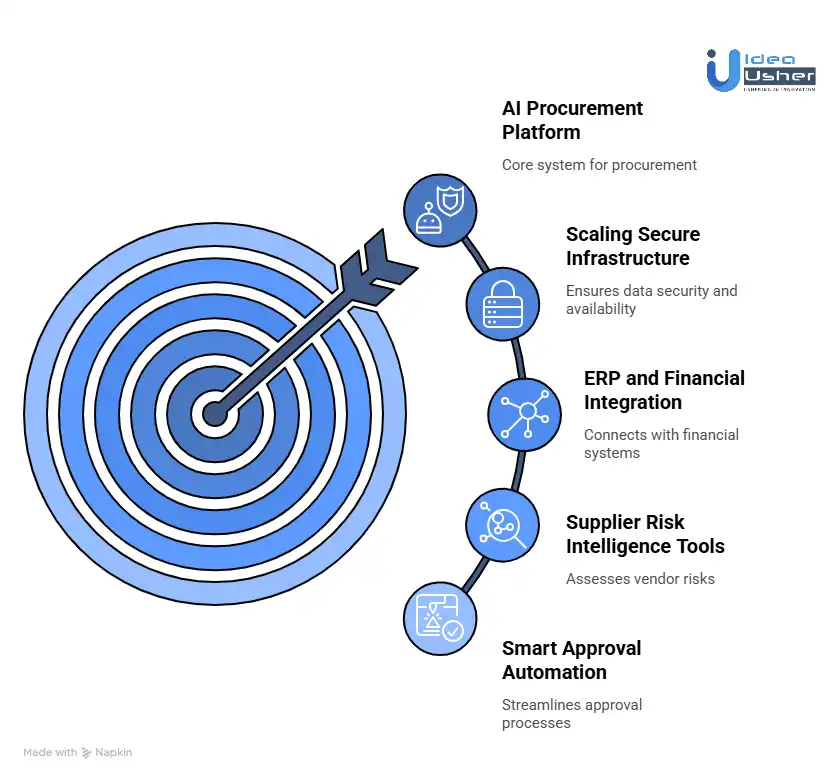
Building high-performance AI procurement platforms requires a deep architectural commitment to data orchestration. At IdeaUsher, we focus on creating systems of intelligence that sit between employees and existing financial records. We bridge complex regulatory requirements with a consumer-grade user experience, deploying pre-vetted development teams to ensure high internal adoption from day one.
1. Mapping Procurement Workflows
Before we write code, we map the friction points of the modern enterprise. Procurement is a web of dependencies involving finance, legal, security, and IT teams. Our discovery process helps uncover hidden inefficiencies, approval delays, and compliance gaps that slow down enterprise purchasing operations. This allows us to design intelligent workflows tailored to the organization’s actual procurement behavior and operational structure.
- Stakeholder Discovery: We identify specific hard stops in current processes, such as manual security reviews or legal redlining.
- Edge Case Identification: Our teams account for different spend types like SaaS and hardware, each requiring a unique approval path.
- Latency Analysis: We measure the time a request sits in a queue to identify where our AI-driven automation provides the highest ROI.
2. Building an AI Intake Engine
The intake engine is the most critical component for adoption. If it is difficult to use, employees bypass it, leading to maverick spending. We utilize Natural Language Processing to convert text requests into structured data packets. By removing the friction of manual entry, we ensure that every purchase request starts with high-quality data and full stakeholder visibility.
Engineering Note: We use Large Language Models to power the intent recognition layer. When a user asks for a tool to manage social media, our AI instantly categorizes this as Marketing Software and triggers privacy checks without requiring complex dropdown menus.
3. Smart Approval Automation
We replace the static chain of command with dynamic, parallel processing. Instead of a request moving slowly from one person to the next, our systems identify all necessary stakeholders and notify them simultaneously. This significantly accelerates approvals while reducing operational bottlenecks across procurement workflows.
- Contextual Routing: We implement rules engines that evaluate the risk and cost of a request in real time.
- Auto-Approval Thresholds: We set logic that allows the system to greenlight low-risk renewals that match historical pricing data.
- Conflict Resolution: We build dashboards for administrators to see where a request is stuck, allowing for instant overrides.
4. Supplier Risk Intelligence Tools
This feature differentiates a basic tool from an enterprise-grade platform. We architect data aggregators that pull from external risk feeds to provide a 360-degree view of the vendor. These systems continuously analyze financial stability, cybersecurity posture, compliance history, and operational performance across multiple data sources.
| Technical Component | Function | Data Source |
| Identity Verification | Confirms vendor legal status. | Government and Tax DBs. |
| Risk Scoring Engine | Calculates a live health score. | Credit bureaus and news APIs. |
| Security Assessment | Evaluates cybersecurity posture. | Security specialized APIs. |
5. ERP and Financial Integration
An AI procurement platform is only as good as the data it can access. We build robust, bi-directional integrations with Enterprise Resource Planning systems like NetSuite, SAP, or Oracle. Successful integration ensures that once a purchase is approved, a Purchase Order is automatically generated in the ERP. We handle the sophisticated API management and data mapping required to ensure financial records remain consistent. Without this connectivity, the platform remains a silo.
6. Scaling Secure Infrastructure
When we manage corporate spend, security is the core product. We build infrastructure to handle sensitive financial data and personal information with enterprise-grade protection. Our architecture includes continuous monitoring, access control frameworks, and advanced threat detection mechanisms to minimize security vulnerabilities.
- Compliance Standards: We build with SOC2 and auditability in mind from the initial design phase.
- Data Encryption: We ensure all information is encrypted both at rest and in transit.
- Multi-Tenancy: We design databases to strictly segregate data between different corporate clients to prevent leakage.
- High Availability: Procurement is mission-critical. We provide the technical talent necessary to ensure a 99.9% uptime guarantee so operations never grind to a halt.
What Enterprises Expect From AI Procurement Tools?
Enterprise expectations have shifted from basic digitization to high-velocity orchestration. Organizations no longer want software that merely records spending; they require AI procurement platforms that actively improve financial outcomes. At IdeaUsher, we focus on priorities that offer a quantifiable impact on operational efficiency and reduce the total cost of ownership across the entire vendor portfolio.
1. Faster Turnaround Times
The most visible metric of success is the reduction in cycle time. In many large organizations, the path from identifying a need to signing a contract can take weeks. We address this by replacing sequential, manual approvals with automated, parallel processing. Our AI-driven workflows reduce procurement friction while maintaining compliance and approval accuracy across departments.
- Zero-Touch Approvals: For low-risk, recurring expenses within budget, our systems bypass human intervention entirely.
- Automated Triage: Requests are instantly categorized and sent to legal, IT, and finance simultaneously rather than waiting in a linear queue.
- Proactive Reminders: The AI identifies which stakeholder is causing a delay and provides nudges to keep the process moving.
2. Better Spend Governance
Governance ensures every dollar aligns with company policy. Without a centralized AI platform, maverick spend often drains a significant budget. We build systems that provide the necessary guardrails without slowing down the business. These governance layers help enterprises enforce procurement policies consistently while maintaining operational flexibility for employees.
Governance Strategy: By integrating your procurement policy directly into the intake engine, the AI prevents non-compliant requests before submission. This shifts the burden from manual audits to automated prevention at the point of inception.
| Feature | Manual Approach | AI-Enabled Approach |
| Policy Enforcement | Relies on employee memory. | Built-in, real-time logic. |
| Duplicate Detection | Spotted during audits. | Blocked instantly at intake. |
| Budget Tracking | Monthly manual updates. | Live sync with ERP data. |
3. Analytics for Leadership
For the C-suite, the value lies in data clarity. Leadership teams expect more than a list of vendors; they need strategic insights for long-term planning. We develop advanced dashboards that turn raw transaction data into a narrative of corporate health. By leveraging predictive models, these dashboards identify savings leakage where the company fails to use negotiated discounts.
Platforms like Sievo excel in this area by aggregating fragmented data to provide clear spend visibility and sustainability tracking. This visibility allows for data-backed decisions on departmental budgets and global supply chain restructuring, ensuring that every dollar spent is an investment in future growth.
AI Procurement Use Cases With High ROI
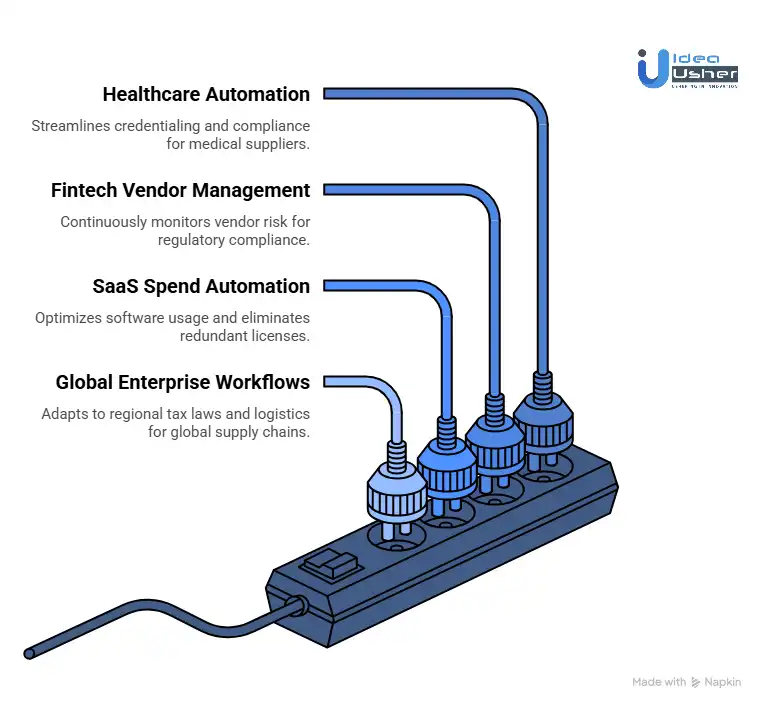
The true power of AI procurement platforms lies in their application to high-stakes industries where inefficiency equals financial or legal risk. We see the most immediate returns in sectors where complex regulations and massive vendor ecosystems collide. By deploying targeted AI agents, we help organizations turn these operational bottlenecks into streamlined, high-performance engines.
1. Healthcare Automation
In healthcare, procurement is a matter of both fiscal responsibility and patient safety. We develop specialized workflows that manage the rigorous credentialing and compliance tracking required for medical suppliers. AI-driven automation helps healthcare organizations reduce procurement delays while maintaining strict regulatory compliance and supply chain visibility.
- Recall Management: Our systems instantly cross-reference product recall notices with purchase history to identify affected inventory across multiple facilities.
- Compliance Auto-Tracking: We build AI agents that monitor expiration dates for healthcare-specific certifications, automatically prompting vendors for updates.
- Consolidated Buying: By analyzing spend across departments, the AI identifies opportunities to consolidate surgical supply orders for better pricing.
2. Fintech Vendor Management
Fintech companies operate under intense regulatory scrutiny regarding third-party risk. We build vendor management modules that treat security and compliance as real-time data streams. These systems continuously monitor vendor risk exposure, helping fintech firms maintain compliance while reducing operational vulnerabilities.
Industry Standard: We implement “Continuous Due Diligence,” where the AI monitors dark web leaks and financial news for any mention of a vendor. If a processor is flagged for a breach, our platform triggers an immediate internal audit and notifies the risk team.
3. SaaS Spend Automation
SaaS sprawl is a primary source of budget leakage. Large enterprises often pay for redundant tools or licenses for former employees. We address this through automated discovery and renewal management. Our AI systems provide complete visibility into software usage, helping enterprises eliminate waste and optimize recurring technology spend.
| ROI Driver | Impact of AI |
| License Optimization | Identifies underused seats to downsize at renewal. |
| Redundancy Check | Flags when a new request overlaps with an existing tool. |
| Renewal Leverage | Surfaces market benchmarks to use in negotiations. |
By using platforms like Vendr, enterprises can automate the negotiation and discovery phase of the SaaS lifecycle, ensuring IT spend remains lean and effective.
4. Global Enterprise Workflows
Managing a supply chain that spans continents requires coordination that manual teams cannot provide. We develop global workflows that adapt to regional tax laws, languages, and shipping logistics. For a global conglomerate, a purchase in Singapore has different VAT and compliance requirements than one in Germany.
Our AI-driven platforms act as an orchestration layer, ensuring the headquarters has full visibility while local offices maintain flexibility. This unified approach eliminates regional silos and creates a single source of truth for global spend. Ivalua provides an excellent example of this scale, offering a unified suite that manages thousands of suppliers while maintaining localized compliance strategies.
Enterprise Integrations Needed in Procurement Platforms
For AI procurement platforms to be effective, they cannot exist as isolated islands of data. True value is realized when the platform acts as a connective tissue between disparate corporate systems. At IdeaUsher, we focus on building deep, bi-directional integrations that allow data to flow seamlessly from a chat window to the general ledger. This ensures every transaction is captured, validated, and recorded without manual entry.
1. SAP and Oracle ERP Sync
The ERP is the financial heart of the enterprise. We ensure our procurement solutions maintain a living link with heavyweights like SAP, Oracle, and NetSuite. This prevents the data siloing that leads to budget discrepancies. These real-time ERP integrations improve financial accuracy while eliminating manual procurement reconciliation tasks.
- Real Time PO Generation: As soon as a request is approved in the intake engine, we trigger the automatic creation of a Purchase Order within the ERP.
- Budget Validation: Before a user submits a request, our AI pings the ERP to check if there are sufficient funds remaining in that specific cost center.
- Automatic Reconciliation: When an invoice arrives, we match it against the ERP records to ensure pricing and quantities align with the original agreement.
2. Slack and Teams Workflows
Adoption happens where people already work. If employees have to log into a separate, clunky portal to buy something, they often bypass the system. We bring the procurement office directly into the company communication hub. This conversational procurement approach significantly improves employee adoption and accelerates request completion across departments.
Workflow Example: A user types a command in Slack. Our AI chatbot initiates a conversational intake process, asks for the necessary documentation, and routes it for approval. Approvers receive a notification in Microsoft Teams with simple buttons to clear requests in seconds without leaving their primary application.
3. CRM and Finance Connectivity
Procurement data often intersects with sales and general finance operations. We build bridges to CRM platforms and specialized finance tools to provide a holistic view of company health. These integrations create a connected operational environment where procurement decisions align directly with financial planning and customer operations.
| Integration Type | Platform | Business Outcome |
| CRM | Salesforce or HubSpot | Links vendor spend to specific client projects or sales cycles. |
| Finance | Quickbooks or Xero | Simplifies tax prep and cash flow forecasting for growing firms. |
| Identity | Okta or Azure AD | Ensures only authorized employees can initiate high value spend. |
By integrating with platforms like Workato, we enable enterprises to create complex cross platform automations that trigger based on procurement events. For instance, when a new software vendor is approved, the system can automatically create a new record in the CRM and provision a security review ticket in Jira. This interconnectedness ensures that procurement is not just a department but a streamlined process that powers the entire organization.
Cost to Develop an AI Procurement Platform Like Omnea
The investment required for AI procurement platforms varies significantly based on scale and security requirements. Building a platform that handles millions in corporate spend demands a higher level of precision than a standard SaaS tool. We help partners navigate these costs by prioritizing high-impact features that deliver immediate ROI while building a scalable foundation for future growth.
1. MVP Development Costs
A Minimum Viable Product focuses on the core intake engine and basic approval workflows. This initial phase allows you to test the platform with a single department or mid-market client before scaling to a full enterprise suite. An MVP-first approach helps validate product-market fit while minimizing early-stage development risk and infrastructure overhead.
- Basic Intake & Workflows: $50,000 to $80,000.
- UI/UX Design: $15,000 to $25,000 for a consumer-grade experience.
- Basic Vendor Database: $10,000 to $20,000.
- Total MVP Estimate: $75,000 to $125,000.
2. AI and Automation Features
The intelligence layer is where the primary value is created. Developing custom NLP models and predictive risk scoring requires specialized talent and significant data processing. Advanced automation capabilities significantly improve procurement efficiency, supplier intelligence, and enterprise decision-making accuracy.
Cost Perspective: Implementing advanced LLM-based intent recognition and autonomous agents typically adds $40,000 to $90,000 to the budget. This includes fine-tuning models on procurement-specific datasets to ensure high accuracy in contract extraction and policy matching.
3. Third-Party Integration Expenses
A procurement tool is only useful if it talks to other systems. Integration costs depend on the number of APIs and the complexity of the data mapping required. Robust integrations ensure procurement workflows remain synchronized across ERP, communication, finance, and identity management systems.
| Integration Type | Complexity | Estimated Cost |
| Communication (Slack/Teams) | Moderate | $10,000 to $15,000 |
| Identity (Okta/AD) | Moderate | $8,000 to $12,000 |
| ERP (SAP/NetSuite) | High | $25,000 to $50,000 |
4. Cloud and Infrastructure
Hosting a data-heavy platform requires a secure and scalable cloud environment. Monthly operational costs scale with your user base and the volume of documents processed by the AI. We generally see initial infrastructure costs ranging from $2,000 to $5,000 per month. This covers managed database services, AI compute instances, and redundant storage for legal documents. As the platform scales to serve global enterprises, these costs can grow to $10,000 or more per month depending on data residency requirements.
5. Security and Compliance
For enterprise adoption, security is not optional. You must budget for the certifications and audits that large corporate legal teams require before they will trust your platform with their financial data. Strong compliance foundations improve enterprise credibility while reducing legal, operational, and cybersecurity risks.
- SOC2 Type 1 & 2 Audits: $20,000 to $40,000.
- Penetration Testing: $10,000 to $15,000 per year.
- Data Privacy Tools: $5,000 to $10,000 for GDPR and CCPA compliance mapping.
6. Development Team Structure
Building a platform of this caliber requires a cross-functional team with specific expertise in fintech and AI. We provide pre-vetted teams that include the following roles to ensure a smooth development lifecycle. This collaborative structure accelerates product delivery while maintaining enterprise-grade quality, scalability, and compliance standards.
- Product Manager: To translate complex procurement laws into software features.
- Full-Stack Developers: Specializing in secure, scalable backend architectures.
- AI/ML Engineers: To build and maintain the NLP and risk-scoring engines.
- DevOps Engineer: To manage the secure cloud infrastructure and CI/CD pipelines.
- QA Specialists: To rigorously test financial logic and integration points.
Partnering with us allows you to access this entire team structure without the overhead of individual hiring, typically reducing total development time by 30% to 40%. This accelerated timeline ensures you can enter the market faster with a platform that is ready for the rigors of enterprise-level procurement.
How Procurement Automation Reduces Operational Costs?
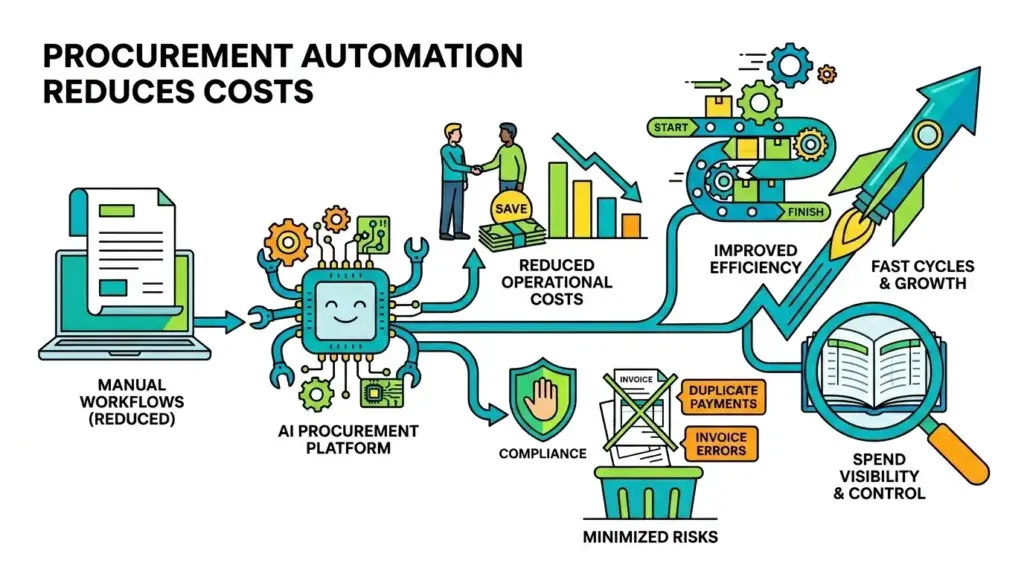
The transition to AI procurement platforms offers a direct path to reclaiming lost margins. By shifting from manual, paper-heavy processes to intelligent digital workflows, organizations can eliminate the hidden costs associated with administrative friction. These platforms act as a force multiplier, allowing the existing workforce to handle a significantly higher volume of transactions while maintaining strict financial discipline and overhead control.
1. Lowering Processing Expenses
Manual procurement is expensive because it consumes thousands of high-value employee hours on low-value data entry. Automation slashes the cost per purchase order by removing the need for human intervention in routine administrative tasks. This reduction in manual workload allows procurement teams to focus on strategic sourcing and supplier optimization instead of repetitive operational tasks.
- Digital Data Extraction: AI-powered tools read invoices and contracts instantly, eliminating hours of manual typing and cross-referencing.
- Touchless Transactions: High-frequency, low-cost items move from request to payment without a single human touchpoint.
- Consolidated Spend: By identifying fragmented purchases across different departments, the system suggests bulk buying opportunities that reduce unit costs.
2. Reducing Approval Errors
Human error in the procurement chain leads to duplicate payments, missed early-payment discounts, and compliance fines. AI platforms provide a rigorous, objective oversight layer that never suffers from fatigue or oversight. Machine learning systems continuously validate procurement data to minimize financial leakage and strengthen compliance enforcement.
Risk Mitigation: Intelligent systems perform three-way matching by comparing the purchase order, the delivery receipt, and the invoice. This ensures that the company only pays for what it actually received at the agreed-upon price, preventing the invoice creep that often goes unnoticed in manual systems.
| Error Type | Manual Risk Level | AI Prevention Method |
| Duplicate Invoices | High | Real-time cross-referencing of vendor and amount. |
| Out-of-Policy Spend | Moderate | Automated block at the point of intake. |
| Calculation Mistakes | Low | Systematic verification of tax and line items. |
3. Faster Cycle Management
Time is a significant operational cost. When procurement cycles are slow, projects stall and supply chain risks increase. Automation accelerates the entire lifecycle by removing the linear bottlenecks that define legacy systems. Instead of waiting days for a manager to find a request in a crowded inbox, the platform uses intelligent routing to send alerts to the correct devices instantly.
By providing approvers with all the necessary context, such as budget availability, vendor risk scores, and contract terms, decisions happen in minutes rather than weeks. This velocity allows the enterprise to be more agile, securing better pricing and ensuring critical supplies are always available. Companies using tools like Airbase see this impact immediately as they gain real-time control over the entire spend-to-close process.
KPIs Enterprises Track in AI Procurement Platforms
The transition to AI procurement platforms allows leadership to manage the supply chain through precise data. By tracking specific Key Performance Indicators, organizations measure the direct impact of automation on the bottom line. These metrics provide the transparency needed to refine strategies and ensure the platform delivers on its efficiency promises.
1. Cycle Time Reduction
This is the primary heartbeat of procurement efficiency. It measures the total time from the initial purchase request to the final issuance of a Purchase Order. Reducing procurement cycle times improves operational agility while accelerating project execution and vendor onboarding.
- Intake Speed: How quickly the AI categorizes and validates a request.
- Approval Velocity: Average time an approver takes to act once notified.
- Onboarding Time: The duration required to verify a new supplier’s credentials.
2. Supplier Approval Rates
Tracking the percentage of suppliers that pass through automated risk gates is vital for understanding ecosystem health. This KPI helps organizations evaluate the effectiveness of their vendor risk management and compliance frameworks. It also provides visibility into supplier quality trends, helping procurement teams strengthen long-term sourcing strategies.
Metric Insight: A high rejection rate might indicate that sourcing criteria are too rigid. A 100% approval rate could suggest that AI risk filters are not sensitive enough. Striking a balance ensures only high quality vendors enter the supply chain.
3. Spend Under Management
Spend Under Management represents the percentage of total corporate spend handled through the platform. High numbers indicate that maverick spend has been minimized. This metric provides visibility into how effectively procurement policies and centralized workflows are being enforced across the enterprise.
| Category | Managed via AI | Goal |
| SaaS and Software | 95% | Eliminate redundant licenses. |
| Professional Services | 80% | Track against project milestones. |
| Office and Hardware | 98% | Leverage volume discounts. |
4. Cost Savings Achieved
The C-suite looks for a hard dollar impact. AI captures savings often missed in manual environments by identifying anomalies and leveraging historical data. Automation allows teams to capture early payment discounts lost to slow processing cycles. By using predictive analytics, platforms like Coupa suggest alternative suppliers that align with market benchmarks. These realized savings provide a clear justification for continued investment. By quantifying these wins, procurement shifts from a cost center to a value generating pillar of the enterprise.
How to Monetize AI Procurement Platforms?
Building high-performance AI procurement platforms requires significant investment, but the monetization potential is immense. Because these tools sit at the center of corporate cash flow, they offer multiple avenues for recurring revenue. Success depends on building scalable architectures that support various pricing tiers and value-added services.
1. SaaS Subscription Models
The most common approach is a tiered subscription model based on usage or organizational size. This provides a predictable revenue stream while allowing smaller firms to enter at a lower price point. Platforms like Procurify utilize this model effectively, scaling costs based on the number of users and the depth of spending controls required.
- User Based Pricing: Charging per seat for procurement officers or department heads.
- Tiered Feature Access: Restricting advanced automation to higher paying customers.
- Market Context: Industry leaders in this space, such as Procurify, have leveraged this model to secure significant funding and reach estimated annual recurring revenues exceeding $20 million as they scale within the mid-market.
2. Enterprise Licensing
For large scale organizations, a flat enterprise license often makes more sense. This model typically involves multi-year contracts with customized support and deployment. Enterprise licensing provides stable long-term revenue while enabling deeper integration and workflow customization for global organizations.
Strategic Note: Enterprise licenses often include dedicated account management and custom integration for legacy ERP systems. Jaggaer frequently employs this strategy, offering massive implementations for global manufacturing firms. Their robust licensing approach has helped them maintain a dominant market position with annual revenues estimated in the $300 million to $400 million range.
3. Vendor Marketplace Monetization
A procurement platform can act as a bridge between buyers and sellers. By creating a curated marketplace, the platform can generate revenue from the supply side of the ecosystem. Marketplace-driven models also strengthen platform stickiness by increasing supplier participation and procurement network effects.
| Revenue Stream | Method | Benefit |
| Referral Fees | Commission on new contracts. | Incentivizes suggesting the best vendors. |
| Premium Listings | Vendors pay for higher visibility. | Helps new suppliers reach buyers faster. |
| Verified Badging | One-time fee for expedited vetting. | Speeds up onboarding for the supplier. |
Solutions like Fairmarkit demonstrate this by using AI to autonomously source bids. Their marketplace-driven efficiency has fueled rapid growth, with the company raising over $90 million in total funding to expand its automated sourcing capabilities.
4. AI Analytics as Feature
Basic reporting might be included in the standard package, but advanced insights are a significant upsell opportunity. Gatekeeping the most sophisticated data tools behind a premium paywall allows for higher margins. Leadership teams are often willing to pay extra for predictive analytics that identify savings leakage.
Suplari excels here by providing AI-driven clean-up of spend data as a high-value insight layer. This specialized value proposition was so strong that it led to their acquisition by Microsoft, where their tech now powers insights for a user base that generates billions in cloud-related revenue.
5. Transaction Based Revenue
Some platforms take a small percentage of the total spend flowing through the system. While more volatile than subscriptions, the upside in high volume environments is substantial. If the platform processes 100 million in spend annually, even a tiny basis point fee results in significant revenue.
Teampay leverages this by integrating spend management with corporate cards, capturing value from every transaction. This model has supported their trajectory in a spend management market where top players can process over $10 billion in annualized volume, capturing substantial interchange and transaction fees.
Why Choose Idea Usher for an AI Procurement Platform?
Selecting the right engineering partner is the difference between a tool that records data and one that orchestrates growth. At Idea Usher, we build high-stakes AI procurement platforms designed for global supply chains. Our approach combines technical expertise with a commitment to security, ensuring your infrastructure is intelligent and audit-ready from day one.
Enterprise AI Expertise
Building software for the enterprise requires a level of precision that generalist firms often overlook. Our team brings a powerhouse of technical knowledge to the table, featuring over 500,000 hours of coding experience led by ex-MAANG/FAANG developers. This elite background allows us to architect systems resilient enough to process billions in transaction volume. We focus on creating secure, multi-tenant environments where data integrity and high-concurrency performance are baked into the core codebase.
Prebuilt AI Modules
Speed is a competitive advantage. We accelerate your journey to market by utilizing a library of production-ready AI modules. Instead of reinventing the wheel, we deploy and customize specialized components for: These prebuilt frameworks significantly reduce development time while ensuring enterprise-grade reliability and performance.
- Intent Recognition: Instantly understanding and routing user purchase requests.
- Contract Intelligence: Automating the extraction of key terms and risk clauses.
- Risk Scoring: Integrating external data feeds to monitor supplier health.
Starting with a foundation of proven modules reduces development timelines by months without compromising on the customizability your specific business logic requires.
MVP to Global Scale
The launch of a Minimum Viable Product is only the beginning. Our partnership model is designed for long-term evolution, supporting your platform as it transitions from a validated concept to a globally deployed enterprise solution. During the initial phase, we focus on a lean, high-impact MVP that proves core value to stakeholders.
As adoption grows, we provide the ongoing DevOps and AI optimization support necessary to scale across multiple regions, currencies, and regulatory environments. This end-to-end commitment ensures your platform never hits a technical ceiling, allowing it to grow alongside your revenue with consistent 99.9% uptime.
Conclusion
Developing an Omnea-like platform requires a strategic blend of intuitive user experience and robust backend automation. By focusing on a centralized intake engine and deep ERP integration, businesses can eliminate procurement silos and regain control over corporate spend. With the right technical foundation and a focus on real-time risk intelligence, your platform can transform procurement from a slow, manual hurdle into a high-speed competitive advantage.
Things to Know About AI Procurement Platforms
Q1: How long does it take to build a functional MVP for an AI procurement tool?
A1: Building a Minimum Viable Product typically takes three to five months. This period focuses on creating a secure intake engine, basic approval routing, and AI document scanning. Launching quickly allows for pilot testing with real users to gather data before expanding into complex global workflows.
Q2: Which AI technologies are most critical for automating procurement intake?
A2: Natural Language Processing (NLP) and Large Language Models (LLMs) are essential for recognizing user intent. These tools understand requests sent via chat or email and map them to the correct department. Additionally, Optical Character Recognition (OCR) is vital for extracting data from quotes and contracts without manual typing.
Q3: How do AI procurement platforms handle data security and compliance?
A3: Security relies on a multi-layered architecture featuring end-to-end encryption and SOC2 compliance. Platforms include automated audit trails that log every approval step for legal transparency. Integrating with identity providers like Okta ensures that only authorized personnel can initiate or approve high-value transactions.
Q4: Can an AI procurement platform integrate with legacy ERP systems?
A4: Yes, platforms use robust APIs to sync data with legacy systems like SAP, Oracle, or NetSuite. These integrations allow the AI to perform real-time budget checks and automatically generate purchase orders. This ensures the corporate general ledger remains the single source of truth while users enjoy a modern interface.