


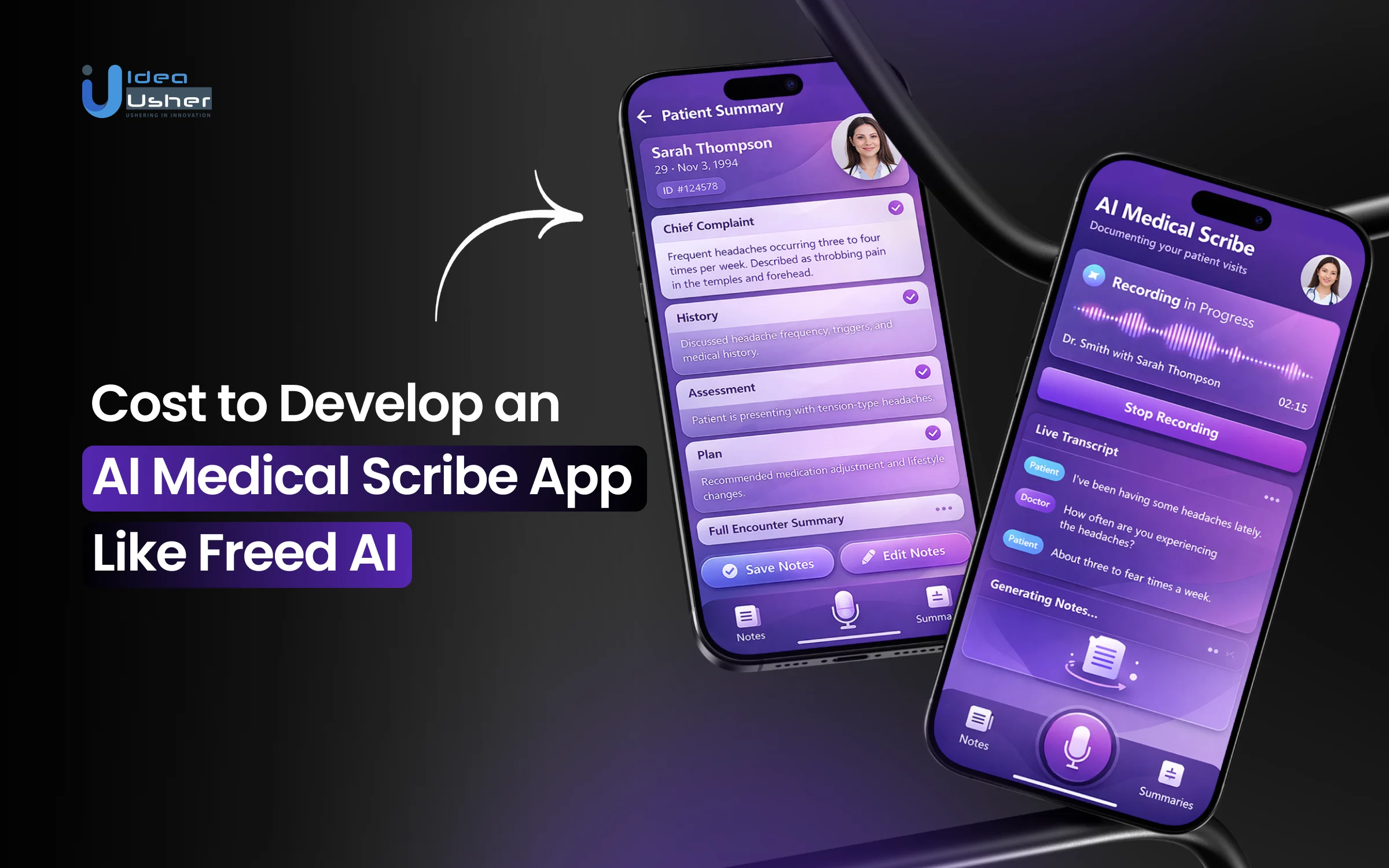
Some inefficiencies in healthcare stay hidden until they start affecting daily work. Clinicians often must finish notes late and may struggle to recall details accurately after long shifts. This ongoing cognitive load gradually impacts documentation quality and care delivery. The popularity of AI medical scribe apps has been increasing as clinicians now need faster documentation, and virtual care has expanded.
The traditional workflow can no longer keep pace with a digital-first environment and rising patient demand. These systems can quickly convert speech into structured clinical notes without disrupting interaction.
We’ve built several AI medical scribe platforms that leverage technologies such as conversational AI and healthcare data interoperability standards. As we have this expertise, we’re sharing this blog to discuss the cost to develop an AI medical scribe app like Freed AI.
Why Clinics Are Investing in AI Medical Scribes?

Source: Data Intelo
As healthcare consolidation accelerates, investors are prioritizing ambient listening tools to solve the documentation crisis and protect revenue cycles. Established platforms like Nuance DAX have already set the industry benchmark, proving that enterprise-level AI integration can effectively standardize care quality across massive hospital networks.
Capital is rapidly shifting toward these solutions because manual documentation is no longer scalable in a high-inflation, labor-short market. By adopting specialized AI like DeepScribe, clinics can capture complex clinical nuances with high precision while eliminating the overhead of human scribes.
This strategic move allows practices to optimize “time-to-chart,” reduce provider burnout, and maintain healthy margins through automated, high-fidelity data entry.
Rising Admin Burdens
Administrative load is a systemic threat to profitability. Physicians often lose two hours to EHR management for every hour of patient care. This burden represents a massive hidden cost for clinics.
Key drivers include:
- Regulatory Demands: Programs like MIPS require granular data that distracts from clinical care.
- Billing Precision: Rigorous insurance denials necessitate hyper-accurate notes for reimbursement.
- EHR Fragmentation: Non-intuitive systems force clinicians into data entry roles.
Reducing Clinician Burnout
Burnout drives turnover costs of $4.6 billion annually. AI scribes provide a cognitive offload by capturing encounters in real time and extracting clinical data. This allows doctors to focus on the patient rather than a screen.
Strategic benefits include:
- Provider Longevity: Reducing turnover avoids the $500,000 plus cost of replacing a senior physician.
- Patient Satisfaction: Higher engagement occurs when doctors are present rather than charting.
- Consistent Quality: AI eliminates documentation fatigue, ensuring high-quality charts at any volume.
Healthcare Automation Demand
Market demand is fueled by a mandate for efficiency. Large systems are adopting AI-first workflows to remain competitive as reimbursement rates stagnate. Automation is now the primary lever for maintaining margins.
Market dynamics show:
- Scalability: AI allows increased patient volume without increasing headcount.
- Maturity: LLM integration has made these tools chart-ready with minimal oversight.
- Capital Flow: Private equity is funding the documentation layer as a gateway for broader clinical AI.
The opportunity lies in platforms that integrate into billing and diagnostic ecosystems, turning notes into actionable assets.

What Does an AI Medical Scribe App Like Freed Do?
Investing in a platform like Freed means backing a sophisticated orchestration layer that bridges the gap between clinicians and Electronic Health Records. These AI medical scribe apps use ambient sensing and clinical LLMs to transform unstructured dialogue into structured medical data.
For investors, this shifts the practice model from manual entry to a “review and approve” workflow, fundamentally improving the unit economics of every patient visit.
1. Automated SOAP Note Workflow
The core value lies in the automated generation of Subjective, Objective, Assessment, and Plan notes.
Unlike old dictation tools, these platforms use speaker diarization to distinguish between the clinician and the patient in a natural flow. By selecting Capture Visit, the AI begins processing the encounter, distinguishing multiple participants and filtering background noise.
- Ambient Capture: The system records patient interactions for up to three hours without requiring a microphone.
- Semantic Mapping: Symptoms and findings are mapped to over 27,000 medical terms and medications.
- Note Synthesis: Within seconds of clicking End Visit, the AI produces a draft that reflects the provider’s specific professional tone and preferred Custom Note Templates.
2. ICD-10 and CPT Automation
For entrepreneurs, revenue integrity is a major selling point. Freed includes an integrated ICD-10 Code Finder and suggests relevant codes based on the encounter. This prevents down-coding, where doctors underbill to save time, ensuring the clinic captures the full value of services.
Strategic Impact: Aligning clinical narratives with accurate billing codes in real time reduces insurance claim denials and accelerates the reimbursement cycle.
3. Pre-visit Patient Insights
High-performance scribes ingest historical EHR data to provide clinicians with a Pre-charting and Visit Prep summary. This ensures the conversation is informed by past labs, chronic conditions, and previous treatments.
- Gap Identification: AI flags missing screenings or vaccinations during the huddle.
- Contextual Awareness: The system uses Smart Visit Prep to surface visit histories and medication trends for a longitudinal health view.
4. Automated Referrals and Orders
The final bottleneck is after visiting the admin. AI scribes automate these outputs by extracting the Plan from the clinical note, turning a single conversation into multiple administrative actions through the AI Assistant feature.
| Output | AI Action | Business Value |
| Patient Instructions | Translates jargon into plain language. | Boosts adherence; cuts calls. |
| Post-visit Letters | Generates Referral Letters for specialists. | Faster care; stronger networks. |
| EHR Integration | One click transfer to browser-based EHRs. | Minimizes clicks and entry errors. |
Key Features of a High-Value AI Medical Scribe App
To be a high-value asset, an AI medical scribe app must function as a clinical-grade intelligence tool rather than a basic recorder. Investors should prioritize AI medical scribe apps that demonstrate a deep understanding of the technical and regulatory demands of healthcare. These features are non-negotiable benchmarks for capturing market share in clinical automation.
1. Medical Speech Recognition
High-value apps use acoustic models trained on millions of hours of medical dialogue to ensure accuracy in noisy settings. This technology handles complex terminology and varied accents without constant manual correction.
This precision builds provider trust by correctly identifying rare pharmaceuticals or anatomical sites on the first pass. Suki AI excels here by using noise cancellation and engines that adapt to specialty-specific terminology.
2. Clinical Context NLP
A robust Natural Language Processing (NLP) engine identifies the intent behind a conversation. It distinguishes between a patient’s anecdotal story and a relevant clinical symptom to extract data for a professional note.
By understanding context, the AI prioritizes medically significant information, ensuring documentation remains concise. Augmedix leverages a powerful NLP layer that filters out non-clinical chatter to ensure only relevant data is structured into the chart.
3. Seamless EHR Transfer
The primary goal of automation is to eliminate manual work, making seamless EHR integration critical. High-value apps offer one-click transfers that move drafted notes directly into the appropriate EHR fields.
This connectivity minimizes the clicks per patient metric, a key indicator for staff efficiency. Saykara provides deep integration that allows captured data to be injected directly into specific EHR fields, reducing the administrative burden.
3. Multi-Device Access
To fit into a fast-paced clinic workflow, the app must be accessible across smartphones, tablets, and desktops. This allows a clinician to start a recording on a mobile device and review the note on a desktop later.
Providing this flexibility ensures the AI scribe remains an unobtrusive part of the doctor’s day. Abridge offers a mobile-first interface that allows capture on the go while maintaining a synchronized web dashboard for review.
4. HIPAA and SOC 2 Security
In healthcare, security is the foundation of any investment. A high-value Scribe app must be fully HIPAA compliant and possess SOC 2 Type II certification to ensure patient data is encrypted at rest and in transit.
These certifications are essential for passing the rigorous risk assessments required by hospital IT departments. Ambience Healthcare focuses on enterprise-grade security, providing the robust compliance frameworks necessary for large health systems.
Cost to Develop an AI Medical Scribe App Like Freed AI
Building an AI medical scribe app like Freed involves balancing specialized AI models with rigorous healthcare security. While a basic MVP can be launched for $30,000 to $50,000, a full-scale, enterprise-ready platform with high accuracy and deep integration often exceeds $400,000.

The investment is split between the frontend user experience and a heavy backend focused on HIPAA-compliant data processing. For a clinic or investor, understanding these cost drivers is essential to evaluating the long-term ROI of the platform.
Cost by Development Stage
The transition from a prototype to a market-ready product involves significant jumps in capital requirements. Most successful scribes start by perfecting the “Note Generation” before scaling to complex “EHR Write-back” features.
- MVP Development ($30,000 – $60,000): Focuses on core ambient listening, basic medical speech-to-text, and a standard SOAP note output. It usually relies on a “copy-paste” model rather than direct integration.
- Moderate Level ($60,000 – $150,000): Adds custom note templates, specialty-specific lexicons, and basic one-way EHR push capabilities via browser extensions.
- Full-Scale Enterprise ($150,000 – $400,000+): Includes bidirectional EHR integration (Epic/Cerner), automated ICD-10 coding, multi-user admin dashboards, and SOC 2 Type II security audits.
Cost of AI Complexity and Accuracy
The “brain” of the app is the most expensive recurring cost. Higher accuracy requires more expensive LLM tokens and specialized fine-tuning to ensure the AI doesn’t hallucinate medical facts.
| Component | Basic Accuracy (85%) | High Precision (99%) |
| Speech-to-Text | Standard APIs ($0.15/hr) | Medical-grade APIs ($0.60/hr) |
| Model Logic | Generic GPT-4o Mini | Fine-tuned Clinical LLMs |
| Diarization | Basic 2-person split | Complex multi-speaker filtering |
| Coding Engine | None | Real-time ICD-10/CPT Suggestions |
Strategic Insight: Reducing cost by using cheaper models often backfires in healthcare. A 10% error rate in a clinical note can lead to “chart fatigue,” where doctors spend more time fixing the AI’s mistakes than they would have spent writing the note manually.
Cost Variation by Region and Team
Labor is the primary variable in the development budget. A typical team for an AI scribe includes two backend engineers, a mobile specialist, a prompt engineer, a QA tester, and a part-time HIPAA compliance consultant.
- North America ($150 – $250/hr): High cost but offers deep expertise in US healthcare regulations (HIPAA/MIPS) and native-level understanding of medical workflows.
- Eastern Europe ($50 – $90/hr): A popular middle ground offering strong technical talent and experience with complex AI integrations at a moderate price point.
- Southeast Asia ($25 – $50/hr): Most cost-effective for building the UI/UX and basic backend, though it may require more oversight for clinical accuracy and regulatory compliance.
Regardless of the region, maintaining a “Compliance First” approach adds roughly 10% to 20% to the total project cost to cover end-to-end encryption, audit logs, and legal BAA agreements.
Cost Impact of Must-Have vs Advanced Features
Building an AI medical scribe app requires balancing speed to market with deep clinical utility. For an investor or clinic manager, the development cost ranges from $25,000 for a basic MVP to $150,000 for a production-ready product. Beyond the initial build, ongoing costs include data security and API consumption, which can scale based on patient volume.

Core MVP Features
The goal of an MVP is to automate the primary pain point: the SOAP note. Launching faster requires focusing on essential tools that provide immediate ROI without over-engineering.
- Capture Visit ($5,000 – $10,000): High-fidelity audio recording with noise suppression to ensure clear dialogue capture.
- Medical Speech-to-Text ($0.30 – $0.60 per hour): Using specialized APIs to transcribe complex terminology and varied clinician accents accurately.
- Note Generation ($10,000 – $15,000): An LLM layer to structure unstructured dialogue into Subjective, Objective, Assessment, and Plan formats.
- HIPAA Compliance ($15,000 – $45,000): Essential encryption and audit logs to legally handle sensitive patient data.
Advanced Features and Cost
Advanced features turn a scribe into a comprehensive assistant. These capabilities increase development complexity and recurring costs due to specialized model training and real time EHR communication.
| Feature | Development Impact | Recurring Cost |
| EHR Write-back | $20,000+ for native integrations (Epic, Cerner). | High maintenance fees. |
| Order Staging | High: Requires logic to stage prescriptions. | Higher token usage. |
| Multilingual Support | Moderate: Real-time translation and diarization. | Higher per-minute rates. |
| Note Templates | Low to Moderate: Building a custom Template Builder. | Minimal. |
Strategic Insight: Platforms like Suki AI command higher prices ($299 – $399/month) because they offer voice-controlled ordering and deep integration. Entry-level apps like Freed remain affordable ($99/month) by focusing on a “copy-paste” integration model through features like Direct Copy.
Customization and Scalability
Scalability depends on the app’s ability to handle high volumes of concurrent users and large datasets. Customization factors, such as specialty-specific lexicons (e.g., Oncology vs. Pediatrics), require fine-tuning models, which can add $10,000 – $50,000 to the initial R&D budget.
Investing in SOC 2 Type II Certification (costing $20,000 – $40,000 annually for audits) is a scalability requirement for hospital systems. While expensive, it is the barrier to entry for enterprise contracts that move the needle from local clinics to national health networks.
Hidden Costs Most Founders Overlook in AI Medical Scribe Apps
Launching an AI medical scribe app requires more than just a slick UI and an API key. Many founders find themselves underwater when they realize that “functional” code is only half the battle in a clinical environment. Beyond the initial build, these four “silent killers” can drain a startup’s runway if not budgeted for from day one.
1. Data Labeling and Fine-Tuning
You cannot simply “set and forget” a generic LLM. To achieve the 99% accuracy clinicians demand, you must invest in high-quality, human-in-the-loop data labeling. This involves hiring medical scribes or retired clinicians to review AI outputs and “ground” the model in medical truth.
- Clinical Annotation ($30 – $100/hr): Expert review of transcripts to identify medical entities.
- Dataset Procurement: Buying de-identified clinical datasets can cost $10,000 – $50,000 per specialty.
- Reinforcement Learning (RLHF): Constant feedback loops to stop the AI from “hallucinating” medications or dosages.
AI Model Maintenance
AI models “drift” over time as medical guidelines change and new drugs enter the market. If your scribe doesn’t know about the latest FDA-approved treatment, it becomes a liability.
The “Update” Tax: Every time a provider like OpenAI or Anthropic releases a new model version, you must re-test your entire prompt library. A single change in how a model follows instructions can break your SOAP note formatting, requiring $2,000 – $5,000 in engineering “fix-it” time per update.
Compliance and Legal Requirements
HIPAA is the floor, not the ceiling. To sell to a large hospital system, you need more than a “HIPAA-compliant” badge on your website.
| Requirement | Estimated Cost | Why It’s Hidden |
| SOC 2 Type II Audit | $20,000 – $40,000/yr | Most founders think a “Type I” (one-time) is enough; hospitals demand “Type II” (ongoing). |
| Cyber Insurance | $5,000 – $15,000/yr | Essential for protecting against data breach lawsuits. |
| Legal BAA Reviews | $300 – $700/hr | Every hospital has its own Business Associate Agreement (BAA) that your lawyer must vet. |
Scaling Infrastructure Growth
Success is expensive. As your user base grows from 10 doctors to 1,000, your infrastructure costs don’t just scale linearly; they often spike due to the “concurrency” of clinical shifts.
- Peak-Load Servers: Doctors all see patients at the same time (9 AM – 11 AM). You must pay for “provisioned throughput” to prevent lag, which can be 3x the cost of standard server hosting.
- Encrypted Storage: High-fidelity audio files are large. Storing them in a HIPAA-compliant, “always-available” cloud bucket adds up to hundreds of dollars per month as your archive grows.
- Real-Time Monitoring: Implementing tools like Datadog or Sentry to catch errors before a doctor does can cost $500+ per month.
Who Should Invest in a Freed-Like AI Scribe App?
The market for AI medical scribe apps is expanding rapidly as healthcare shifts from manual documentation to automated clinical intelligence. If you are positioned in one of the following three categories, developing or investing in a platform like Freed provides a high-yield strategic advantage.

Founders Targeting Healthcare SaaS
Entrepreneurs in the health tech space should view these apps as a high retention “wedge” product. Unlike complex diagnostic tools, a scribe solves a universal pain point with a low barrier to user adoption.
- Market Opportunity: While industry giants focus on massive hospital systems, a significant underserved market exists for small to mid-sized clinics.
- Ease of Entry: A competitive platform can be launched as an MVP by focusing on a browser-first experience that works across various web-based EHR systems.
- Sticky Revenue: Once a provider adopts a scribe, the switching cost is high because the AI learns their specific note-taking style over time.
Clinics Building Internal Tools
Large multi-specialty practices and private hospital chains are increasingly moving away from third-party subscriptions to build proprietary internal automation. This allows for total control over data sovereignty and specialty-specific accuracy.
The Build vs. Buy Equation: For a clinic with many providers, the ongoing licensing fees for external software often outweigh the one-time cost of building a custom tool. An internally owned system allows for tailored billing workflows and direct oversight of patient data security.
Telehealth Startups Scaling Rapidly
Telehealth platforms face a unique challenge because documentation must be finished instantly to maintain patient throughput. For these startups, an integrated AI scribe is a necessity for maintaining operational efficiency.
New doctors can start seeing patients immediately without the need for extensive EHR training, which reduces ramp-up time. Documentation time drops from minutes to seconds per encounter, allowing for more visits per shift. Furthermore, automated multilingual support helps these platforms reach a more diverse patient base.
By automating the administrative burden, telehealth companies can attract top-tier clinical talent who prioritize work-life balance. For these organizations, the AI scribe is not just a tool; it is a key recruitment and retention strategy.
How to Build ICD-10 and CPT Coding Automation?
AI medical scribe apps have evolved into sophisticated systems that do far more than just record conversations. These platforms now function as clinical operating systems that analyze patient encounters in real time to suggest highly accurate billing codes.
By bridging the gap between clinical dialogue and financial documentation, these tools are becoming essential for maintaining revenue integrity in modern practices.
1. Training AI for Medical Codes
Training a model for high-precision billing requires massive datasets and deep clinical reasoning. Modern systems use NLP to map descriptive patient symptoms directly to the most specific hierarchical codes available.
- Clinical Dataset Training: Models are trained on millions of de-identified encounters to recognize thousands of ways a single condition might be described verbally.
- Contextual Reasoning: The AI must distinguish between a “history of” a condition versus an “active” diagnosis to ensure the correct ICD-10 assignment is applied.
- Specialty Specific Logic: Coding requirements for a surgeon differ vastly from those of a psychiatrist. Specialized training ensures the AI understands the procedural nuances unique to each field.
2. Reducing Errors with AI
AI assistance acts as a real-time auditor, catching omissions or documentation gaps before a claim is even drafted. This proactive approach minimizes the traditional back-and-forth between providers and billing departments.
Efficiency Gain: Platforms like DeepScribe and Suki AI utilize bi-directional EHR integration to push suggested codes directly into discrete fields. This reduces the “copy-paste tax” and ensures that laterality or severity details, often missed in manual entries, are captured on the first pass.
By flagging inconsistencies, such as a procedure code that does not align with the documented diagnosis, the AI prevents simple human errors that lead to immediate claim denials. This allows staff to focus on complex cases rather than routine data entry.
3. Compliance Risks in Automation
Despite the efficiency gains, automated coding introduces specific regulatory and financial risks that require careful management. The logic behind an AI selection must be transparent to survive an external audit.
- Upcoding Risks: There is a danger that an AI might over-interpret documentation to suggest higher-level codes than supported, which could trigger fraud investigations.
- Payer Specific Rules: Different insurance carriers have unique requirements. An AI that is not updated with these specific rules may generate technically “correct” codes that are still rejected by certain payers.
- Human in the Loop Requirement: Legally, the clinician remains the party responsible for the accuracy of the chart. Systems must include a final review step where the provider confirms and signs off on all suggested codes to maintain compliance.
To mitigate these risks, leading apps provide “audit trails” that link every suggested code back to a specific sentence in the clinical note. This transparency is essential for defending against audits and ensuring long-term revenue integrity.
Designing AI for Pre-Visit Patient Summaries
Modern AI medical scribe apps are expanding beyond the exam room to assist with pre-visit chart reviews. By synthesizing a patient’s longitudinal record into a concise brief, AI helps clinicians walk into every encounter with a clear cognitive map of the patient’s history. This reduces the time spent digging through cluttered EHR tabs and allows for a more focused, patient-centric visit.

Extracting Insights from History
Effective pre-visit AI does not just copy data; it interprets it. High-value systems use clinical-grade NLP to sift through years of labs, imaging, and specialist notes to identify the thread of a patient’s health.
- Salience Filtering: The AI distinguishes between routine visits and significant clinical events, such as a recent hospitalization.
- Trend Identification: Instead of showing a single value, the AI highlights trends, such as a steadily rising A1c or a sudden drop in kidney function.
- Gaps in Care: Smart systems flag missing screenings or overdue follow-ups, presenting them as actionable “prep notes” for the provider.
Structuring Summaries for Clinicians
A wall of text is a liability in a fast-paced clinic. AI summaries must be scannable, prioritizing the most relevant information based on the scheduled Reason for Visit.
Apps like Ambience Healthcare have pioneered “chart awareness,” which organizes a patient’s history by diagnosis rather than date. This allows a doctor to see every lab and note related to a specific condition, like heart failure, in one consolidated view. Similarly, Nabla offers “pre-charting” capabilities that help clinicians draft the foundation of a note before the patient even walks through the door.
The 60 Second Brief: A well-designed summary follows a Problem-Action hierarchy. It lists the active problem list, the most recent pertinent lab results, and a pending section for any results the doctor is still waiting to receive.
Data Privacy and Security
Using patient data for AI summarization requires a Security First architecture. Because this process involves reading the entire chart, founders must implement rigorous safeguards to maintain trust.
- De-identification: Advanced apps use pseudonymization to strip away identifiable names during the processing phase. This ensures the AI model only “sees” clinical facts.
- No Persistent Storage: Reputable providers, such as Abridge, emphasize that they do not store the ingested chart data after the summary is generated. Once the clinician signs off, the temporary data packet is deleted from the AI’s memory.
- Strict Access Control: Audit logs must track every time the AI accesses a record. This transparency is a core requirement for SOC 2 Type II compliance and hospital IT approvals.
Providing clinicians with a clear source citation allows them to verify the AI’s summary against the original note. This transparency mitigates the risk of hallucinations and ensures that the final clinical decision remains firmly in human hands.
AI Models Behind AI Medical Scribe Apps Like Freed AI
Building a high-performing AI medical scribe app requires a sophisticated stack that moves beyond basic transcription. These apps leverage a combination of specialized speech-to-text engines and LLMs adapted for clinical environments.
Speech Recognition
Most modern scribe apps use OpenAI’s Whisper as a foundation due to its accuracy across dozens of languages. However, out-of-the-box models often struggle with rapid-fire medical terminology.
- Whisper Large V3: The current gold standard for general transcription. It is robust against background noise, making it ideal for busy clinics.
- Custom Clinical ASR: To reach professional-grade precision, many developers use engines like Deepgram’s Nova-3. These are trained specifically on medical phonetics to distinguish between similar-sounding drug names.
- Latency: Developers often choose Whisper Turbo for instant notes or the full Large V3 for maximum precision in complex cases.
NLP: GPT-Based vs. Clinical Models
Once speech is converted to text, the AI must summarize it. While models like GPT-4o are fluent, they can occasionally hallucinate facts if not properly constrained.
The Clinical Edge: Leading apps often use hybrid architectures. They might use a GPT-based model for conversational flow but verify facts against specialized models like Google’s MedGemma or Speechmatics’ 2025 Medical Model. This ensures that clinical acronyms are interpreted correctly within the specific context of the visit.
Fine-Tuning Models for Healthcare
Fine-tuning takes a general model and gives it a medical degree. This is done through targeted training layers to ensure the AI follows medical logic and provider preferences.
| Fine-Tuning Method | Data Required | Primary Goal |
| Supervised Fine-Tuning (SFT) | 10,000+ Labeled Pairs | Teaches the AI exactly how to format a SOAP note based on real transcripts. |
| RLHF (Human Feedback) | 1,000+ Expert Rankings | Uses feedback from clinicians to rank which summaries feel most natural. |
| PEFT (LoRA) | Minimal Compute | A lightweight update that allows the app to learn a specific doctor’s unique shorthand. |
By combining these fine-tuned models with Retrieval-Augmented Generation (RAG), developers allow the AI to look up the latest guidelines in real time. This ensures the output is a medically sound document ready for a physician’s signature.
Why Founders Choose Idea Usher for AI Medical Scribe Apps?
Choosing the right development partner is the difference between a prototype and a market-ready clinical tool. At Idea Usher, we combine deep technical rigor with specialized healthcare domain expertise to build AI medical scribe apps that providers actually trust.
Healthcare Platform Experience
With over 500,000 hours of coding experience, our team has a proven track record of engineering scalable AI healthcare ecosystems. We understand the specific friction points of clinical workflows, ensuring that our platforms integrate seamlessly into the daily lives of physicians without adding to their administrative burden.
Custom AI Development
Our team of ex-MAANG developers specializes in moving beyond generic APIs to build proprietary, high-precision models. We possess the capabilities to develop custom speech recognition and clinical NLP engines tailored to specific medical sub-specialties, ensuring superior accuracy in recognizing complex terminology and nuanced patient dialogues.
Compliance-First Approach
We treat regulatory alignment as a foundational architectural requirement rather than a final checklist. Every line of code we write is designed to satisfy the most stringent global standards, including HIPAA, SOC 2 Type II, and GDPR, providing founders with an audit-ready infrastructure that safeguards both patient data and institutional reputation.
Conclusion
The investment required to build an AI medical scribe scales from a lean MVP to a high-tier enterprise platform. A basic version focusing on core transcription and simple note generation occupies the lower end of the spectrum. Advanced systems with bi-directional EHR integration, automated ICD-10 coding, and multi-language support represent a more significant financial commitment. Ultimately, the total cost is determined by the depth of AI fine-tuning and the rigorous security measures required to ensure full HIPAA and SOC 2 compliance.
FAQs
A1: The cost to develop an AI medical scribe scales based on complexity. A basic version focusing on core transcription starts at the lower end of the financial spectrum. Advanced systems with EHR integration and automated coding represent a more significant investment due to the extensive fine-tuning and security measures required.
A2: AI is not replacing medical scribes but is instead evolving the role into a more efficient, digital-first function. While manual note-taking is being automated, the need for human oversight remains critical to ensure clinical accuracy. This shift allows healthcare providers to focus more on patient care while the AI handles the documentation.
A3: An AI medical scribe works by capturing ambient audio during a patient encounter and using speech-to-text engines to create a transcript. Specialized clinical NLP models then analyze the dialogue to extract relevant medical facts and symptoms. Finally, the system structures this information into a formatted SOAP note or clinical summary.
A4: Core features include high-accuracy ambient recording, automated SOAP note generation, and multi-language support. Advanced platforms also offer bi-directional EHR integration, suggested ICD-10 coding, and pre-visit patient summaries. These tools are built on a foundation of HIPAA-compliant security to ensure all captured data is protected.


