


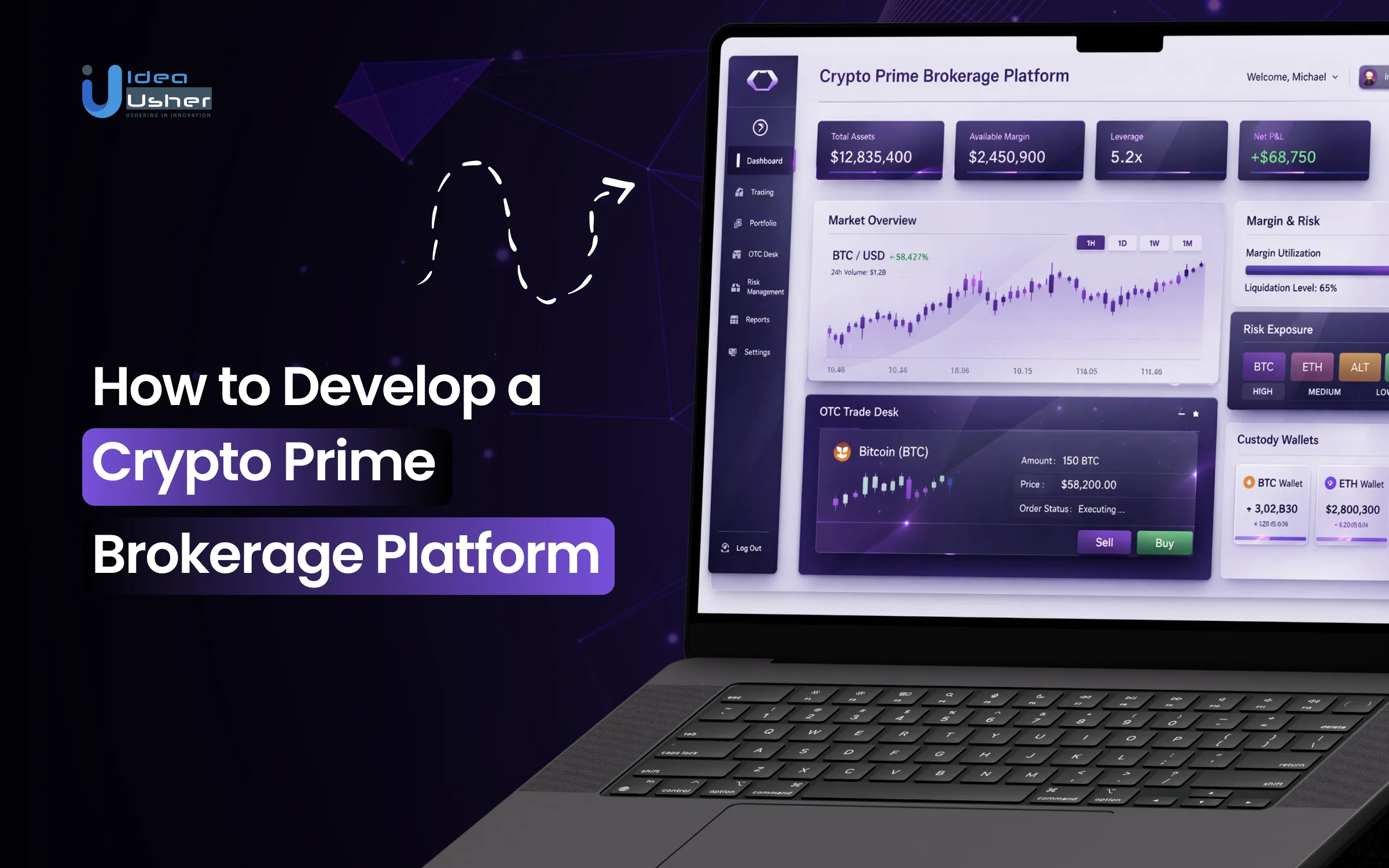
Crypto prime brokerage platforms sit between institutional clients and fragmented digital asset markets, bringing structure to how trading, custody, and liquidity are accessed. Rather than managing multiple exchanges, wallets, and service providers independently, institutions look for a unified layer that handles execution, risk, and reporting coherently, setting expectations that go well beyond basic trading infrastructure.
Once multiple services are brought under one roof, coordination becomes the real challenge. Order routing, collateral management, custody integration, financing, settlement, and compliance workflows all need to function together without creating operational gaps. The platform’s value ultimately depends on how smoothly these components interact, allowing institutions to trade efficiently while maintaining control, transparency, and regulatory alignment.
In this blog, we explain how to develop a crypto prime brokerage platform by breaking down core system components, architectural considerations, and practical steps involved in building a secure and scalable institutional trading and custody infrastructure.

What is a Crypto Prime Brokerage Platform?
A crypto prime brokerage platform is an institutional-grade service that acts as a central gateway for professional and large-scale traders to access and manage digital asset markets. It bundles together multiple services that institutions (like hedge funds, asset managers, family offices, and professional trading desks) need to operate efficiently in the cryptocurrency space.
- Intermediary Role: The platform acts as a “middleman,” either holding its own inventory of digital assets or purchasing them on your behalf from larger exchanges to fill your order.
- Multi-venue execution: One platform to execute trades across centralized exchanges (CEXs), decentralized exchanges (DEXs), and OTC markets, often with smart order routing for best pricing.
- Simplified Pricing: Instead of a dynamic “order book” where prices shift based on peer-to-peer demand, brokers often provide fixed or quoted prices.
- Fiat-to-Crypto On-ramps: They typically offer robust support for government-issued money (fiat) like USD or EUR via bank transfers, credit/debit cards, and e-wallets.
- Managed Security: Brokers often handle the custody (storage) of your assets, similar to a traditional bank, reducing the need for users to manage complex private keys or digital wallets themselves.
Difference Between Crypto Prime Brokerage Platform & Crypto Exchange
Crypto exchanges focus on facilitating direct market trading, whereas crypto prime brokerage platforms provide institutional-grade infrastructure by unifying liquidity access, custody, financing, compliance, and risk management within a single operating framework.
| Aspect | Crypto Prime Brokerage Platform | Crypto Exchange |
| Core Purpose | Acts as a single institutional counterparty providing execution, custody, risk, and financing | Acts as a trading venue matching buyers and sellers |
| Counterparty Model | Users trade against the prime broker as a single counterparty | Users trade directly against the exchange or other market participants |
| Liquidity Access | Aggregates liquidity across multiple exchanges, OTC desks, and venues | Limited to liquidity available on that specific exchange |
| Custody Structure | Client assets are segregated and often custodied independently | Assets are typically pooled within exchange-controlled wallets |
| Margin & Financing | Offers cross-margining, collateral optimization, and institutional financing | Margin is venue-specific with limited cross-asset optimization |
| Risk Management | Centralized, real-time risk monitoring across all venues and positions | Risk controls apply only within the exchange’s own environment |
| Settlement Model | Uses internal ledger with controlled on-chain settlement | Trades settle directly within the exchange’s internal systems |
| Compliance Focus | Designed for institutional compliance, audits, and reporting | Primarily focused on regulatory requirements for trading venues |
| User Type | Hedge funds, banks, family offices, prop trading firms | Retail traders and crypto-native participants |
| Operational Complexity | Reduces operational burden by consolidating execution, custody, and reporting | Requires users to manage multiple exchanges and custodians independently |
How Crypto Prime Brokerage Platform work?
A crypto prime brokerage platform centralizes trading, custody, settlement, and reporting into a single interface, enabling institutions to access multiple liquidity venues while managing risk, assets, and post-trade operations efficiently.

1. The Onboarding & Master Account
The user signs a single master agreement with the Prime Broker instead of the client signing contracts with 20 different exchanges.
- Unified KYC/AML: The client completes identity verification once.
- Credit Line: The Prime Broker assesses the client’s creditworthiness and extends a single line of credit or margin facility.
2. The Aggregation Engine (Finding the Best Price)
The client wants to buy 1,000 Bitcoin. If they go to just Binance, they might move the market price against themselves.
The Prime Broker’s system scans all connected liquidity sources simultaneously:
- Centralized Exchanges (CEXs): Binance, Coinbase, Kraken, OKX.
- Decentralized Exchanges (DEXs): Uniswap, Curve.
- OTC Desks: Specialized firms for large block trades.
- Market Makers: Proprietary trading firms.
The platform splits the order intelligently: “Buy 300 BTC from Binance, 200 from an OTC desk, and 500 from Kraken” to get the client the average best price without revealing the full size of the trade (reducing “slippage”).
3. The Execution Management System (EMS)
This is the dashboard traders use. It looks similar to a trading terminal for stocks, but in the background, it is converting the single order into multiple API calls to different exchanges. It ensures the trade happens instantly and reports back a single “fill” price.
4. Capital Efficiency: The “Margin Engine”
This is the most complex part. In crypto, if you want to trade on Binance, you usually have to deposit funds into Binance first. This is inefficient if your money is stuck on Kraken. Prime brokerages solve this with a Master Funding Model:
The Omnibus Wallet: The Prime Broker holds a large pool of funds (a “master account”) on each exchange.
Sub-Accounts: The client gets a sub-account on each exchange, but the risk is monitored by the Prime Broker.
Cross-Margining: The client can keep their collateral in one place (e.g., a cold wallet or a specific exchange) but trade on multiple venues. The system calculates the client’s total exposure across all venues in real-time. If the client loses money on Binance but has money on Kraken, the prime broker manages the overall risk to prevent liquidation.
5. Post-Trade: Settlement & Custody
After trade execution, the platform consolidates positions, settles assets across venues, and delivers unified custody and reporting, giving clients a single, accurate view of holdings and post-trade activity.
The “Prime” Balance: The client doesn’t see 10 different balances. They see one “Net Asset Value” (NAV) in their prime brokerage portal.
Real Settlement: The Prime Broker moves the actual coins between the exchange sub-accounts and the client’s preferred custody solution.
Reporting: The platform generates a single consolidated report for tax and accounting purposes, aggregating thousands of trades from dozens of venues into a simple format.
Why is Crypto Prime Brokerage Platform Gaining Popularity?
The global crypto prime brokerage market reached USD 1.58 billion in 2024 and is projected to grow to USD 8.34 billion by 2033, expanding at a CAGR of 22.9% between 2025 and 2033, driven by rising institutional adoption of digital assets. This growth reflects increasing reliance on prime brokerage platforms to consolidate execution, custody, and risk management for institutional crypto participants.

At the infrastructure level, cloud-based deployments represented over 62% of new crypto prime brokerage implementations in 2024, reflecting a growing preference for scalable, resilient, and operationally efficient platform architectures.
Coinbase Prime exemplifies mature crypto prime brokerage at scale, acting as custodian for most spot Bitcoin and Ethereum ETFs, with institutional clients generating 83% of trading volume and custody AUM peaking at $245.7 billion, validating strong institutional demand for consolidated execution and custody infrastructure.
FalconX demonstrates the scale of institutional crypto prime brokerage, with an $8 billion valuation, over $1.5 trillion in cumulative trading volume, 600+ institutional clients, and 2.5× year-over-year revenue growth in Q2 2024, underscoring strong demand for integrated execution and financing services.
Hidden Road processed $3 trillion in fund transfers in 2024, highlighting market maturity. After Ripple Prime acquired and rebranded the firm, it reportedly tripled in size, now serving over 300 institutional customers and clearing $3 trillion across markets. This growth shows how traditional prime brokerage models are converging with digital asset infrastructure.
Together, these platforms demonstrate that crypto prime brokerage is no longer an emerging concept but a scalable, institutionally adopted business model, with proven revenue generation, deep liquidity, and growing reliance from global financial institutions.
Benefits of Crypto Prime Brokerage Platforms for Institutions
Crypto prime brokerage platforms address the operational, liquidity, and risk challenges institutions face in digital asset markets by delivering consolidated market access, capital efficiency, and enterprise-level controls through a single, trusted counterparty.

A. Benefits for Institutional Traders & Funds
Crypto prime brokerage platforms remove market fragmentation for professional trading firms by centralizing liquidity access, balances, and execution workflows, enabling scalable trading strategies without operational friction.
- Unified Liquidity Access: Traders access multiple exchanges and liquidity venues through a single platform, removing the need to manage separate accounts, credentials, and trading interfaces across fragmented markets.
- Capital Efficiency Through Netting: Instead of pre-funding balances on every exchange, institutions trade using a single consolidated balance, freeing trapped capital and improving overall margin and liquidity utilization.
- Improved Execution Quality: Smart order routing and aggregated liquidity help reduce slippage and price impact, enabling institutions to execute larger trades at more favorable prices across multiple venues.
- Scalable Trading Operations: The platform supports increased trading volume and strategy complexity without adding operational overhead, allowing funds to scale activity without expanding internal infrastructure or teams.
B. Benefits for Operations & Back-Office Teams
Prime brokerage platforms simplify post-trade operations by consolidating settlement, custody movements, and reporting, replacing fragmented manual workflows with a unified and auditable operational framework.
- Single Net Asset Value View: Operations teams see all positions, balances, and exposures in one consolidated view, simplifying daily NAV calculation and eliminating reconciliation across multiple exchange statements.
- Automated Post-Trade Settlement: After execution, assets are automatically moved between exchanges and custody solutions, reducing manual intervention and ensuring timely, accurate settlement.
- Streamlined Reconciliation & Reporting: The platform aggregates transaction data across venues into standardized reports, simplifying accounting, tax reporting, and regulatory audits.
- Operational Risk Reduction: By minimizing manual processes and fragmented systems, the platform reduces settlement errors, reporting discrepancies, and operational risk exposure.
Key Features of a Crypto Prime Brokerage Platform
Crypto prime brokerage platforms are built to support institutional-scale digital asset trading with robust infrastructure, security, and operational efficiency. These features enable seamless market access, optimized execution, capital efficiency, and comprehensive risk and compliance management.

1. Unified Multi-Venue Trading Dashboard
A single institutional dashboard consolidates positions, orders, balances, and executions across exchanges and OTC desks. Users eliminate fragmented workflows, reduce operational overhead, and gain real-time visibility into trading activity without switching platforms or manually reconciling data.
2. Smart Order Routing & OTC Desks
The platform intelligently routes orders across centralized exchanges and OTC liquidity pools based on price, depth, latency, and counterparty risk. This ensures best execution, minimizes slippage, and protects traders from fragmented liquidity and venue-specific failures.
3. Single-Counterparty Trade Execution Model
Users trade with the platform as a single counterparty while execution is handled across multiple venues in the background. This simplifies legal agreements, reduces counterparty exposure, streamlines reconciliation, and mirrors traditional prime brokerage structures familiar to institutions.
4. Real-Time Portfolio
The system aggregates balances, open positions, margin usage, and unrealized PnL (Profit and Loss) across all venues in real time. Users gain accurate exposure visibility at both asset and portfolio levels, enabling faster risk decisions and confident capital deployment.
5. Segregated Custody Wallets
Each client’s digital assets are held in segregated wallets, ensuring clear ownership, regulatory alignment, and insolvency protection. Asset isolation builds institutional trust, simplifies audits, and prevents commingling risks common in retail-focused crypto platforms.
6. On-Chain Settlement Ledger
An internal ledger records all trades, transfers, and collateral movements instantly, while remaining mapped to on-chain settlements. This enables high-frequency trading without blockchain latency while preserving transparency, traceability, and accurate reconciliation across custody and execution layers.
7. Cross-Margin & Management System
Clients can deploy collateral across multiple positions and venues using a unified cross-margin framework. The system dynamically evaluates asset values, applies haircuts, and optimizes capital efficiency while maintaining strict risk thresholds required by institutional risk teams.
8. Real-Time Margin Monitoring
Margin utilization, exposure breaches, and collateral health are monitored continuously. Automated alerts notify users before risk thresholds are crossed, enabling proactive position management and reducing forced liquidations during volatile market conditions.
9. Automated Liquidation & Risk Mitigation
The platform executes automated, rule-based liquidation strategies when predefined risk limits are breached. This protects both the client and the platform from cascading losses while ensuring orderly unwinds, minimal market impact, and transparent post-event reporting.
10. Secure API Access Management
Institutional-grade APIs allow funds and trading desks to integrate their proprietary strategies directly. Secure authentication, granular permissions, and high-throughput access enable algorithmic trading, portfolio automation, and real-time data consumption without compromising platform security.
Crypto Prime Brokerage Platform Development Process
The crypto prime brokerage platform development demands expertise in institutional trading, security, and compliance. Our developers follow a structured, end-to-end approach to deliver scalable, secure, and compliant solutions for institutional clients.

1. Consultation
We begin by consulting closely with our clients to understand their business objectives, target institutions, and growth plans. Based on this, we define the single-counterparty execution model, shaping legal structure, balance sheet exposure, margin workflows, and institutional trust expectations.
2. Regulatory & Jurisdictional Requirements
Our developers align platform architecture with licensing, custody obligations, and compliance mandates across target jurisdictions. Regulatory assumptions directly influence wallet segregation, reporting depth, KYC workflows, and whether brokerage, custody, or execution layers remain independent.
3. Design Prime Brokerage Architecture
We architect the platform as modular services covering execution, custody, ledger, risk, and compliance. This structure ensures independent scaling, controlled system risk, and seamless integration with exchanges, custodians, liquidity providers, and banking partners.
4. Multi-Venue Execution Engine
Our team develops an execution layer that connects centralized exchanges and OTC desks simultaneously. We prioritize smart order routing, latency management, venue risk limits, and failover logic to maintain best execution during volatile market conditions.
5. Institutional Custody & Segregation
We set up client-level asset segregation using MPC, HSM, or hybrid custody models. Our custody design supports hot, warm, and cold wallets while ensuring auditability, regulatory alignment, and clear ownership protections for institutional clients.
6. Internal Ledger & Settlement Logic
Our developers build a real-time internal ledger mapped to on-chain settlements. This allows instant balance updates, high-frequency trading, accurate reconciliation, and controlled settlement flows without exposing users to blockchain latency or operational risk.
7. Margin, Collateral & Credit Controls
We implement cross-margin systems, collateral valuation logic, haircut rules, and exposure limits. This engine continuously evaluates portfolio risk, supports financing workflows, and enforces institution-grade credit controls required for leveraged trading.
8. Automate Risk Monitoring & Liquidations
Our platform monitors margin health and exposure in real time. When risk thresholds are breached, automated liquidation workflows execute orderly unwinds, minimize market impact, and generate transparent audit trails for compliance and post-event analysis.
9. Secure Client Access & Trading APIs
We build trader dashboards, reporting interfaces, and institutional APIs with strict role-based access control. This enables secure collaboration across trading, risk, and compliance teams while supporting algorithmic strategies and system-level integrations.
10. Stress Test & Launch the Platform
Before go-live, we conduct security audits, stress testing, reconciliation simulations, and compliance dry runs. Prime brokerage platforms fail at edge cases, so our focus remains on operational resilience and production-grade readiness.
Crypto Prime Brokerage Platform Development Cost
The crypto prime brokerage platform development cost depends on platform complexity, security requirements, compliance scope, and integration depth. The table outlines estimated development costs based on core features, infrastructure, and institutional-grade requirements.
| Development Phase | What We Deliver | Estimated Cost |
| Operating Model Definition | Institutional use case mapping, counterparty structure, margin assumptions, and execution model clarity | $5,000 – $8,000 |
| Regulatory & Compliance Mapping | Target jurisdiction analysis, MVP licensing scope, custody obligations, and compliance requirements | $10,000 – $13,000 |
| Platform Architecture Design | Scalable MVP architecture covering execution, custody, ledger, and risk components | $15,000 – $22,000 |
| Execution Engine Development | Core multi-venue execution with limited exchanges, basic smart routing, failover logic | $18,000 – $26,000 |
| Custody & Asset Segregation | MVP custody setup with segregated wallets using MPC or managed custody providers | $22,000 – $35,000 |
| Ledger & Settlement System | Simplified real-time internal ledger with on-chain settlement tracking and reconciliation | $20,000 – $27,000 |
| Margin & Credit Risk Engine | Basic cross-margin logic, collateral valuation rules, and exposure limits | $15,000 – $23,000 |
| Risk Monitoring & Liquidation | Core risk alerts, margin threshold monitoring, and controlled liquidation workflows | $12,000 – $15,000 |
| Client Interfaces & APIs | Essential trading dashboard, reporting views, and secure institutional APIs | $10,000 – $12,000 |
| Testing, Security & Launch | MVP stress testing, security hardening, compliance checks, and production deployment | $12,000 – $17,000 |
Total Estimated Cost: $62,000 – $126,000+
Note: Actual development costs vary based on regulatory scope, custody approach, integrations, security requirements, and customization complexity across jurisdictions.
Consult with IdeaUsher to get a tailored cost estimate aligned with your business model, compliance needs, and long-term platform scalability goals.
Challenges and How Our Developers Will Solve Those
Crypto prime brokerage platform development involves challenges in security, liquidity integration, scalability, and compliance. Our developers overcome these through proven architecture, institutional-grade controls, and a regulatory-first approach.

1. Exchange API Performance Issues
Challenge: Assuming exchange APIs behave consistently, only to face rate limits, delayed order statuses, and mismatched fills during high-volume or volatile trading periods.
Solution: Our developers build exchange-specific adapters with idempotent order handling, retry policies, state reconciliation, and venue isolation, ensuring execution reliability even during rate limits, partial fills, or exchange-side outages.
2. Data Inconsistencies Across Trading Venues
Challenge: Relying on exchange-reported balances directly, leading to mismatches between executed trades, wallet balances, and internal portfolio views.
Solution: We implement an authoritative internal ledger that consumes exchange events asynchronously, resolves conflicts deterministically, and provides reconciliation workflows, ensuring accurate balances regardless of inconsistent external venue reporting.
3. Blockchain Confirmation Delays
Challenge: Tying user balances directly to on-chain confirmations causes blocked trading, delayed withdrawals, and a poor experience during network congestion.
Solution: Our developers decouple trading balances from blockchain finality using pending states, settlement buffers, and confirmation tracking without exposing users to network latency.
4. Custody Provider Constraints
Challenge: Integrating a third-party custody provider without validating transaction limits, signing latency, or API constraints, blocking critical workflows post-integration.
Solution: We validate custody APIs early by load-testing signing latency, transaction limits, and policy constraints, while abstracting custody logic to allow provider replacement without rewriting execution or ledger systems.
5. Margin Calculation Failures
Challenge: Using simplified margin formulas that fail when prices gap, liquidity dries up, or correlated assets move simultaneously.
Solution: Our developers design margin engines using real-time pricing, asset correlation buffers, conservative haircuts, and continuous recalculation to remain stable during volatility spikes.
How Does a Prime Brokerage Platform Handle Exchange Downtime?
Exchange downtime can disrupt trading and liquidity access for institutional participants. A crypto prime brokerage platform mitigates this risk through multi-venue connectivity, liquidity redundancy, and intelligent order routing to ensure uninterrupted execution.
1. Venue Isolation & Failure Detection
The platform continuously monitors exchange health, latency, and order acknowledgments. When anomalies are detected, the affected venue is automatically isolated, preventing failed orders, stale executions, and inaccurate exposure calculations from impacting client portfolios.
2. Intelligent Order Rerouting Across Venues
During downtime or liquidity drops, orders are dynamically rerouted to alternative exchanges or OTC desks. This maintains execution continuity, reduces slippage, and prevents over-reliance on a single liquidity source during stressed market conditions.
3. Real-Time Freezing & Risk Controls
If a venue becomes unavailable, exposure tied to that venue is temporarily frozen. This prevents new risk accumulation, preserves capital, and allows accurate margin assessment while settlement and balance states are stabilized.
4. Internal Ledger Reconciliation Safeguards
The internal ledger becomes the source of truth during outages. Pending trades, unsettled balances, and in-flight transfers are tracked deterministically, enabling controlled reconciliation once the affected exchange resumes normal operations.
5. Automated Client Notifications
Clients and internal risk teams receive real-time alerts detailing affected venues, exposure impact, and mitigation actions. Transparent communication reduces uncertainty and allows informed trading decisions during volatile or disrupted market environments.
Examples of Crypto Prime Brokerage Platforms in The Market
The crypto market includes several mature prime brokerage platforms serving institutional traders and financial firms. These platforms provide consolidated liquidity access, institutional custody, financing, and risk management across global digital asset markets.
1. Coinbase Prime

Coinbase Prime is an institutional crypto prime brokerage offering secure custody, multi-venue execution, financing, and reporting. It’s trusted by global institutions for regulated access, deep liquidity, capital efficiency, and enterprise-grade compliance within the digital asset ecosystem.
2. Copper

Copper is a crypto prime brokerage platform known for institutional custody, MPC-based security, and off-exchange settlement. Its ClearLoop infrastructure enables capital-efficient trading, reduced counterparty risk, and seamless connectivity across major exchanges and liquidity venues.
3. FalconX
FalconX is a leading crypto prime brokerage delivering deep global liquidity, smart order routing, and credit solutions. Designed for hedge funds and asset managers, it focuses on best execution, balance-sheet financing, and scalable institutional trading infrastructure.
4. Hidden Road

Hidden Road operates as a multi-asset prime brokerage extending into digital assets, offering clearing, financing, and execution. Its crypto prime brokerage model bridges traditional market structure with institutional crypto trading, emphasizing risk management and capital efficiency.
5. LTP (LiquidityTech Protocol)

LTP provides an institutional crypto prime brokerage stack focused on liquidity aggregation, execution technology, and market-making connectivity. It enables professional firms to access fragmented crypto markets through a unified, low-latency, institutional-grade trading layer.
Conclusion
Developing an institutional-grade trading platform requires more than connecting to exchanges and exposing APIs. It involves careful design around liquidity aggregation, custody, risk controls, and regulatory alignment, all working together as a single operating framework. A well-architected solution reduces operational complexity while improving execution quality and capital efficiency for institutional users. When approached with a clear understanding of market structure and institutional expectations, crypto prime brokerage platform development becomes a strategic investment in scalable infrastructure that supports long-term participation in digital asset markets without compromising security or compliance.
Develop a Crypto Prime Brokerage Platform with IdeaUsher!
We have delivered crypto-finance and institutional trading solutions for global enterprises. Leveraging this experience, our ex-FAANG/MAANG developers design and build crypto prime brokerage platforms that meet the operational, security, and scalability demands of institutional markets.
Why Work With Us?
- Institutional Trading Infrastructure: We build platforms designed for hedge funds, asset managers, and professional trading desks with enterprise-grade reliability.
- Multi-Venue Liquidity Aggregation: Our systems aggregate liquidity across exchanges, OTC desks, and market makers using intelligent execution logic.
- Custody, Margin & Risk Controls: We integrate secure custody, margin management, and real-time risk monitoring to protect institutional capital.
- Scalable, Market-Ready Architecture: Platforms are engineered to perform under high volumes, volatility, and evolving regulatory conditions.
Explore our portfolio to understand our approach to delivering blockchain and crypto-based solutions for numerous enterprises.
Speak with our experts to begin crypto prime brokerage platform development aligned with your business goals.


FAQs
A.1. A crypto prime brokerage platform aggregates liquidity, routes orders, integrates institutional custody, manages margin and financing, controls risk, enforces compliance, and unifies reporting to support institutional trading at scale.
A.2. The platform connects to multiple exchanges, OTC desks, and market makers through APIs to aggregate liquidity. Smart order routing algorithms distribute orders across venues to achieve best execution and reduce slippage.
A.3. The platform protects institutional assets and ensures operational resilience by using segregated custody, multi-signature or MPC wallets, strict access controls, real-time monitoring, incident response processes, and regular audits.
A.4. The platform manages counterparty risk by requiring collateral, setting margin requirements, monitoring exposure in real time, enforcing credit limits, and using settlement controls to reduce reliance on individual exchanges or liquidity providers.


