


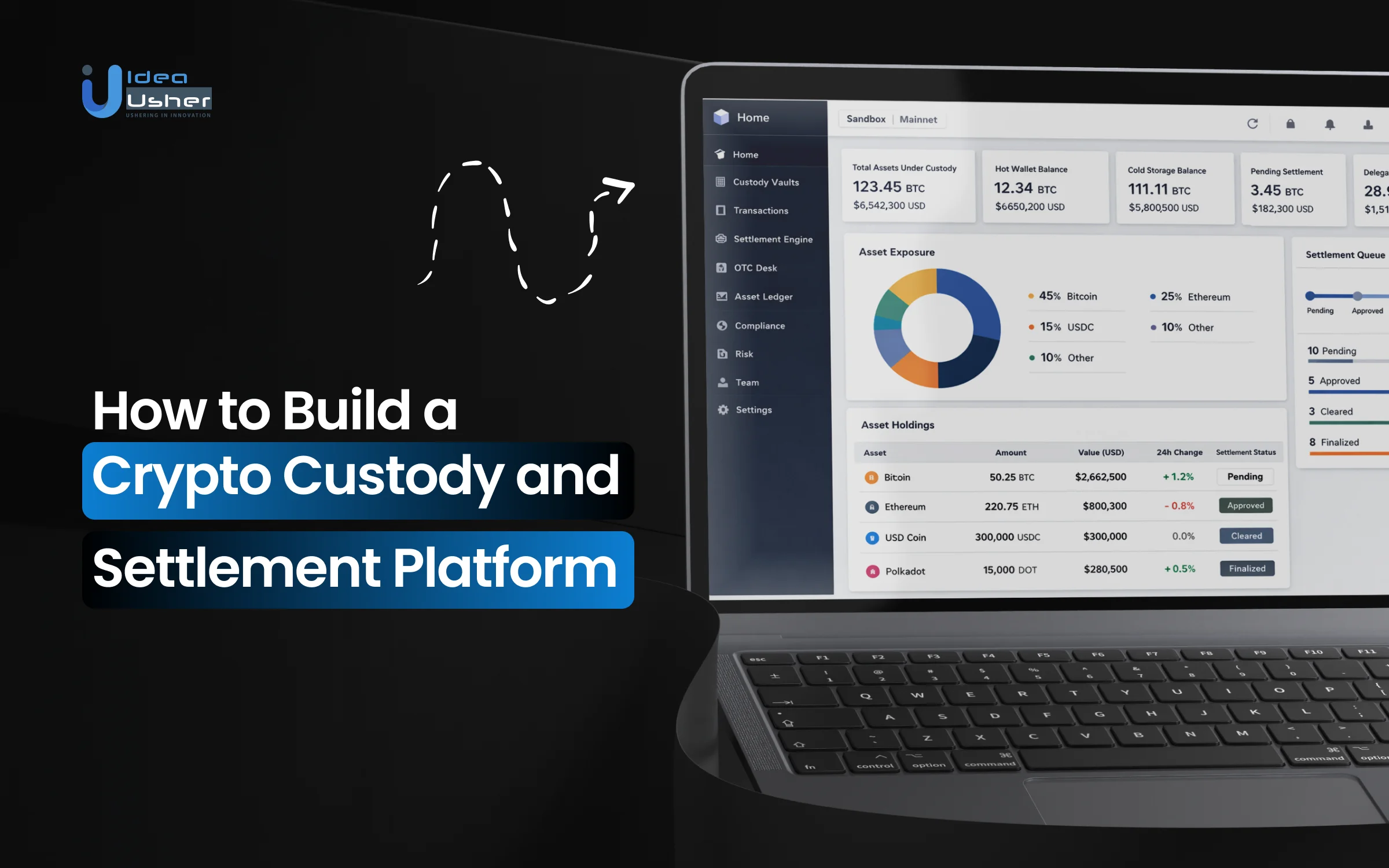
Crypto custody and settlement platforms form the backbone of digital asset infrastructure, where asset safety and transaction finality matter more than surface-level features. Securing assets is only part of the challenge but the real complexity lies in how transactions are authorized, executed, and settled without exposing funds and to tackle these factors, businesses are eager for crypto settlement platform development, where reliability and control are essential.
As volumes increase, settlement behavior becomes a true test of system design. Key management, approval workflows, transaction batching, reconciliation, and monitoring must operate consistently across on-chain and off-chain environments. Custody and settlement logic need to remain tightly coordinated so assets are never left in an undefined state between execution and confirmation.
In this blog, we explain how to build a crypto custody and settlement platform by breaking down core system components, architectural decisions, and practical considerations involved in delivering secure, auditable, and scalable digital asset settlement infrastructure.

What is a Crypto Custody and Settlement Platform?
A crypto custody and settlement platform securely stores and manages digital assets for users, while enabling efficient transaction clearing and settlement. It uses advanced key-management systems and secure storage to protect cryptographic private keys, which are essential for accessing crypto assets.
The platform also provides settlement mechanisms to ensure transactions are completed accurately and efficiently, both on and off-chain. These platforms are vital for institutional and enterprise users and the institutions use a crypto custody and settlement platform, cause
- Bankruptcy Remoteness: Unlike some exchanges, regulated custodians (like Coinbase Prime or Anchorage Digital) legally segregate client assets from their own balance sheets, ensuring they are not part of the firm’s estate if it fails.
- Insurance & Recourse: Many licensed providers carry comprehensive insurance against theft, cyber-attacks, and internal fraud.
- Fiduciary Duty: Regulated platforms operate under frameworks like the EU’s MiCA or US National Bank Charters, providing a clear legal structure for institutions to fulfill their responsibilities to clients.
How Crypto Custody and Settlement Layers Work Together?
Crypto custody and settlement layers operate together to secure assets, authorize transactions, and ensure accurate transfer and finality across on-chain and off-chain systems.
1. What the Custody Layer Controls
The custody layer governs private key management, wallet infrastructure, asset segregation, and authorization workflows. It ensures digital assets remain secure, auditable, and protected from unauthorized access throughout their entire lifecycle.
2. What the Settlement Layer Executes
The settlement layer handles transaction orchestration, signing coordination, broadcast, confirmation tracking, and finality validation. It ensures asset movements are executed accurately on-chain while maintaining consistency with internal accounting records.
3. Custody and Settlement Interdependency
When custody and settlement operate separately, platforms face partial execution, balance mismatches, and audit failures. Tight architectural coupling ensures every transaction updates custody state, ledger records, and on-chain status atomically.
4. How Unified Architecture Reduces Operational Risk
Architecting custody and settlement together eliminates race conditions, reconciliation gaps, and insider risk. A unified design improves system reliability, simplifies audits, and enables predictable behavior during peak volumes and network volatility.
What Architecture Secures Crypto Custody for Institutions?
Institutional crypto custody relies on a layered security architecture designed to protect private keys, enforce controls, and prevent single points of failure. This architecture balances security, compliance, and operational resilience at scale.
| Architecture Component | What It Protects | How It Enables Institutional-Grade Security |
| Hot, Warm, and Cold Custody Architecture | Asset exposure and liquidity risk | Segregates operational liquidity from long-term storage, minimizing attack surface while maintaining availability for settlements and withdrawals. |
| MPC-Based Custody | Private key compromise and insider threats | Distributes signing authority so private keys are never fully reconstructed or exposed, significantly reducing single-point compromise risks. |
| HSM-Backed Key Storage | Cryptographic key integrity | Uses tamper-resistant hardware for secure key generation and storage, meeting regulatory, audit, and compliance requirements. |
| Key Lifecycle Management | Long-term key security | Governs secure key generation, rotation, recovery, and revocation to prevent stale keys and irreversible asset loss. |
| Role-Based Access Control | Privilege abuse and unauthorized actions | Enforces strict role separation so no single operator can initiate, approve, and execute sensitive custody operations alone. |
| Approval Workflow Architecture | Transaction governance and auditability | Requires multi-step approvals for withdrawals and transfers, creating traceable decision paths essential for institutional oversight. |
How Does a Crypto Settlement Platform Work?
A crypto custody and settlement platform manages private keys, authorizes transactions, and executes asset transfers. It coordinates secure storage with on-chain and off-chain settlement to ensure accuracy, finality, and regulatory compliance.

1. Onboarding and Account Initialization
The process begins with institutional onboarding, where client identity, compliance requirements, and custody permissions are verified. Once approved, custody accounts, internal ledgers, and role-based access controls are initialized based on the client’s operating model.
2. Wallet Creation and Asset Custody
The platform generates secure custody wallets using MPC or HSM-backed architectures. Assets are assigned to hot, warm, or cold custody layers based on usage and risk policies, ensuring secure storage without compromising operational liquidity.
3. Deposit Monitoring and Balance Attribution
Incoming blockchain transactions are continuously monitored. Deposits are validated, attributed to the correct client accounts, and reflected in the internal ledger only after required confirmation thresholds and finality conditions are met.
4. Transaction Initiation and Policy Validation
When a transfer or withdrawal is requested, the platform validates it against custody policies, approval workflows, compliance checks, and risk thresholds before any signing or on-chain execution occurs.
5. Secure Signing and Transaction Execution
Approved transactions are signed using MPC or controlled signing environments. The settlement engine broadcasts transactions to the blockchain, tracks confirmations, and monitors finality across supported networks.
6. Settlement & Ledger Finalization
Once finality is achieved, custody states and internal ledger balances are updated atomically. This ensures on-chain outcomes, internal accounting, and client balances remain fully synchronized.
7. Reconciliation and Reporting
All custody and settlement activities are logged immutably. The platform continuously reconciles blockchain data with internal records and generates audit-ready reports for clients, compliance teams, and regulators.
Why Crypto Custody and Settlement Platforms are Growing?
The market is expected to increase from $3.28 billion in 2025 to $7.74 billion by 2032, indicating that secure storage has become essential infrastructure, according to Research and Markets. As regulatory clarity improves and risk management frameworks develop, institutions are increasingly investing in digital assets with greater confidence.

The scale of capital flowing into crypto settlement platform is institutional, with over $30 billion invested in crypto infrastructure companies between Q4 2025 and Q1 2026 alone.
- Stablecoins now process ~$9–$46 trillion annually, with monthly volumes exceeding $1.25 trillion, proving that crypto settlement systems are operating at global payment-network scale.
- Coinbase Custody safeguards assets for institutions across 470+ supported assets and offers up to $250M in insurance coverage, reflecting rising institutional demand for insured, regulated custody.
- Over 75% of institutions plan to increase digital asset allocations, and 59% expect to allocate more than 5% of AUM, creating sustained demand for regulated custody and settlement infrastructure.
- BVNK processes $25B+ annually in enterprise crypto settlement volume, highlighting strong B2B demand for stablecoin-based treasury and payment infrastructure.
- Tokenized real-world assets grew 260% in H1 2025, with projections ranging from $2T to $16T by 2030, expanding custody needs beyond crypto into securities and funds.
- Custody economics scale efficiently, with institutional insurance coverage reaching $250M+ per provider and custody costs dropping sharply as assets under custody grow.
Real transaction volume, institutional participation, and regulatory alignment drive the growth of crypto settlement platform development. As stablecoins, tokenized assets, and institutional capital scale, custody and settlement infrastructure becomes essential financial plumbing, not just speculative crypto tooling.
Benefits of Using Crypto Custody and Settlement Platforms Across Institutions
Crypto custody and settlement platforms enable institutions to securely manage digital assets while meeting regulatory standards. They reduce operational risk, improve transaction efficiency, and support scalable, compliant participation in digital asset markets.

1. Banks and Financial Institutions
Crypto custody and settlement platforms allow banks to offer regulated digital asset services without disrupting existing risk frameworks. They enable asset segregation, audit-ready reporting, and secure settlement while integrating seamlessly with traditional compliance, accounting, and governance models.
Real-World Example: BNY Mellon – Tokenized Deposits and Structured Credit
- The Implementation: BNY Mellon launched a tokenized deposit service that allows institutional clients to transfer funds using blockchain infrastructure while keeping deposits within the regulated banking system. The platform operates on BNY’s private, permissioned blockchain and is governed by existing bank risk and compliance controls.
- The Users: Early adopters include Citadel Securities, DRW Holdings, and Intercontinental Exchange.
- The Impact: ICE plans to support tokenized deposits across its clearing houses, enabling near-continuous trading and settlement without abandoning regulated infrastructure.
2. Crypto Exchanges and Trading Platforms
Exchanges reduce operational risk, enable faster settlements, and secure asset management. Custody platforms lower hot wallet exposure, prevent mismatches, and support high-volume withdrawals during volatility without compromising security.
Real-World Example: Galaxy Digital + Coinbase Prime
- The Integration: Galaxy Digital integrated its institutional staking infrastructure directly into Coinbase Prime, allowing custody clients to access staking without moving assets out of Coinbase’s secure custody environment.
- The Scale: Galaxy manages approximately $6.6 billion in assets under stake, reflecting institutional trust in integrated custody-settlement models.
- The Context: This marked Galaxy’s fourth custodial integration in 2025, following partnerships with Fireblocks, Zodia Custody, and BitGo, signaling a custody-first strategy for institutional expansion.
3. Asset Managers and Investment Funds
For asset managers, custody platforms deliver institutional-grade asset protection, transparent ownership records, and independent audit trails. They simplify NAV calculations, enable proof-of-reserves, and support multi-jurisdiction regulatory compliance.
Real-World Example: BlackRock + Coinbase
- The Implementation: BlackRock’s iShares Bitcoin Trust (IBIT) uses Coinbase for custody. Coinbase currently holds approximately 607,086 BTC for this single fund.
- The Scale: Across institutional clients including BlackRock, Grayscale, Tesla, and SpaceX, Coinbase custodies roughly 13.7% of all circulating Bitcoin, approximately 2.7 million BTC valued at ~$261 billion.
4. Fintech and Neobanking Platforms
Fintechs use custody and settlement platforms to quickly launch crypto services and ensure compliance. These platforms simplify blockchain, enabling secure wallets, controlled withdrawals, and seamless fiat and banking system integration.
Real-World Example: BVNK
- The Scale: BVNK processes over $25 billion annually, serving global enterprises.
- The Integration: BVNK integrated Chainalysis KYT tools into its self-custody infrastructure, enabling real-time compliance monitoring, risk scoring, and transaction freezing for high-risk activity.
- The Validation: Citibank invested in BVNK as part of a strategic partnership, with BVNK’s valuation exceeding $750 million. Citibank has publicly confirmed exploration of stablecoins for cross-border remittances.
5. Payment Providers and PSPs
Custody platforms let payment providers securely manage crypto liquidity, settle transactions, control treasury, reconcile in real-time, and handle regulatory reports, supporting stablecoin and cross-border payments.
Real-World Example: Finastra + Circle
- The Implementation: Finastra integrated USDC settlement into its Global PAYplus platform, enabling stablecoin-based settlement while preserving fiat-denominated payment instructions.
- The Scale: Finastra’s customers process over $5 trillion in cross-border payments daily, serving 8,000+ institutions, including 45 of the world’s top 50 banks.
- The Impact: Banks can now reduce dependence on correspondent banking chains while maintaining FX, compliance, and reporting workflows.
Core Features of a Crypto Custody and Settlement Platform
Crypto custody and settlement platforms are built to secure digital assets, control transactions, and support institutional operations. These key features form the foundation of crypto settlement platform development by enabling compliant settlement, secure storage, and efficient institutional workflows.

1. Crypto Custody Key Management
This feature defines how private keys are generated, stored, rotated, and recovered using MPC or HSM-backed controls. It eliminates single-point compromise, enforces separation of duties, and protects digital asset ownership from insider abuse and external attacks.
2. Hot, Warm, and Cold Wallet Architecture
This architecture separates operational liquidity from long-term asset storage using risk-tiered wallet layers. Assets move automatically based on balance thresholds, usage patterns, and security rules, minimizing exposure while ensuring transaction availability during high settlement volumes.
3. MPC-Based Transaction Approvals
This mechanism replaces single-key signing with distributed cryptographic authorization. Transactions require multiple independent approvals aligned with governance policies, allowing high-volume settlements without exposing private keys or introducing operational bottlenecks.
4. Atomic Crypto Settlement Engine
This engine coordinates custody updates and transaction settlement as a single atomic process. It prevents partial execution, balance inconsistencies, and double-spend scenarios by synchronizing signing, broadcasting, confirmation tracking, and ledger finalization.
5. Internal Crypto Ledger System
This system maintains an immutable internal record of balances synchronized with on-chain state. It enables accurate client accounting, internal transfers, and net settlement while insulating operational workflows from blockchain latency and network congestion.
6. Policy-Based Withdrawal Controls
This control layer enforces programmable withdrawal rules based on asset type, transaction value, destination risk, and user roles. High-risk transfers are automatically delayed, blocked, or escalated before signing occurs, reducing financial and compliance exposure.
7. Automated Balance Reconciliation
This process continuously compares blockchain data with internal ledger records and client balances. It identifies discrepancies caused by failed transactions, re-orgs, or indexing delays, ensuring accounting accuracy and audit readiness at all times.
8. Transaction Finality Monitoring
This capability tracks confirmations, re-org events, and settlement status across supported blockchains. Transactions are only marked complete after irreversible finality is achieved, preventing premature balance updates and settlement assumptions.
9. Audit-Ready Transaction Logs
This logging framework produces immutable, timestamped records for every custody and settlement action. It captures approvals, signatures, balance changes, and metadata required for regulatory audits, internal reviews, and forensic investigations.
10. Compliance Controls for Custody Platforms
This layer embeds AML screening, Travel Rule data exchange, transaction risk scoring, and regulatory reporting directly into custody and settlement workflows, ensuring compliance without degrading performance or user experience.
Crypto Settlement Platform Development Process
Crypto settlement platform development requires a structured, security-first approach aligned with regulatory needs. Our developers follow a disciplined process focused on architecture design, compliance integration, and scalable infrastructure.

1. Consultation and Custody Scoping
We consult with the client to understand business objectives, target markets, and operating models. We then define the platform’s custody and VASP classification, mapping licensing, asset segregation, and settlement rules to ensure architecture and data flows meet regulatory expectations from day one.
2. Security and Threat Architecture Design
Our team conducts deep threat modeling across key management, transaction signing, settlement execution, and operational access. Based on identified risks, we design MPC, HSM, approval workflows, wallet isolation, and fail-safe mechanisms to remove single points of failure.
3. Custody and Key Management Setup
We implement institutional-grade key generation, storage, rotation, and recovery systems. Our developers configure hot, warm, and cold custody layers with policy-based asset routing to balance security, liquidity, and operational performance at scale.
4. Wallet and Blockchain Integration
We build multi-chain wallet infrastructure for secure address generation, deposit detection, and balance tracking. Our developers integrate blockchain nodes, indexers, and confirmation tracking systems to ensure reliable, real-time interaction with supported networks.
5. Internal Ledger and Accounting Layer
We develop an immutable internal ledger that mirrors on-chain balances in real time. This ledger becomes the system of record for client accounting, internal transfers, and settlement netting, independent of blockchain latency or network congestion.
6. Settlement Engine Development
We design and implement a settlement engine that coordinates transaction intent, policy checks, signing, broadcast, confirmation tracking, and ledger finalization. Atomic execution ensures custody and settlement states remain synchronized at all times.
7. Compliance and Risk Controls
We embed AML screening, Travel Rule data exchange, transaction risk scoring, and withdrawal controls directly into custody and settlement workflows. Our developers ensure compliance checks do not slow transaction throughput or disrupt operational efficiency.
8. Reconciliation and Audit Framework
We implement continuous reconciliation between blockchain data, internal ledgers, and client balances. Our platform generates immutable audit trails, proof-of-reserves data, and regulator-ready reports to support institutional transparency and compliance reviews.
9. Testing and Security Validation
We stress-test the platform under peak transaction volumes, market volatility, and simulated attack scenarios. Our developers validate failover mechanisms, emergency controls, and incident response procedures before moving to production.
10. Launch and Post-Production Hardening
After launch, we continuously monitor, optimize, and harden the platform. Our team refines security policies, settlement logic, and compliance rules based on real-world usage, regulatory updates, and evolving threat landscapes.
Crypto Custody and Settlement Platform Development Cost
The crypto settlement platform development cost varies based on security, compliance, and architectural complexity. The cost breakdown table below outlines estimated expenses across core development, infrastructure, and regulatory components.
| Development Phase | What We Deliver | Estimated Cost |
| Consultation | Regulatory classification, custody scope, business model alignment, and compliance requirement mapping | $5,000 – $10,000 |
| Security & Threat Architecture | Threat modeling, custody security design, MPC or HSM strategy, and risk controls | $8,000 – $15,000 |
| Custody & Key Management | Core key management, secure wallet layers, and basic custody policies | $20,000 – $35,000 |
| Wallet & Blockchain Integration | Single or limited-chain wallets, deposit detection, and node integration | $15,000 – $25,000 |
| Internal Ledger System | Core internal ledger, balance tracking, and client accounting logic | $18,000 – $30,000 |
| Settlement Engine Development | Basic atomic settlement workflows and transaction orchestration | $20,000 – $35,000 |
| Compliance & Risk Controls | Basic AML checks, Travel Rule readiness, and withdrawal rules | $10,000 – $20,000 |
| Reconciliation & Audit Layer | Automated balance reconciliation and audit-ready transaction logs | $8,000 – $15,000 |
| Testing & Security Validation | Load testing, security checks, and incident readiness validation | $7,000 – $12,000 |
| Launch & Post-Go-Live Support | Production deployment, monitoring setup, and early-stage hardening | $5,000 – $10,000 |
Total Estimated Cost: $60,000 – $126,000+
Note: Actual crypto settlement platform development costs vary based on regulatory scope, custody model, security architecture, jurisdictions, integrations, and scalability requirements.
Consult with IdeaUsher to evaluate your specific compliance, architecture, and feature needs and receive a realistic cost and timeline estimate.
Common Mistakes That Cause Custody Platforms to Fail in Production
Many crypto custody platforms fail due to security gaps, compliance oversights, or scalability limitations. Our developers mitigate these risks with robust architecture, regulatory alignment, and production-ready infrastructure during crypto settlement platform development.

1. Treating Custody as Simple Wallet Management
Challenge: Many platforms mistake custody for wallet creation, ignoring governance, approvals, accounting, and operational security layers required in production.
Solution: We architect custody as a control system combining key governance, approval workflows, asset segregation, internal ledgers, and audit-ready operational visibility across all asset movements.
2. Separating Custody and Settlement Systems
Challenge: Building custody and settlement independently causes balance mismatches, partial execution failures, and reconciliation issues during high-volume operations.
Solution: We implement atomic settlement logic that synchronizes custody state updates, transaction execution, confirmation tracking, and ledger finalization into one coordinated workflow.
3. Weak Key Governance and Insider Risk
Challenge: Single-key or poorly governed signing systems expose platforms to insider abuse, audit failures, and irreversible asset loss.
Solution: We enforce MPC-based signing, strict role separation, multi-approval workflows, and cryptographically enforced governance policies across all custody and settlement transactions.
4. Lack of Real-Time Reconciliation
Challenge: Delayed or manual reconciliation allows balance discrepancies to persist unnoticed until audits, outages, or financial losses occur.
Solution: We build continuous reconciliation pipelines that compare blockchain state, internal ledger records, and client balances in near real time.
5. Blockchain Finality and Re-Org Risk
Challenge: Assuming confirmations equal finality leads to incorrect balance updates during chain re-orgs or network instability.
Solution: We track chain-specific finality rules, confirmation depth, and re-org thresholds before marking transactions settled or balances available.
How Do Crypto Custody Platforms Meet Regulatory Standards?
Crypto custody platforms meet regulatory requirements through integrated compliance controls, auditability, and risk management. They enforce security standards using advanced key management, access controls, continuous monitoring, and institutional-grade security frameworks during crypto settlement platform development.
1. Regulatory & Licensing Classification
Crypto custody platforms align with FATF VASP definitions, MiCA custody rules, and SEC or FCA regulatory frameworks. Licensing scope defines asset segregation, reporting obligations, capital requirements, and how custody and settlement operations are legally structured.
2. AML, KYC, and Transaction Monitoring
Platforms implement FATF-aligned AML programs, continuous KYC validation, and real-time transaction monitoring. These controls are embedded directly into custody and settlement workflows to detect illicit activity without disrupting institutional transaction throughput.
3. Travel Rule and Secure Data Exchange
To meet FATF Travel Rule requirements, custody platforms securely exchange originator and beneficiary information. Transaction metadata is encrypted, validated before settlement, and logged immutably to support cross-border regulatory audits.
4. Client Asset Segregation and Safeguards
Regulations such as MiCA and FCA custody guidelines require strict separation of client and platform assets. Custody systems enforce segregation across wallets, internal ledgers, and reporting layers to ensure clear ownership and insolvency protection.
5. Security Standards and Audit Readiness
Institutional custody platforms align with SOC 2 Type II, ISO 27001, and PCI DSS principles. These standards govern access controls, cryptographic key management, logging, change management, and incident response across custody infrastructure.
Examples of Crypto Custody and Settlement Platforms in The Market
Crypto custody and settlement platforms enable secure digital asset storage and post-trade settlement for institutions. These platforms demonstrate how institutions securely store digital assets while enabling compliant, efficient settlement across trading and financial ecosystems.
1. Anchorage Digital

Anchorage Digital is a federally chartered crypto bank providing institutional custody, on-chain settlement, and integrated trading. It uses advanced cryptography, policy-based controls, and segregated custody, enabling secure asset settlement directly from custody while meeting stringent regulatory and compliance requirements.
2. Sygnum Bank

Sygnum Bank delivers regulated crypto custody with integrated crypto-fiat settlement via its 24/7 digital banking infrastructure. As a licensed digital asset bank, it uniquely combines custody, settlement, tokenization, and compliance, serving institutional clients across traditional and decentralized finance.
3. Fidelity Digital Assets

Fidelity Digital Assets offers institutional-grade crypto custody with integrated trade execution and settlement workflows. Built on Fidelity’s financial-market infrastructure, it emphasizes operational resilience, strong governance, and secure settlement between custody, trading venues, and institutional counterparties.
4. Coinbase Custody

Coinbase Custody provides regulated, insured cold-storage custody for institutional investors, integrated with Coinbase’s broader trading and settlement ecosystem. It supports secure post-trade settlement, governance participation, and scalable custody infrastructure for funds, enterprises, and financial institutions.
5. Copper.co

Copper.co is an institutional crypto custody and settlement platform using MPC technology. Its ClearLoop settlement network enables off-exchange trading and near real-time settlement without asset movement, significantly reducing counterparty risk and improving capital efficiency for institutional participants.
Conclusion
Building a crypto custody and settlement platform requires more than secure storage. It demands institutional-grade architecture, regulatory alignment, and reliable transaction finality. Successful platforms integrate robust key management, compliance controls, and scalable settlement infrastructure from the outset. As regulatory scrutiny and institutional participation continue to increase, designing custody and settlement systems with security, resilience, and compliance at their core is essential for long-term adoption and operational trust in digital asset markets.
Build a Secure Crypto Settlement Platform with Us!
We have delivered multiple blockchain custody, settlement, and digital asset infrastructure solutions for fintechs and enterprises. Drawing on this experience, our ex-FAANG/MAANG developers build secure, compliant crypto custody and settlement platforms designed for institutional use.
Why Work With Us?
- Institutional-Grade Custody Architecture: We implement MPC, HSM, and asset segregation models to meet security and regulatory standards.
- Regulatory-Aligned Settlement Flows: Our systems support compliant asset movement, reconciliation, and reporting across jurisdictions.
- Compliance-Ready Infrastructure: We design platforms to support Travel Rule, audits, and operational risk requirements.
- Enterprise-Scale Reliability: High-availability systems built to handle volume, regulatory scrutiny, and future product expansion.
Review our portfolio to see how we deliver secure, compliant blockchain and crypto solutions for enterprises across regulated industries.
Get in touch for a free consultation to start building a secure crypto custody and settlement platform.


FAQs
A.1. Institutions use HSMs, MPC, or hybrid key-management models combined with access controls, policy engines, and segregation of duties to reduce single points of failure and insider risk within custody settlement platform development.
A.2. Developers integrate AML/KYC, Travel Rule compliance, audit logs, transaction monitoring, and asset segregation during crypto settlement platform development to align with financial regulations across multiple jurisdictions.
A.3. Institutional custody platforms must follow standards such as SOC 2, ISO 27001, PCI DSS where applicable, and implement continuous monitoring, penetration testing, and incident response frameworks.
A.4. Settlement engines synchronize blockchain transactions with internal ledgers, ensuring consistency, reconciliation, and finality across wallets, exchanges, and custodial accounts.


