


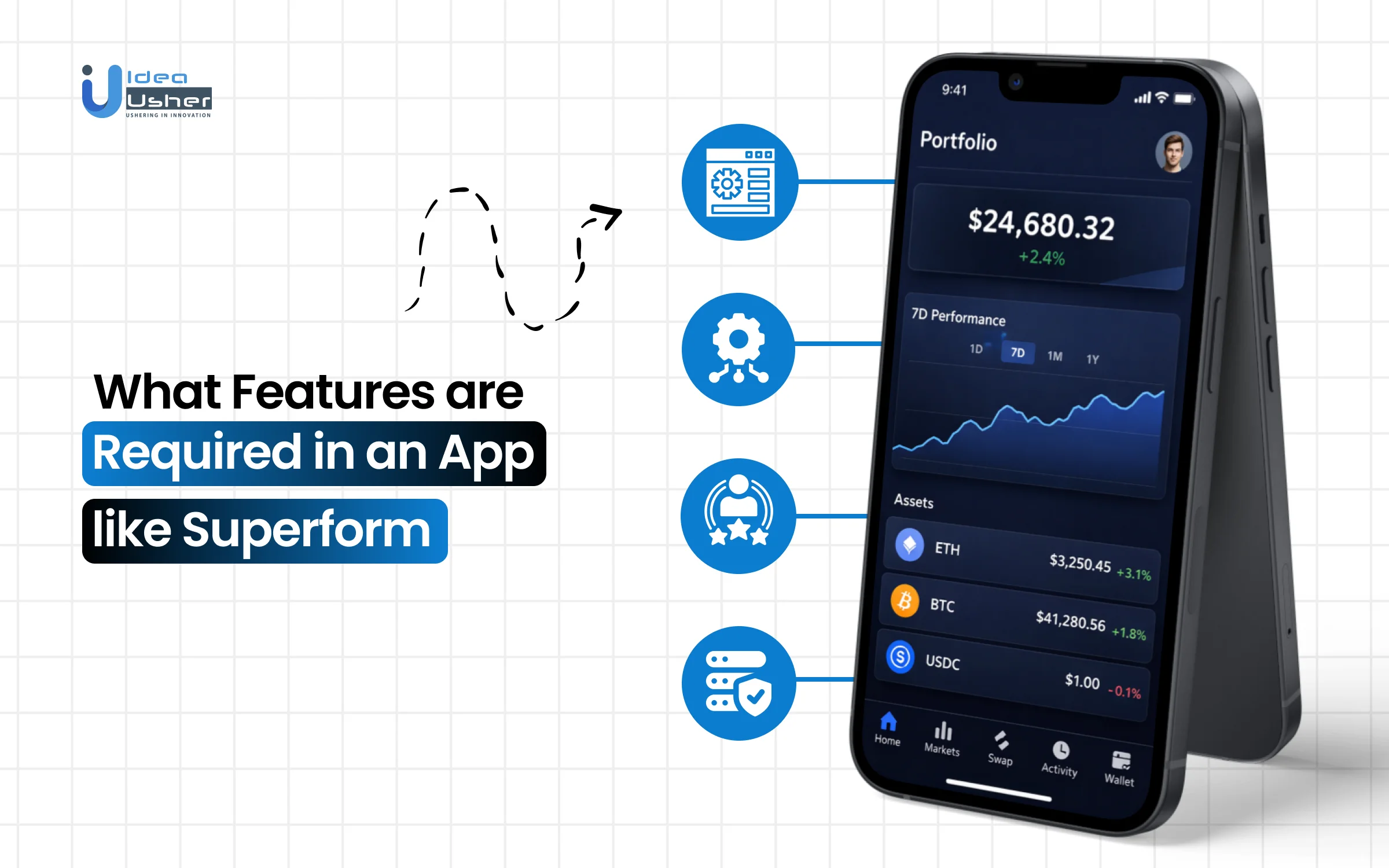
On-chain finance apps succeed when they make complex actions feel intentional rather than overwhelming. Users expect to move capital, manage risk, and access yield opportunities without navigating multiple protocols or interfaces. Meeting these expectations depends less on visual polish and more on the underlying capabilities, which is why understanding Superform app features starts with how users interact with capital across DeFi ecosystems.
Bringing these capabilities together requires careful coordination across multiple system layers. Strategy selection, capital routing, execution transparency, and permission controls must operate within a single experience without obscuring fund movement. Platforms like Superform show how composability across protocols preserves user control, auditability, and reliability. The balance between abstraction and visibility determines whether complexity is reduced or merely hidden.
In this blog, we break down the essential features required in an app like Superform by examining functional components, user experience considerations, and system capabilities that support scalable and trustworthy on-chain finance applications.

What is an On-Chain Finance App, Superform?
Superform is an on-chain finance application and decentralized protocol that functions as a user-owned, non-custodial “neobank” built on decentralized finance (DeFi) infrastructure. It lets people save, earn, send, and swap crypto assets directly on the blockchain while keeping full control of their funds, without relying on traditional financial intermediaries or centralized custodians.
This on-chain finance app operates as a permissionless, cross-chain wealth and yield marketplace that aggregates and routes assets into DeFi vaults and strategies across multiple blockchains. Superform abstracts away the complexity of bridges, swaps, and network management, allowing users to discover, access, and from a single interface.
Core Product Philosophy Behind a Superform-Like App
This section defines the design principles that govern every feature, contract, and workflow in an on-chain finance app like Superform. These are not UI choices or growth tactics; they are architectural decisions that determine whether the platform can scale securely across chains.
1. Chain Abstraction Over Chain Awareness
A Superform-like app simplifies blockchain use, masking chains, bridges, gas tokens, and execution paths into a unified experience. It dynamically chooses the best chain and route for capital deployment.
2. Intent-Based Transaction Execution
The platform operates on user intent instead of requiring multiple transactions. One signed action shows the desired outcome, while the system manages swaps, bridging, approvals, and vault interactions behind the scenes securely and verifiably.
3. High-Reliability Execution Infrastructure
Cross-chain execution causes latency, failures, and asynchronous settlement. A Superform-like app assumes executions can fail, ensuring capital safety via retries, fallback paths, and state reconciliation.
4. Protocol-Level Security Architecture
Users should not be required to assess bridge risks, contract dependencies, or execution logic. The platform embeds security controls at the protocol layer, enforcing guardrails, validation checks, and risk constraints before any transaction is executed.
5. Modularity Over Monolithic Design
Every component such as vault integrations, execution logic, messaging, and risk controls, is modular. This allows new strategies, chains, and protocols to be added without disrupting existing capital flows or forcing full system upgrades.
6. Transparency Without Cognitive Overload
Users can inspect execution paths, contract interactions, and on-chain outcomes without being overwhelmed, while complexity is abstracted, transparency is preserved, and trust without sacrificing usability.
How Does the Superform App Work?
A Superform-like on-chain finance app operates as an intent-driven execution platform. Instead of users manually interacting with multiple protocols and chains, the system coordinates discovery, execution, risk control, and monitoring through tightly integrated on-chain and off-chain infrastructure.

1. Yield Discovery and Strategy Evaluation
The user begins by exploring yield opportunities through a unified interface that aggregates vaults across chains. The Unified Yield Dashboard normalizes APY, TVL, and performance metrics, while Strategy Glass Box Transparency exposes underlying protocols, allocations, and on-chain contracts to support informed decision-making.
Real-world example: A user holding USDC on Polygon compares stable-yield strategies on Ethereum, Arbitrum, and Base without switching networks or opening external dashboards.
2. Intent Creation and Execution Preferences
Once a strategy is selected, the user defines a single execution intent rather than executing multiple transactions. Intent-Based Capital Deployment captures desired outcomes, while Risk-Responsive Execution Controls embed constraints such as slippage limits, exposure caps, or execution timing conditions.
Real-world example: A user allocates ETH to a yield strategy but specifies that execution should halt if slippage exceeds 0.5% during volatile market conditions.
3. Automated Cross-Chain Execution Orchestration
After intent confirmation, the platform orchestrates the full execution flow. Backend Execution Routing, Relayer Infrastructure, and Gas Abstraction handle swaps, bridging, approvals, and routing across chains without user intervention, ensuring consistent execution even in asynchronous environments.
Real-world example: A user deposits BNB on BSC into an Ethereum-based vault without manually bridging assets, managing approvals, or holding ETH for gas.
4. Smart Contract Validation and Safe Settlement
During execution, smart contracts enforce safety at every step. Execution Guardrails, Cross-Chain State Verification, and Failure Recovery Logic validate execution paths, manage partial failures, and ensure capital is either settled correctly or safely recoverable.
Real-world example: If a bridge experiences congestion mid-execution, the system pauses and reconciles state instead of forcing execution at unfavorable rates.
5. Portfolio Tracking and Performance Visibility
Once capital is deployed, positions are reconstructed across chains into a single view. Cross-Chain Portfolio Management and On-Chain Indexing Infrastructure track yield accrual, historical performance, and exposure in near real time.
Real-world example: A user sees yield earned from an Arbitrum strategy reflected alongside positions on Ethereum and Optimism in one dashboard.
6. Automated Optimization and Risk Management
Post-deployment, the platform continuously monitors strategies. Automation & Keeper Systems enable auto-compounding or rebalancing, while the Risk Monitoring Engine tracks TVL shifts, volatility, and protocol dependencies to trigger protective actions when conditions degrade.
Real-world example: When an underlying protocol shows abnormal TVL decline, exposure is automatically reduced and the user is notified.
7. Institutional Controls and Governance Oversight
For organizational users, Institutional Operational Dashboards, Multi-Signature Controls, and RBAC enable governed capital management. Reporting and audit trails support transparency, compliance, and internal approvals without disrupting execution efficiency.
Real-world example: A DAO treasury deploys capital into yield strategies requiring 3-of-5 signer approval for reallocations and exports monthly performance reports for governance review.
Why is the On-Chain Finance App Gaining Popularity?
The global decentralized finance market was valued at USD 26.94 billion in 2025 and is projected to reach USD 1,417.65 billion by 2033, growing at a 68.2% CAGR from 2026 to 2033. This growth reflects the accelerating adoption of user-owned, programmable financial infrastructure worldwide.

These adoption drivers directly inform the feature set required in an on-chain finance app like Superform. Key drivers behind this rapid popularity include:
- Lower global transaction costs: Traditional banks charge 2–4% FX fees on international spending, while on-chain finance apps route cross-border payments at ≤1%, significantly reducing everyday and travel-related expenses.
- Support for micro-transactions at scale: On-chain rails enable transfers costing fractions of a cent, with platforms processing payments around $0.001, unlocking high-volume use cases where 87% of transactions are under $5.
- Near-instant settlement speeds: On-chain networks now achieve finality in seconds rather than days. In 2025, Solana processed over 33 billion transactions, averaging 1,100+ transactions per second, demonstrating real-world usage at scale.
- Meaningfully higher yields than traditional savings: While banks typically offer 1–2% interest, on-chain finance apps provide access to ~10% normalized yields on stable assets with instant liquidity, accelerating the shift from passive deposits to self-custodial yield.
Modern on-chain finance apps remove the usability barriers of self-custody by abstracting wallet management, gas fees, and bridging complexity. Users retain full ownership while experiencing neobank-level simplicity, accelerating the shift from niche DeFi tools to mainstream financial alternatives.
Core User-Facing Features of a Superform-Like On-Chain Finance App
This section addresses the elements users interact with, while representing the underlying execution and security complexity. These features serve as interfaces to robust on-chain infrastructure, abstracting complexity without compromising control or transparency.

1. Unified Cross-Chain Yield Dashboard
A command-layer dashboard aggregating TVL, net APY, and realized P&L across 12+ chains. It shows 90-day performance trends, risk-adjusted returns, volatility signals, and color-coded risk indicators, with every metric verifiable on-chain, positioning the app as an execution cockpit.
2. One-Click Cross-Chain Transactions
Users deploy capital from any asset on any chain through a single signed intent. The platform abstracts bridging, swaps, approvals, and gas while providing pre-execution previews with exact outputs, sub-0.5% slippage thresholds, fee breakdowns, and deposit-token-based gas payment.
3. Strategy “Glass Box” Transparency
Each vault exposes live allocations across 15+ underlying protocols, showing per-component APY contribution, exposure percentages, and contract-level links. Users can inspect 360-day performance history, volatility metrics, and complete on-chain fund movement trails, replacing opaque yield with verifiable strategy intelligence.
4. Advanced Position Management Tools
Built-in auto-compounding reduces manual harvesting friction and can improve effective APY by 15–25%. Users define rule-based triggers like yield differentials, TVL drawdowns, or protocol changes to automate rebalancing, exits, or redeployments across chains without continuous manual oversight.
5. Institutional Operations Dashboard
Designed for DAOs and treasury teams, this layer supports multi-signature vaults, 4-tier RBAC, and quorum-based approvals for high-value transactions. Every action is immutably logged with precise timestamps and exportable reports, enabling audit-ready governance and institutional capital operations.
6. The “DeFi Lego” Integration Panel
Vault tokens can be reused as collateral across 20+ integrated DeFi protocols, enabling yield stacking without unwinding positions. Real-time simulations preview recursive strategies, liquidation thresholds, and capital efficiency impacts, turning complex composability into a controlled, understandable execution flow.
7. On-Chain Strategy Reputation System
Strategists maintain portable, on-chain profiles showing historical TVL, risk-adjusted performance, and strategy longevity. Governance-curated vault lists, forkable strategies, and creator royalties support a transparent strategy economy where visibility and adoption depend on immutable performance.
Smart Contract Architecture for On-Chain Finance Apps
Smart contract architecture forms the foundation of modern on-chain finance apps and directly enables core Superform app features. Rather than acting as passive vaults, contracts actively coordinate execution, enforce risk controls, and preserve capital integrity during cross-chain failures.

1. Modular Vault and Strategy Framework
The architecture uses standardized adapters to onboard 100+ strategies without redeploying core contracts. Each adapter isolates strategy risk, supports versioned upgrades, and enforces per-vault limits, allowing rapid ecosystem expansion without increasing systemic failure surfaces.
2. Intent-Based Execution Contracts
User actions are signed once and converted into 5–10 deterministic execution steps on-chain. Intent contracts enforce slippage ceilings, execution deadlines, and route validation, ensuring capital reaches the intended strategy even when swaps, bridges, and approvals span multiple chains.
3. Cross-Chain State Verification
Contracts track execution across 2–4 asynchronous chains using message proofs and state checkpoints. Intermediate states are validated before final settlement, preventing capital loss during partial execution, delayed confirmations, or cross-chain messaging inconsistencies.
4. Capital Safety Guardrails
Protocol-enforced constraints cap TVL exposure per strategy, restrict slippage beyond 0.5–1%, and rate-limit execution frequency. These hard-coded guardrails prevent abnormal capital flows, protecting users from oracle errors, volatile liquidity, or downstream protocol failures.
5. Trust-Minimized Upgradeable Contracts
Core contracts follow controlled upgrade patterns with 24–72 hour timelocks, governance approval thresholds, and immutable storage separation. This enables protocol evolution while guaranteeing user positions remain unaffected and preventing silent logic changes or emergency governance abuse.
6. Failure Recovery Mechanisms
Smart contracts include fallback paths for 100% of user funds during failed execution, stuck bridges, or protocol downtime. Emergency exits bypass strategy logic, allowing direct fund recovery even under chain halts or critical dependency failures.
7. Strategy-Level Accounting & Attribution Logic
The system tracks yield, fees, and rewards per strategy with block-level precision. Performance attribution spans net APY, fee extraction, and strategist share, enabling transparent accounting, accurate user reporting, and sustainable incentive distribution.
8. Permissioned Automation Compatibility
Automation supports allowlisted keepers with narrowly scoped permissions. Rebalancing, compounding, and monitoring actions execute under predefined limits, reducing human intervention while preventing unrestricted contract access that could expose user capital to automation failures.
Security & Risk Infrastructure Features for On-Chain Finance Apps
Security functions as a continuous control layer in modern on-chain finance apps, directly supporting critical Superform app features. The infrastructure actively monitors risk, enforces real-time protections, and responds to failures across chains and strategies to preserve capital integrity.

1. On-Chain Risk Monitoring
The platform monitors 100+ on-chain signals including TVL shifts, APY spikes, liquidity depth, and oracle deviations. Strategies are continuously re-evaluated at block or minute intervals, enabling early detection of unusual behavior before losses propagate system-wide.
2. Protocol Dependency Mapping
Each strategy maintains a live dependency graph across multiple underlying protocols. If a core dependency experiences TVL collapse, exploit alerts, or paused contracts, downstream strategies are automatically flagged, throttled, or disabled to prevent cascading capital exposure.
3. Dynamic Risk Scoring
Strategies are assigned dynamic risk scores based on volatility, protocol age, audit coverage, and capital concentration. Threshold-based tiering adjusts execution limits, warnings, or access automatically, ensuring higher-risk strategies never scale unchecked during unstable market conditions.
4. Real-Time Execution Anomaly Detection
Execution flows are monitored for anomalies such as slippage exceeding 1%, abnormal gas spikes, or routing deviations. When thresholds are breached, transactions are halted or rerouted automatically, preventing silent value leakage during volatile liquidity or degraded execution paths.
5. Emergency Controls and Kill Switches
The system includes scoped emergency controls allowing strategy-level, chain-level, or protocol-level pauses. Unlike global freezes, these controls isolate failures precisely, ensuring unaffected strategies and user funds remain operational during targeted incident response.
6. Proof-Based Audit & Verification Registry
Rather than static audit badges, the platform maintains a live registry linking each strategy to audit reports, code hashes, and version history. Users can verify exactly which contract version is active, eliminating ambiguity during upgrades or redeployments.
7. Capital Isolation & Loss Containment Design
User funds are segmented by strategy and adapter, ensuring failures are strictly non-propagating. Even in worst-case exploits, loss exposure is capped at the affected strategy level, preventing systemic drain across unrelated vaults or chains.
8. Incident Response System
The platform triggers structured alerts within minutes when incidents occur, detailing impact scope, affected strategies, and recovery actions. Clear, time-stamped disclosures replace silent failures, maintaining trust during events where uncertainty typically causes panic withdrawals.
Backend & Execution Layer Features of App like Superform
Backend and execution infrastructure underpin advanced on-chain finance platforms and directly enable key Superform app features. This layer coordinates indexing, transaction routing, automation, and retries to ensure reliable, cost-efficient execution across multi-chain environments.

1. Cross-Chain Data Indexing
The backend indexes 10+ blockchains in near real time, processing millions of events daily to reconstruct accurate portfolio states. Chain-specific indexers normalize vault data, rewards, and positions, ensuring UI consistency despite differing block times and finality models.
2. Transaction Routing Engine
A centralized orchestration layer decomposes each user intent into 5–10 execution steps, dynamically selecting routes based on liquidity depth, gas prices, and success probability to maximize reliability across congested or volatile network conditions.
3. Gas Abstraction Services
The platform supports gasless or gas-abstracted transactions by sponsoring execution and settling costs post-factum. Batch processing and route optimization reduce effective gas spend by 40–70%, improving user experience without sacrificing execution transparency.
4. Relayer and Retry Mechanisms
A distributed relayer network executes transactions with built-in retries, nonce management, and failover logic. If a transaction fails due to congestion or RPC instability, alternative routes or relayers are automatically selected to maintain execution continuity.
5. Execution State Tracking System
Every execution step emits structured status updates, allowing users to track pending, completed, or failed actions in real time. Intermediate states prevent uncertainty during asynchronous cross-chain execution, reducing support load and user confusion.
6. Automation and Keeper Layer
Automated jobs handle compounding, rebalancing, and monitoring at defined intervals. Keeper permissions are tightly scoped, execution frequency is rate-limited, and actions are auditable, enabling automation without granting unrestricted access to user capital.
7. Data Integrity and Caching Systems
To maintain 99.9% uptime, the backend uses redundant RPC providers, cached state snapshots, and fallback data sources. In case of indexer lag or provider failure, the system degrades gracefully rather than blocking user operations.
8. Analytics and Observability Stack
A full observability layer tracks execution latency, failure rates, gas efficiency, and strategy performance. Metrics are logged per chain and per strategy, enabling rapid debugging, performance tuning, and data-driven product optimization at scale.
Advanced Features for User Retention in a Superform-Like DeFi App
Once an on-chain finance app reaches feature parity, growth is no longer driven by execution alone. These advanced capabilities are designed to increase user lifetime value, deepen capital stickiness, unlock new revenue streams, and attract institutional-grade participants, especially in competitive markets with multiple Superform-class platforms.

1. Personalized Yield Tools
Instead of offering generic yield opportunities, the platform adapts strategies to individual portfolio composition, risk tolerance, and historical behavior. This personalization improves decision relevance, reduces churn caused by poor outcomes, and increases long-term retention by aligning yield performance with user expectations.
2. Risk-Adaptive Execution
Dynamic execution controls adjust slippage, position sizing, or execution timing during volatility or liquidity stress. By prioritizing capital preservation over short-term APY, the platform builds trust, reduces loss-driven churn, and positions itself as a long-term capital management solution rather than a yield-chasing tool.
3. Strategy SDK Integration
A controlled Strategy SDK enables external strategists, DAOs, and funds to deploy strategies directly on the platform. This transforms the app into a two-sided ecosystem where third-party builders drive innovation, liquidity, and fee generation without increasing internal development overhead.
4. Institutional Compliance Options
Jurisdiction-aware execution flows allow institutions to participate through permissioned strategies, reporting controls, or restricted access layers. This expands the addressable market beyond retail users, enabling enterprise contracts, treasury deployments, and regulated capital inflows without compromising the permissionless core.
5. Execution Assurance Mechanisms
Liquidity buffers, fallback routes, and delayed execution guarantees improve reliability during network congestion or market stress. Users trade marginal yield for predictability, leading to higher retained TVL and reduced capital flight during periods when most platforms experience trust erosion.
6. Adaptive Fee Optimization
Advanced revenue attribution tracks value creation across users, strategists, and the protocol. Dynamic fee models adjust based on strategy performance, risk profile, and capital duration, maximizing protocol revenue while maintaining transparency and avoiding flat, value-agnostic fee structures.
7. Governance Strategy Controls
Reputation-weighted strategy discovery prioritizes consistent performance and risk discipline over headline APY. This improves overall capital quality, discourages mercenary liquidity, and strengthens long-term ecosystem health, making the platform more attractive to serious users and institutions alike.
Revenue Models in Superform-Like On-Chain Finance App
Monetization must be native to execution, not added as an external fee layer. These Superform app-like features ensure revenue is generated transparently, scales with usage, and aligns protocol incentives with user outcomes, without degrading performance, trust, or capital efficiency.

1. Performance-Based Yield Fees
Fees are charged only on realized yield, not deposits. Smart contracts calculate performance deltas per strategy and deduct 1–3% of earned yield, aligning protocol revenue directly with user success instead of penalizing idle capital.
2. Strategy Revenue Sharing Model
The system tracks revenue per strategy and distributes it among the protocol, strategists, and referrers. Transparent attribution ensures contributors are compensated proportionally, enabling sustainable incentives without hidden spreads or opaque fee extraction.
3. Tiered Premium Strategy Access
Advanced or capacity-constrained strategies can be gated behind premium access tiers. Users pay for priority allocation, higher limits, or early entry, monetizing demand while preventing overcrowding that would otherwise degrade returns for all participants.
4. Institutional Infrastructure Fees
DAOs, funds, and enterprises can deploy white-labeled interfaces or dedicated execution pipelines. Revenue is generated through monthly infrastructure fees or volume-based pricing, without fragmenting liquidity or duplicating smart contract logic.
5. Cross-Chain Service Fees
Gas abstraction, batching, relayers, and automation services are monetized as execution add-ons. Small per-transaction fees or bundled service plans capture value from operational complexity while preserving transparent, predictable user costs.
6. Governance-Based Fee Configuration
Protocol governance controls fee ranges, routing, and distribution logic. This allows fees to evolve with market conditions, strategy risk, and user behavior, ensuring monetization remains adaptive, transparent, and aligned with long-term ecosystem health.
Conclusion
Building a successful platform starts with understanding the core Superform app features that drive user trust, capital efficiency, and seamless cross-chain yield access. From intuitive dashboards and automated vault strategies to robust security layers and real-time analytics, every feature should serve a clear financial purpose. If you are planning to develop a similar solution, focus on scalability, compliance readiness, and user-centric design. A well-structured combination of these Superform app features will position your product to compete effectively in the evolving on-chain finance ecosystem.
Build Feature-Rich On-Chain Finance App with IdeaUsher
Our team combines hands-on experience in blockchain architecture, DeFi protocols, cross-chain execution, and payment systems, led by ex-FAANG/MAANG engineers with real-world financial product expertise. Using this foundation, we help businesses design and build feature-complete, Superform-style on-chain finance apps tailored to their operational needs, risk appetite, and user experience goals.
Why Work With Us?
- Feature-First Product Strategy: We map user needs directly to smart contract architecture and execution logic.
- Non-Custodial Automation Expertise: Our platforms deliver automation without custody, trust tradeoffs, or hidden control layers.
- Composable DeFi Integrations: We build adapter-based integrations that remain stable as protocols and markets evolve.
- User-Centric Financial Infrastructure: Engineers design every feature to reduce friction, improve capital efficiency, and scale globally.
Explore our portfolio to see how we support organizations with robust blockchain and financial infrastructure built for long-term scale.
Connect with our team for a free consultation and define the right feature set for your on-chain finance app.


FAQs
A.1. A Superform-like app should include cross-chain yield aggregation, automated vault strategies, real-time portfolio tracking, liquidity routing, and transparent APY insights. Strong smart contract security, intuitive dashboards, and seamless wallet integration are also essential for trust and usability.
A.2. Cross-chain interoperability allows users to access yield opportunities across multiple blockchains without manually bridging assets. It improves capital efficiency, expands liquidity access, and enhances user convenience, making the platform more competitive and scalable in the DeFi ecosystem.
A.3. Smart contract security is critical because vulnerabilities can lead to significant financial losses. Comprehensive audits, automated testing, bug bounty programs, and secure contract architecture help protect user funds and establish long-term credibility in the market.
A.4. Clear performance analytics, simplified deposit flows, gas optimization, risk indicators, and responsive design significantly improve adoption. Users value transparency and simplicity, so a clean interface combined with actionable data builds confidence and encourages long-term engagement.


