


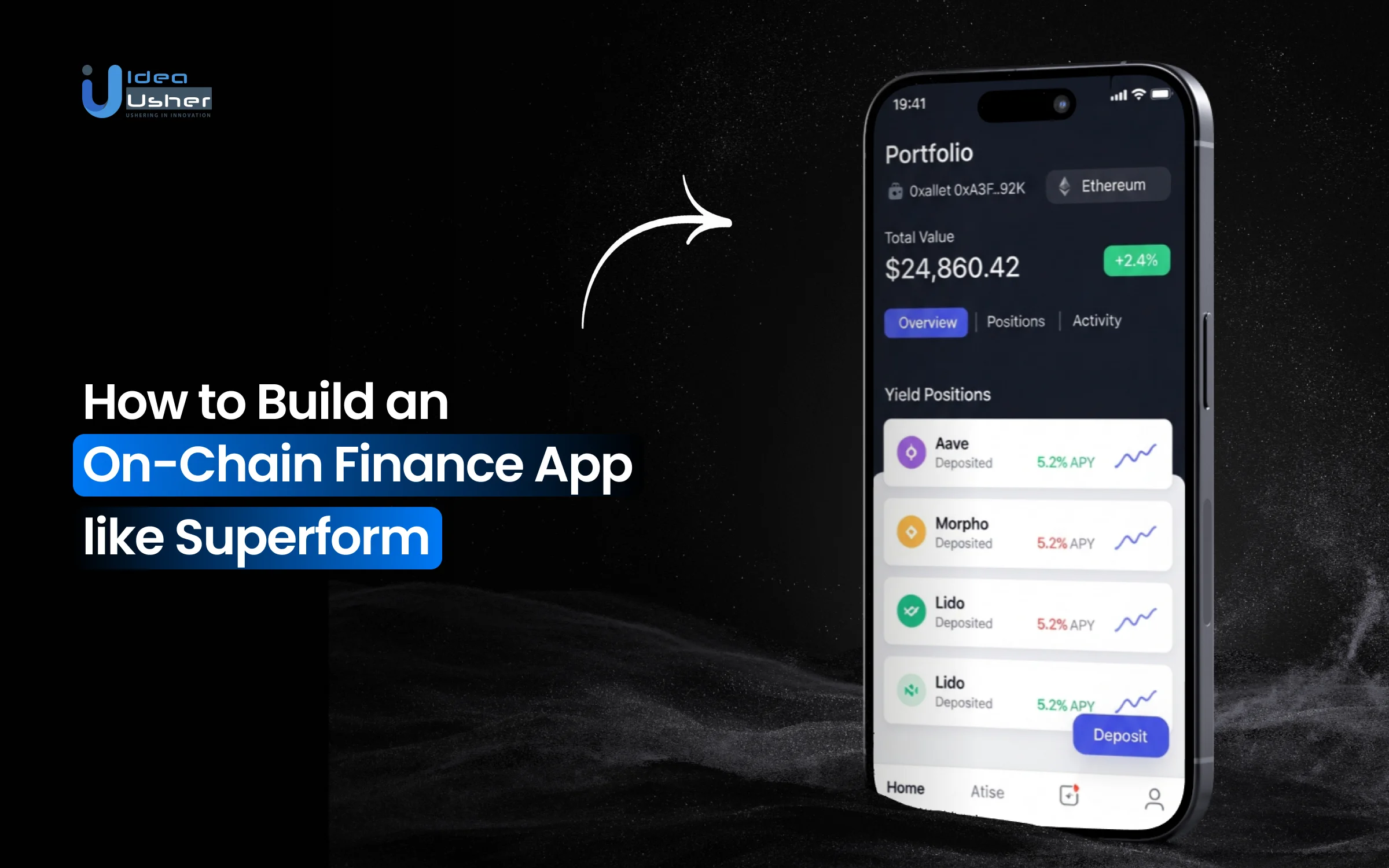
On-chain finance apps are increasingly expected to manage capital across multiple protocols rather than operate as isolated products. Users want exposure, yield, and risk management without manually navigating complex DeFi stacks. This shift is shaping on-chain finance app development, where the challenge lies in coordinating strategy execution, liquidity movement, and user intent through a single, reliable interface.
Making on-chain finance easier for users means handling complexity behind the interface. Capital routing, vault interactions, cross-protocol execution, and permissioning must work reliably. Platforms like Superform demonstrate how these pieces can be coordinated while keeping actions transparent and auditable. The real measure of success lies in whether this abstraction reduces friction without limiting control.
In this blog, we explain how to build an on-chain finance app like Superform by breaking down core system components, architectural decisions, and execution considerations involved in designing scalable and composable DeFi applications.

What is an On-Chain Finance App, Superform?
Superform is an on-chain finance application and decentralized protocol designed to help crypto users manage and grow digital assets across multiple blockchains without relying on centralized financial intermediaries. It serves as a reference model for modern on-chain finance apps by combining non-custodial asset management, cross-chain yield access, and smart-contract-based execution into a single, user-owned interface.
This app functions as an on-chain wealth app and cross-chain yield marketplace, enabling users to access DeFi earning strategies through non-custodial smart contracts. The platform aggregates yield opportunities across multiple blockchains and abstracts away bridges and swaps, delivering a user-owned neobank model that offers save, earn, send, and swap functionality entirely on-chain.
- Non-custodial smart-contract suite acting as a yield router and execution hub that lets users access any listed vault from any chain in a single transaction.
- Modular, permissionless vault ecosystem where DeFi protocols can list their ERC-4626-compliant vaults without needing approval from the protocol team.
- Single-transaction, cross-chain deposit/withdrawal support that batches actions across multiple chains and strategies, reducing gas costs and user complexity.
- Smart Accounts based on ERC-7579 with features like gas abstraction, session key management, and optional social recovery for enhanced UX.
- Composable and permissionless “Hooks” framework that enables developers to architect and chain complex transaction flows across chains.
- Validator-secured vault architecture that maintains protocol integrity and price accuracy via decentralized validation.
- Support for multiple interoperability bridges (LayerZero, Wormhole, Hyperlane, etc.) to abstract cross-chain messaging and asset routing.
- SuperVaults with “set-and-forget” automated yield strategies that deploy user capital into optimized DeFi earning mechanisms.
- Cross-chain yield abstraction layer that treats chains as infrastructure rather than user decisions, focusing on outcomes rather than individual blockchain mechanics.
A. Business Model: How it Operates
Superform operates as a decentralized cross-chain yield marketplace that aggregates opportunities and executes transactions across multiple blockchain networks. It functions as a non-custodial orchestration layer or a middleware financial layer, routing assets into DeFi strategies while users maintain full control.
Key aspects of its operations include:
- DeFi Yield Aggregator: Bundles earning opportunities from multiple protocols (SuperVaults) into unified products, allowing users to deposit once and access a range of strategies.
- Cross-Chain Execution: Abstracts bridging, network switching, and swaps into one seamless step for users.
- Smart Wallet / Account Abstraction: Uses programmable accounts that enable advanced features like simplified login, gas management, and modular security.
- Permissionless Protocol: Allows other DeFi protocols to list vaults and strategies without central approvals, expanding the marketplace.
- Validator Network and Governance: Tokens (UP) coordinate protocol parameters and economic security, aligning users and ecosystem participants.
B. Revenue Model: How it Generates Money
Superform generates revenue by monetizing on-chain activity across its protocol, including yield aggregation, cross-chain execution, infrastructure services, and token-based incentives, while remaining fully non-custodial and permissionless.
- Vault & Performance Fees: Superform takes a protocol-level cut from yield or performance fees generated by SuperVaults and third-party ERC-4626 vaults accessed through its aggregation layer.
- Cross-Chain Execution & Routing Fees: The protocol earns fees for orchestrating single-transaction cross-chain deposits, withdrawals, swaps, and bridge interactions using its routing and execution infrastructure.
- UP Token Staking & Fee Distribution: Protocol fees may be distributed to UP token stakers and validators, aligning governance participation with protocol revenue and long-term network security.
- Validator, Keeper & Automation Fees: Fees are generated from automated execution services, keepers, and validator coordination required to maintain cross-chain operations and vault integrity.
- Protocol Partnerships & Marketplace Revenue Share: Superform can earn revenue-sharing fees from integrated DeFi protocols whose vaults, strategies, and liquidity are distributed through its on-chain marketplace.
Why On-Chain Finance Apps Are Replacing Traditional DeFi Apps?
On-chain finance apps are redefining DeFi by enabling intent-driven execution, transparent logic, and programmable capital directly on-chain. This shift improves security, composability, and automation while reducing fragmentation and user complexity.
| Aspect | Limitation of Traditional DeFi Apps | How On-Chain Finance Apps Solve It |
| Protocol Access & Interfaces | Fragmented protocol-specific interfaces force users to manage assets across multiple apps and chains manually. | A unified on-chain execution layer abstracts multiple protocols into a single interaction surface. |
| Yield Management | Manual yield discovery and rebalancing require constant user involvement and timing precision. | Smart contract–driven strategy automation executes predefined actions without manual intervention. |
| Cross-Chain User Experience | Chain-locked UX restricts capital mobility and increases friction when moving funds across ecosystems. | Chain-abstracted execution enables users to deploy capital across chains through a single transaction intent. |
| Protocol Complexity Exposure | Protocol complexity is directly exposed to end users, increasing cognitive load and error risk. | Infrastructure-level abstraction hides protocol mechanics while maintaining non-custodial control. |
| Application Scalability | Frontends scale poorly as strategies, chains, and integrations increase. | Modular contract architecture scales horizontally without degrading user experience. |
| Risk Management | Users must actively monitor risk, protocol changes, and reward mechanics. | On-chain logic embeds risk boundaries and execution rules directly into smart contracts. |
| Portfolio Visibility | Portfolio visibility is fragmented across wallets, chains, and dashboards. | Unified on-chain data indexing provides a consolidated portfolio and performance view. |
Global Market Growth of On-Chain Finance App
The global decentralized finance market was valued at USD 26.94 billion in 2025 and is projected to reach USD 1,417.65 billion by 2033, growing at a 68.2% CAGR from 2026 to 2033. This growth reflects a structural shift toward self-custodial, programmable financial infrastructure rather than short-term speculative cycles.

This growth is already visible at the application layer. Platforms like Superform have scaled to an estimated $10B in TVL across 50+ protocols and 10+ blockchains, supported by 180,000+ active depositors. The data points to a clear shift from short-term trading toward long-term, self-custodial yield management.
At the macro level, on-chain financial activity continues to accelerate. Stablecoin transaction volume reached $33 trillion in 2025, with global supply exceeding $300 billion. Decentralized exchanges now account for 20%+ of total crypto volume, reinforcing on-chain finance as a primary execution layer rather than a niche alternative.
The momentum extends beyond yield platforms. Cross-chain infrastructure protocols now serve millions of users globally, while on-chain neobanks are processing daily consumer transactions at scale, including payments for everyday expenses. Together, these signals confirm that on-chain finance apps are transitioning from experimental DeFi products into core financial infrastructure supporting global, user-owned capital movement
How the On-Chain Finance App Superform Works?
Superform is an on-chain finance app that automates cross-chain DeFi strategies using intent-based execution. It enables non-custodial vaults, modular integrations, and secure settlement across networks with transparent, programmable on-chain workflows.

1. The Core Architecture
The Superregistry catalogs 3,500+ vaults across 15+ chains. The Superformula translates intents into atomic execution paths. Superform contracts mint ERC-4626 vault tokens, with universally composable receipts usable as collateral anywhere in DeFi.
Real-World Transaction Example: A user browses 3,500+ vaults, selects a Curve pool on Arbitrum, and deposits USDC from Optimism. The Superformula routes via the Across bridge, executes an atomic swap and a deposit, all in one 38-second transaction.
2. The Deposit Flow
Users sign a single intent and Superform’s solver network executes multi-step flows across bridges, swaps, and deposits with 94% optimal routing. Failed steps trigger automatic reverts, guaranteeing users never face intermediate loss states.
Real-World Transaction Example: Alice deposits 10,000 USDC from Optimism into a 12.4% APY Curve vault on Arbitrum. Preview shows $3.42 fees, 45-second estimate. One signature later, she receives Superform vault tokens representing her Arbitrum position.
3. The Withdrawal Flow
Withdrawals reverse deposits atomically, redeeming underlying tokens, bridging, swapping, and settling to any destination chain or asset. All fees are pre-calculated and displayed before the user signs a single transaction.
Real-World Transaction Example: Alice withdraws 10,124 USDC-equivalent from Arbitrum back to Optimism. System previews bridge fees, 0.3% slippage, and 52-second finality. She approves; funds arrive in her wallet with full transaction transparency.
4. Cross-Chain State Management & Verification
Optimistic verification with 12-block dispute windows reduces cross-chain latency by 40%. Failed messages trigger auto-reverts within 60 minutes, returning funds to source chains. State oracles synchronize portfolio views across chains every 15 seconds.
Real-World Transaction Example: A cross-chain deposit from Polygon to Avalanche encounters bridge congestion. After 45 minutes without confirmation, Superform’s contracts auto-revert. The user’s 5,000 USDC returns to Polygon with no gas costs lost.
5. The Strategist & Permissionless Listing Model
Superform’s strategist model scales through permissionless participation. Developers deploy compliant adapters to list vaults within 24 hours, accounting for 65% of listings. Strategists with verified 12-month performance and 15%+ APY earn 0.5–2% royalties on reused strategies.
Real-World Transaction Example: A developer deploys a Superform adapter for a new Pendle vault. Within 24 hours, it’s live. Users deposit $2.3M in week one; the developer earns 1.5% creator royalties on $180,000 in generated fees.
6. Superform Vault Tokens
ERC-4626 compliant vault tokens transfer like any ERC-20 serve as collateral on Aave, Compound, and Morpho. This unlocks liquidity without exiting yield positions, creating capital efficiency previously impossible in fragmented DeFi.
Real-World Transaction Example: Alice uses 5,000 USDC-equivalent of her Superform vault tokens as collateral on Aave to borrow 2,500 USDC for a new opportunity, all while her original position continues earning 12.4% APY.
7. Fee Collection & Distribution
Yield generated through the platform is shared via an automated performance fee model, with 20% distributed 80/15/5 between strategists, protocol treasury, and insurance fund. All deductions occur automatically and are transparently recorded on-chain.
Real-World Transaction Example: Alice’s vault generates $127 in monthly yield. Smart contracts automatically deduct $25.40, distributing $20.32 to the strategist, $3.81 to the protocol treasury, and $1.27 to the insurance fund. Alice sees her net APY adjust in real-time, while strategists receive automatic payments, no manual claims, no delayed settlements, and complete on-chain transparency.
Benefits of On-Chain Finance Apps Over Typical DeFi Apps
On-chain finance apps improve DeFi with intent-based execution, transparent logic, and automated risk controls. They reduce fragmentation, enhance composability, and deliver predictable, non-custodial outcomes across protocols and chains securely globally.
1. Intent-Based User Experience
Users sign a single intent describing their desired outcome, while smart contracts translate it into validated, multi-step execution flows, eliminating manual sequencing errors and reducing failed transactions across swaps, bridges, and deposits.
2. Chain-Abstracted Execution
Capital is deployed across multiple chains without users selecting networks or bridges. Execution logic determines optimal routes, handles asynchronous settlement, and guarantees atomic completion or full reversion without exposing infrastructure complexity.
3. Non-Custodial Automation
Strategy automation is enforced directly by smart contracts with predefined rules and constraints. Assets never enter platform custody, and no off-chain operator can move funds outside explicitly approved execution logic.
4. Capital Composability
Vault positions are tokenized using standardized ERC-4626 receipts, allowing users to reuse yield-bearing assets as collateral elsewhere in DeFi without unwinding positions or interrupting ongoing yield generation.
5. Built-In Risk Isolation
Each vault and strategy operates within isolated contracts, ensuring exploits, oracle failures, or protocol insolvency impact only scoped capital and cannot cascade across unrelated user positions.
Key Features of an On-Chain Finance App like Superform
On-chain finance app development like Superform combines intent-based execution, non-custodial vaults, and cross-chain automation to streamline DeFi participation. These key features enable transparent execution, modular integrations, and built-in risk controls.

1. Non-Custodial Vault and Asset Management
Assets must remain fully user-owned, with vaults implemented as isolated smart contracts. Funds should only move via deterministic, auditable logic, ensuring users never delegate custody while still benefiting from pooled execution and strategy efficiency.
2. Intent-Based Transaction Execution
Users submit high-level intents such as deposit, rebalance, or exit instead of manual transaction sequencing. The protocol translates these intents into validated, multi-step on-chain executions, reducing UX friction while preserving atomicity and execution guarantees.
3. Chain-Abstracted Capital Deployment
Users should deploy capital without selecting networks, bridges, or routers. The system determines optimal chains, routes liquidity securely, and settles asynchronously, enabling true cross-chain participation without exposing users to underlying infrastructure complexity.
4. Smart Contract–Driven Strategy Automation
Yield strategies must be encoded directly into smart contracts with predefined rules, triggers, and constraints. This removes human dependency, ensures predictable execution, and allows capital to react automatically to market conditions without off-chain intervention.
5. Modular Protocol Integrations
Each protocol integration should function as an independent module with standardized interfaces. This allows integrations to be upgraded, replaced, or disabled without impacting core vault logic, preserving long-term maintainability and ecosystem adaptability.
6. Risk Isolation at Vault Level
Every vault and strategy must be sandboxed to prevent failure propagation. Contract-level isolation ensures exploits, oracle failures, or protocol insolvency affect only scoped capital, not the entire platform or unrelated user funds.
7. Unified Cross-Chain Portfolio
Portfolio state should be reconstructed from on-chain events across all supported chains. Real-time indexing and normalization enable users to view performance, allocations, and yield exposure from a single interface without relying on off-chain custody data.
8. On-Chain Fee and Revenue Enforcement
Fees must be enforced programmatically at the smart contract level, not through off-chain accounting. Performance fees, protocol cuts, and partner revenue shares should execute automatically, ensuring transparent, trustless monetization aligned with user outcomes.
9. Governance Controls Contracts
Upgrades should follow transparent governance flows using time locks, multi-signature approvals, and versioned deployments. This balances long-term adaptability with user trust, ensuring no unilateral changes can compromise funds or execution logic.
10. Built-In Fail-Safe Mechanisms
Emergency controls such as pauses, strategy shutdowns, and safe withdrawals must be embedded by design. These mechanisms allow rapid response to exploits or systemic risks without requiring protocol-level migrations or user-side technical intervention.
How to Build an On-Chain Finance App like Superform?
An on-chain finance app development like Superform requires intent-driven design, secure smart contracts, and modular DeFi integrations. Our developers follow structured architecture, protocol composability, and security-first practices to ensure scalable, transparent, and non-custodial on-chain execution.

1. Consultation & Define Capital Intent
We begin by modeling how capital should move through the system, not by choosing tools or chains. Our developers define user intents, supported financial actions, exposure limits, and execution boundaries before on-chain finance app development to ensure every contract enforces capital logic consistently from day one.
2. Design an Intent-First Interaction Layer
We architect an intent-based interaction model instead of exposing transactions where users express outcomes, not steps. This abstraction becomes the backbone for cross-chain execution, UX simplification, and deterministic contract behavior without compromising non-custodial control.
3. Smart Contract System Architecture
Our developers separate vaults, strategies, execution routers, and governance into isolated, composable contracts. This modularity allows independent audits, controlled upgrades, and horizontal scalability without introducing systemic risk or tightly coupled dependencies.
4. Develop Non-Custodial Vault
Vaults are designed so assets only move through pre-defined, verifiable logic paths. We eliminate discretionary control entirely, ensuring funds are governed solely by smart contracts, user-approved intents, and transparent execution rules.
5. Implement Secure Cross-Chain Execution
Our team integrates cross-chain messaging with explicit failure handling, confirmation tracking, and asynchronous settlement logic. Users never select bridges or routes; our infrastructure resolves execution paths while maintaining traceability and capital safety across networks.
6. Encode On-Chain Strategy Automation
We translate yield and allocation strategies into enforceable on-chain logic rather than relying on off-chain operators. Triggers, constraints, and execution conditions are hard-coded, ensuring strategies execute predictably under defined market conditions.
7. Integrate DeFi Protocols Using Adapters
Each protocol integration is built as a standalone adapter with standardized interfaces. This allows our developers to upgrade, disable, or replace integrations without touching core vault logic, preserving system integrity as external protocols evolve.
8. Risk Management and Emergency Controls
Risk isolation is enforced at the vault and strategy levels. Our developers implement pause controls, execution guards, and safe exit paths so the platform can respond instantly to exploits, oracle failures, or liquidity shocks without cascading damage.
9. Build On-Chain Portfolio Tracking
We index contract events across chains to rebuild user portfolios in real time instead of relying on off-chain balances. This guarantees accurate performance tracking, transparent yield attribution, and auditable financial history.
10. Audit, Govern, and Scale the Platform
Our deployment approach prioritizes security and trust over speed. We conduct layered audits, introduce governance-controlled upgrades, launch with capped exposure, and scale progressively as execution reliability and capital confidence increase.
On-Chain Finance App like Superform Development Cost
The on-chain finance app development like Superform cost depends on architecture complexity, security requirements, and cross-chain functionality. These phases help to define scope, manage risk, ensure protocol security, and support scalable long-term infrastructure growth.
| Development Phase | What We Deliver | Estimated Cost |
| Capital Intent & Financial Scope | Capital flow mapping, supported actions, risk boundaries, chain scope, and financial assumptions documentation. | $8,000 – $12,000 |
| Intent-Based Interaction Design | Intent schemas, transaction abstraction logic, UX flows, wallet interactions, and execution sequencing models. | $10,000 – $15,000 |
| Smart Contract Architecture | Modular contract architecture for vaults, strategies, routers, governance, and upgrade pathways. | $15,000 – $22,000 |
| Non-Custodial Vault Development | Non-custodial vault contracts with deterministic asset flows and strict permission boundaries. | $18,000 – $25,000 |
| Cross-Chain Execution Layer | Cross-chain messaging, execution routing, failure handling, and asynchronous settlement infrastructure. | $20,000 – $30,000 |
| On-Chain Strategy Automation | Smart contract–based strategies with triggers, constraints, automation logic, and execution validation. | $15,000 – $22,000 |
| DeFi Protocol Integrations | Adapter-based integrations, sandboxed protocol logic, version control, and integration-level testing. | $12,000 – $18,000 |
| Risk Controls & Emergency Systems | Vault isolation, pause controls, execution guards, emergency withdrawals, and risk thresholds. | $8,000 – $12,000 |
| Indexing & Portfolio Tracking | On-chain event indexing, cross-chain portfolio reconstruction, performance tracking, and analytics pipelines. | $10,000 – $15,000 |
| Audit, Governance & Scaling | Security audits, governance setup, phased rollout planning, and post-launch optimization support. | $12,000 – $18,000 |
Total Estimated Cost: $63,000 – $124,000+
Note: Actual on-chain finance app development costs vary based on supported chains, strategy complexity, security depth, audit requirements, and long-term scalability expectations.
Consult with IdeaUsher to evaluate your on-chain finance app development like Superform requirements, architecture scope, and development roadmap.
Challenges and How Our Developers Solve Them?
An on-chain finance app development like Superform involves challenges around security, cross-chain execution, and protocol composability. Our developers solve these through structured architecture, rigorous audits, and resilient, modular on-chain design.

1. Secure DeFi Transaction Abstraction
Challenge: Abstracting multi-step DeFi transactions into simple user actions without introducing hidden execution paths, security gaps, or unpredictable fund movements.
Solution: Our developers implement intent-based execution layers that validate user intent, enforce deterministic contract flows, and restrict asset movement strictly to predefined, auditable logic paths.
2. Cross-Chain Failure Handling
Challenge: Cross-chain transactions can fail mid-execution, leaving funds partially deployed, delayed, or exposed across multiple networks.
Solution: We build execution state tracking, confirmation checkpoints, retry mechanisms, and failure-aware settlement logic to ensure capital safety even during asynchronous cross-chain disruptions.
3. Vault Risk Isolation
Challenge: A single protocol exploit or strategy failure can cascade across vaults, putting unrelated user funds at systemic risk.
Solution: Our developers enforce strict vault- and strategy-level isolation using sandboxed contracts, ensuring failures remain contained and never propagate across the broader platform.
4. Trusted & Secure Contract Upgrades
Challenge: Smart contracts must evolve over time without allowing unilateral upgrades that undermine transparency, predictability, or user trust.
Solution: We implement governance-controlled upgrades using timelocks, multisignature approvals, and versioned deployments, giving users visibility and protection against sudden or malicious changes.
5. Cross-Chain Portfolio Tracking
Challenge: Tracking user portfolios across multiple chains is complex when balances, rewards, and events are fragmented across networks.
Solution: We reconstruct portfolio state directly from indexed on-chain events, enabling accurate, auditable performance tracking without relying on off-chain balance assumptions.
What Security Audits Does an On-Chain Finance Platform Need?
On-chain finance platforms require comprehensive security audits to validate smart contracts, cross-chain logic, and protocol integrations. These audits help identify vulnerabilities, enforce risk controls, and ensure reliable, trust-minimized execution across decentralized systems.

1. Smart Contract Logic and Asset Flow
This audit reviews vault logic, strategy execution, permission boundaries, and asset movement paths to ensure funds move only through deterministic, intended contract flows without hidden backdoors or exploit-prone conditions.
2. Cross-Chain Execution and Bridge Risk
Cross-chain audits evaluate messaging logic, asynchronous execution handling, failure recovery mechanisms, and replay protection to prevent partial settlements, stuck funds, or exploit vectors introduced by bridging and cross-network coordination.
3. Economic and Incentive Design
These audits analyze fee logic, strategy incentives, liquidation conditions, and edge-case economic scenarios to ensure the protocol cannot be exploited through game-theoretic manipulation or unexpected capital behavior under stress.
4. Upgradeability and Governance Control
This audit verifies timelocks, multisignature controls, upgrade paths, and governance permissions to ensure contract upgrades are transparent, non-abusive, and cannot be executed unilaterally or without sufficient user protection.
5. Live Contract Surveillance
This audit layer focuses on real-time monitoring of deployed contracts, execution patterns, and abnormal state changes, combined with predefined incident response procedures to quickly pause execution, isolate risk, and protect user funds during live threats.
Conclusion
Building a platform like Superform requires more than technical execution. It demands a clear understanding of decentralized infrastructure, secure smart contract architecture, cross-chain interoperability, and user-focused design. As you plan your roadmap, prioritize compliance considerations, liquidity strategy, and rigorous security testing. Successful on-chain finance app development depends on aligning innovation with reliability and long-term scalability. When you approach each stage with strategic clarity, you position your product to deliver real financial value while earning user trust in an increasingly competitive decentralized ecosystem.
Build a Secure On-Chain Finance App with IdeaUsher
We bring deep expertise in blockchain engineering, payment infrastructure, and on-chain finance systems, backed by ex-FAANG/MAANG developers who have built scalable, production-grade financial platforms. Leveraging this experience, we design and develop Superform-like on-chain finance apps aligned precisely with your business model, capital strategy, and long-term growth objectives.
Why Work With Us?
- On-Chain Finance Architecture Expertise: We design intent-based, non-custodial systems that abstract complexity without compromising user control.
- Cross-Chain Execution Engineering: Our developers build secure, failure-aware cross-chain execution and settlement infrastructure.
- Institutional-Grade Security Design: We prioritize deterministic asset flows, vault isolation, audits, and governance-ready upgrades.
- Scalable Financial Infrastructure: Platforms are built to support multi-chain growth, high TVL, and long-term protocol evolution.
Explore our portfolio to see how we design and deliver scalable blockchain, payment, and on-chain finance solutions for complex, real-world business use cases.
Get in touch for a free consultation and start building your on-chain finance app with confidence.


FAQs
A.1. Secure smart contract design requires modular architecture, code reviews, automated testing, and third-party audits. Limiting upgrade permissions and implementing multi-signature controls further reduces vulnerabilities and protects user funds from exploitation.
A.2. Common stacks include Solidity for smart contracts, React or Next.js for frontend, and Node.js for backend services. Integrating reliable wallet providers, cross-chain bridges, and indexing tools ensures scalability, performance, and seamless user interaction.
A.3. Compliance involves understanding regional regulations, implementing KYC or AML measures when required, and consulting legal experts. Structuring token models carefully and maintaining transparent governance frameworks reduces regulatory risk and supports sustainable growth.
A.4. Conduct thorough smart contract audits, perform beta testing, and build community engagement before launch. Establish liquidity partnerships, create educational content, and implement incentive programs to attract early adopters and strengthen market positioning.


