


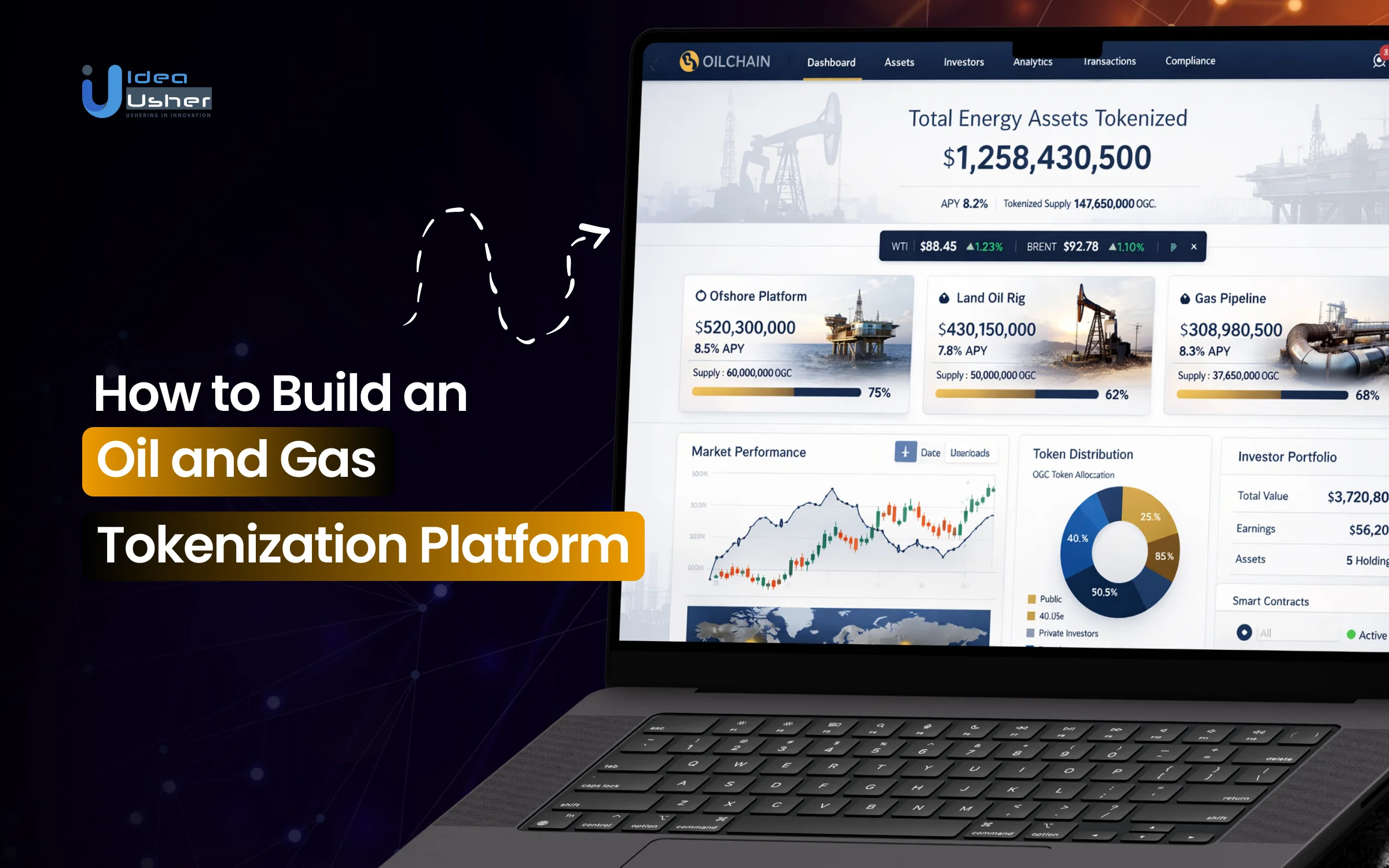
For decades, oil and gas investments carried a quiet frustration where capital could remain locked for years, and ownership often felt distant. As projects grew larger and more global, the gap between asset value and investor access slowly widened. The popularity of oil and gas tokenization platforms has grown as they enable fractional participation, reduce exit friction, and provide clearer visibility into reserves and cash flows.
They may also enable faster settlement and broader cross-border investor reach. Investors did not adopt this shift for novelty, but because it effectively addressed problems that traditional structures had never solved.
Over the years, we’ve developed numerous energy-focused asset tokenization solutions, powered by blockchain-based RWA frameworks and secure data oracle systems. As IdeaUsher has this expertise, we’re sharing this blog to discuss the steps to build an oil and gas tokenization platform.
Key Market Takeaways for Oil and Gas Tokenization Platform
According to Mordor Intelligence, the asset tokenization market is entering a breakout phase, moving from USD 2.08 trillion in 2025 toward an estimated USD 18.74 trillion by 2031. Oil and gas stand out within this growth because they have always been capital-heavy and difficult to access. Tokenization changes that dynamic by converting reserves, royalties, and production rights into fractional digital assets.

Source: Mordor Intelligence
Oil and gas tokenization platforms are gaining traction because they transform physical energy assets into programmable financial instruments. Transparent ledgers improve trust across the asset lifecycle, while lower minimum investments have steadily increased retail participation over the past few years.
For operators, this model also creates new funding channels without relying entirely on traditional debt or private equity.
Several real-world implementations already validate the model. Zoniqx enabled one of the first tokenized upstream oil and gas funds by structuring compliant security tokens tied to producing assets.
Tokenized Energy focuses on U.S. minerals and royalty interests, using SPV-backed tokens that distribute yield digitally in collaboration with Avanza USA.

What Is an Oil and Gas Tokenization Platform?
An oil and gas tokenization platform converts physical energy assets such as reserves, production rights, or future revenue streams into compliant digital tokens on a blockchain. These tokens represent economic or ownership rights and can be securely issued, transferred, and settled, with built-in rules for regulatory compliance, reporting, and lifecycle management.
How Oil and Gas Tokenization Differs from Other RWA Platforms?
While Real World Asset tokenization includes real estate, art, and commodities, oil and gas tokenization is structurally more complex due to the nature of the underlying assets.
1. Assets Are Dynamic and Depleting
Oil and gas assets are continuously depleting. A token representing an interest in a well today does not map to the same physical volume tomorrow. The platform must reflect this depletion in near-real-time using tamper-proof IoT data and production oracles. Most RWA platforms designed for static assets do not face this requirement.
2. Production-Linked Revenue Flows
Revenue flows are tied to daily production and market prices rather than one-time sales. Smart contracts must automate the division-of-order waterfall by allocating payments to taxes, royalties, and operating costs, and then distributing Net Revenue Interest to token holders. This replaces long manual accounting cycles with automated settlement.
3. Live Data–Driven Valuation
The value of a tokenized royalty is not based on a fixed appraisal. It is driven by multiple live factors.
- Real Time Production Data showing how much the well is producing today
- Future Reserve Estimates indicating how much resource remains underground
- Live Commodity Prices reflect the current global market value of oil and gas
A mature platform integrates multiple data oracles to provide a live and cryptographically verified Proof of Reserve and Proof of Flow. This gives investors clear visibility into what is driving the value of their investment.
4. Complex Legal Ownership
Oil and gas ownership involves mineral rights, leases, royalties, and working interests rather than simple titles. These interests are treated as securities in most jurisdictions, which requires permissioned token standards such as ERC-3643 with embedded KYC, AML, and transfer controls that generic RWA platforms often lack.
Types of Oil and Gas Tokenization Platforms
Oil and gas tokenization platforms are typically structured around the specific economic rights or operational layers they represent. Each model serves a different investor profile and regulatory use case.
1. Reserve-Backed Tokenization Platforms
These platforms tokenize proven or probable reserves in the ground. Tokens represent an economic claim on a defined portion of recoverable resources, with valuation linked to reserve reports, depletion curves, and commodity prices. This model is commonly used for long-term exposure to upstream assets.
A practical example is PermianChain, which links verified reserve data to digital tokens tied to producing basins.
2. Production & Revenue Tokenization Platforms
Here, tokens are backed by ongoing production or future cash flows rather than raw reserves. Token holders receive distributions based on actual output and realized prices, making this model suitable for royalty interests and Net Revenue Interest structures.
Platforms such as Aspen Digital have explored tokenized energy revenue structures within regulated digital asset frameworks.
3. Working Interest Tokenization Platforms
These platforms tokenize operational ownership in oil and gas projects. Tokens may carry both upside and cost exposure, as holders share in both revenue and operating expenses. This structure closely mirrors traditional working interest agreements and requires strict compliance controls.
An example is Fluidity, which has supported tokenized participation models aligned with regulated securities structures.
4. Infrastructure and Midstream Tokenization Platforms
Instead of upstream assets, these platforms focus on pipelines, storage facilities, and processing infrastructure. Tokens are backed by throughput fees or long-term contracts, offering more predictable and yield-oriented cash flows.
Initiatives built on Energy Web illustrate how blockchain infrastructure can support tokenized energy networks and midstream coordination.
5. Hybrid Asset and Financing Platforms
Hybrid platforms combine reserve data, production revenue, and structured financing instruments. They are often used for project funding, refinancing, or risk distribution, blending asset tokenization with capital markets functionality.
Platforms like Securitize demonstrate how regulated tokenization frameworks can be extended to complex real asset and energy financing use cases
How Do Oil and Gas Tokenization Platforms Work?
Oil and gas tokenization platforms turn real producing assets into digital tokens that represent verified ownership or revenue rights on a blockchain. Legal structures and smart contracts should securely link on-chain tokens to real-world cash flows while oracles continuously update production data.

1. Asset Selection & Legal Structuring
The process begins with a real, revenue-generating asset. An operator or asset holder works with legal teams to structure the asset within a Special Purpose Vehicle (SPV). This legal entity holds the mineral rights or revenue interest and exists solely for that purpose, ensuring bankruptcy remoteness. The SPV’s ownership is structured to be represented digitally.
2. The Digital Twin & Token Minting
A digital twin of the asset is created on the blockchain. Key data such as reserve reports, legal titles, and lease agreements is hashed and stored immutably, often using IPFS. The platform then mints a limited number of security tokens using standards like ERC 3643 rather than simple ERC 20. These tokens represent fractional ownership or revenue rights in the SPV. Each token functions as a programmable digital security.
3. Oracles for Living Assets
This is where the system becomes technically profound. A barrel of oil in the ground is a depleting and dynamic asset. Tokenization platforms address this by using decentralized oracle networks.
- IoT sensors at the wellhead measure production in real time.
- SCADA systems and third-party data, including satellite imagery, feed into the system.
- This multi-sourced data is aggregated, cryptographically signed, and pushed to the blockchain by oracles such as Chainlink.
The outcome is a live, tamper-resistant proof of flow that updates the token’s underlying value in near-real-time.
4. Investor Onboarding & Primary Offering
Tokens are offered to investors through the platform. Every investor undergoes embedded KYC and AML checks along with accreditation verification through a decentralized identity layer such as ONCHAINID.
Their verified status is linked directly to their wallet. Because the platform uses standards such as ERC-3643, tokens can only be transferred to other whitelisted, verified wallets, ensuring ongoing regulatory compliance.
5. Automated Revenue Distribution
This is where the operational advantage becomes clear. Traditional oil and gas revenue distribution relies on manual division order accounting, which can take sixty to ninety days.
- The platform encodes this waterfall logic directly into smart contracts.
- When revenue reaches the SPV’s account, the contract is triggered.
It automatically executes payments in sequence:
Taxes & Royalties → Operating Expenses → Net Revenue to Token Holders.
Payments are made in stablecoins or fiat directly to investor wallets, often within minutes. What once took months is now an automated, transparent process.
6. Secondary Trading & Governance
Investors can trade their tokens on integrated and compliant secondary markets built into the platform. Each transfer verifies the recipient’s identity, ensuring regulatory requirements continue to be enforced. Advanced platforms may also include hybrid DAO features, allowing token holders to vote directly on key operational decisions, such as approving new capital expenditures, from their wallets.
How to Develop an Oil and Gas Tokenization Platform?
The process begins by defining how each token represents reserves production rights or revenue flows and this should align with regulatory and licensing rules. Smart contracts are then built to track volumes prices and payouts securely while integrating oracle feeds for production and market data.
We have built multiple oil and gas tokenization platforms for clients and this is how the approach typically works.

1. Asset Verification
We start by validating the underlying oil and gas assets. Proven or producing reserves are reviewed through geological and engineering audits. We define a clear token-to-reserve relationship so each token reflects a measurable economic interest. Data sources are prepared early to support reliable oracle integration later.
2. Legal Structuring
Next, we establish the legal foundation. Jurisdiction-specific SPVs are created to hold assets and issue tokens. Investor rights, cash flow entitlements, and obligations are clearly defined and aligned with token behavior. Operating agreements and compliance documentation are structured to match on-chain execution.
3. Data and Oracles
We then connect physical production to the blockchain layer. Wellhead sensors and SCADA systems are integrated to capture real-time production data. Decentralized oracles are configured to publish verified data on chain. This enables continuous proof of reserves and production transparency.
4. Smart Contracts
At this stage, we build the token and revenue logic. ERC-3643 security tokens are implemented for regulated ownership and yield. Revenue waterfalls automate distributions from production income. Safety controls, upgrade paths, and governance features are added to ensure long-term stability.
5. Compliance Layer
Compliance is embedded directly into the platform. We integrate KYC and AML providers and issue ONCHAINID claims for investors. Jurisdiction-based transfer restrictions and eligibility rules are enforced automatically. This ensures every transaction remains compliant by design.
6. Platform Interface
Finally, we deliver a production-ready platform. Investors access dashboards showing live production, revenue, and token holdings. Issuers manage issuance, redemption, and secondary transfers. Admin tools provide full oversight of assets, users, and platform operations.
How Are Oil Price Benchmarks Integrated Into Yield Calculations?
Oil and gas tokenization platforms typically source WTI or Brent prices from on-chain oracles and use them as a reference price. Smart contracts may apply a fixed differential and combine it with verified production data to compute revenue. After automated cost deductions yield can be distributed transparently to token holders.

The Role of Benchmarks. The Price Anchor
Most oil and gas assets do not sell physical barrels at the exact headline WTI or Brent price. These benchmarks act as the primary price anchor. The actual sales price is usually the benchmark price adjusted for location and quality differences.
- Example: Oil produced in the Permian Basin may be priced at WTI Cushing minus 2.00 dollars per barrel due to transportation costs.
- Example: High-quality North Sea crude may sell at a Brent price plus $ 0.50 per barrel.
The platform’s first responsibility is to accurately define and apply this asset-specific pricing formula.
The Integration and Calculation Pipeline
1. Sourcing the Benchmark Price Feed
Platforms do not manually enter prices. They rely on decentralized oracle networks, such as Chainlink, to retrieve official settlement prices for benchmarks such as WTI from NYMEX and Brent from ICE. These prices are delivered on chain at predefined intervals such as daily, weekly, or monthly. The data is tamper-resistant and verifiable by all participants.
2. Applying the Asset Specific Differential
Each smart contract stores the pricing formula tied to the asset. When the benchmark price is received from the oracle, the contract automatically applies the predefined differential.
Calculation Logic Conceptual:
Gross Sales Price per Barrel = Oracle WTI Price + Pre-set Quality or Location Differential
3. Calculating Gross Revenue
This step introduces physical world data. The platform’s IoT oracle system monitors wellhead flow meters and submits verified production volume for the distribution period.
The smart contract then calculates revenue.
Gross Revenue = Gross Sales Price per Barrel x Total Barrels Sold
4. Executing the Waterfall to Reach Net Revenue
Gross revenue is not distributed directly. The smart contract executes the encoded division order waterfall.
- Royalties payable to mineral rights owners are deducted
- Operating expenses, such as labor and maintenance, are deducted
- Transportation and marketing costs are deducted
- Taxes are deducted
The remaining amount is the Net Revenue Interest, which is eligible for distribution.
5. Prorating and Distributing Yield to Token Holders
The platform calculates each investor’s share based on token ownership.
- Yield Per Token = Net Revenue Interest divided by Total Tokens Outstanding
- Investor Payout = Yield Per Token multiplied by Tokens Held
Funds are distributed automatically in stablecoins or through a fiat gateway. Every step from price sourcing to payout is recorded on-chain, creating a fully auditable trail.
Why This Matters: Transparency vs. The Black Box
This automated, oracle-driven process solves a historic pain point in energy investing: trust.
| Traditional Model | Tokenized Model |
| The operator sells oil to a third-party buyer at an undisclosed price. | Sales price is derived from a public oracle-fed benchmark. |
| Operator calculates costs and revenue internally and issues statements months later. | Costs are defined in the smart contract and calculations are on chain and automatic. |
| Investor receives a check or ACH with minimal line item detail. | Investor receives crypto or fiat with an immutable explorable receipt of every deduction. |
| The process operates as a black box dependent on operator reporting. | The process functions as a glass box verifiable by permissioned parties in real time. |
This replaces a black box with a glass box.
Handling Complexities
Dynamic Differentials
Advanced platforms can support variable differentials by connecting to regional pricing oracles or by allowing audited updates from approved counterparties with cryptographic proof.
Price Hedging Integration
If production is hedged, smart contracts can incorporate hedge settlement data. Yield calculations then reflect hedged prices for covered volumes rather than spot benchmarks alone.
Circuit Breakers for Extreme Events
Protective logic can be embedded into contracts. If benchmark prices fall below predefined thresholds, distributions can pause automatically and risk protocols can activate to protect both the asset and token holders.
Can Platforms Bundle Multiple Wells or Fields Under One Token?
Yes, oil and gas tokenization platforms can bundle multiple wells or fields into a single token. Instead of representing a single asset, the token may track a portfolio owned by a structured entity, and revenue is calculated at the aggregate level. This approach can gradually reduce asset risk and may deliver more stable distributions through unified smart contract logic.

Common Bundling Structures
| Structure Name | Asset Composition | How It Helps Investors |
| Diversified Production Pool | Five to ten producing wells in the same basin | Helps smooth production decline and reduce operational risk |
| Development Package | Producing wells plus development locations | Balances early cash flow with future growth potential |
| Royalty and Non-Operated Interest Aggregator | Royalty and non-operated interests across fields | Creates a single diversified and manageable digital asset |
How the Platform Technically Manages a Multi-Asset Bundle?
1. The Legal and Financial Wrapper
A master legal entity, such as a fund or holding company, is created to own interests in all underlying wells and fields. This is the entity that gets tokenized. Investors hold tokens that represent shares in the portfolio entity rather than direct ownership in individual wells. This approach provides liability isolation and simplifies governance and reporting.
2. The Oracle Aggregation Layer
This layer is where platform sophistication becomes critical. To calculate yield and valuation, the system must aggregate real-world data from multiple physical assets.
Multiple IoT Feeds: Each well or field uses its own flow meters and sensors. The oracle network connects to each data source, verifies integrity, and aggregates production volumes across all assets.
Consolidated Revenue Calculation: The platform runs parallel calculations for each asset
- Fetches the relevant pricing benchmark based on location and crude quality
- Applies asset-specific price differentials
- Multiplies by actual production volume
- Sums revenue across all assets to calculate total portfolio income
Portfolio Gross Revenue = (Well A Volume x Price Benchmark + Differential A) + (Well B Volume x Price Benchmark + Differential B) + (Royalty C Percentage of Well C Revenue)
A good example is Source.Energy. Rather than tokenizing individual wells in isolation, they structure tokenized portfolios that aggregate producing assets and future drilling locations within defined project areas. This creates a diversified development-focused digital security from the outset.
3. Unified Smart Contract Waterfall
The smart contract defines a single master waterfall for the entire portfolio.
- All gross revenue from every asset flows into a controlled account owned by the portfolio SPV
- The contract deducts portfolio-level expenses such as management and administration
- Aggregated asset-level costs, including operating expenses, royalties, and taxes, are applied
- Remaining net portfolio income is distributed pro rata to token holders
An investor holding 1,000 tokens receives a single consolidated distribution reflecting their share of profits from all underlying assets, without having to track multiple payments.
4. Dynamic Portfolio Valuation and Reporting
The investor dashboard provides a unified real-time view of the portfolio:
- Total combined daily production
- Blended average production cost per barrel across all assets
- Revenue contribution by individual well or field for transparency
- Portfolio health indicators, such as aggregate decline rate and reserve life
This structure delivers portfolio-level diversification while preserving asset-level transparency and auditability.
Top 5 Oil and Gas Tokenization Platforms
We examined the market closely and identified oil and gas tokenization platforms that banks may feasibly adopt. These platforms could enable controlled digitization of energy assets while still aligning with regulatory and custody expectations.
1. EnergyFunders

EnergyFunders operates as a regulated energy investment platform that has explored blockchain-based fractional ownership for U.S. oil and gas projects. It allows accredited investors to participate in drilling and production opportunities with improved digitization of ownership records.
2. Securitize

Securitize provides institutional-grade infrastructure for tokenizing regulated real-world assets, including oil and gas equity or revenue interests in the U.S. market. Its platform supports compliant issuance, investor onboarding, and secondary trading for energy-backed securities.
3. Plume Network

Plume Network is an RWA-focused blockchain ecosystem designed to support the tokenization of commodities and infrastructure assets, including oil and gas. It offers EVM compatibility and compliance-aligned tooling for U.S. energy issuers.
4. ExxonMobil (Enterprise Pilots)

Large U.S. energy companies like ExxonMobil have explored blockchain pilots for energy trading, settlement, and asset data management, rather than public token issuance. These initiatives focus on digitizing workflows and improving transparency across the oil and gas value chain.
6. Elmnts

Elmnts focuses on tokenizing U.S. oil and gas well interests and associated royalty streams using blockchain infrastructure. The platform is designed to fractionalize ownership and automate revenue participation from energy production. It aims to improve liquidity and transparency in traditionally illiquid energy assets.
Conclusion
Oil and gas tokenization platforms mark a clear shift in how energy assets may be financed and operated at scale. When production data connects reliably with compliant blockchain systems, capital can flow more efficiently while asset control stays firmly with operators. Automated financial logic can quietly reduce friction and improve trust across stakeholders. For enterprise leaders, building such a platform is often a strategic step toward durable scalability and predictable revenue rather than just a technical build.
Looking to Develop an Oil and Gas Tokenization Platform?
At IdeaUsher, we help you design an oil and gas tokenization platform by aligning asset structures with production data and regulatory expectations. Our team may integrate secure data pipelines, compliant smart contracts, and enterprise-grade blockchain infrastructure.
Why Choose Us?
Backed by more than 500,000 hours of hands-on engineering, our teams apply deep experience from MAANG and FAANG environments to complex blockchain systems. We integrate IoT-driven data, secure oracle layers, and compliance logic in a way that operates under real-world conditions.
Built for Real-World Complexity – We solve the hard problems:
- Multi-source IoT oracles for depleting assets
- ERC-3643 compliant token standards
- Automated royalty waterfalls with smart contracts
- Legal-SPV blockchain binding
Check out our latest projects to see how we deliver institutional-grade tokenization platforms.


FAQs
A1: Developing an oil and gas tokenization platform typically begins by mapping the asset structure to legal ownership and production rights. Real-world data sources, such as metering systems, may then connect to the blockchain through secure oracles. Smart contracts can enforce issuance rules and settlement logic while compliance layers quietly manage permissions. Over time, the platform should scale carefully as volumes and counterparties increase.
A2: An oil and gas tokenization platform links verified production or reserve data to digital tokens that represent economic rights. As oil or gas is produced, data updates may trigger automated calculations on the chain. Transfers and settlements can be executed programmatically once conditions are met. This approach can reduce manual reconciliation and improve visibility across the value chain.
A3: Core features often include asset registry modules, data oracle integrations, and permissioned token issuance. Smart contracts may manage revenue distribution and lifecycle events. Compliance controls usually govern who can hold or transfer tokens. Analytics dashboards can give operators and investors a clear technical view of performance.
A4: These platforms typically generate revenue through issuance fees and transaction charges. Some may earn ongoing income from data services or settlement automation. Licensing the platform to operators or financial institutions can also create steady returns. Over time, network activity may compound platform value.


