

Building a DePIN platform isn’t a linear software project where features alone determine delivery speed. Physical infrastructure coordination, data validation, incentive design, and on-chain execution introduce dependencies affecting DePIN development timeline, team composition, and cost scaling, making planning as critical as technical execution.
DePIN projects demand close coordination between protocol developers, backend engineers, data pipelines, and hardware/network operations teams, unlike purely digital platforms. Budget depends on engineering effort, testing cycles, security reviews, incentive modeling, and phased rollouts for validating real-world participation. Time, team structure, and budget remain tightly linked, with choices in one area directly shaping the others.
In this blog, we break down the time, team composition, and budget required to build a DePIN platform by examining development phases, role requirements, and the practical considerations involved in taking a decentralized infrastructure network from concept to live deployment.

What Does “Building a DePIN Platform” Actually Mean?
Building a DePIN platform involves more than launching a token or smart contracts. It combines physical or distributed infrastructure with blockchain incentives, making it distinct from traditional Web3 apps. Development includes designing resource discovery, verification, coordination, and rewarding at scale.
A DePIN platform is an operational network connecting contributors like node operators, devices, or service providers with users. It ensures trust, uptime, and fair incentives, making DePIN development infrastructure-first, not token-first.
A. Core Layers That Define a DePIN Platform
A DePIN platform is built on multiple interconnected layers that work together to coordinate infrastructure, validate participation, and distribute incentives reliably. Each layer directly influences system complexity, scalability, and development effort.
| DePIN Platform Layer | What This Layer Covers | Why It Matters |
| Physical / Node Infrastructure Layer | Devices, nodes, or operators contributing real-world resources such as compute, storage, bandwidth, sensors, or energy | Forms the foundation of the DePIN network by enabling real-world participation |
| Network Coordination & Validation Layer | Node onboarding, uptime monitoring, data validation, performance tracking, and trust enforcement mechanisms | Ensures network reliability, prevents abuse, and maintains service quality |
| Token Incentive & Economic Layer | Reward distribution logic, penalties, emission schedules, and incentive sustainability models | Aligns participant behavior with network goals and long-term growth |
| Blockchain & Smart Contract Layer | Token contracts, reward settlement, governance rules, upgrade mechanisms, and on-chain transparency | Automates trust, incentives, and governance without centralized control |
| User, Operator, and Admin Interfaces | Dashboards for node operators, users, and administrators to monitor activity and manage participation | Drives adoption by making the network usable and transparent |
B. MVP vs Production-Ready DePIN Platforms
Many founders underestimate the gap between a DePIN MVP and a production-ready platform. An MVP may demonstrate token rewards or basic node participation, but a live network requires robust validation, abuse prevention, scalability planning, and monitoring from day one. Without these, DePIN networks struggle with unreliable nodes, incentive exploitation, and poor adoption.
C. Why Scope Definition Comes Before Time and Budget Estimates?
Time, team, and budget estimates for DePIN platforms are only meaningful when the scope is clearly defined. The complexity of the infrastructure, the depth of incentive logic, and the scale of the network directly impact development effort. This guide approaches estimation with a realistic, production-focused perspective, setting clear assumptions before moving into detailed timelines, team structures, and cost considerations.
Why DePIN Is Gaining Momentum in the Market?
Decentralized Physical Infrastructure Networks (DePIN) are evolving from a niche concept to a significant market force. The market, currently valued at $30-50 billion, is projected by the World Economic Forum to reach $3.5 trillion by 2028.

This growth indicates a potential increase of 70 to 100 times within a few years. The sector is currently active, featuring over 350 live DePIN tokens and more than 13 million devices providing resources each day. This swift expansion is driven by multiple global trends coming together, not just speculative hype.
- Insatiable AI Compute Demand: The AI race has driven a GPU shortage that is constraining centralized clouds, with NVIDIA expecting demand to exceed supply into 2026. This is accelerating decentralized compute networks like Render Network and Akash Network, where DePIN leaders Aethir and io.net now hold about 48% sector share
- Community-Powered Infrastructure: User-owned networks are gaining preference over centralized monopolies, with Helium surpassing 400,000 active community hotspots worldwide.
- Explosion of Edge Devices: Billions of IoT sensors, vehicles, and mobile devices generate high-volume local data, making centralized processing costly and inefficient, accelerating demand for decentralized edge networks.
- Underutilized Hardware Markets: Vast global hardware capacity remains idle, and DePIN turns it into a revenue-generating supply, especially as 84% of enterprises cite cloud spend control as a top challenge.
However, rapid growth and capital inflow alone do not ensure long-term stability. The ultimate success of DePIN depends on the effectiveness of the network’s incentive and token economic model, which directly influences sustainability, contributor behavior, and usage balance.
Time Required to Build a DePIN Platform: A Phase-Wise Breakdown
Building a DePIN platform requires a phased approach that aligns architecture, incentives, and infrastructure. Careful sequencing at each stage is essential to prevent security risks, incentive failures, and unnecessary rework.
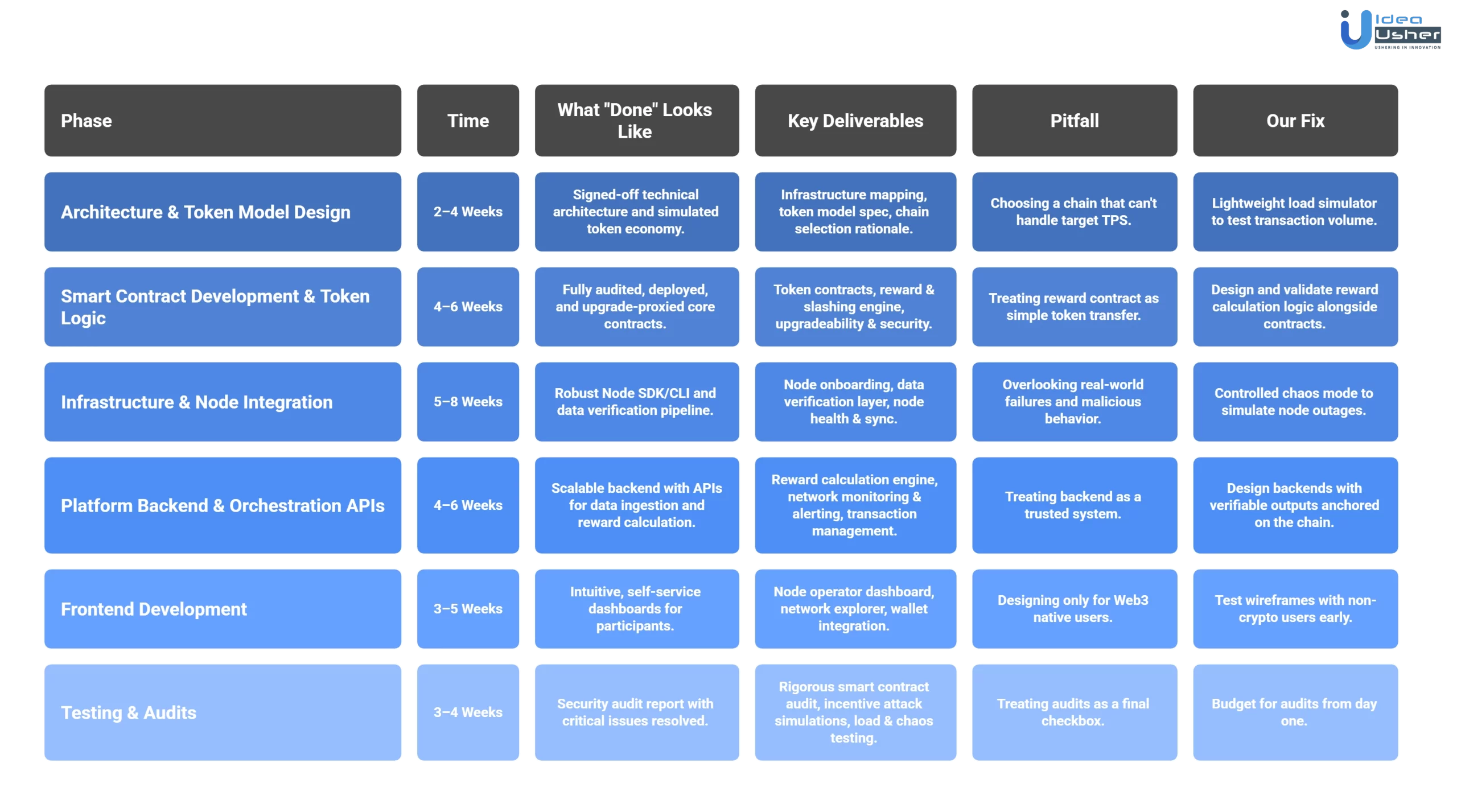
1. DePIN Architecture & Token Model Design (2–4 Weeks)
This phase defines how the DePIN platform functions and scales. Poor architecture and token design create long-term limitations that are difficult to fix later.
What “Done” Looks Like: A signed-off technical architecture document and a simulated token economy model that passes basic Sybil and spam attack tests.
Key Deliverables:
- Infrastructure Mapping: Clear data flows from edge device → off-chain verifier → on-chain settlement.
- Token Model Spec: Defined token utility beyond “pay for rewards.” Staking mechanics, slashing conditions, and governance hooks.
- Chain Selection Rationale: Not just “EVM-compatible.” Decision based on transaction cost profiles, data availability needs, and existing DePIN tooling (e.g., peaq, IoTeX, Helium vs. Arbitrum vs. a custom L2).
The Pitfall: Spending 4 weeks on architecture only to realize your chosen chain can’t handle your target TPS for proof submissions.
Our Fix: We build a lightweight load simulator in the first week to test transaction volume, latency, and cost assumptions, helping validate the blockchain choice before finalizing the DePIN architecture.
2. Smart Contract Development & Token Logic (4–6 Weeks)
This stage focuses on building secure smart contracts and token logic. Precision matters, as flaws here directly impact trust, security, and long-term network stability.
What “Done” Looks Like: Fully audited, deployed, and upgrade-proxied core contracts on a testnet.
Key Deliverables:
- Token Contracts: Beyond ERC-20. Mint/burn logic controlled by reward oracles, vested team allocations, and tax-on-transfer mechanics if needed.
- Reward & Slashing Engine: The heart of the system. Must handle partial proofs, weighted rewards, and clear dispute initiation logic.
- Upgradeability & Security: Using transparent proxy patterns with clear multi-sig governance for upgrades. Security is a process, not a feature.
The Pitfall: Treating the reward contract as a simple “send X tokens to address Y.” Reality requires complex off-chain computation with on-chain verification.
Our Fix: We design and validate reward calculation logic during Phase 2, alongside smart contract development, ensuring seamless integration and avoiding costly redesigns after deployment.
3. Infrastructure & Node Integration (5–8 Weeks)
This phase connects blockchain logic with real-world infrastructure and nodes. Reliable integration creates defensibility, performance consistency, and long-term network credibility.
What “Done” Looks Like: A robust Node SDK/CLI and a data verification pipeline that can handle real-world noise and malicious actors.
Key Deliverables:
- Node Onboarding: Secure, automated device registration and identity attestation (hardware fingerprints, secure enclaves).
- Data Verification Layer (“The Oracle Problem”): This is the most critical subsystem. Will you use TLS-Notary, TEEs (Trusted Execution Environments), zero-knowledge proofs, or a consensus of nodes? This decision drives 80% of this phase’s complexity.
- Node Health & Sync: Handling offline nodes, data backfill, and graceful de-registration.
The Pitfall: Assuming nodes will remain honest and consistently online overlooks real world failures, unreliable connectivity, and malicious behavior, leading to fragile infrastructure design.
Our Fix: We introduce a controlled chaos mode in testing that simulates node outages and corrupt data, ensuring the network remains resilient under unpredictable operating conditions.
4. Platform Backend & Orchestration APIs (4–6 Weeks)
This phase builds the backend systems and orchestration APIs that coordinate nodes, manage data flows, and keep decentralized infrastructure operational at scale.
What “Done” Looks Like: A scalable backend with APIs that can ingest node data, compute rewards, and feed transactions to the blockchain reliably.
Key Deliverables:
- Reward Calculation Engine: The off-chain workhorse that processes verified data and calculates rewards per the economic model. Must be idempotent and fault-tolerant.
- Network Monitoring & Alerting: Dashboards for network health, node churn, reward pool balances, and security events.
- Transaction Management: Efficiently batching on-chain settlements to minimize gas costs and handle blockchain re-orgs.
The Pitfall: Treating the backend as a trusted system creates a centralized point of failure that undermines decentralization, transparency, and long term network trust.
Our Fix: We design backends with verifiable outputs anchored on the chain, allowing independent validation and enabling future replacement by community-operated infrastructure.
5. Frontend Development (3–5 Weeks)
This phase focuses on dashboards and user experience that help participants understand performance, rewards, and responsibilities, directly influencing trust, engagement, and long term network adoption.
What “Done” Looks Like: Intuitive, self-service dashboards that allow node operators and token holders to interact with the system without reading documentation.
Key Deliverables:
- Node Operator Dashboard: Real-time earnings, node health status, reward history, and easy claim/restake functions.
- Network Explorer: A “block explorer” for physical infrastructure. Show total network capacity, geographic distribution, and historical data.
- Wallet Integration: Seamless connectivity (MetaMask, WalletConnect, etc.) with clear signing requests that explain each transaction’s purpose.
The Pitfall: Designing only for Web3 native users excludes practical operators who lack crypto expertise, creating usability barriers that slow onboarding and limit real world network participation.
Our Fix: We test wireframes with non-crypto users early, ensuring interfaces remain intuitive, clear, and accessible for all types of node operators.
6. Testing & Audits (3–4 Weeks)
This phase stress tests the entire DePIN system under adversarial conditions, validating security, economic resilience, and operational reliability before real world deployment.
What “Done” Looks Like: A security audit report with all critical issues resolved, and a successful incentivized testnet run with no loss of funds.
Key Deliverables:
- Rigorous Smart Contract Audit: By a reputable firm (e.g., Quantstamp, Trail of Bits). Budget for this from day one.
- Incentive Attack Simulations: Run internal “attack squads” to find loopholes in the reward logic (e.g., spinning up 1000 virtual nodes in one location).
- Load & Chaos Testing: Simulate mainnet-scale data loads and network partitions.
The Pitfall: Treating audits as a final checkbox delays critical fixes and increases risk, often forcing costly redesigns when vulnerabilities are discovered late in development.
Our Fix: We involve auditors early in Phase 2, enabling iterative security feedback and stronger contract design throughout the development lifecycle.
Team Required to Build a DePIN Platform
A DePIN platform demands a hybrid team that understands both blockchain trust systems and real-world infrastructure. Success depends not on team size, but on assembling the right two-sided expertise from day one. Below is the non-negotiable team structure required to achieve that balance.

1. Blockchain & Trust Layer
This layer defines the trust mechanisms and economic rules of the DePIN platform. Decisions made here directly shape the DePIN development timeline and are difficult to change once the network is live.
- Blockchain Architect: Defines the end-to-end technical architecture, including blockchain selection, interoperability strategy, and the long-term smart contract upgrade roadmap.
- Smart Contract Developers: Translate tokenomics into secure, gas-efficient smart contracts governing rewards, staking, slashing, and governance.
- Audit & Security Specialists: Perform continuous security reviews, threat modeling, and formal audits to ensure the protocol remains resilient before and after mainnet launch.
Why this pod cannot be generic: Traditional DeFi experience is not enough. DePIN platforms rely on oracle-based data, off-chain inputs, and constant node churn. Proven experience with verifiable off-chain computation and adversarial environments is essential.
2. Infrastructure & Backend Orchestration
This layer forms the operational backbone of the DePIN platform, connecting real-world contributors to the blockchain while directly influencing system scalability and the overall DePIN development timeline.
- Backend Engineers (Node.js, Rust, Go): Develop reward calculation engines, data aggregation services, coordination logic, and API layers that interface with on-chain contracts.
- Infrastructure & DevOps Engineers: Design and maintain highly available coordination services, ensuring reliable node communication, scalability, and secure deployments across cloud or hybrid environments.
- Data & Monitoring Engineers: Instrument the entire system. Build observability pipelines and dashboards that track network health, node performance, and unusual behavior in real time.
Critical insight: The backend must be designed to be provably honest. Architect it so the community could theoretically operate its own instance, eliminating opaque centralized points of failure.
3. DePIN-Specific Specialists (The Differentiation Layer)
This layer focuses on the specialized skills that turn a DePIN concept into a viable network. These roles shape long-term protocol behavior and can significantly influence the DePIN development timeline.
- Tokenomics Designer: Arguably the most important role. Models supply, demand, incentive curves, penalties, and long-term sustainability to ensure continued node participation and real token utility.
- Network & Distributed Systems Engineer: Designs communication protocols and coordination models capable of handling thousands or millions of nodes while maintaining data integrity, low latency, and fault tolerance.
- Hardware / IoT Integration Specialist (if applicable): Bridges hardware constraints with software systems. Designs SDKs, firmware interfaces, and integration layers that make device participation reliable and frictionless.
Reality check: Many roles can be outsourced, but tokenomics design and core protocol engineering must remain in-house. These define the intellectual and competitive core of the DePIN network.
4. Product, UX & Go-To-Market Execution
This layer turns technical capability into real-world adoption, shaping how participants interact with the platform and how efficiently the DePIN development timeline reaches market readiness.
- Web3 Product Manager: Translates complex technical systems into a coherent roadmap, balancing protocol integrity, node operator experience, and ecosystem growth.
- UI/UX Designer (Operator-First Focus): Designs interfaces for node operators and infrastructure contributors, not speculative users. Simplicity and clarity directly affect network expansion.
- QA & Test Engineers: Go beyond traditional testing by simulating malicious behavior, incentive exploits, and real-world failure scenarios through incentivized testnets.
Common pitfall: Building a technically elegant protocol with poor node onboarding. The first hundred node operators are not just users; they are the foundation of the network.
Budget Required to Build a DePIN Platform: The Real Capital Allocation
Building a DePIN platform requires careful capital allocation across architecture, infrastructure, security, and incentives. Clear budget planning aligned with the DePIN development timeline helps founders make realistic decisions and avoid costly trade-offs during development and launch.
| Cost Factor | What You’re Really Funding | Cost Range | Why This Can’t Be Skipped |
| Architecture & Token Design | Market simulation, attack modeling, final tech specs, and tokenomic flywheel design. | $15,000 – $30,000 | The blueprint phase. Mistakes here lead to costly, fundamental rewrites or a broken economic model. |
| Smart Contract Development | Custom reward/slashing logic, upgradeable proxies, and mandatory security audits by top firms. | $25,000 – $60,000+ | Your on-chain constitution. An unaudited contract is an existential threat to user funds and network trust. |
| Backend Development | Data verification oracles, reward calculation engines, node communication protocols, and high-availability DevOps. | $40,000 – $90,000+ | The most complex engineering work, bridging physical world and blockchain. Its reliability determines network uptime. |
| Frontend Development | Node operator dashboards, network explorers, and UX designed for non-crypto natives to onboard seamlessly. | $15,000 – $35,000 | Adoption catalyst. Poor UX strangles node growth, the critical interface for operators. |
| Testing & Deployment | Incentivized testnet rewards, Sybil attack simulations, chaos engineering, and mainnet launch logistics. | $10,000 – $25,000+ | Battle readiness. This proves your network survives real-world abuse before real value is at stake. |
Total DePIN Platform Development Cost
Estimating the total DePIN platform development cost requires understanding the DePIN development timeline alongside architecture design, smart contracts, node integration, backend systems, user interfaces, security audits, and ongoing maintenance for a scalable network.
| Development Stage | What Comes in This Stage | Total Estimated Cost |
| MVP DePIN Platform | Core DePIN architecture, basic token model, limited smart contracts, controlled node onboarding, simple reward logic, minimal operator dashboard, internal testing | $80,000 – $120,000 |
| Mid-Scale DePIN Platform | Production-ready architecture, tokenomics, slashing logic, node integration, backend orchestration, dashboards, wallet support, audits, and a public testnet. | $140,000 – $250,000 |
| Full-Fledged DePIN Platform | Token economics, resilient verification, node coordination, honest backend, dashboards, security audits, testnet, and mainnet readiness. | $250,000 – $420,000+ |
What Increases or Reduces DePIN Platform Cost Significantly?
DePIN platform costs are not fixed. They expand or compress based on architectural decisions, infrastructure assumptions, and the maturity of the incentive model. Understanding these cost drivers early helps founders avoid unexpected overruns and misaligned expectations.
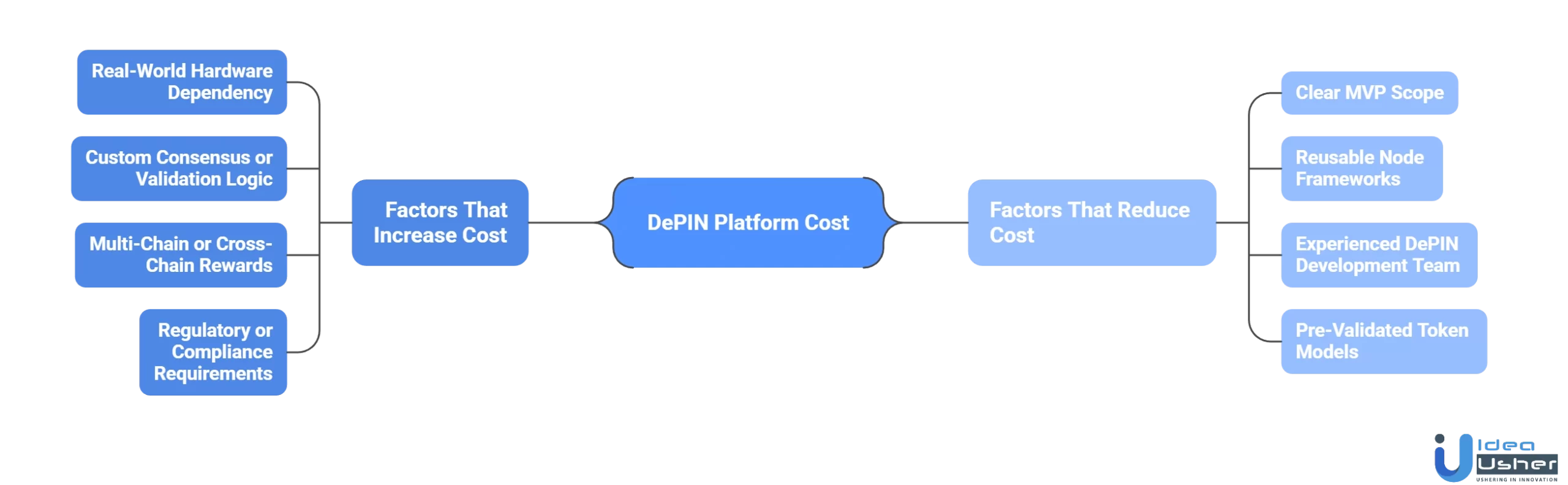
A. Factors That Increase DePIN Platform Cost
Several factors can raise a DePIN platform’s cost, and each directly impacts the DePIN development timeline and overall resource planning.
1. Real-World Hardware Dependency
When a DePIN platform relies on physical devices or specialized hardware, the development effort increases significantly. Hardware constraints, firmware integration, device testing, and unreliable connectivity introduce complexity that software-only networks do not face.
2. Custom Consensus or Validation Logic
Building proprietary validation or consensus mechanisms requires extensive research, testing, and security analysis. These systems must handle adversarial behavior and edge cases, making them both time- and cost-intensive.
3. Multi-Chain or Cross-Chain Rewards
Supporting rewards across multiple blockchains adds complexity in settlement logic, bridging, security assumptions, and operational overhead. Each additional chain increases testing, monitoring, and failure surface area.
4. Regulatory or Compliance Requirements
DePIN platforms operating in regulated environments must account for compliance reviews, legal constraints, reporting requirements, and region-specific infrastructure rules, all of which extend timelines and budgets.
B. Factors That Reduce DePIN Platform Cost
Optimizing certain elements can lower a DePIN platform’s cost, shortening the DePIN development timeline while maintaining efficiency and network reliability.
1. Clear MVP Scope
Defining a focused MVP prevents unnecessary features and overengineering. A well-scoped initial launch allows teams to validate incentives and infrastructure before committing to large-scale complexity.
2. Reusable Node Frameworks
Leveraging existing node SDKs, verification patterns, and infrastructure templates reduces development effort and shortens integration timelines without compromising reliability.
3. Experienced DePIN Development Team
Teams with prior DePIN experience avoid trial-and-error architecture decisions. Proven patterns and realistic assumptions lead to faster execution and lower long-term costs.
4. Pre-Validated Token Models
Using token models that have already been tested in similar networks reduces simulation cycles and redesign efforts, helping stabilize both development cost and incentive behavior.
Build vs Partner: Should You Build In-House or With a DePIN Development Company?
When planning a DePIN platform, one of the earliest strategic decisions is whether to build everything in-house or partner with a specialized DePIN development company. This choice directly affects speed, risk, long-term cost, and network stability.
A. Building a DePIN Platform In-House
Building a DePIN platform in-house provides full control over design and operations, but it can extend the DePIN development timeline and introduce structural challenges that require careful management.
Advantages
- Full architectural control: Direct ownership of protocol design, system decisions, and intellectual property
- Tight vision alignment: Faster iteration when product, engineering, and strategy sit within one team
- Long-term autonomy: Greater flexibility to evolve the protocol without external dependencies
Challenges
- Talent acquisition hurdles: DePIN-specific roles are difficult and expensive to hire
- Longer ramp-up time: Teams often need multiple iterations to align incentives with real-world behavior
- Higher early-stage burn: Mistakes in architecture or tokenomics can be costly to fix post-launch
- Operational risk: Limited experience with adversarial infrastructure increases failure probability
B. Partnering With a DePIN Development Company
Partnering with a DePIN development company accelerates your project by leveraging proven expertise and frameworks, ensuring your DePIN development timeline stays on track while reducing risk and complexity.
Advantages
- Faster time-to-market: Reuse of established architectures and infrastructure frameworks
- Access to specialized expertise: Immediate availability of tokenomics, infrastructure, and security specialists
- Reduced execution risk: Early identification of incentive flaws and system bottlenecks
- Predictable delivery: Clear milestones and phased development reduce uncertainty
Considerations
- Requires strong alignment: Clear ownership, documentation, and roadmap control are essential
- Founders must stay involved: Core protocol and incentive decisions cannot be fully outsourced
C. The Hybrid Model: A Practical Middle Ground
Most successful DePIN platforms adopt a hybrid approach. Founders retain ownership of core protocol logic and token economics, while partnering on execution-heavy components such as infrastructure, backend orchestration, and user interfaces.
This approach offers:
- Faster execution without losing strategic control: Core decisions around protocol design, incentives, and governance remain with the founding team, while experienced partners accelerate implementation using proven DePIN patterns.
- Lower hiring overhead without long-term dependency: Teams avoid lengthy and expensive hiring cycles for niche roles, while still maintaining independence by keeping critical intellectual property in-house.
- A smoother transition from MVP to scalable network: Early builds focus on validation and learning, while the same architecture can be expanded incrementally into a production-grade, adversarial-ready network.
How to Decide What’s Right for Your DePIN Platform?
Deciding the right approach for your DePIN platform depends on risk, readiness, and network complexity, while aligning with your DePIN development timeline to ensure feasible execution and long-term operational success.
A. When Building In-House Makes Sense (And When It Doesn’t)
Here’s a slightly tighter version with the keyword blended naturally:
Building internally is viable only if your team has hands-on experience with decentralized infrastructure, incentive modeling, distributed systems, and production blockchain deployments. In practice, most in-house teams underestimate the DePIN development timeline and execution complexity.
- The difficulty of aligning token incentives with real-world behavior
- The operational complexity of managing unreliable or adversarial nodes
- The cost of architectural mistakes discovered after network launch
Without prior DePIN experience, in-house development often leads to extended timelines, higher burn, and unstable early networks.
B. Why Partnering With a Specialized DePIN Development Company Reduces Risk?
A DePIN-focused development partner brings pattern recognition from previous builds. This includes understanding common failure points in incentive design, validation logic, and infrastructure coordination. Partnering early helps teams:
- Avoid architectural dead ends before code hardens
- Use pre-validated token and reward models
- Design infrastructure that scales without centralization bottlenecks
- Reach testnet and mainnet readiness faster with fewer redesign cycles
This is not about outsourcing decisions but it is about applying experience where mistakes are most expensive.
C. Advantages of Working With an Experienced Blockchain Team
Teams with real experience building and deploying blockchain platforms know that success comes from operational execution, not just smart contract development. An experienced DePIN development partner contributes:
- Production-grade architectures tailored to real-world infrastructure
- Incentive models tested against Sybil attacks and dishonest node behavior
- Backend systems designed to be verifiable, replaceable, and scalable
- UX designed for node operators, not just crypto-native users
These elements are difficult to acquire through documentation alone and typically come from real deployment experience.
D. A Practical Approach: Focus on Ownership, Partner for Execution
Many successful DePIN projects retain control over core protocol vision, governance, and ecosystem strategy while partnering on execution-heavy layers such as infrastructure, backend orchestration, and security hardening. This approach allows founders to:
- Maintain ownership of their protocol and token model
- Reduce hiring overhead and time-to-market
- Launch with higher confidence in network stability
E. Making a Confident, Defensible Decision
If your priority is rapid learning at any cost, in-house development may work. If your priority is launching a secure, scalable, and economically sound DePIN platform, partnering with a team that specializes in DePIN development is often the more defensible choice.
The right partner does not replace your vision. They accelerate it while protecting it from avoidable risk.
Conclusion
Building a DePIN platform is less about rushing to market and more about aligning expectations with reality. Timeframes depend on technical scope, network complexity, and regulatory readiness, while team composition and budget shape how efficiently decisions are executed. Understanding the DePIN development timeline helps clarify tradeoffs between speed, cost, and resilience. When these elements are planned together, progress becomes predictable, risks are easier to manage, and stakeholders can have informed conversations about delivery, scalability, and long-term sustainability without unnecessary surprises that align planning with execution and realistic organizational priorities.
Why Partner with IdeaUsher for DePIN Platform Development?
Building a DePIN platform isn’t just about writing smart contracts; it requires the right mix of infrastructure planning, blockchain expertise, hardware integration, and long-term scalability. At IdeaUsher, we help founders and enterprises turn complex DePIN ideas into production-ready platforms with clear timelines, optimized budgets, and the right technical team in place.
What Sets Us Apart?
- End-to-End DePIN Expertise: From protocol design and node architecture to token economics and frontend dashboards, we handle the entire development lifecycle.
- Optimized Time & Cost Planning: We help you define realistic development timelines and budgets without compromising on performance or security.
- Dedicated DePIN Teams: Our blockchain engineers, IoT specialists, and DevOps experts work together to build resilient decentralized infrastructure platforms.
- Scalable & Future-Ready Builds: We design DePIN platforms that can support network growth, increase node participation, and evolve business requirements.
Explore our portfolio to see how we help startups and enterprises build scalable blockchain platforms with clear roadmaps and optimized development costs.
Looking to validate your DePIN idea or estimate development costs?
Get in touch with us for a free consultation, and let’s map out the time, team, and budget needed to bring your DePIN platform to life.


FAQs
A.1. Building a DePIN platform usually takes six to eighteen months, depending on protocol complexity, hardware integration, and compliance requirements. MVP development is faster, while full-scale deployment requires extensive testing, partnerships, and network onboarding.
A.2. A DePIN platform needs blockchain engineers, backend developers, IoT or hardware specialists, security experts, and product managers. Legal and token economics support is also important to ensure regulatory readiness and sustainable network incentives.
A.3. Hardware integration increases costs through manufacturing, logistics, testing, and support. Platforms that rely on third-party devices face lower upfront expenses, while custom hardware demands higher investment but offers greater control over network performance.
A.4. Hardware sourcing, protocol design, regulatory approvals, and network testing are the biggest timeline drivers. Early clarity on architecture and incentives reduces rework, helping teams manage development timelines more predictably and avoid launch delays.