

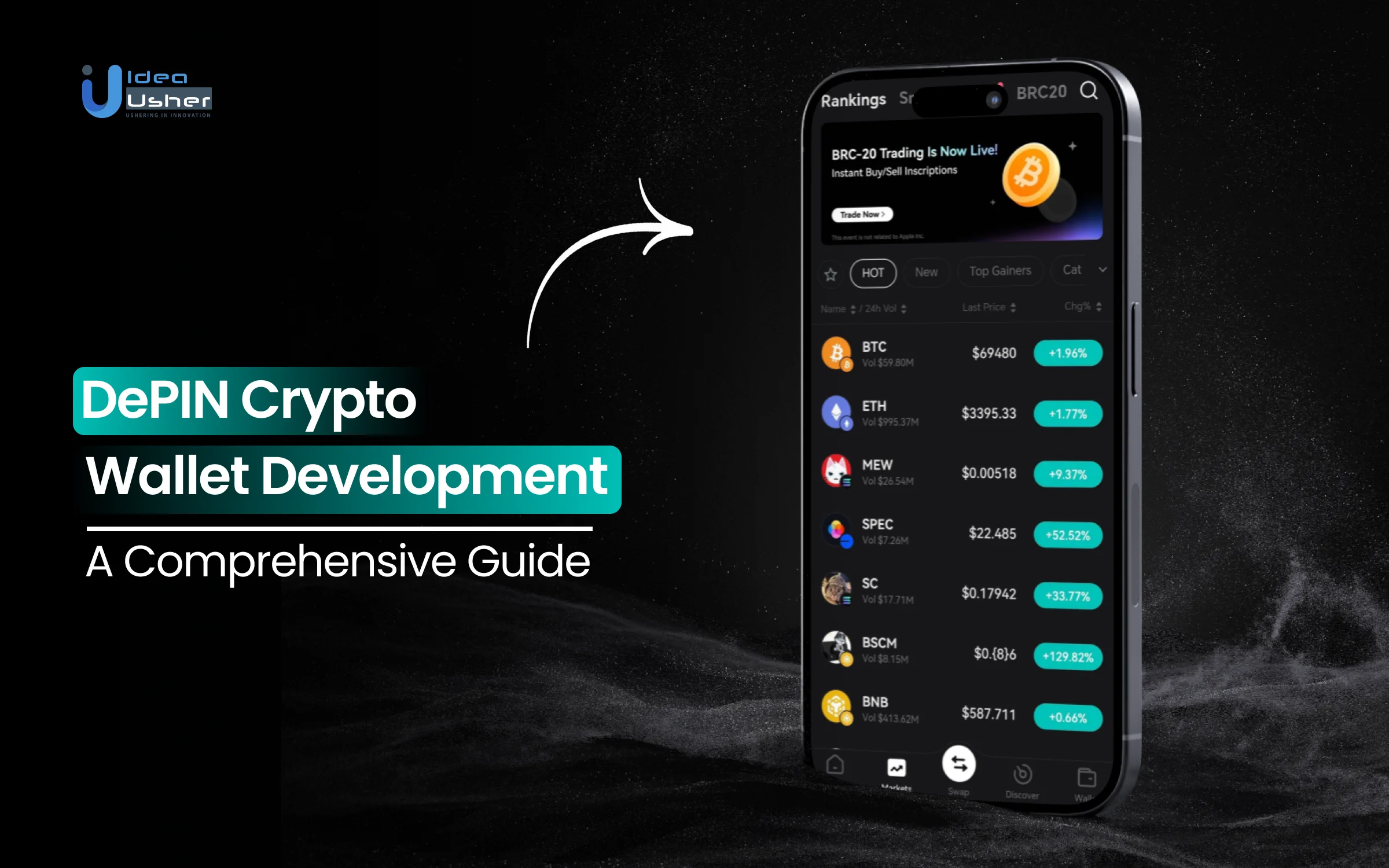
Crypto wallets are typically designed to store assets and sign transactions, but their role changes significantly inside decentralized physical infrastructure networks. Participation, device identity, reward claims, and network actions often flow through the wallet layer rather than a separate dashboard. This expanded responsibility is central to DePIN crypto wallet development, where the wallet acts as both a value container and an infrastructure participation interface.
In DePIN ecosystems, wallet behavior is closely tied to how nodes register, how contributions are verified, and how incentives are distributed. Support for staking, reward tracking, device binding, and network-specific permissions becomes just as important as secure key management and transaction signing. The design must account for higher interaction frequency, verifiable activity, and protocol-level integrations without adding user friction.
In this blog, we present a comprehensive guide to DePIN crypto wallet development by covering core wallet capabilities, system architecture, security practices, and integration patterns required to support decentralized infrastructure networks at scale.

What Is a DePIN Crypto Wallet?
A DePIN (Decentralized Physical Infrastructure Network) crypto wallet is a specialized blockchain wallet designed to interact with DePIN ecosystems. These decentralized protocols use blockchain, smart contracts, and token incentives to coordinate, operate, and reward participants who contribute real-world physical infrastructure, such as routers, sensors, storage, compute nodes, and energy assets.
Unlike a standard cryptocurrency wallet, which primarily stores and signs keys for value transfer and basic smart contract interactions, a DePIN crypto wallet also serves as an interface between a contributor’s physical infrastructure and the DePIN protocol. It enables:
- Secure identity and key management tied to a device or node
- Protocol interaction including node registration, proof submission, and governance calls
- Reward handling and incentive mechanics specific to DePIN models
- On-chain and off-chain data synchronization related to device performance
A. Difference Between DePIN Wallet & Regular Crypto Wallet
DePIN wallets are more than digital vaults; they are operational dashboards for physical infrastructure. While regular wallets store tokens, DePIN wallets manage hardware, automate work proofs, and distribute network rewards.
| Feature / Aspect | DePIN Crypto Wallet | Regular Crypto Wallet |
| Primary Purpose | Hardware Management & Reward Gateway. A tool for operating a hardware-based “business” within a physical network. | A secure vault and transfer tool for holding and transacting cryptocurrencies and digital assets. |
| Core Function | 1. Device/Node Management 2. Reward Tracking & Claiming 3. Network Participation | 1. Token Storage & Security 2. Sending & Receiving Assets 3. dApp & DeFi Interaction |
| Key Differentiator | Hardware Integration. It is designed to onboard, monitor, and manage physical hardware (hotspots, servers, sensors) on a blockchain. | Asset-Centric. Focus is purely on the blockchain-native digital assets themselves, with no connection to the physical world. |
| User Role | Network Operator / Contributor. The user is an active provider of real-world resources (connectivity, storage, compute). | Holder / Trader / Investor. The user is primarily an owner and transactor of digital assets. |
| Rewards Mechanism | Active, Algorithmic Rewards. Earnings generated automatically based on provable work (data transferred, storage provided). Requires claiming. | Passive or Active Financial Actions. Earnings come from manual actions like staking, providing liquidity (yield farming), or trading. Not tied to physical work. |
| Analogy | The Control Panel for a Mini-Business. Like the admin console for a cloud server or a fleet management dashboard for a delivery service. | A Digital Bank Account + Safe. Like a combination of a checking account (for transactions) and a safe deposit box (for storage). |
B. Role in Device & Node Participation
A DePIN wallet serves as the identity and management tool for network participation. When installing physical hardware such as a Helium hotspot, Filecoin storage server, or Hivemapper dashcam, the wallet allows users to:
- Onboard the device through a blockchain transaction that registers it to your wallet address
- Monitor performance metrics like uptime, data transferred, or storage capacity
- Verify ownership and control over your contribution
- Troubleshoot issues through network diagnostics tied to your specific hardware
- Scale your operation by adding more devices under the same wallet identity
This creates an immutable link between your physical hardware and your digital identity on the blockchain, ensuring you receive proper attribution and rewards for your contribution.
C. Role in Proof & Rewards Lifecycle
The wallet orchestrates the entire economic cycle of DePIN participation. It handles three critical phases:
- Proof Generation & Submission: Your hardware performs work (providing coverage, storing files, etc.) and generates cryptographic proof. Your wallet facilitates submitting this proof to the blockchain for verification.
- Reward Calculation & Distribution: The network’s protocol calculates rewards based on verified proof. Your wallet displays pending rewards in real-time, showing exactly what you’ve earned for your contribution.
- Claiming & Management: Most DePIN networks require you to actively “claim” rewards through your wallet. This initiates a blockchain transaction that moves tokens from the protocol’s reward pool to your personal wallet address. From there, you can hold, stake for additional benefits, or swap for other assets.
This lifecycle transforms physical work into digital value, with your wallet as the essential intermediary, ensuring you’re properly compensated for your infrastructure contribution.
Global Market Growth of DePIN and Infrastructure Networks
Decentralized Physical Infrastructure Networks (DePIN) are quickly transitioning from a niche concept to a major global market. Currently valued at $30-50 billion, the market is projected by the World Economic Forum to reach $3.5 trillion by 2028.

This momentum is underscored by robust venture capital confidence. From January 2024 to July 2025 alone, over $744 million was raised across 165+ DePIN startups, fueling innovation and expansion across wireless, compute, storage, and sensor networks worldwide.
The following platforms exemplify this growth with concrete business and usage metrics:
- Helium (Wireless Networks): A leader in decentralized wireless, Helium has achieved over 622,000 customer sign-ups for its mobile service and operates a network of more than 121,000 active hotspots, proving the viability of community-built telecom infrastructure.
- Hivemapper (Mapping & Sensors): Demonstrating real-world utility, Hivemapper’s global contributor network has mapped 37% of the world’s roads (over 500 million kilometers), while its Annual Recurring Revenue (ARR) grew from $500,000 to approximately $3 million in late 2025.
- Render Network (Compute & AI): As a leading decentralized GPU provider, Render has achieved a market capitalization of $1.83 billion, capitalizing on the explosive demand for computing power for AI and rendering tasks.
- Akash Network (Compute): This decentralized cloud computing platform has secured over $4.3 million in Annual Recurring Revenue (ARR), attracting enterprise customers seeking scalable, cost-effective compute solutions.
- Grass (AI Data): Highlighting user-scale adoption, Grass has onboarded over 2 million users in its beta phase, creating a network that monetizes unused bandwidth for AI training data collection.
The trajectory from a multi-billion to a multi-trillion-dollar future is actively being built. Substantial investments and successful DePIN platforms show decentralized models deliver real utility and revenue today. As these networks grow, they lay the groundwork for a more open, efficient, user-owned digital economy.
Why DePIN Needs Specialized Crypto Wallets?
DePIN networks require specialized crypto wallets to handle infrastructure-based rewards, device proofs, staking, and protocol-level interactions securely. The following reasons explain why standard wallets often fall short in DePIN ecosystems.

1. Standard Wallet Limitations
Standard Web3 wallets such as MetaMask are built for occasional, user-triggered transactions, not continuous hardware interaction. They lack automated proof submission, device monitoring, hardware onboarding flows, and infrastructure metrics support, making them unsuitable for always-active DePIN participation environments.
2. Device Binding Requirements
DePIN networks require every hardware node to have a cryptographically verifiable on-chain identity. Specialized wallets enable secure device pairing, key generation, ownership proofs, and device-to-wallet binding, ensuring that physical infrastructure contributions are permanently and verifiably linked to the correct wallet owner.
3. Proof Submission Requirements
DePIN protocols depend on frequent proof submissions that validate real-world resource contribution. Specialized wallets support automated proof packaging, scheduled submissions, retry logic, gas optimization, and smart contract interfacing, enabling reliable, repeatable proof workflows without constant manual signing by the user.
4. Micro-reward and Streaming Payment
DePIN reward models distribute frequent micro-payments instead of large lump sums. Specialized wallets handle reward aggregation, gas-efficient claiming, streaming accrual tracking, and threshold-based claim optimization, ensuring that transaction fees do not outweigh earnings and reward visibility remains transparent to contributors.
5. Always-on Network Participation
DePIN devices operate continuously, so wallet infrastructure must support background services, automated submissions, uptime tracking, alerts, and remote diagnostics. Specialized wallets function as operational control layers, enabling persistent network participation rather than intermittent, user-opened transaction signing.
Types of DePIN Crypto Wallet
Types of DePIN crypto wallets vary by custody model, platform support, and infrastructure interaction requirements across decentralized networks. Below is a practical classification commonly referenced in DePIN wallet architecture discussions.
| Wallet Type | Primary Purpose | Key Characteristics | Example |
| Network Operator Wallets | To manage hardware nodes and earn service rewards | → Project-Specific: Directly tied to one DePIN network → Hardware Management: Interfaces with physical devices → Automated Rewards: Collects and claims micro-rewards | Helium (HNT), Hivemapper (HONEY), Filecoin (FIL), Render (RNDR) |
| Investor/Holder Wallets | To securely store, trade, and stake DePIN tokens | → General-Purpose: Supports many DePIN tokens → Multi-Chain: Often works across different blockchains → Financial Features: Focus on swapping, DeFi, staking | Trust Wallet, Guarda Wallet, Tangem, Bitget Wallet |
| Hybrid Multi-Chain Wallets | To both interact with DePIN dApps and manage assets | → dApp Browser: Allows direct use of DePIN services → Asset Management: Also holds and swaps tokens → Balance: Less hardware integration than Operator wallets | Phantom, Bitget Wallet |
Core Functional Requirements of a DePIN Wallet
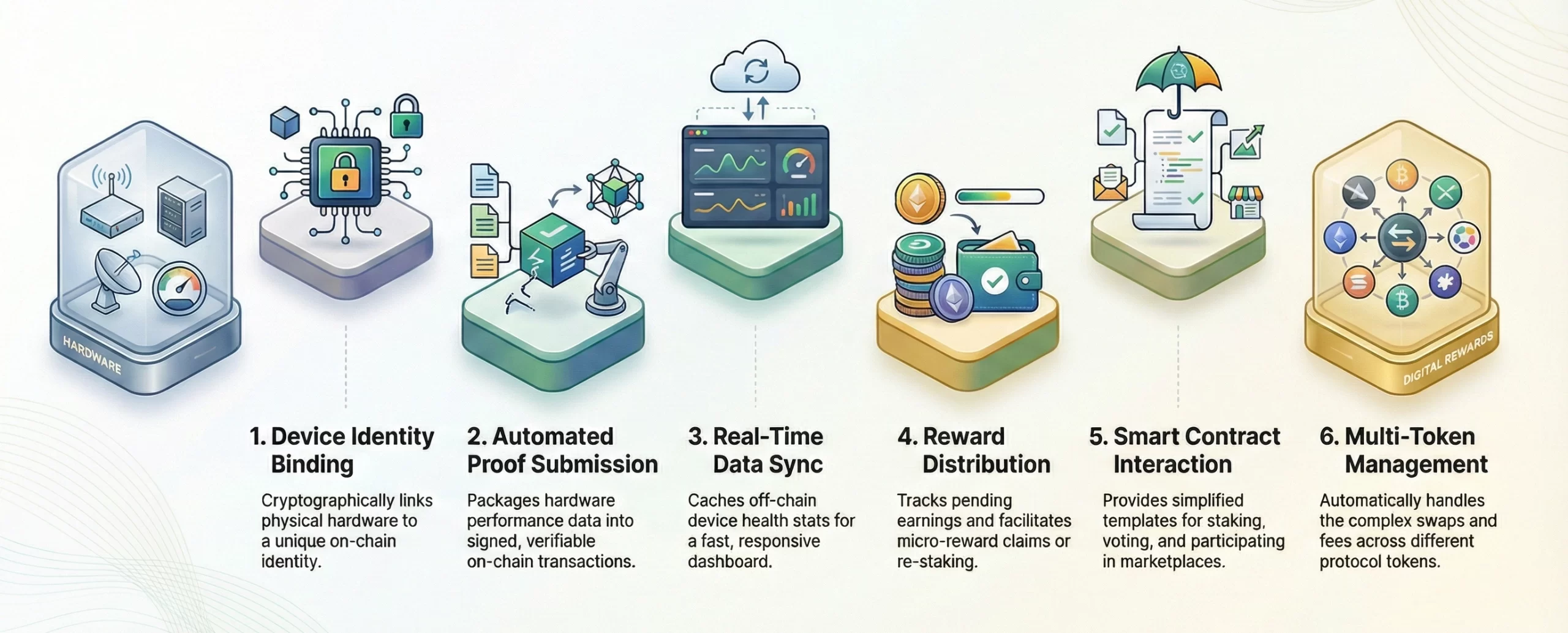
A DePIN wallet is not merely an asset holder; it is a specialized client application that must meet a strict set of functional requirements to interface between physical hardware, a blockchain network, and a decentralized economic protocol. These requirements are what distinguish it from a standard Web3 wallet.
1. Device and Node Identity Management
The wallet must cryptographically bind a physical device’s unique identifier to a blockchain address, creating a verifiable on-chain identity (a “Node NFT” or similar) for that piece of infrastructure.
- Why it’s required: This establishes unforgeable ownership and attribution. The network must know which wallet owns and earns rewards from which hardware. This is the foundational step for all subsequent proof and reward functions.
- User Facing Function: The “Add a Device” or “Onboard Hotspot” wizard, where the user scans a QR code or enters a serial number, and the wallet submits a registration transaction to the blockchain.
2. Proof Collection and Submission Engine
The wallet must automatically collect raw performance data from the connected hardware (e.g., bytes stored, GPS location proofs, compute time), package it into a cryptographically signed proof, and submit it as a verifiable transaction to the network’s consensus mechanism (Proof-of-Coverage, Proof-of-Storage, etc.).
- Why it’s required: This is the core work engine. It automates the process of converting physical work into on-chain, verifiable data that the protocol’s smart contracts can audit and reward. It handles scheduling, batching, and gas optimization for these frequent submissions.
- User Facing Function: A background process the user doesn’t directly see, but evidenced in the “Proofs Submitted” log and the steady accrual of pending rewards.
3. Reward Distribution Handling
The wallet must accurately interpret the reward distribution signals from the protocol’s smart contracts, calculate pending earnings, and provide a secure interface for claiming, streaming, or re-staking those rewards.
- Why it’s required: It manages the entire value flow from the protocol to the user. This includes handling micro-rewards efficiently (aggregating them to save gas), displaying accruals in real-time, and facilitating actions like compounding rewards by re-staking.
- User Facing Function: The main rewards dashboard showing “Pending,” “Claimable,” and “Total Earned,” along with the “Claim” or “Stake” buttons.
4. Smart Contract Interaction Layer
The wallet must contain a dedicated and upgradable module of pre-built interactions with the specific DePIN protocol’s suite of smart contracts (for staking, governance, service marketplace, data oracles).
- Why it’s required: DePIN protocols are complex. Users cannot be expected to manually craft transactions to interact with each contract. This layer provides simplified, audited, and safe transaction templates for all essential network actions.
- User Facing Function: Simple buttons for “Stake Tokens,” “Vote on Proposal #12,” “List Storage for Rent,” or “Purchase Compute Credits.”
5. Multi-Token and Fee Support
The wallet must natively support the DePIN’s reward token, governance token, and any necessary fee-paying token (which may be on a different chain, like Ethereum for fees on an L2). It must manage the economics of swapping or bridging these assets for the user.
- Why it’s required: Participation often requires holding multiple tokens for different functions (e.g., HNT for rewards, IOT for data transfers, SOL for fees on the Helium IOT subnet). The wallet must abstract this complexity.
- User Facing Function: A built-in token swap feature, a clear display of balances for all network-relevant tokens, and automatic fee token estimation during transactions.
6. On-chain and Off-chain Data Sync
The wallet must maintain a local cache of critical off-chain data (device health stats, preliminary reward calculations, network metrics) and synchronize it with the immutable on-chain state in a reliable, verifiable manner.
- Why it’s required: For performance and usability. Querying the blockchain for every data point is slow. The wallet uses indexed off-chain data (from a trusted oracle or the project’s API) for a fast UI, while using on-chain proofs as the single source of truth for settlements and disputes.
- User Facing Function: A snappy dashboard that shows your device’s uptime and estimated earnings instantly (off-chain data), with a clear indicator that final rewards are settled on-chain when you claim them.
Key Features of DePIN Crypto Wallet
Key features of a DePIN crypto wallet include secure key management, device-level integration, token rewards tracking, and multi-chain interoperability. These are the core capabilities commonly included in modern DePIN wallet solutions.

1. Token Management
DePIN wallets manage tokens with specific utilities such as paying for services, staking hardware, or governance. Unlike generic wallets, they understand each token’s distinct purpose, providing context-aware actions like “Stake for Node” rather than just “Send”.
2. Staking & Incentives Dashboard
This unified hub displays both financial staking yields and hardware-based earnings. It solves the complex accounting of micro-rewards from physical devices, presenting tangible contributions alongside abstract token rewards in a single economic view.
3. DApp Browser/Marketplace Access
More than a generic portal, this is a curated, first-party gateway to the DePIN’s own service marketplace. It enables seamless authentication and one-click transactions for buying or selling real-world infrastructure services like storage or compute.
4. Hardware Onboarding & Management
This feature performs the “on-chainification” of physical devices, cryptographically binding a device’s identity to the blockchain. It creates a verifiable, non-transferable digital asset (like a Node NFT) that represents the hardware on the ledger.
5. Real-time Data Monitoring
The wallet displays oracle-verified performance data, including storage provided, coverage area, and energy output, which directly impact earnings. This ensures transparent, auditable proof of completed physical work before final on-chain settlement.
6. MPC (Multi-Party Computation) Wallets
MPC wallets prevent single points of failure by splitting signing keys across devices and requiring a threshold for transactions. This stops thieves who compromise one device from accessing funds or tampering, securing assets and rewards.
7. Governance Participation
Governance here has direct physical consequences. The wallet facilitates voting on proposals that can alter hardware specifications, radio parameters, or reward structures, directly impacting the real-world network operated by the users.
8. Interoperability
These wallets act as multi-chain conductors, abstracting complexity. They seamlessly manage assets and actions across different underlying blockchains (e.g., rewards on a subnet, tokens on a mainnet), presenting a unified interface to the user.
DePIN Crypto Wallet Development Process
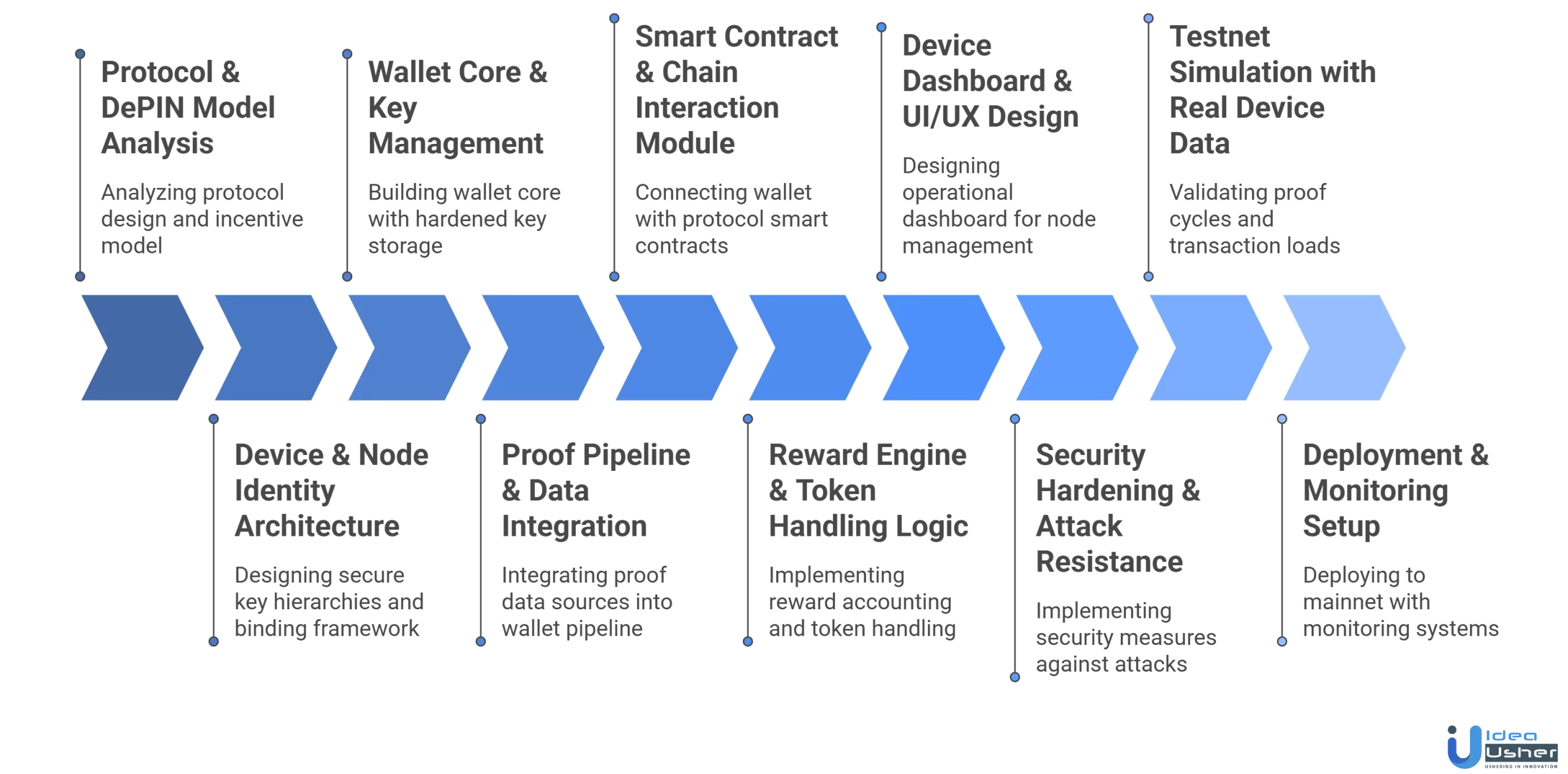
Below is the DePIN crypto wallet development lifecycle from our engineering and delivery perspective. This reflects how our developers design, build, secure, and deploy production-ready DePIN wallet systems that support device participation, proof pipelines, and tokenized reward flows.
1. Protocol and DePIN Model Analysis
We begin by analyzing the DePIN protocol design, incentive model, and node participation logic. Our team maps device types, proof mechanisms, reward formulas, contract flows, and transaction frequency so the wallet architecture aligns with real infrastructure behavior and economics.
2. Device and Node Identity Architecture
Our developers design the device identity and binding framework early. We define secure key hierarchies, device pairing methods, ownership mapping, and transfer logic so each physical node can be cryptographically linked, verified, and reassigned without identity conflicts.
3. Wallet and Key Management Layer
We build the wallet core with hardened key storage, signing engines, transaction builders, and permission controls. Our implementation supports hardware-backed security, multi-device access, and reliable recovery models to protect infrastructure-linked wallet credentials at all times.
4. Proof Pipeline and Data Integration
We integrate proof data sources such as device telemetry and oracle inputs into the wallet pipeline. Our developers implement automated proof formatting, validation checks, batching, and submission handlers to ensure contribution proofs are delivered consistently and correctly on-chain.
5. Smart Contract and Chain Interaction
Our team connects the wallet with protocol smart contracts for node registration, staking, proof submission, and reward claims. We optimize gas usage, implement batching strategies, and add fallback handling to support high-frequency DePIN transaction workloads reliably.
6. Reward Engine and Token Handling
We implement reward accounting and token handling modules that track accruals, aggregate micro-rewards, and optimize claim timing. Our wallet interfaces show pending rewards, claimed tokens, and contribution-based earnings with clear, audit-friendly visibility for operators.
7. Device Dashboard and UX Layer
We design an operational dashboard inside the wallet so users can manage nodes, not just funds. Our UX layer includes device status, uptime metrics, contribution charts, alerts, and configuration controls to support day-to-day infrastructure participation.
8. Security Hardening and Attack Resistance
Our security process includes threat modeling, anti-spoof protections, signed telemetry verification, anomaly detection, and secure device-to-wallet communication. We hardened the wallet against proof forgery, device impersonation, and replay attacks common in DePIN environments.
9. Testnet Simulation with Real Data
Before release, we run testnet simulations using staged or live device data. Our developers validate proof cycles, reward triggers, transaction loads, and failure recovery paths to ensure the wallet performs correctly under realistic network conditions.
10. Mainnet Deployment and Monitoring
We deploy to the mainnet with monitoring, logging, and alerting systems in place. Our team sets up upgrade pipelines, performance tracking, and incident response workflows so the DePIN wallet remains stable, scalable, and maintainable after launch.
DePIN Crypto Wallet Development Cost
DePIN crypto wallet development cost varies based on network architecture, security features, multi-chain support, and hardware integrations. Below is a structured cost breakdown that organizations typically evaluate during project planning.
| Development Module | What Our Developers Build | Complexity Level | Estimated Cost Range |
| Protocol & Architecture Planning | DePIN model analysis, proof flow mapping, device participation logic, wallet architecture blueprint | Medium | $6,000 – $12,000 |
| Wallet Core & Key Management | Key generation, secure storage, signing engine, transaction builder, recovery design | High | $10,000 – $22,000 |
| Device & Node Identity Binding | Device pairing flows, node registration logic, ownership mapping, transfer mechanisms | High | $8,000 – $18,000 |
| Proof Submission Pipeline | Proof formatting, automated submissions, batching, retry logic, scheduler | High | $12,000 – $26,000 |
| Smart Contract Integration | Node registration, staking, proof contracts, reward claim interaction | Medium–High | $7,000 – $16,000 |
| Reward Engine & Token Logic | Micro-reward aggregation, claim optimization, multi-token support | Medium | $6,000 – $14,000 |
| Device Dashboard & Operational UI | Node status dashboard, contribution metrics, alerts, device controls | Medium | $7,000 – $16,000 |
| Background Services & Automation | Always-on services, auto submissions, monitoring jobs | High | $6,000 – $15,000 |
| Security Hardening | Anti-spoof checks, signed telemetry validation, threat mitigation | High | $6,000 – $14,000 |
| Multi-Chain Support (Optional) | Support for multiple networks or L2s | Medium–High | $8,000 – $20,000 |
| Testnet Simulation & QA | Device data simulation, proof cycle testing, load testing | Medium | $5,000 – $10,000 |
| Mainnet Deployment & Monitoring | Production deployment, logging, alerting, upgrade pipelines | Medium | $4,000 – $9,000 |
Total Estimated Cost: $55,000 – $125,000+
Note: DePIN wallet development costs vary by integration depth, proof complexity, security, automation, and multi-chain or custom hardware requirements.
Consult with IdeaUsher to get a precise cost and architecture plan tailored to your DePIN wallet requirements, device model, and protocol design goals.
Unique Cost Drivers in DePIN Wallet Development
DePIN wallet development costs depend on blockchain integration, hardware connectivity, security layers, and compliance requirements. Here are the key cost drivers teams typically evaluate during the development.
1. Device Protocol Diversity and Integration
Cost rises when wallets must support multiple hardware protocols like IoT, gateways, sensors, or custom firmware APIs, each requiring separate adapters, validation layers, and secure communication handling.
2. Proof Mechanism Complexity
Protocols using multi-stage proofs, geo-verification, bandwidth attestations, or compute validation require custom proof packaging, verification logic, and failure handling pipelines, significantly increasing backend and wallet engineering effort.
3. Proof Submission Frequency
High-frequency proof cycles such as hourly or real-time submissions, demand batching engines, schedulers, nonce management, and gas optimization systems, adding automation and transaction orchestration development overhead.
4. Hardware Key Storage Requirements
Supporting TPM, secure enclave, or hardware-backed signing changes wallet key architecture and recovery design, requiring specialized cryptographic implementation and device-level security testing.
5. Device Ownership Transfer Logic
If nodes can be resold or reassigned, secure ownership transfer workflows must be built, including device unbinding, re-registration, and fraud prevention checks, increasing smart contract and wallet logic complexity.
6. Off-chain Telemetry Processing
Wallets that ingest live device telemetry need indexing services, validation filters, and preprocessing pipelines before proof submission, adding infrastructure and data engineering scope beyond standard wallet builds.
7. Multi-Chain or L2 Reward Settlement
When rewards settle across multiple chains or Layer 2 networks, developers must build cross-chain transaction handling, token mapping, and balance reconciliation logic inside the wallet.
8. Anti-Spoof and Device Integrity Checks
Adding spoof detection, signed telemetry verification, and anomaly scoring introduces additional cryptographic checks and behavioral validation layers that expand both security engineering and testing scope.
Should a DePIN Wallet be Custodial or Non-Custodial?
Wallet custody is a foundational choice in the DePIN ecosystem. A non-custodial model supports user sovereignty and direct participation but requires more user responsibility for key management. The ideal balance combines security with accessibility.
| Aspect | Non-Custodial Wallet (The Only Correct Choice) | Custodial Wallet (A Deal-Breaker) |
| Core Philosophy | Aligns with DePIN’s decentralization: “Not your keys, not your hardware, not your rewards.” You have sovereign control. | Contradicts DePIN: re-creates a centralized intermediary, defeating the purpose of a user-owned network. |
| Asset & Ownership Risk | You hold the private keys. You truly own the assets and the linked hardware identity. No third-party seizure risk. | The custodian (exchange, provider) holds the keys. They can freeze, lose, or be compelled to surrender your assets and node access. |
| Trust Model | Trust-minimized. Security depends on your key management. The protocol’s smart contracts enforce rewards. | Requires high trust. You must trust the custodian’s security, integrity, and solvency absolutely. |
| Impact on Node Operation | Direct, permissionless control. Your signed transactions are the only authority to register hardware or claim rewards. | Indirect, mediated control. All operations require the custodian’s approval and systems, adding a point of failure. |
| Regulatory & Access Risk | Your access is global and censorship-resistant. As long as you have your keys and internet, you control your node. | Your access can be region-locked, frozen, or terminated based on the custodian’s terms, government pressure, or KYC/AML checks. |
DePIN Crypto Wallet Development Challenges & Solutions
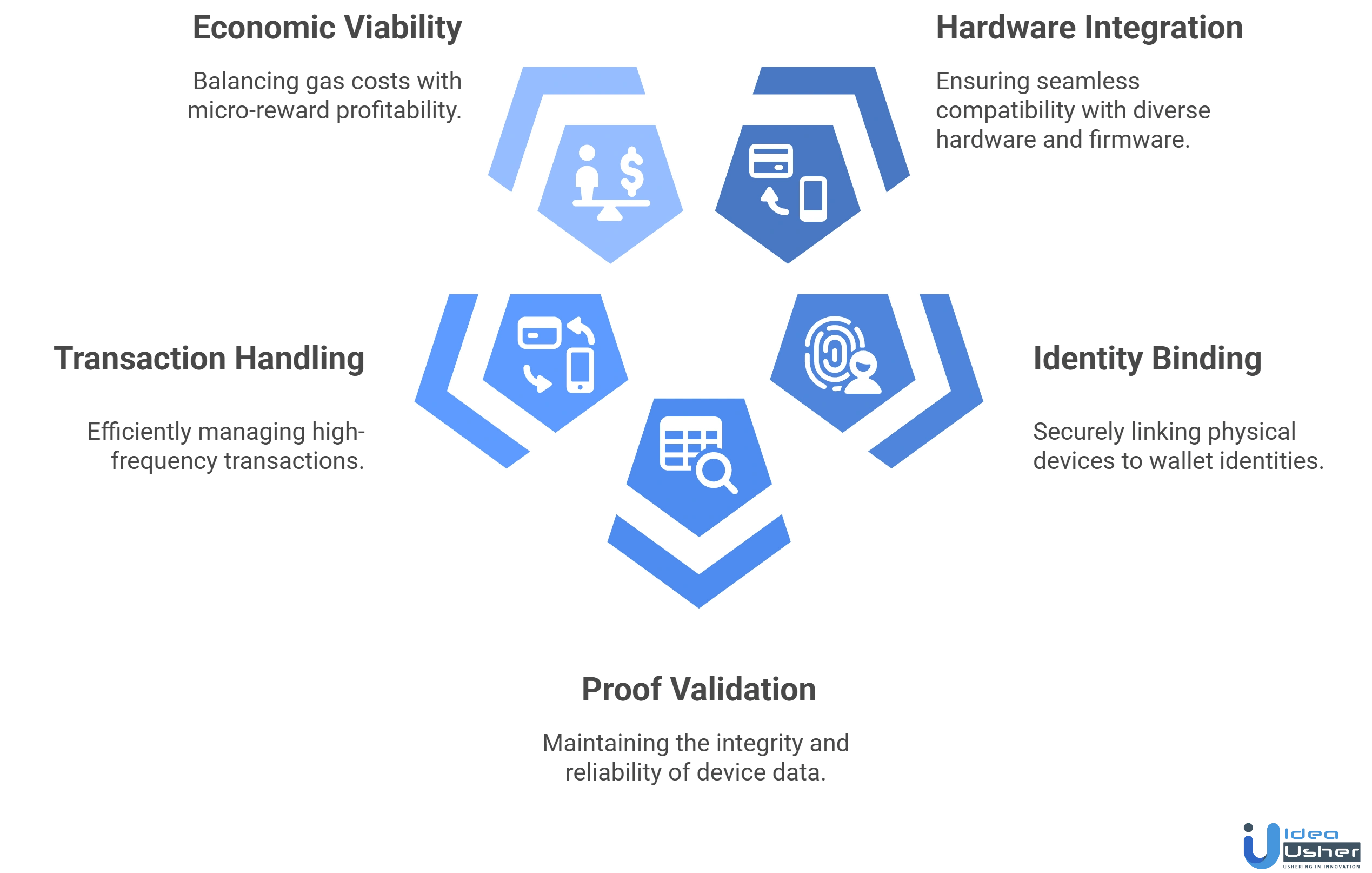
DePIN crypto wallet development presents unique challenges in security, scalability, device integration, and on-chain validation. Here’s how our developers address these with proven, standards-based engineering approaches and frameworks in practice.
1. Hardware Diversity and Unstable Interfaces
Challenge: DePIN wallets must integrate with diverse hardware types, firmware versions, and inconsistent vendor APIs that behave unpredictably across environments and updates.
Solution: Our developers build modular device adapters, protocol abstraction layers, and fallback handlers, then validate integrations using real-device test matrices across firmware versions and network conditions.
2. Reliable Device-to-Wallet Identity
Challenge: Securely binding physical devices to wallet identities is difficult due to cloning risks, key reuse attacks, spoofed registrations, and legitimate ownership transfer needs.
Solution: We implement hardware-backed keys, signed device attestations, secure pairing flows, and controlled transfer protocols that preserve verifiable identity while allowing safe, auditable ownership reassignment.
3. Proof Data Reliability and Validation
Challenge: Device telemetry and contribution data can be noisy, delayed, incomplete, or manipulated, causing proof rejection and incorrect reward calculations on-chain.
Solution: We add preprocessing filters, schema validation, timestamp checks, and anomaly scoring before proof packaging so that only normalized, verifiable data reaches smart contract submission pipelines.
4. High-Frequency Transaction Handling
Challenge: Frequent proof submissions create nonce conflicts, mempool congestion, transaction failures, and unpredictable fees under sustained automated submission workloads from active nodes.
Solution: Our wallet pipelines use batching, queued submission workers, nonce managers, and adaptive gas strategies to maintain reliable throughput and reduce failed or duplicated transactions.
5. Gas Cost vs Micro-Reward Economics
Challenge: Micro-reward models can become unprofitable when claim transactions cost more in gas than the actual earned token value for contributors.
Solution: We implement reward aggregation, smart claim thresholds, fee forecasting, and timing optimizers so claims execute only when economically justified and net-positive for node operators.
Conclusion
This guide outlined the core components, risks, and design priorities involved in DePIN crypto wallet development. Effective DePIN crypto wallet development relies on secure key management, modular architecture, network interoperability, and clear governance controls. Strong planning across compliance, performance, and usability supports reliable operation within decentralized infrastructure networks. When technical standards and user-focused design align, wallet solutions become more resilient and scalable. A structured, disciplined approach ultimately strengthens deployment quality and long-term ecosystem participation.
Why Choose IdeaUsher for Your DePIN Crypto Wallet Development?
At IdeaUsher, our developers bring strong hands-on experience in blockchain development, including crypto wallets, token platforms, and decentralized applications. Leveraging this foundation, we build reliable DePIN token platforms and DePIN crypto wallets tailored to infrastructure-driven ecosystems.
Why Partner with Us?
- Blockchain Product Expertise: Proven experience building crypto wallets, token systems, and Web3 platforms.
- DePIN-Focused Solutions: We translate blockchain capabilities into DePIN-ready wallet and token architectures.
- Custom Development Approach: Every platform is designed around your protocol, reward logic, and network model.
- Security & Scalability: We implement secure, scalable frameworks aligned with industry best practices.
Explore our portfolio to see how we’ve delivered blockchain solutions across multiple sectors.
Connect with us for a free consultation to discuss your DePIN platform or wallet requirements.


FAQs
A.1. The right blockchain depends on transaction speed, network fees, node support, smart contract capability, and ecosystem maturity. DePIN crypto wallet development should align with infrastructure protocols and scalability needs to avoid performance and compatibility issues after launch.
A.2. Yes, DePIN crypto wallets can support multi-chain assets through cross-chain bridges and modular integration layers. Proper routing logic, token standard mappings, and security validation are required to ensure secure transfers and accurate balance tracking.
A.3. Core security features include multi-layer encryption, secure private key storage, hardware wallet support, multi-signature options, transaction verification, and regular security audits. Strong authentication and permission controls are necessary to protect infrastructure-linked assets and operations.
A.4. Testing should include security audits, node interaction checks, transaction simulations, load testing, and usability validation. Controlled beta releases and bug bounty programs help identify vulnerabilities and performance gaps before full market rollout.