


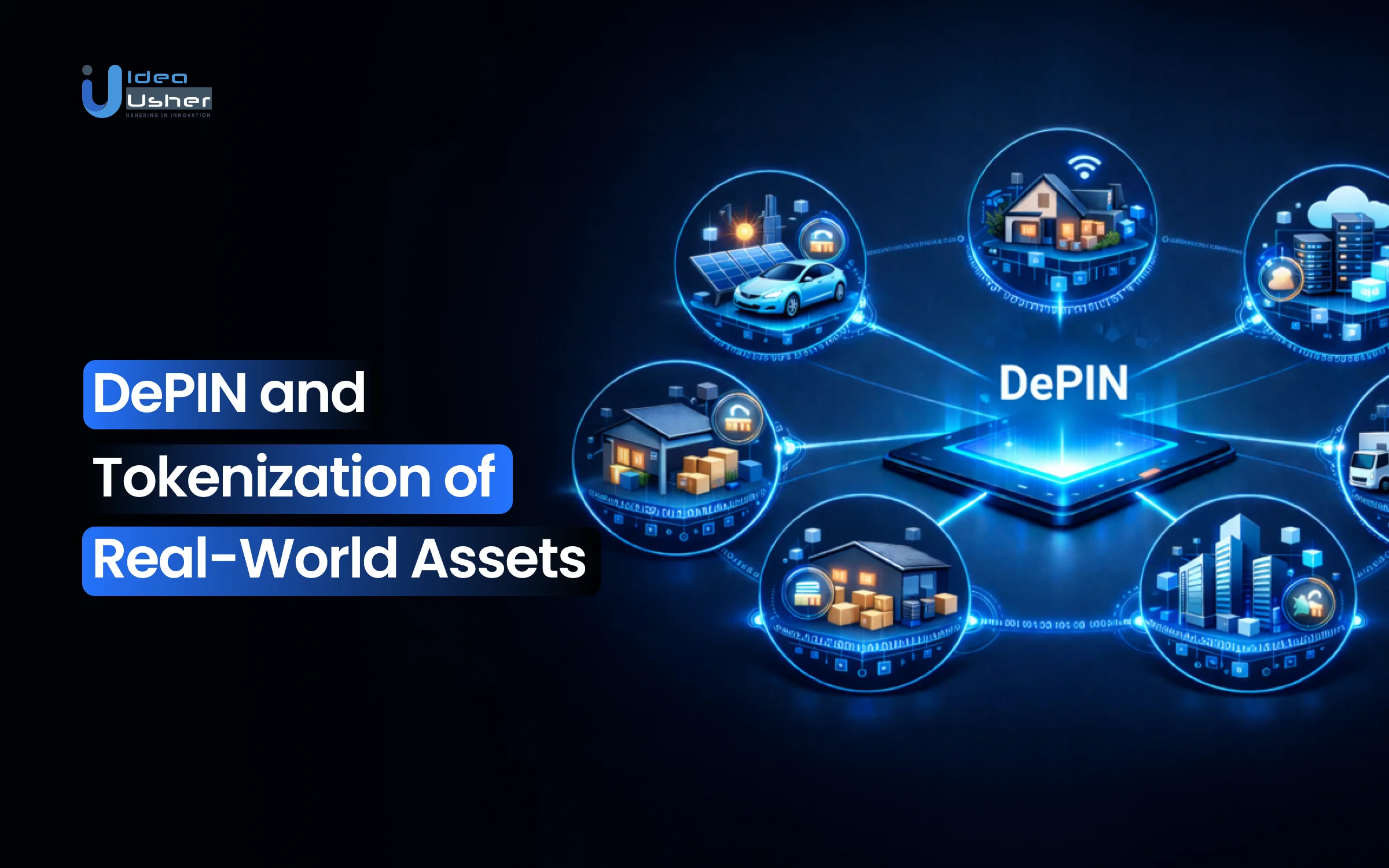
Physical infrastructure and real-world assets have traditionally been managed through centralized systems, with ownership, access, and monetization controlled by a small set of operators. As blockchain coordination and token models mature, these assets can now be represented, tracked, and exchanged with greater transparency and programmability. This shift is driving interest in DePIN tokenization for real-world assets, where infrastructure and asset value are linked through on-chain incentive and ownership layers.
In these models, physical resources and tangible assets are paired with verifiable data, device activity, or usage records that can be recorded and validated through decentralized networks. Tokenization then enables fractional ownership, automated rewards, and programmable transfer rules tied to real-world performance. The strength of the system depends on how well asset verification, data integrity, and token mechanics are designed to work together.
In this blog, we explore how DePIN and tokenization of real-world assets intersect by explaining core concepts, system components, and practical design considerations involved in building asset-backed, infrastructure-driven token platforms.

What Is DePIN?
DePIN (Decentralized Physical Infrastructure Networks) is a model where real-world infrastructure such as compute hardware, storage systems, wireless hotspots, sensors, and edge devices, is built and operated by distributed participants instead of a single centralized provider. Contributors supply physical resources, and the network coordinates usage, verification, and rewards through blockchain-based systems.
In a DePIN network, infrastructure is not owned by one company; it is crowdsourced, cryptographically verified, and token-incentivized.
At a high level, a DePIN system combines five working layers:
- Physical Resource Layer: real hardware like GPUs, storage nodes, routers, sensors, or edge devices
- Node Operator Layer: individuals or organizations that deploy and maintain these resources
- Proof & Verification Layer: mechanisms that confirm the resource is online and performing real work
- Blockchain Coordination Layer: smart contracts that record activity and automate rules
- Token Incentive Layer: rewards distributed based on measurable contribution and performance
Unlike traditional infrastructure platforms that scale through capital expenditure, DePIN networks scale through open participation and incentive design. More contributors joining the network directly increases available capacity.
For this reason, DePIN is increasingly being used as the operational backbone for tokenized infrastructure models, which is where it begins to intersect directly with real-world asset tokenization.
Why Physical Infrastructure and Real-World Assets Are Moving On-Chain?
The blockchain narrative is shifting from purely digital assets toward real-world infrastructure and RWAs, led by DePIN. This transition is accelerating the growth of DePIN tokenization for real-world assets and utility-driven, asset-backed value creation.
A. The Shift from Digital Tokens to Asset-Backed Networks
The crypto market’s first major waves waves like Bitcoin and Ethereum, proved decentralized digital value but stayed disconnected from the physical economy. Blockchain’s next step is coordinating real-world infrastructure backed by productive, income-generating assets.
- Limits of Purely Financial Tokenization: Tokenizing static assets like real estate often creates only a digital ownership claim, without improving how the asset is operated, utilized, or value-produced.
- Rise of Infrastructure-Backed Token Economies: DePIN tokens power active infrastructure networks, where value is tied to real usage and output such as compute, storage, or connectivity, creating a verifiable link between on-chain rewards and off-chain utility.
B. DePIN RWA Convergence: Utility Meets Yield
The convergence of DePIN (decentralized operation) and RWA (real-world asset backing) creates a powerful new model that combines the best of both worlds:
| Dimension | Traditional RWA (Static) | DePIN (Dynamic) | DePIN + RWA Convergence |
| Primary Value Driver | Asset Ownership & Appreciation | Network Usage & Growth | Asset Utility + Network Demand |
| Token Function | Dividend/Equity Share | Network Fuel & Incentive | Incentive + Yield-Bearing Ownership |
| Contribution | Capital Only | Work/Service + Capital | Verifiable Work + Staked Capital |
| Example | Tokenized apartment building | Helium Network (hotspots provide coverage) | Solar Panel Network where token represents both ownership of the physical panel and rewards for the energy it verifiably produces. |
This model merges the yield potential of RWAs with the growth mechanics and community alignment of DePIN. Contributors are not just passive investors; they are active operators whose verified work directly increases the network’s value and their own rewards.
C. Market Drivers Behind Infrastructure-Backed Tokens
Several economic and technology trends are accelerating DePIN tokenization for real-world assets, driving faster adoption of infrastructure-backed token models across networks and markets.
- The Search for Sustainable Yield: Investors seek yield from real economic activity. Infrastructure networks generating user fees (storage, compute, data) provide revenue-backed yield more sustainable than inflationary token farming.
- Demand for Verifiable Impact: Blockchain’s transparency lets anyone verify network capacity, usage, and rewards, proving value from real-world work.
- Efficiency in Capital Formation: Traditional infrastructure requires massive capital and centralized management. DePIN’s crowdsourced model enables modular, permissionless global deployment, reducing barriers and enabling agile build-outs (e.g., Helium).
- Technological Maturation: Reliable oracles, verifiable compute, and zero-knowledge proofs enable secure bridging of off-chain physical events (sensor readings, GPU tasks) to on-chain smart contracts.
Moving physical infrastructure on-chain is not about creating a digital copy of the old world. It’s about using a new coordination layer (blockchain) to build, operate, and own infrastructure in a fundamentally more efficient, transparent, and participatory way. The token becomes the intersection point of work, ownership, and utility.
How DePIN and Real-World Asset Tokenization Work Together?
DePIN and Real-World Asset (RWA) tokenization intersect when physical infrastructure assets are not only represented on-chain but also continuously verified and economically activated through decentralized networks. One provides the operational backbone, the other provides the ownership and value layer.

A. RWA Tokenization Layer (Ownership & Rights)
This layer digitally represents rights to physical assets (solar panels, servers, antennas) on-chain as programmable, tradeable tokens, enabling new ownership, investment, and liquidity models.
Key Components & Actions:
- Asset Representation: A physical asset is minted as a digital token, such as an NFT or a security token, on a blockchain.
- Rights Encoding: The token’s smart contract encodes specific rights for the holder, which could be full ownership, a fractional revenue share, or specific usage rights to the asset’s output.
- Fractional Participation: The token can be divided, allowing multiple individuals to own a share of a single, high-value physical asset, lowering the barrier to investment.
- Transfer and Liquidity: These digital tokens can be seamlessly bought, sold, or traded on secondary markets, providing liquidity for assets that are traditionally illiquid.
B. DePIN Layer (Verification & Production)
This layer connects physical assets to live, decentralized networks, monitors performance, and uses cryptographic proofs to verify function, turning static objects into active, income-generating participants.
Key Components & Actions:
- Physical Network Connection: The asset is equipped with software or a hardware module that connects it to the DePIN network, allowing it to receive tasks and transmit data.
- Continuous Proof Generation: The asset’s client software continuously generates cryptographic proof of its work such as proof of location, data served, or energy produced, which is tamper-evident and verifiable.
- Real Output Measurement: The network’s middleware measures the asset’s actual contribution, like gigabytes of storage provided, megawatt-hours of energy delivered, or hours of wireless coverage supplied.
- Automated Reward Trigger: Based on the verified proof of performance, a smart contract on the blockchain automatically triggers and distributes token rewards to the address holding the corresponding RWA token, directly linking effort to payout.
In simple terms:
- RWA Tokenization puts a legal and financial claim to an asset on-chain. (answers the question “Who owns it and what are their rights?”)
- DePIN proves that the asset is real, operational, and productively contributing to a network. (answers “Is it working, what is it doing, and what does it earn?”)
Together, they create tokenized assets that are both verifiably authentic and actively generating value, moving from a passive ownership record to a live, performance-linked economic model. This turns tokenization from a static ownership record into a live, performance-linked infrastructure model.
Market Growth and Adoption Trends in DePIN and RWA Tokenization
Decentralized Physical Infrastructure Networks (DePIN) are rapidly emerging as a major market force. Currently valued at $30-50 billion, the World Economic Forum projects the market will reach $3.5 trillion by 2028, representing a 375% compound annual growth rate.

The momentum behind the convergence of DePIN and RWA is accelerating as both sectors grow in parallel. The DePIN sector alone has expanded rapidly from a $5.2 billion market cap to an estimated $19 to $33 billion, strengthening the case for integrated real-world tokenized infrastructure.
Key market trends driving convergence:
- RWA tokenization grew from $15.2 billion (late 2024) to over $24 billion (mid-2025) from an 85% increase, with forecasts projecting $16 trillion by 2030
- Market shift towards tangible fundamentals: DePIN now prioritizes verifiable revenue over network size, generating $72 million in on-chain revenue in 2025.
Similarly, RWA tokenization is accelerating beyond pilot programs into the production of market-ready financial products, driven by institutional demand for efficiency, transparency, and new investor access
Static Asset Tokens vs DePIN-Backed Asset Tokens
DePIN-RWA’s core innovation isn’t tokenization itself, but what’s tokenized and how tokens behave. Unlike previous RWA tokenization, this shifts from digital claims on static assets to dynamic, performance-linked keys to productive networks, changing the fundamental economic model.
| Aspect | Static Tokenization Model | DePIN-Backed Tokenization Model |
| Primary Value Driver | Market demand, speculation, underlying asset appraisal. | Measurable output, network usage, and verifiable performance of the asset. |
| Transparency | Limited. Owners must trust reports on the asset’s condition and revenue. | High. Performance data (uptime, output) is publicly verifiable on-chain via cryptographic proofs. |
| Economic Model | Passive. Value accrues through appreciation or periodic dividends. | Active & Performance-Linked. Value accrues through continuous, automated micro-rewards for proven work. |
| Owner’s Role | Passive investor. | Active participant/network operator. Holding the token means contributing to the network’s service. |
| Example | A token representing 10% ownership of a commercial building. | A token representing a WiFi hotspot that earns crypto for providing verifiable coverage. |
Types of Real-World Assets to Tokenize in DePIN Platform
DePIN tokenization for real-world assets transforms physical assets like GPUs and solar panels into verifiable, income-generating nodes in a decentralized network. While many assets can be tokenized, DePIN is best suited for assets that are:
- Networkable: Can be connected to a digital network to provide a service.
- Verifiable: Their operation, output, or state can be measured and cryptographically proven.
- Revenue-Generating: Their utility can be packaged and sold to create sustainable demand.
The most promising assets fall into the following four infrastructure categories.

1. Compute Infrastructure Assets
These assets provide processing power, which is becoming a globally scarce and high-demand resource, especially for AI and complex simulations.
- GPUs (Graphics Processing Units): The most sought-after compute asset. High-end GPUs (like NVIDIA H100s) can be pooled in a DePIN to offer decentralized, on-demand AI training and inference, competing with centralized cloud providers.
- Edge Nodes: Smaller, geographically distributed servers or devices (like industrial PCs) that provide low-latency compute close to end-users. Ideal for applications in smart cities, IoT data processing, and content delivery.
- Data Centers: Entire facilities or racks within them can be tokenized and integrated into a DePIN. This allows data center operators to monetize spare capacity and lets the network offer enterprise-grade, decentralized cloud services.
2. Connectivity Infrastructure
These assets form the physical layer of communication networks, an area where decentralized build-outs can rapidly fill coverage gaps.
- Wireless Hotspots: Devices like Helium 5G radios or LoRaWAN gateways. When tokenized, each hotspot becomes a node that earns rewards for providing verified wireless coverage, creating a crowdsourced alternative to traditional telecoms.
- IoT Gateways: Devices that aggregate data from multiple sensors and relay it to the internet. A DePIN can incentivize the deployment of these gateways in specific industrial or agricultural areas to create dedicated data networks.
- Mesh Network Nodes: Devices that relay data for other devices in the network, extending range without centralized backhaul. Tokenization rewards participants for strengthening and expanding the network’s resilience and coverage area.
3. Storage & Data Infrastructure
These assets provide the capacity to store information or the means to collect unique data streams from the physical world.
- Storage Nodes: Hard drives and servers with unused capacity. By tokenizing this hardware, owners can contribute to a global, decentralized file storage network (like Filecoin), earning rewards for providing provable, secure storage space.
- Sensor Networks: Arrays of devices measuring environmental data (air quality, temperature, seismic activity), traffic flow, or energy usage. Tokenizing each sensor creates a marketplace for high-fidelity, real-world data, rewarding operators for maintaining and calibrating their devices.
- Mapping Devices: Dashcams, drones, or specialized imaging sensors. Networks like Hivemapper tokenize these devices to crowdsource continuously updated geospatial data, rewarding contributors for driving specific routes and collecting fresh imagery.
4. Energy & Utility Assets
This category tokenizes the infrastructure of energy production, distribution, and consumption, enabling peer-to-peer energy markets and grid-balancing services.
- Solar Nodes: Rooftop solar panels or small solar farms. When equipped with a smart meter and tokenized, they can automatically sell excess renewable energy to neighbors or to the grid within a DePIN, creating a direct revenue stream for the owner.
- Grid Sensors: Devices that monitor voltage, frequency, and load on the electricity grid. A DePIN can incentivize their deployment to create a high-resolution map of grid health, providing valuable data for stability and enabling automatic demand response.
- Charging Stations: Electric vehicle (EV) chargers. Tokenizing a charger allows it to become part of a decentralized charging network. Owners earn fees for providing charging services, and the network can optimize pricing and availability in real-time.
How DePIN Improves RWA Tokenization More Than Traditional Models?
Traditional RWA tokenization struggles with the “black box”problem. DePIN provides the missing verification and automation layer, transforming tokenized assets from static property titles into dynamic, transparent, self-sustaining economic units.
Here are the key advantages DePIN brings to RWA tokenization:
- Continuous Proof of Asset Activity: Instead of annual reports, DePIN assets generate cryptographic proof of their work every second, minute, or hour. A solar panel doesn’t just exist; it continuously proves it’s producing energy.
- Real-Time Performance Verification: Anyone, including investors and auditors, can independently verify an asset’s performance in real-time by checking on-chain data, eliminating reliance on infrequent, centralized reports.
- Automated Reward Distribution: Smart contracts automatically convert verified activity into token rewards. This removes the need for manual invoicing, payment processing, and costly intermediary administration for revenue sharing.
- Usage-Based Yield vs. Static Yield: Yield is no longer a static, promised percentage. It is directly and transparently generated by the asset’s actual usage and output, aligning investor returns with real-world utility and demand.
- Reduced Reporting Fraud Risk: The cryptographic and decentralized nature of proof generation makes it nearly impossible to falsify performance data without colluding with the entire network, drastically reducing fraud.
- On-Chain Telemetry: Every asset provides a transparent, immutable log of its operational history like its uptime, output, and maintenance events. This creates a valuable, verifiable record for due diligence, valuation, and insurance.
The Practical Impact
The combined effect of these features makes the DePIN model fundamentally more practical and scalable for managing tokenized physical assets through DePIN tokenization for real-world assets.
| Challenge | Traditional RWA Model | DePIN-Backed RWA Model |
| Performance Trust | Requires trust in the issuer’s reports and audits. | Trust-minimized via continuous, cryptographic on-chain proofs. |
| Revenue Distribution | Manual, slow, and prone to errors; high administrative overhead. | Fully automated via smart contracts triggered by verified data. |
| Asset Monitoring | Opaque; requires scheduled physical audits. | Transparent and real-time via public on-chain dashboards. |
| Yield Model | Often fixed or speculative, detached from real asset performance. | Dynamic and utility-based, directly tied to the asset’s proven output and network demand. |
DePIN solves the core“oracle problem” for RWAs. It provides a reliable, automated, and fraud-resistant bridge between off-chain physical events and on-chain financial contracts. This doesn’t just make tokenization possible; it makes it operationally efficient, economically aligned, and scalable in a way traditional models are not.
How DePIN Validates Real-World Asset Performance On-Chain?
The central innovation of DePIN is its ability to create cryptographically secured trust about physical events. It replaces the need for manual audits with an automated, adversarial system that proves an asset is not just present, but actively performing valuable work. Here’s how this trust is engineered.

1. Proof of Resource Availability
This mechanism proves an asset is online, properly connected, and ready to perform its function. It’s the base layer of verification.
How it works: Devices must periodically respond to network challenges within a set timeframe.
Real-World Example: A wireless hotspot proves it is online by signing and returning a cryptographic challenge from a nearby, verified device. Failure to respond indicates downtime.
Blockchain Action: Successful proofs are submitted as transactions, logging verifiable uptime used for base-level rewards.
2. Proof of Usage / Work
This is the core of value verification. It proves the asset is not just available but is actively delivering the service it promises.
How it works: The device generates cryptographic evidence of a specific task. The method varies by resource type.
Common Proof Types:
- Proof of Bandwidth: Data packets are relayed with a verifiable cryptographic watermark.
- Proof of Storage: The network periodically challenges a node to prove it still holds a unique piece of stored data.
- Proof of Compute: A node submits a verifiable computation result (e.g., a rendered frame, an AI model output) that is cheap to verify but expensive to produce.
Blockchain Action: These proofs are submitted and verified by other nodes or a dedicated oracle network. Validated proofs trigger reward distribution in smart contracts.
3. Telemetry & Oracle Feeds
Devices generate raw performance data such as energy output in kWh or data transferred in GB, and the system formats and delivers this data to the blockchain so smart contracts can act on it as a continuous data bridge.
How it works: Trusted oracles or decentralized oracle networks collect signed telemetry data from devices, aggregate it, and submit it on-chain.
Key Role: They translate real-world metrics into blockchain-readable data feeds that smart contracts use to calculate precise rewards based on how much work was done.
Example: A solar panel’s inverter sends signed energy production data to an oracle, which submits a daily total to the blockchain to calculate the operator’s yield.
4. Anti-Spoofing Mechanisms
DePIN designers assume participants may try to cheat for rewards, so they build anti-spoofing systems that make cheating economically irrational or technically infeasible.
Key Techniques:
- Cross-Verification: The network requires multiple geographically distinct peer devices to verify each node’s activity (for example, hotspots witness each other in Helium’s Proof-of-Coverage system).
- Hardware Attestation: Using secure hardware elements (like TPMs) to guarantee that a specific, certified device is generating the proof, not a spoofed virtual machine.
- Location Bonding: The network requires operators to stake assets and slashes them if verification systems or radio frequency analysis prove the device’s claimed location is false.
Purpose: These mechanisms ensure that proofs correspond to genuine physical activity, protecting the network’s integrity.
5. Device Identity & Attestation
Before the network trusts any proof, it must first verify the device that generates it. This process builds a Sybil-resistant identity layer.
How it works: The system issues each physical device a unique cryptographic identity (key pair) during a secure manufacturing or onboarding process.
Attestation: This process cryptographically binds the device’s hardware to its on-chain identity, often using a certificate from the manufacturer. This prevents the cloning of a single device identity across multiple fake nodes.
Result: Each proof of work links unforgeably to a specific, certified piece of hardware, creating accountability.
Token Design Models for DePIN-Backed Real-World Assets
The token design for a DePIN-RWA hybrid determines how value flows between asset owners, network users, and the protocol itself. The right model aligns incentives, ensures sustainability, and clearly defines the source and structure of yield.
| Model | Core Concept & How It Works | Emission vs. Revenue Linkage | Yield Source for Holders |
| Asset-Backed Reward Tokens | The token is minted as a reward for verified work, representing a claim on future network utility. | Emission-Linked. Value depends on revenue catching up to emissions. | Inflation rewards transitioning to usage fees. |
| Revenue-Share Tokens | Represents a direct claim on the protocol’s treasury or cash flow from the asset pool. | Revenue-Linked. Value is tied directly to network income. | Direct revenue distribution (dividend-like). |
| Usage Credit Tokens | A stable token purchased to pay for network services; burned upon use. | Burn-Linked. Supply is driven by burn/mint for stability. | Typically none (utility medium of exchange). |
| Dual-Token Models | Separates utility credit (payments) from governance token (speculation/governance). | Split. Credit is burn-linked; governance token is emission/fee-linked. | Governance token: emission rewards & fee share. |
| Token + NFT Hybrid | The asset is a unique NFT; a fungible token is used for rewards/payments. | Asset-Linked. NFT value tied to its performance; fungible token follows other models. | NFT: Direct yield from the specific asset’s activity. |
Real-World Examples of DePIN and RWA Tokenization Platforms
Real-world platforms show how DePIN tokenization for real-world assets work together in practice. These examples highlight asset verification, measurable output, and usage-based token rewards operating at real infrastructure scale.
1. Helium
Helium creates decentralized wireless networks for IoT and mobile devices by incentivizing individuals to deploy and operate hotspots.

- Asset Type: Wireless Hotspots (5G, LoRaWAN gateways)
- Proof Method: Proof-of-Coverage. Hotspots cryptographically prove their location and network integrity by exchanging wireless “challenges” with geographically adjacent peers.
- Reward Logic: Operators earn HNT tokens for creating verifiable network coverage and for relaying device data. The model is shifting from rewarding pure coverage to prioritizing actual data transfer.
- Demand Side: IoT enterprises, developers, and cities purchase Data Credits (minted by burning HNT) to connect sensors, trackers, and devices to the network.
2. Hivemapper
Hivemapper builds a decentralized Geospatial Data Infrastructure, constantly updated global street map by incentivizing drivers with dashcams.

- Asset Type: Dashcams with integrated GPS and connectivity.
- Proof Method: Proof-of-Location & Imagery. The device cryptographically signs and timestamps imagery with location data, proving that it captures unique, fresh map data.
- Reward Logic: Contributors earn HONEY tokens for every verified “map tile” (a segment of road imagery). Rewards are higher for mapping new roads or high-demand areas.
- Demand Side: Mapping platforms, logistics companies, and urban planners purchase fresh map data via API for navigation, analytics, and development.
3. Render Network
Render Network creates a decentralized marketplace for GPU computing power, primarily for graphics rendering and AI workloads.

- Asset Type: GPUs (from individual workstations to data center racks).
- Proof Method: Proof-of-Render. Node operators submit cryptographic proofs, such as hashes of output frames, to show they completed specific rendering jobs correctly and on time.
- Reward Logic: GPU providers earn RNDR tokens based on the computational complexity of jobs, the tier of their hardware, and their speed and reliability.
- Demand Side: 3D artists, animation studios, and AI researchers pay RNDR tokens for on-demand, scalable GPU power to render scenes, visual effects, or train machine learning models.
4. Filecoin
Filecoin creates a decentralized data storage network, turning unused hard drive space into a verifiable global storage marketplace.

- Asset Type: Hard drives and storage servers.
- Proof Method: Proof-of-Replication & Spacetime. Storage miners must cryptographically prove they are storing unique, client-encrypted data and continue to store it reliably over time.
- Reward Logic: Storage providers earn FIL tokens in two ways: for committing storage capacity to the network, and for successfully fulfilling storage deals with clients over their contract duration.
- Demand Side: Users, developers, and organizations pay FIL to store and retrieve data in a decentralized, censorship-resistant, and resilient manner, often for archival, dataset hosting, or Web3 application needs.
5. Akash Network
Akash operates as a decentralized marketplace for cloud compute, enabling anyone to rent out or access underutilized computing resources (like from data centers) in an open, permissionless market.

- Asset Type: Server capacity (CPU, RAM, storage) from data centers, crypto mining farms, and individual servers.
- Proof Method: Proof-of-Lease & Work. Providers run a lightweight client to make their resources discoverable. After a provider wins a lease through an auction, they must host the client’s containerized workload and continuously prove correct operation to receive payment.
- Reward Logic: Providers earn AKT tokens (and/or stablecoins like USDC) from the lease payments made by tenants. The platform sets pricing through a reverse auction model in which tenants define their requirements and providers submit bids, often driving costs well below centralized cloud prices.
- Demand Side: Developers, startups, and enterprises seeking cost-effective, censorship-resistant cloud compute for hosting websites, APIs, databases, blockchain nodes, and machine learning inference.
Conclusion
DePIN tokenization for real-world assets reshapes how people own, verify, and monetize physical value through blockchain systems. It connects assets directly to infrastructure, usage, and measurable contribution rather than abstract financial instruments. This model increases transparency in asset performance and aligns incentives among operators, users, and investors. For readers exploring this shift, it creates a clearer link between digital networks and physical economies, demonstrating how decentralized coordination can deliver sustainable yield, accountability, and long-term value creation driven by real-world activity across finance and infrastructure.
Partner With IdeaUsher for DePIN Powered RWA Tokenization Platform
With extensive experience building blockchain platforms, IdeaUsher applies that expertise to develop DePIN driven tokenization systems connected to real world assets and infrastructure. We help teams move beyond static asset representation toward models backed by measurable usage, performance, and revenue.
Why Work With Us?
- DePIN and RWA Architecture Expertise: Tokenization frameworks aligned with infrastructure output and verifiable contribution
- Performance Linked Token Models: Designs that connect asset value directly to real world activity and cash flow
- Security First Implementation: Onchain logic, data verification, and integrations built with compliance and security in mind
- Long Term Platform Design: Solutions structured for sustainability, transparency, and evolving regulatory landscapes
Explore our portfolio to see how we support teams in launching decentralized platforms built for real world value creation.


FAQs
A.1. DePIN networks can supply verified real-world data and infrastructure that support asset tracking and usage reporting. This improves trust in tokenized assets by linking on-chain records with measurable physical performance and independently validated resource activity.
A.2. DePIN infrastructure can tokenize assets tied to physical networks, including connectivity hardware, compute resources, energy systems, sensors, mobility data, storage infrastructure, and other assets that generate measurable real-world usage and performance data.
A.3. DePIN improves transparency by recording asset performance, utilization, and rewards on-chain. Instead of periodic reports, stakeholders can monitor real-time activity, revenue flows, and contributor behavior directly through blockchain data.
Key risks include regulatory uncertainty, hardware reliability, incentive misalignment, and data integrity. Successful projects address these early by designing compliant structures, robust verification systems, and token models tied strictly to real-world usage.


