


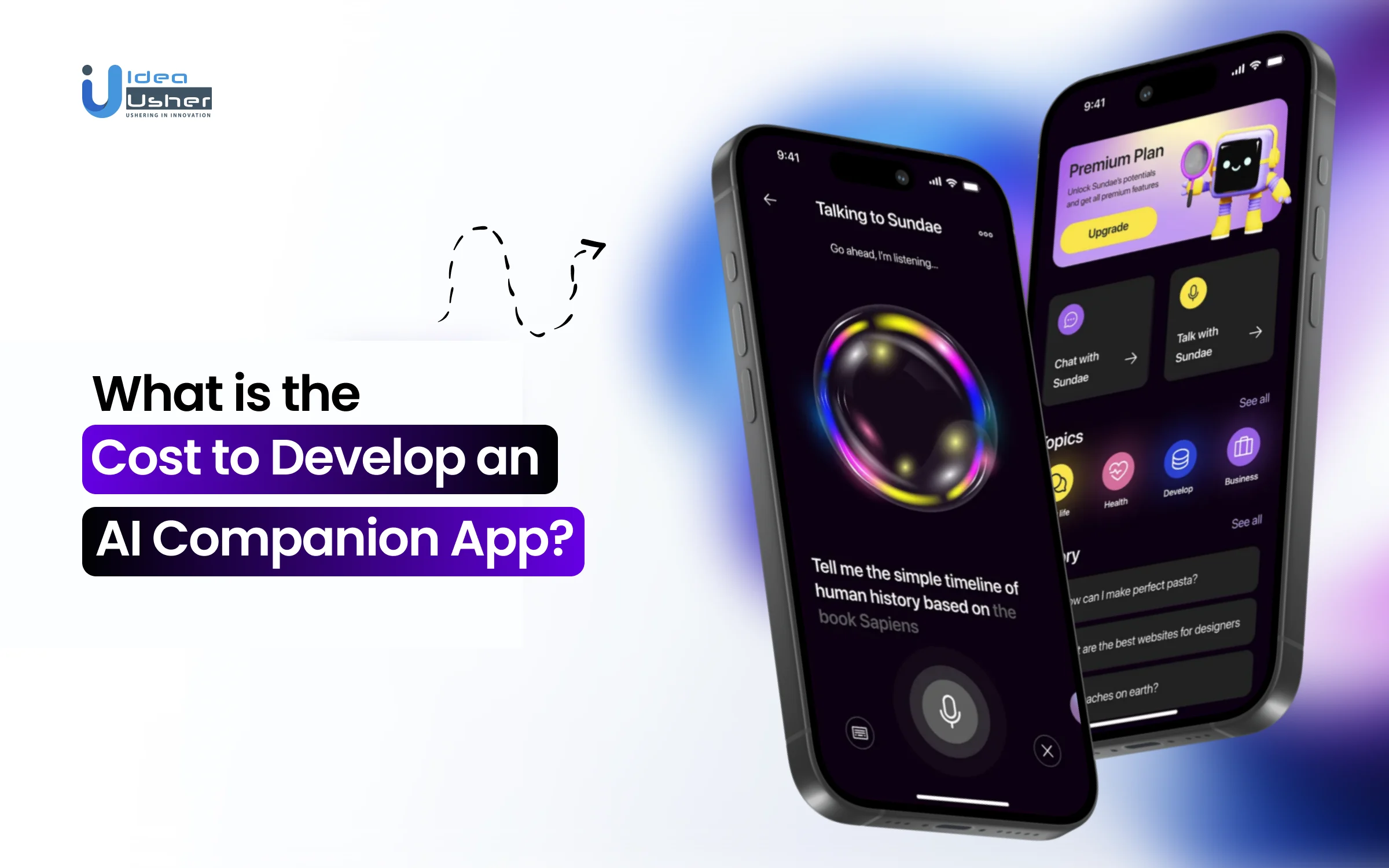
Building an AI product usually begins with strong excitement, but it can quickly shift into uncertainty around cost and execution. Most founders know the experience they want to deliver, but translating that vision into realistic numbers often takes time. An AI companion app relies on several connected layers that must work together smoothly. These layers include language models, data pipelines, infrastructure security, and experience design.
Each technical choice can significantly affect long-term cost and performance. Personalization depth and scalability may increase value, but they also add complexity. Understanding this early can help you plan more confidently and avoid expensive surprises later.
We’ve built many emotionally aware AI companions powered by memory intelligence systems and sentiment analysis. Thanks to these years of experience, we’re sharing this blog to discuss the cost of developing an AI companion app. Let’s start.
Key Market Takeaways for AI Companion App
According to Gminsights, the AI companion app market is growing rapidly, with estimates placing its value at USD 14.1 billion in 2024 and forecasting a 26.8% CAGR through 2034, largely driven by rising mental health needs and advances in generative AI. Some forecasts point to even sharper acceleration, projecting growth from USD 10.8 billion in 2024 to nearly USD 291 billion by 2034. Together, these signals indicate AI companions are moving beyond novelty toward everyday emotional and social support tools.

Source: Gminsights
User adoption has surged, with 100+ AI companion apps live by early 2025, representing a 60% year-over-year increase. Apps like Pi by Inflection AI have attracted millions of users through calm, empathetic conversations focused on reflection, wellness, and productivity.
Meanwhile, Nomi.ai has built a loyal base of 10+ million users by offering deeply customizable companions with memory and role-play features that foster long-term emotional connection.
Large platforms are accelerating mainstream adoption through integration. Snapchat’s My AI, powered by customized OpenAI GPT technology, has reached over 150 million users as a built-in companion for casual conversation, advice, and creative interaction.
Partnerships like Snapchat’s collaboration with OpenAI highlight how major tech players are rapidly scaling AI companionship, leveraging distribution and infrastructure to normalize AI-driven relationships at a massive scale.

What Is an AI Companion App?
An AI companion app is a software application that uses artificial intelligence to interact with users in a conversational, personalized, and emotionally responsive way, often simulating aspects of companionship or support.
These apps can engage in dialogue, remember user preferences, adapt their behavior over time, and provide functions such as emotional support, motivation, entertainment, or daily assistance, aiming to create an ongoing, human-like relationship rather than just completing single tasks.
Key Features of an AI Companion App
An AI companion app should feel natural to interact with while still performing practical tasks. It can remember patterns over time and respond in an emotionally aware yet technically reliable manner. It also allows personalization while steadily supporting daily routines and ongoing conversations.

1. Conversational Chat Interface
Users interact with the AI through natural text or voice conversations that flow like human dialogue. This feature enables real-time back-and-forth communication, making the companion feel approachable and easy to talk to.
Example: Replika is well known for its natural, ongoing chat experience, allowing users to have free-flowing conversations that feel personal and human-like.
2. Personalized Memory & Preferences
The app remembers user details such as interests, routines, and past conversations. This enables the AI companion to tailor responses and interactions, creating a more personal and consistent experience over time.
Example: Nomi AI focuses on remembering user details, past discussions, and preferences to create long-term, personalized interactions that evolve.
3. Emotional Awareness & Support
The AI detects emotional cues in user messages and responds with empathy and understanding. Users can rely on this feature for encouragement, comfort, or a nonjudgmental space to express feelings.
Example: Wysa is designed to recognize emotional states and provide empathetic responses, offering mental health–focused support through conversational interaction.
4. Customizable Personality & Appearance
Users can customize how their AI companion looks and behaves, including personality traits, tone of voice, or visual avatar. This helps users feel more connected and in control of their experience.
Example: Anima AI allows users to customize their AI companion’s personality traits and interaction style, giving users control over how the companion behaves.
5. Daily Check-Ins & Reminders
The companion proactively checks in with users and offers reminders for tasks, goals, or self-care activities. This feature supports routines and helps users stay engaged and organized.
Example: Finch uses daily check-ins and reminders to help users maintain routines, self-care habits, and personal goals through friendly AI interactions.
6. Interactive Activities & Games
Users can participate in activities such as storytelling, roleplay, quizzes, or simple games with the AI. These interactions make the app more entertaining and strengthen ongoing engagement.
Example: Character.AI enables users to engage in roleplay, storytelling, and interactive scenarios, making conversations playful and highly engaging.
7. Multimodal Interaction
The app supports multiple interaction methods, including text, voice, and images. This flexibility allows users to choose how they communicate, making interactions richer and more immersive.
Example: Xiaoice supports text, voice, and visual interactions, offering a rich, multimodal companion experience across different platforms.
Cost Required to Develop an AI Companion App
We take a cost-effective, outcome-driven approach to building AI companion apps, focusing solely on features that deliver real user value. This phased structure allows our clients to launch efficiently, validate early, and scale intelligently without unnecessary spend.

Phase 1: Discovery & Personality Architecture
Concept: Define the AI’s identity and its emotional engagement with users. This phase determines whether the companion feels generic or genuinely engaging.
| Component | MVP Cost | Scale Cost | What This Delivers |
| Character Engineering | $3k – $7k | $15k – $30k | Personality rules, tone of voice, emotional limits, and behavioral consistency |
| UX & Conversation Design | $5k – $12k | $20k – $50k | Natural dialogue flows, chat UI, response pacing, and micro-interactions |
| Phase 1 Total | $8k – $19k | $35k – $80k | A clearly defined, emotionally coherent AI personality |
Phase 2: Core Engineering & Memory Systems
Concept: Build the intelligence and memory that allow the AI to remember users, reason over time, and act intentionally.
| Component | MVP Cost | Scale Cost | What This Delivers |
| LLM Orchestration | $10k – $20k | $30k – $60k | Model integration, prompt control, safety layers |
| Long-Term Memory | $8k – $15k | $25k – $55k | Persistent user memory using vector databases |
| Agentic Decision Logic | $7k – $12k | $20k – $45k | Proactive follow-ups, contextual actions, decision loops |
| Phase 2 Total | $25k – $47k | $75k – $160k | A companion that remembers, adapts, and evolves |
Phase 3: Multimodal & Security Infrastructure
Concept: Enable how users interact with the AI while ensuring privacy, trust, and scalability.
| Component | MVP Cost | Scale Cost | What This Delivers |
| Multimodal Features | $5k – $10k | $30k – $70k | Voice input/output and optional visual understanding |
| Privacy & Compliance | $4k – $8k | $15k – $40k | GDPR/CCPA compliance, encryption, data protection |
| Backend & Cloud Setup | $5k – $10k | $15k – $35k | Scalable infrastructure for concurrent users |
| Phase 3 Total | $14k – $28k | $60k – $145k | Secure, scalable, multi-interface access |
Phase 4: Launch & Ongoing Operations
Concept: Ensure the AI performs reliably in real-world conditions and remains stable as usage grows.
| Cost Area | Estimated Cost | Purpose |
| Testing & QA | $5k – $15k (one-time) | Personality consistency and edge-case handling |
| LLM Usage Fees | $0.10 – $2.50 per 1M tokens | Ongoing inference costs based on usage |
| Annual Maintenance | 15%–20% of build cost | Updates, monitoring, bug fixes, optimizations |
This is a rough estimate to help with planning, not a fixed price. Based on the project scope, costs typically range from $150,000 to $ 400,000 USD. Connect with us for a free consultation, and we’ll provide a clearer, tailored estimate.
Unique Factors That Affect the Cost of an AI Companion App
Beyond features and tech stacks, a few often-overlooked decisions can dramatically influence the final cost of an AI companion app. These factors shape whether the product feels like a novelty or a trusted presence, and they can shift budgets by tens of thousands of dollars.

1. Depth of Personality
Many products treat personality as a surface feature, defined by an avatar or a friendly tone. In reality, personality is demonstrated by consistent behavior over time: the AI remembers past guidance, stays aligned with earlier conversations, and responds in a way that feels reliable rather than random.
Cost impact: $15,000 to $45,000+
A lightweight personality with a fixed tone may cost between $5,000 and $15,000. However, a living personality that adapts over time requires:
- Behavioral rules layered on top of the language model
- Extensive scenario testing to prevent out-of-character responses
- Ongoing refinement based on real user interactions
That level of depth can add $30,000 to $45,000 or more to the overall budget.
2. Memory Longevity and Recall Accuracy
Teams often rely on short-term session memory or overload large context windows with entire chat histories. What truly matters is accurate, selective recall, where the AI remembers relevant facts and emotional context from past conversations without fabricating details or losing meaning.
Cost impact: $20,000 to $70,000
- Temporary session memory that resets quickly adds minimal cost
- Long-term semantic memory using vector databases and retrieval-augmented generation typically costs $20,000 to $40,000
- Advanced personal and emotional memory with validation layers and prioritization logic ranges from $50,000 to $70,000+
Costs rise because every memory recall must be precise, timely, and believable. Preventing memory errors requires additional validation logic and continuous tuning.
3. Proactivity vs. Reactivity
Teams often build apps that look refined but remain purely reactive, responding only when prompted. What truly matters is timely proactivity, where the companion checks in, follows up, or offers support at the right moment without feeling intrusive.
Cost impact: $12,000 to $60,000
- Basic scheduled reminders typically cost $2,000 to $5,000
- Intelligent proactivity using behavior analysis and trigger logic ranges from $25,000 to $40,000
- Fully autonomous systems that integrate calendars, habits, or wearables for context-aware initiation can cost $45,000 to $60,000+
This work includes timing algorithms, decision engines, and extensive testing to prevent notification fatigue.
4. Emotional Risk Management
Teams often prioritize functionality while overlooking emotional responsibility. What truly matters is safe handling of vulnerable moments, where the AI recognizes distress, avoids harmful reinforcement, and escalates appropriately when users share personal struggles.
Cost impact: $18,000 to $85,000+
- Basic content filtering costs $3,000 to $8,000
- Sentiment detection with foundational guardrails typically ranges from $15,000 to $25,000
- Comprehensive emotional safety systems with expert-reviewed escalation protocols, compliance-ready architecture, and ethical training range from $40,000 to $85,000+
For mental health or crisis-oriented companions, regulatory and clinical oversight can push costs even higher.
Why Your AI Companion App Gets More Expensive as It Succeeds
A successful AI companion app faces a unique business paradox. Rising user engagement directly translates to increasing operational costs. Unlike a traditional social media app, where an increased user base primarily increases server load, an AI companion’s expenses are tied to the complexity, length, and intelligence of each interaction.
1. The Token Tax: The Direct Cost of Conversation
Every word exchanged with an AI companion consumes computational resources measured in tokens. As user activity grows, this becomes the most direct and variable cost.
How it scales: Costs do not rise only with user count. They multiply with engagement depth. A 10 percent increase in daily active users with deep 30-message conversations can trigger a 25-40 percent increase in token costs.
The data: If the app uses a model like GPT-4, a single complex user session can cost between $0.10 and $0.30. At 10,000 daily sessions, this equates to $ 1,000 to $ 3,000 per day, or $ 30,000 to $ 90,000 per month, purely in API fees.
Advanced features such as long-term memory via RAG increase token usage per query by 15-30%. The system must process both the live query and relevant historical data.
2. Memory and Complexity Infrastructure
A simple chatbot can be stateless. A true companion remembers. This memory includes user history, preferences, and emotional context, and it becomes increasingly expensive to manage at scale.
Vector database costs
Platforms such as Pinecone or Weaviate charge based on data stored and query volume. As more user history is retained and queried simultaneously, monthly costs can rise from hundreds to tens of thousands of dollars.
Example scaling: Storing 1MB of vector data per user is inexpensive for 1,000 users. At 100,000 users, this equates to 100GB of high-performance, specialized storage that requires dedicated infrastructure.
3. Proactive Intelligence
Reactive systems are cheaper. True companions are proactive. They send check-ins, remember key dates, and detect behavioral patterns. This agentic logic runs continuously, even when the app is not open.
Computational overhead: Running millions of daily decisions, such as whether to nudge a user, requires scalable job queues like Kafka or Celery and continuous engineering maintenance.
Cost of errors: Poorly tuned proactive logic increases annoyance and churn. Refining this behavior requires ongoing data science and MLOps work, which becomes a significant engineering cost.
4. The Performance and Safety Treadmill
As usage increases, performance and safety can no longer be compromised. Maintaining trust becomes a major cost center.
Latency and reliability
At 10 users, a 2-second response time is acceptable. At 10,000 concurrent users, response times must remain under a second. This requires load balancers, aggressive caching using tools like Redis, and GPU clusters. This infrastructure is capital-intensive.
Safety and moderation at scale
Manually reviewing 1,000 conversations is feasible. Monitoring 1,000,000 conversations requires custom moderation models, real-time filtering pipelines, and continuous security oversight, adding both fixed and variable costs.
The Scale Trap vs the Architecture Advantage
Many apps fall into the Scale Trap. They launch as simple wrappers around powerful APIs. At low usage, margins look healthy. At 10x usage, margins collapse due to uncontrollable API costs and limited architectural flexibility.
The alternative is building with an Architecture Advantage from day one. This approach has higher initial costs but far lower marginal costs at scale.
| Cost Driver | The Scale Trap Simple Wrapper | The Architecture Advantage Purpose Built |
| Per conversation cost tokens | Very high due to premium general models on every query | Managed using smaller specialized models for routine tasks |
| Memory and context cost | Crippling due to repeated long history injection | Optimized through selective vector retrieval |
| Infrastructure control | Minimal and vendor locked | High control over hardware caching and model choice |
| Cost trajectory | Near linear with usage leading to margin collapse | Logarithmic with falling marginal cost per user |
Strategic Cost Management for Scaling
To scale profitably, the architecture must be intentional from the start.
- Implement a hybrid model strategy: Use smaller open source models such as Llama 3 or Mistral for routine interactions. Route only complex or emotionally sensitive conversations to premium models such as GPT -4.
- Architect for efficient memory: Avoid using the main LLM for memory recall. Build a separate optimized RAG system that retrieves only relevant memory fragments with minimal token overhead.
- Build a cost monitoring dashboard: Track cost per daily active user and cost per 1,000 tokens as core metrics. Set automated alerts for sudden spikes to catch inefficiencies early.
- Plan for proactive caching: Cache frequent responses and recurring user patterns at the application layer. This reduces unnecessary model calls and stabilizes costs as engagement grows.
Why 75% Teens Use AI Companion Apps for Emotional Support?
Teens may turn to AI companion apps because they feel available, supportive, and easy to talk to at any moment. According to recent surveys, 75 percent of teens use AI companion chatbots for social interaction or emotional support. This behavior is likely to increase as digital systems become integrated into daily communication habits and emotional needs.

1. The 24/7 Judgment Free Zone
The Need. Immediate and unconditional acceptance.
The AI Answer. Unlike a human who may be busy, tired, or biased, an AI companion is always available. It never rolls its eyes, never breaks confidentiality, and offers a space free from the fear of social judgment or embarrassment that teens often feel with peers or adults.
2. The Crisis in Access to Traditional Support
The Gap. A severe shortage of mental health professionals, combined with high costs and long waitlists.
The AI Bridge. AI becomes a default accessible alternative. For many teens, it is not a choice between a therapist and a chatbot. It is a choice between a chatbot and no one. It fills the void when systems are overloaded.
3. The Designed Vibe of Validation
AI companions are engineered for engagement, not resolution.
- They listen or seem to. They remember details from past conversations, which creates an illusion of deep attention.
- They validate. Their base programming is to be agreeable and supportive, which can feel incredibly affirming to a teenager exploring identity or struggling with self-doubt.
- They do not escalate. Unlike a concerned parent or counselor who might initiate a difficult intervention, an AI typically keeps the conversation flowing. This feels safer and less daunting to many teens.
4. The Normalization of Digital Intimacy
Gen Z is the first generation to form friendships, relationships, and social identities primarily online. Developing a meaningful bond with a digital entity is a logical extension of lived experience rather than a strange concept.
5. The Homework Helper Trojan Horse
Many teens first engage with AI tools like ChatGPT for schoolwork. The interface feels familiar, and the tone feels helpful. The transition from explaining this math problem to feeling stressed about this math test happens naturally. The tool for productivity quietly becomes a tool for confession.
Top 5 AI Companion Apps in the USA
We have reviewed several AI companion apps with notable technical depth. We examined how conversation flow and memory systems perform in practice. This perspective may be helpful when evaluating the space.
1. Replika

Replika is a popular AI companion designed to be a virtual friend who listens, chats, and provides emotional support. It learns from conversations over time and can be customized in personality and appearance, making interactions feel more personal and continuous.
2. Nomi

Nomi focuses on creating emotionally intelligent AI companions that feel natural and thoughtful. It emphasizes deep, meaningful conversations and long-term memory to build a strong sense of connection.
3. Character.AI

Character.AI allows users to chat with thousands of AI characters, including fictional, historical, and user-created personas. It is widely used for companionship, role-play, creative writing, and entertainment.
4. Kindroid

Kindroid is an AI companion app centered on realistic conversations and long-term memory. It prioritizes consistent personality, emotional depth, and immersive one-on-one interaction. Its memory and persona modeling systems are designed to minimize behavioral drift over extended use.
5. Botify AI

Botify AI allows users to interact with customizable AI characters. It supports role-play driven companionship with flexible personality settings. The platform emphasizes creative control and adaptive dialogue to shape distinct interaction experiences over time.
Conclusion
System intelligence, rather than surface features, shapes the cost to develop an AI companion app. It should be designed to remember context, adapt its behavior, and reliably engage users over time. This architecture will directly affect performance and long-term stability.
Businesses that invest deliberately may build platforms with strong retention and predictable revenue. These systems can evolve gradually rather than fade, unlike short-lived AI experiments. Technical depth matters more than fast delivery.
Looking to Develop an AI Companion App?
IdeaUsher can help you design an AI companion app with a stable and scalable system architecture. Our team can guide memory design, model integration, and infrastructure planning from an early stage. This approach helps you build a reliable product that grows steadily with users.
Why Choose Us?
- 500,000+ hours of coding expertise by ex-MAANG/FAANG developers
- We build “thinking” partners, not just reactive interfaces
- Architect for privacy & personality from day one
We Specialize In:
Living Memory Systems that recall user history & preferences- Emotion-Aware AI that adapts tone to user sentiment
- Proactive Agent Logic for timely, thoughtful nudges
- Enterprise-Grade Security keeps sensitive data truly private.
Check out our latest projects, from health coaches to productivity partners—each built to form real digital relationships.


FAQs
A1: To develop an AI companion app, you should start with a clear system design rather than a feature list. The app must be built around memory handling, context awareness, and behavior modeling from day one. You will likely need iterative training, careful prompt control, and continuous evaluation to maintain consistent responses as the system grows.
A2: The cost will depend on architectural choices and long-term system complexity, rather than on UI features alone. Expenses may increase with persistent memory storage model tuning and infrastructure scaling. A well-planned system can gradually reduce rework and operational risk.
A3: AI companion apps work by combining language models with memory layers and behavior rules. The system should track user context and past interactions to respond consistently. Over time, it can adapt gradually based on usage patterns and feedback loops.
A4: Most AI companion apps generate revenue through subscriptions or usage-based pricing. Some may offer premium memory depth personalization or integrations. Long-term revenue usually depends on retention rather than short-term acquisition.


