


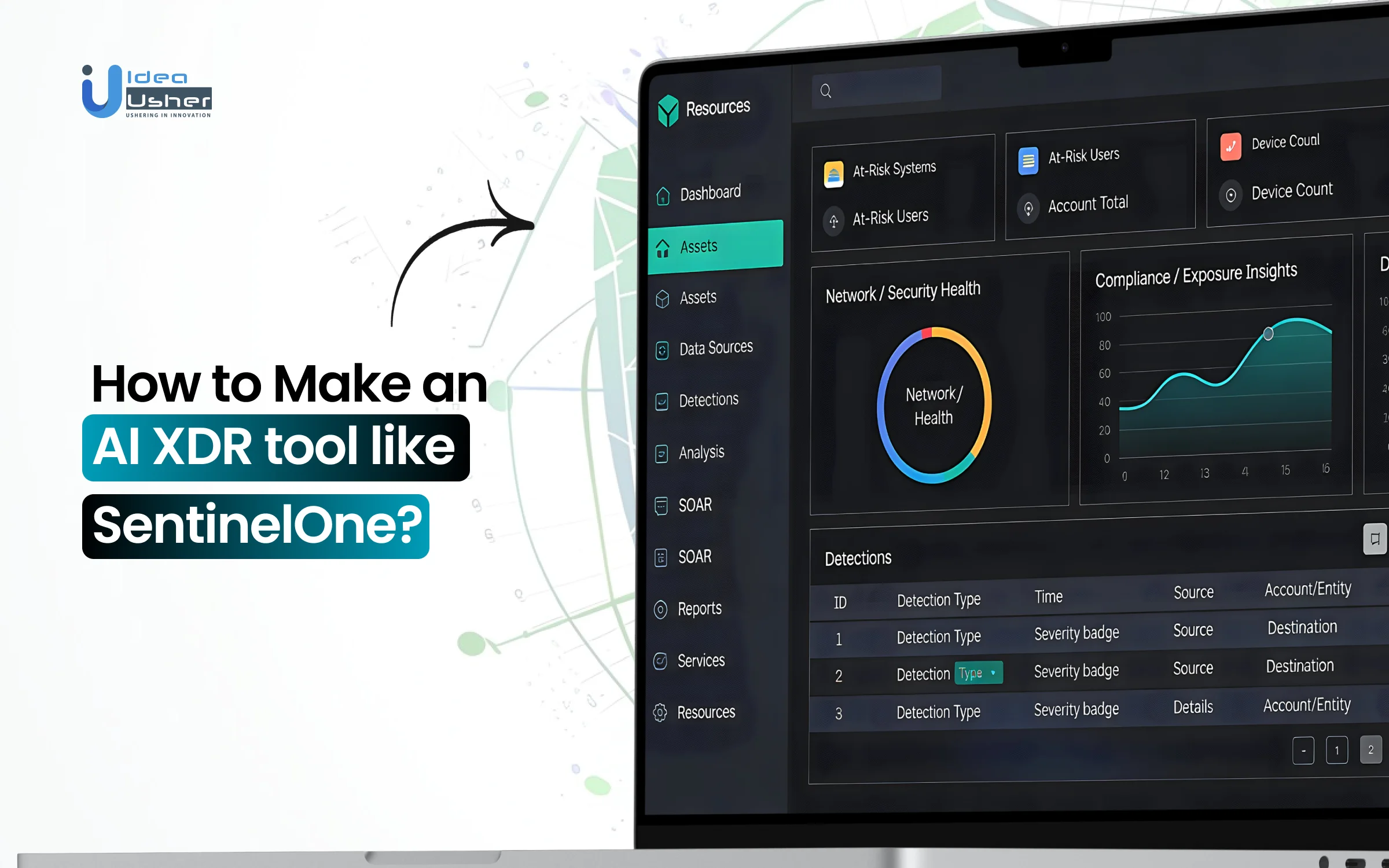
Security teams today operate under constant pressure and often receive more alerts than they can realistically process. Every new device or cloud workload can create a new path for attackers, and analysts must respond quickly with only partial visibility across their tools. Modern AI XDR tools like SentinelOne move beyond rigid rules and isolated systems, bringing together signals from endpoints, networks, identities, and cloud environments.
They can track behavior patterns over time and automatically connect events into a single attack storyline that shows how a threat unfolds. These platforms can even isolate compromised devices or roll back malicious changes within seconds, helping teams stay ahead of fast-moving threats.
We’ve built many advanced security intelligence and XDR-driven solutions over the years, powered by behavioral AI and distributed telemetry processing. As IdeaUsher has this expertise, we’re sharing this blog to discuss the steps to develop an AI XDR tool like SentinelOne. Let’s start!
Key Market Takeaways for AI XDR tools
According to GMInsights, the XDR market is gaining momentum, reaching about USD 1.7 billion in 2023 and expected to grow at more than 19% a year through 2032. This surge reflects how quickly threats are spreading across cloud, identity, email, and network layers. It is pushing companies to adopt tools that consolidate all their signals in one place. With security teams overwhelmed by alerts and struggling to hire enough talent, many organizations are moving beyond older EDR and SIEM setups in favor of more unified XDR platforms.

Source: GMInsights
CrowdStrike Falcon Insight XDR illustrates how the field is evolving. It blends data from endpoints, cloud environments, and partner tools to uncover movement and attack chains that might otherwise go unnoticed.
The company’s “1 Click XDR” approach also helps tighten cloud security by spotting workloads that lack coverage, particularly in environments running GPUs and generative AI, and automatically bringing them under protection.
Stellar Cyber has carved out its own space by focusing on correlation and noise reduction, giving analysts clearer insight with fewer distractions. Its emphasis on cutting false positives and improving SOC efficiency resonates strongly with both enterprises and managed service providers.

What is the SentinelOne Platform?
SentinelOne’s Singularity Platform brings together endpoint, cloud, and identity protection in one unified system. It uses behavioral analysis and machine learning to identify suspicious activity as it unfolds and respond automatically when needed. The platform blends EDR capabilities, threat hunting tools, and managed services to give security teams full visibility and rapid control across their entire environment.
Here are some of its key features,
Real-Time Threat Detection
Users can watch activity across their endpoints in real time, with the agent identifying behaviors associated with ransomware, zero-day exploits, and other emerging threats. Alerts are generated instantly when suspicious activity is detected. This helps teams respond to threats before they spread.
Storyline Visualization
Analysts receive a clear visual timeline showing how the attack unfolded, with each event linked in a narrative that is easy to interpret. This view helps teams quickly understand scope, origin, and impact. It shortens investigation time by eliminating the need to piece together scattered logs.
ActiveEDR Response
Users can take direct action on affected endpoints or configure automated responses for faster containment. This includes isolating devices, killing malicious processes, or running remediation scripts when an attack is active. It gives analysts hands-on control while supporting a fully autonomous response when needed.
Rollback Capabilities
Administrators can restore systems to a clean state after a ransomware attempt or destructive attack. Rollback operations revert devices to their pre-attack configuration directly from the console. This reduces downtime and minimizes recovery effort after major incidents.
Threat Hunting Tools
The platform lets analysts query extensive historical data and run forensic searches across endpoints, helping uncover hidden or long-running threats. This deep visibility supports proactive detection and stronger investigations. It empowers security teams to move from reactive defense to continuous threat hunting.
Unified Console Dashboard
Users manage endpoints, cloud workloads, identities, alerts, and workflows from a single interface. The dashboard centralizes visibility and control, reducing the need to switch between tools. This simplifies daily operations and improves decision-making across the security team.
Automated Remediation
Teams can approve or trigger actions such as quarantining files, isolating devices, or neutralizing threats directly from alerts. These automated workflows accelerate response and limit the potential blast radius of an attack. It allows organizations to contain threats in seconds rather than minutes or hours.
How Does the SentinelOne Platform Work?
The SentinelOne platform uses an intelligent agent that evaluates behavior locally and can stop threats within milliseconds. Its cloud data lake correlates activity across devices and users, so analysts might detect complex attacks more reliably. The platform also automates containment and remediation, often improving response speed and reducing manual effort.

1. Intelligent Agent
At the core of SentinelOne’s approach is a compact yet highly capable software agent that lives directly on each protected device. Rather than relying on traditional tools that ship data to the cloud, SentinelOne’s agent is designed to make smart decisions locally and instantly.
Real-Time Local AI Decisions
Every agent includes built-in behavioral AI models that continuously analyze activity on the device. Because this analysis occurs on the endpoint itself, the agent can detect and disrupt malicious actions within milliseconds, even before a cloud service can respond.
Static and Behavioral Detection
The agent uses two complementary techniques:
- Static AI inspects files, scripts, and executables for patterns and traits commonly associated with malware.
- Behavioral AI builds an understanding of what “normal” looks like on that specific device and flags unusual patterns that suggest an attack.
Storyline Technology
Instead of flooding security teams with unconnected alerts, SentinelOne automatically threads related events together, such as registry changes, file operations, process launches, and network calls, into a single, easy-to-follow narrative. This provides analysts with complete context and significantly simplifies investigations.
Protection That Works Offline
Because decision-making happens on the device, protection continues even when a laptop is traveling, offline, or disconnected from the SentinelOne console. The agent can block threats in isolated environments without relying on cloud connectivity.
2. The Singularity Data Lake
While endpoint agents handle immediate protection, SentinelOne’s cloud-based Singularity Data Lake acts as the intelligence hub for the entire organization.
Unified Ingestion of Security Data
The platform collects and standardizes data from many sources, including endpoint telemetry, cloud workloads, identity systems, network tools, and third-party security products. This consolidation makes it possible to see attacks that span different parts of the infrastructure.
Cross-Entity Correlation
By analyzing relationships between users, devices, cloud assets, and applications, the data lake uncovers multi-stage intrusions that isolated systems would likely miss.
Deep, Long-Term Analytics
Historical data is preserved for extended periods, which allows analysts to investigate attacks even if adversaries attempt to erase evidence on individual machines.
3. Autonomous Response
SentinelOne goes beyond identifying attacks and is capable of taking decisive action to stop and reverse them.
Immediate Containment
When suspicious or malicious behavior is confirmed, the platform can automatically isolate the affected machine from the network. This prevents lateral movement and potential data theft.
One-Click Recovery
Analysts can restore an endpoint to a clean pre-attack state with a single action. This includes removing malicious files, reversing unauthorized changes, and recovering encrypted data in ransomware incidents.
Automated Playbooks with Hyperautomation
Organizations can build custom workflows that trigger specific responses based on severity, compliance requirements, or the criticality of affected assets. This reduces the need for manual intervention.
4. Purple AI: Generative Security Assistant
Purple AI brings natural-language intelligence to the SOC, providing analysts with an assistant that interprets security events and presents them in clear, understandable terms.
Conversational Investigations
Analysts can ask questions in plain language, such as “Show me devices where PowerShell ran after business hours and then contacted an external IP.” Purple AI interprets the request and executes the necessary search.
Auto-Generated Incident Summaries
The system can convert technical activity into readable summaries suitable for leadership and can include recommended next steps.
Query Translation
Natural-language questions are transformed into optimized search queries, making advanced threat hunting accessible to analysts at any skill level.
What is the Business Model of the SentinelOne Platform?
SentinelOne builds its business around a subscription-driven cybersecurity platform called Singularity. It uses automated, AI-enhanced detection and response to protect endpoints, cloud workloads, identities, and network environments. The model is designed to generate predictable recurring revenue while expanding value through modular add-ons and managed services.
1. Subscription Licensing
The heart of SentinelOne’s revenue engine is its tiered subscription plans for the Singularity Platform. Organizations typically pay per endpoint, device, or usage band, enabling SentinelOne to scale with customer growth. This recurring model has been a major driver of the company’s expansion, and subscription revenue rose sharply in FY2024, accounting for $621.1 million of total revenue.
2. Upsell Through Add-On Modules
SentinelOne supplements its core platform with specialized modules that expand into adjacent security needs:
- Singularity Cloud Workload Security for protecting cloud and containerized environments
- Singularity Identity for detecting identity-based threats and lateral movement
These modules deepen customer adoption and create consistent upsell opportunities, increasing the long-term value of each customer relationship.
3. Managed Detection and Response Services
For organizations that need continuous monitoring, SentinelOne offers MDR services. These services generate additional revenue and strengthen customer retention by embedding SentinelOne into daily security operations.
4. International Expansion
Approximately 40% of SentinelOne’s revenue now comes from international markets, which have grown more than 30% year over year in recent periods. This diversification reduces reliance on U.S. demand and opens new enterprise opportunities.
Financial Performance Snapshot
SentinelOne’s recent results show a company scaling quickly:
- Q3 FY2026 revenue reached $259 million, an increase of 23% year over year
- Annual Recurring Revenue grew to $1.06 billion, also up 23% year over year
- Net new ARR in the quarter totaled $54 million
- The company now has 1,572 customers generating $100K or more in ARR, a 20% increase year over year
- Gross margin stood at 75% in Q1 FY2025
- FY2026 guidance projects revenue approaching $1 billion, reflecting strong demand for endpoint, cloud, and identity protection
ARR per customer also reached record highs, showing strong multi-module adoption and growing platform penetration.
Funding and Capital Strategy
Before becoming public, SentinelOne raised more than $700 million across several venture rounds. Funding progressed from early seed capital in 2013 to major growth rounds in 2020:
- Seed in 2013: $2.52 million
- Series A in 2014: $12 million
- Series B in 2015: $25 million
- Series E in 2020: $200 million at a valuation of $1.1 billion
- Series F in 2020: $267 million at a valuation above $3 billion
Since its 2021 IPO on the New York Stock Exchange under the ticker S, SentinelOne has relied primarily on public-market funding to support R&D, expand globally, and accelerate advancements in autonomous AI-driven security.
How to Build an AI XDR Tool Like SentinelOne?
An AI XDR platform can start with an endpoint agent that monitors system behaviour in real time and may make prevention decisions autonomously. A unified data layer should collect telemetry to enable advanced detection models to learn patterns and reliably surface malicious activity. We have built many AI-XDR platforms similar to SentinelOne for our clients, and here is the approach we typically take.

Step 1: Autonomous Endpoint Agent
We begin by engineering a lightweight, tamper-resistant endpoint agent that runs near the kernel to observe processes, memory activity, registry interactions, file system behavior, and network patterns. This agent runs behavioral AI locally and makes prevention decisions in real time, which allows clients to maintain protection even without cloud access.
Step 2: Unified Telemetry and Data Lake
Next, we build a high-throughput ingestion layer that collects telemetry from endpoints, cloud workloads, and identity systems into a unified XDR schema. This architecture supports real-time correlation and historical analysis, providing clients with full visibility and a strong foundation for advanced detection.
Step 3: Behavioral AI and Detection Models
We train behavioral AI models that learn normal activity patterns for users, devices, and workloads in each client environment. These models detect anomalies, lateral movement, and fileless attacks with high accuracy while keeping false positives low, which helps clients achieve consistent and immediate detection.
Step 4: Attack Correlation and Storylines
Our team creates a correlation engine that links thousands of events into a single attack timeline, which allows analysts to understand threats at a glance. The system performs automatic root-cause analysis and presents incidents as complete narratives rather than fragmented alerts.
Step 5: Automated Response and Remediation
We implement automated response capabilities that stop malicious processes, isolate compromised endpoints, and roll back harmful system changes or encrypted files. These actions integrate with firewalls, IAM tools, and ticketing systems to enable clients to remediate threats quickly and consistently.
Step 6: Generative AI for SOC and Hunting
Finally, we integrate generative AI to enable natural-language threat hunting, automated incident triage, and concise summaries of complex attacks. This reduces SOC workload and improves response speed, which helps clients operate with greater efficiency and confidence.
How Much Revenue Can an AI XDR Tool Generate?
AI-enabled XDR platforms generate revenue through subscription models that scale with customers’ additions of endpoints, users, workloads, and data sources. This structure creates predictable recurring revenue streams. It is one of the reasons investors value the category so highly.
1. Core Revenue: Per-Endpoint Pricing
Most XDR vendors still anchor pricing to endpoints such as laptops, servers, and virtual machines. Typical pricing ranges from $5 to $15 per endpoint per month, depending on feature depth, data retention, and support tiers.
If a vendor serves 10,000 customers, each with 500 protected endpoints, and the average price is $10 per endpoint per month, the calculation is:
- Monthly Recurring Revenue: 10,000 × 500 × $10 = $50,000,000 per month
- Annual Recurring Revenue: $50 million × 12 = $600 million per year
This type of predictable revenue model mirrors the growth drivers of companies like CrowdStrike and SentinelOne.
2. Additional Revenue
Modern XDR platforms extend far beyond endpoints. Vendors charge separately for cloud workloads, identity systems, and other telemetry sources.
Common ranges include:
- Cloud workloads: $3 to $8 per workload per month
- Identity protection or ITDR: often priced per user or per identity-aware application
These add-on modules frequently increase a customer’s annual contract value (ACV) by 30 to 50 percent, especially for organizations with heavy cloud adoption.
3. Data Ingestion and Data Lake Pricing
Some vendors generate significant revenue by charging for the amount of data customers ingest and retain. This model may use a price per gigabyte per day or per month. It is often tied to long-term log retention and advanced analytics.
For large enterprises with high event volume, this component alone can reach six or seven figures annually and represents one of the strongest levers for revenue expansion.
4. High-Margin Add-Ons
Premium services often create the highest margin for XDR providers.
Managed Detection and Response
This service provides 24/7 monitoring performed by the vendor’s analysts. Pricing typically ranges from $50,000 to $200,000 per year for mid-size organizations.
Proactive Threat Hunting
These services are usually structured as ongoing retainers for deep investigation.
Premium AI Features
Advanced copilots, automated playbooks, and AI-powered response features are delivered through higher-tier subscriptions. These upgrades can dramatically increase account value. In many cases, customers end up paying two to three times the base subscription cost after adding premium services.
Revenue Benchmarks
CrowdStrike and the Falcon Platform
- Fiscal year 2024 revenue: $3.06 billion
- Growth rate: 36 percent year over year
- ARR: $3.44 billion
- Customers typically deploy seven or more modules, which demonstrates the strength of the platform adoption model.
CrowdStrike’s results highlight how a modular XDR architecture can compound revenue across endpoint, cloud, identity, and data lake products.
SentinelOne and the Singularity Platform
- Fiscal year 2024 revenue: $621 million
- Growth rate: 47 percent year over year
- ARR: $724 million
- Gross margin: about 75 percent
SentinelOne’s financial performance demonstrates the potential of a highly automated, AI-native XDR model, particularly as operating efficiency improves with scale.
How AI XDR Tools Cut Detection and Response Time by 80%?
AI XDR tools give you a clearer view of threats by pulling every signal into one platform, so you are not wasting time switching between dashboards. This unified flow can help you investigate issues more quickly, as the system automatically correlates events. According to reports, XDR can reduce time to detect and respond by about 80 percent by centralizing and analyzing data in a single platform.

The Problem: Fragmented Visibility and Manual Work
Before explaining how AI-XDR closes the gap, it helps to understand why the traditional model slows everything down.
1. Alerts Are Scattered Across Independent Tools
A single attack may trigger clues in several different systems: an endpoint agent flags a suspicious process, the network sensor records lateral movement, and identity tools report abnormal login activity. None of this arrives in one place. An analyst must navigate multiple dashboards, switch contexts repeatedly, and manually assemble the story.
2. Manual Triage Consumes Most of the Workday
Even routine alerts require manual checks, including enrichment, correlation, and validation. Analysts lose countless hours sifting through low-value events to uncover the few that matter. This “swivel-chair” workflow is slow, error-prone, and no match for attacks happening at machine speed.
The Architecture Behind AI-XDR’s Speed Gains
The dramatic improvement, in some cases an 80% drop in mean time to detect and mean time to respond, comes from replacing those slow, manual steps with an integrated, intelligence-driven system.
Below are the core architectural pieces that create the efficiency gains.
1. Unified Data Collection and Correlation
AI-XDR tools consolidate telemetry from endpoints, servers, cloud assets, identities, networks, and email into a single analytics layer. Once the data is normalized and tied together:
- Analysts stop jumping between consoles. Trend Micro customers note that having “everything visible in one dashboard” eliminates hours of repetitive work.
- Related alerts are automatically merged into a single incident. Instead of dozens of disconnected notifications, the system builds a clear narrative of the entire attack chain. Initial access, lateral movement, credential misuse, and follow-up actions are displayed in a single view, eliminating the need for manual correlation.
This unified visibility is often the strongest driver of time savings.
2. AI-Based Triage and Prioritization
Once the data is centralized, machine learning takes over the most time-consuming part of triage.
- Behavior analytics establishes a living profile of normal activity. When a user or device behaves outside its baseline, such as accessing unusual systems or running unfamiliar processes, the deviation is flagged immediately.
- Each event receives an automated risk score. High-risk incidents rise to the top while low-value noise is suppressed. SOCs no longer spend hours sorting through hundreds of minor alerts. They see the few that require immediate attention.
This shift dramatically reduces detection delays because analysts no longer spend time sifting through irrelevant logs.
3. Autonomous and Assisted Response
Faster detection is only half the advantage. AI-XDR also shortens the time between threat detection and containment.
Automated playbooks execute pre-approved actions instantly. Compromised endpoints can be isolated, malicious domains can be blocked, and risky accounts can be suspended without waiting for human intervention.
Natural-language investigation accelerates deeper analysis. Modern platforms such as SentinelOne’s Purple AI or Trend Micro’s AI assistants allow analysts to ask complex questions in plain language.
Example: “Show me every device that contacted this command-and-control server and then accessed sensitive HR files.”
What once required hours of pivoting through logs becomes a near-instant query.
Challenges to Make an AI XDR Tool like SentinelOne
When building an AI-driven XDR platform like SentinelOne, the hard part is not choosing the right AI models or stack. It is getting all of the moving parts to work together reliably at scale and at a reasonable cost.
At Idea Usher, after helping multiple clients design and build security platforms, we have observed recurring failure patterns. The good news is that the challenges are predictable, and so are the ways to handle them.
1. High Compute Cost & Performance Constraints
AI models that ingest endpoint telemetry, logs, and network data at scale are highly resource-intensive. If you push everything to the cloud, real-time responsiveness suffers due to latency. If you place heavy models directly on the endpoint, user performance drops and stability issues appear.
The Solution
Optimize the models first
Before deployment, we optimize models using frameworks such as TensorRT and ONNX Runtime. Techniques like pruning and quantization often reduce model size significantly with minimal loss in accuracy.
Push prevention to the edge
We configure the endpoint agent to run ultra-light behavioral models that detect and block known TTPs without requiring network connectivity. This ensures instant blocking and offline protection.
Let the cloud handle the heavy lifting.
The cloud environment is responsible for advanced detection work. It correlates signals across endpoints, identities, and cloud workloads and trains new models that are later distilled for the edge.
2. False Positives and Alert Noise
A noisy AI system quickly becomes counterproductive. Naive ML models trigger alerts based on isolated anomalies and overwhelm SOC teams with low-context signals.
The Solution
- Look beyond isolated events: A single suspicious process is rarely meaningful. We elevate detection to the level of full behavioral narratives, including complete process trees and user-session behavior.
- Build a real correlation engine: On top of the data lake, we implement a correlation engine that clusters related events into one incident and suppresses duplicates.
- Close the loop with analyst feedback: We integrate SOC feedback directly into the model. Labels such as true positive or false positive help the system adapt to your environment.
3. Cross-Platform OS and Cloud Complexity
Modern environments consist of Windows, macOS, Linux, multiple cloud platforms, containers, and Kubernetes. Hard-coded cloud integrations often break as services evolve.
The Solution
- Microkernel-style endpoint agent: We build the agent with a small, secure core responsible for communication and configuration. OS-specific modules plug in as needed.
- Cloud-native connector framework: Instead of writing separate integrations for each provider, we build a framework with a unified interface. Declarative modules manage authentication and data normalization.
4. Trust and Safety in Generative AI
Generative AI assistants support threat hunting and incident understanding. Generic LLMs hallucinate and often misunderstand cybersecurity terminology.
The Solution
- Fine-tune on security knowledge: We fine-tune models on cybersecurity frameworks such as MITRE ATT&CK, incident reports, and anonymized internal data.
- Use Retrieval-Augmented Generation: A vector database indexes documentation, runbooks, past incidents, and logs. Each query retrieves relevant information before the model answers.
- Enforce strict guardrails: All prompts pass through a sanitization layer that blocks unsafe input. Responses follow predefined structures with clear steps and a confidence score.
Tools & APIs to Make an AI XDR tool like SentinelOne
Building an AI-powered XDR platform is more than linking APIs; it requires deep engineering across endpoints, data pipelines, and machine learning. What appears simple from the outside is actually a stack of tightly connected layers that collect telemetry, analyze behavior, and respond in real time.

1. AI and Machine Learning
This layer powers detection, classification, and behavioral understanding across your environment.
Core ML Frameworks
PyTorch and TensorFlow are used to build models for anomaly detection, malware scoring, and behavioral analysis. PyTorch fits rapid experimentation, while TensorFlow and TensorFlow Lite support efficient deployment on constrained endpoint environments.
Model Portability
ONNX allows models trained in research environments to run reliably in production codebases written in C++ or Rust. It provides a unified execution path across both cloud systems and endpoint agents.
Behavioral Modeling Pipelines
Feature engineering pipelines convert raw telemetry into learning signals, and unsupervised models build behavioral baselines for each device or user. This helps surface subtle threats that signature-based tools usually miss.
2. Endpoint and Systems Engineering
The endpoint agent is the backbone of any XDR platform. It must be fast, silent, resilient, and nearly impossible to tamper with.
Core Languages
C and C++ power the kernel-level modules that track system calls, process activity, memory operations, and network behavior, while Rust handles safer parsing, communication, and cryptographic tasks to reduce memory-based risks in the agent.
OS Level APIs and Frameworks
Each OS exposes different hooks the agent must use: Windows relies on Win32, NT Kernel APIs, ETW, and WFP; Linux relies on eBPF, Auditd, and Netfilter; and macOS relies on the Endpoint Security Framework, XNU interfaces, and OpenBSM for similar visibility and control.
3. Data and Cloud Infrastructure
Your detection, investigation, and automation logic is only as strong as the data layer beneath it.
Event Streaming
Apache Kafka and Apache Pulsar are used to ingest and process millions to billions of events per day, providing the durability, horizontal scalability, and sustained throughput required to handle enterprise-level telemetry from endpoints, cloud workloads, and identity systems.
Search and Analytics
Elasticsearch and OpenSearch enable fast threat hunting, incident investigations, and historical lookbacks, and they power the analyst console by delivering complex queries in sub-second response times, even when the system handles massive volumes of security data.
Cloud Storage and Processing
Long-term telemetry is stored in object storage such as AWS S3, Azure Blob, or Google Cloud Storage, while data lake platforms like Databricks or AWS Lake Formation manage governance, schema control, and large-scale analytics across the entire security dataset.
4. Security and Identity Integrations
An XDR system is only useful if it can see and correlate across the entire environment.
Identity Providers
- Microsoft Graph API for Azure AD signals like risky logins, MFA patterns, and identity posture.
- Okta APIs and similar identity providers for authentication events and behavioral patterns.
Cloud Security APIs
- AWS Security Hub, Azure Security Center, and Google SCC for infrastructure misconfigurations, cloud workload posture, and native cloud alerts.
5. Generative AI
Modern XDR tools use GenAI to simplify investigation, triage, and threat hunting.
Private LLMs
Private models such as Llama 2, Mistral, or custom, fine-tuned cybersecurity LLMs are deployed locally so sensitive telemetry remains within the environment, maintaining data sovereignty while enabling the models to support analysis and automation tasks safely.
Vector Databases
Vector stores such as Pinecone, FAISS, or Weaviate store embeddings of incidents, threat intelligence, and internal documentation, providing the LLM with a structured memory layer that helps it answer questions with context drawn from the organization’s security history.
Prompt and Response Governance
A retrieval-augmented generation pipeline guides the LLM with verified context. It helps prevent erratic output, while guardrails ensure responses remain accurate, secure, and consistent with the platform’s security and automation requirements.
Conclusion
Building an AI XDR platform at the level of SentinelOne is really about giving the system autonomy and scalable intelligence so it can protect complex environments without constant oversight. If a business chooses to pursue this path, it could tap into one of the most valuable cybersecurity opportunities in 2025 as demand for smarter detection continues to rise. With a clear technical plan and a partner who can execute carefully, an enterprise might launch a strong AI XDR product faster and with less risk.
Looking to Develop an AI XDR tool like SentinelOne?
Idea Usher can help you plan and build the core systems of an AI XDR platform that might work with real autonomy. Our team can design behavioral engines and unified data pipelines that enable your security stack to detect and respond to threats with high precision.
With over 500,000 hours of coding experience, our team of ex-MAANG/FAANG developers has the battle-tested expertise to architect the core pillars of your next-generation AI XDR:
- The Autonomous Engine: We build the high-fidelity behavioral AI models and lightweight agents that enable real-time, offline threat prevention—the core of true autonomy.
- The Unified Data Foundation: We engineer the petabyte-scale data pipelines and normalization layers needed to unify endpoint, cloud, and identity telemetry into a single source of truth.
- The AI Force Multiplier: We implement the generative AI layers (like “Purple AI”) that turn natural language into powerful threat hunts and automate analyst workflows.
Check out our latest projects to see the kind of complex, scalable platforms we can bring to life for you.


FAQs
A1: To develop an AI XDR tool you should start by collecting telemetry from endpoints, networks, and cloud workloads. You will need machine learning models that can detect abnormal behavior rather than simple signatures. The system should correlate alerts across sources and automate response actions. You must also design it to scale reliably, as security data grows rapidly.
A2: The cost of developing an AI XDR tool can vary widely based on scope and depth. A basic MVP might require a moderate investment in data engineering and ML expertise. A production-grade platform will likely cost more due to cloud infrastructure model training and continuous updates. You should expect ongoing expenses for data storage and security research.
A3: AI XDR tools usually make money through subscription-based pricing models. You might charge per endpoint per user or per volume of data processed. Enterprise tiers can include advanced automation and compliance features. Some vendors may also offer managed detection services as an add-on.
A4: An AI XDR tool should include real-time threat detection and cross-domain correlation. It must provide automated response workflows that reduce manual effort. Strong visibility dashboards can help analysts investigate incidents faster. You should also support integrations with SIEM, SOAR, and cloud security tools.


