


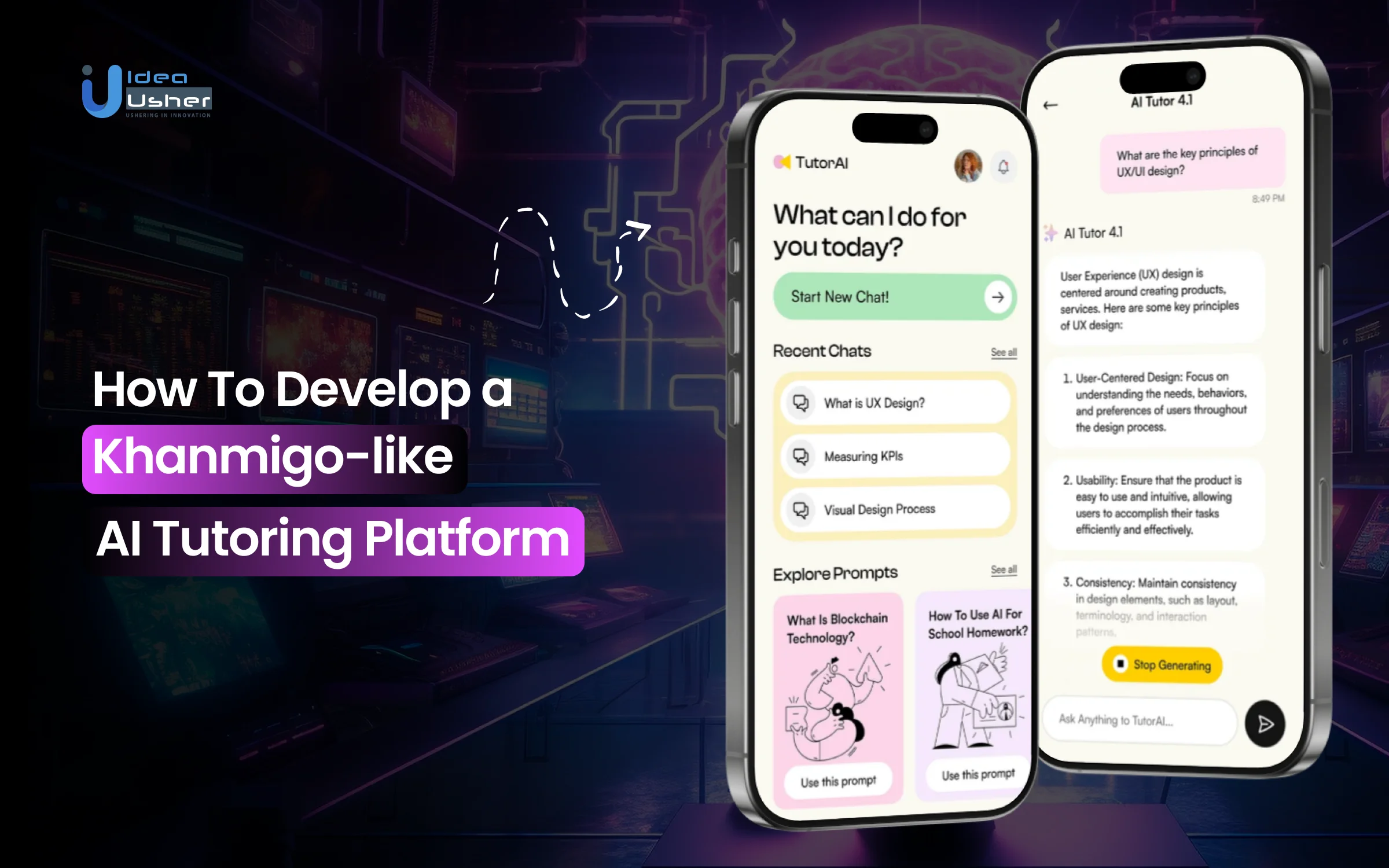
Students today require more support, yet teachers and parents often cannot provide consistent, personalized guidance outside the classroom. Homework, concept clarification, and exam preparation can be overwhelming. This has fueled demand for a Khanmigo-like AI Tutoring Platform that engages learners in natural conversation, provides step-by-step guidance, and delivers tailored explanations whenever students need help, anytime, anywhere.
Modern AI tutoring platforms show the power of conversational AI, adaptive models, and curriculum-aware reasoning. They break down complex concepts, ask guiding questions, identify misunderstandings early, and adjust explanations to each learner’s pace. This personalized, interactive approach creates a supportive learning environment often missing in traditional education.
In this guide, we’ll explore how to develop an AI tutoring platform similar to Khanmigo and the essential features it requires. IdeaUsher helps multiple enterprises build and launch their AI solutions to market and has the expertise to develop a scalable AI tutor that truly supports students.

What is an AI Tutoring Platform, Khanmigo?
A Khanmigo-like AI tutoring platform is an intelligent, adaptive learning system that leverages artificial intelligence, natural language processing, and generative models to provide personalized tutoring, real-time feedback, and multi-subject guidance. It simulates a human tutor, offering interactive Q&A, Socratic questioning, and content recommendations tailored to each student’s learning pace and performance.
The platform is a scalable, tech-driven education solution that reduces traditional instruction, improves learning outcomes, and provides analytics for educators and institutions. Its AI personalization and automation boost engagement, deliver measurable results, and offer monetization opportunities in both markets.
- Generative AI tutoring with multi-turn reasoning for interactive, human-like guidance
- Socratic questioning to promote critical thinking rather than just providing answers
- Real-time adaptive feedback on essays, coding exercises, and practice questions
- AI-driven content recommendations tailored to each learner’s progress and engagement
- Educator support tools like AI-assisted lesson hooks, quiz generation, and intervention insights
Business Model:
This dual-segment approach helps Khanmigo serve both the direct-to-consumer (D2C) and business/education-institution segments, increasing reach and flexibility.
- Khanmigo serves individual learners and parents for home use, as well as schools, districts, and educators for institutional adoption.
- For teachers and educators, the platform is offered free of charge through partnerships, such as support from Microsoft, which covers AI operational costs.
- Students and parents access Khanmigo via a subscription model, allowing the platform to monetize direct consumer usage.
Revenue Model:
Khanmigo earns revenue through student and parent subscriptions while providing free access to educators, combining direct-to-consumer monetization with strategic partnerships.
- Individual learners or parents can access Khanmigo’s AI tutoring features for $4 per month or $44 per year.
- The subscription provides full access to 24/7 AI tutoring, writing assistance, and integration with Khan Academy’s content library.
- There are no tiered plans or per-use fees. A simple, low-cost recurring subscription gives unlimited access within licensing and geographic limits.
How a Khanmigo-like AI Tutoring Platform Works?
A Khanmigo-like AI tutoring platform uses advanced artificial intelligence to provide personalized, adaptive, and interactive learning experiences for students across multiple subjects. Here is the step-by-step working process:

1. Student Interaction & Input
Students use various methods to interact with the platform, including text, essays, coding, multiple-choice, or audio/video submissions. Multi-modal parsers convert these inputs into formats like tokenized text or JSON for AI processing.
2. Content Understanding & Analysis
The platform uses models like BERT or GPT to analyze text and extract meaning. OCR with CNN converts handwritten submissions into machine-readable text. Coding exercises run in sandboxed environments, and the ASR (automatic speech recognition) system transcribes audio responses, capturing fluency and prosody.
3. Assessment & Evaluation
AI grading engines combine multiple techniques to evaluate student work:
- Rule-based systems assess objective answers using deterministic answer key matching.
- Machine learning models score subjective responses like essays or coding exercises using regression and classification algorithms trained on human-graded examples.
- Dynamic rubric generation creates weighted scoring criteria for novel or creative questions, allowing partial credit through probabilistic scoring and confidence intervals.
4. Personalized Feedback
Once the evaluation is complete, the platform offers real-time, personalized feedback with hints, corrections, explanations, and improvement suggestions. This helps students understand mistakes, reinforce learning, and develop problem-solving skills.
5. Knowledge Mapping & Adaptive Learning
The platform uses graph neural networks and ontology mapping to compare student responses against curriculum knowledge. It employs Bayesian inference, fuzzy logic, and pattern recognition to determine mastery, misconceptions, and gaps. This supports adaptive learning and personalized remediation.
6. Progress Tracking & Analytics
The system tracks student performance, engagement, and learning trends. Teachers and parents view dashboards with insights to identify strengths, weaknesses, and progress. Predictive analytics suggest next steps or interventions to improve learning outcomes.
7. Educator Review & Resource Integration
Educators review AI evaluations, adjust scores, and add guidance, while the platform integrates assessments with lessons, exercises, and practice materials. This ensures accurate scoring, ongoing model improvement, and easy access to relevant learning resources for students.
Why 77% Student Adoption of AI Tutoring Signals a High-Growth Market Opportunity?
The global AI tutors market size was estimated at USD 1.63 billion in 2024 and is projected to reach USD 7.99 billion by 2030, growing at a CAGR of 30.5% from 2025 to 2030. This nearly 5x growth trajectory reflects unprecedented demand from students, parents, and educational institutions seeking personalized, scalable learning solutions.

Usage of generative AI among students aged 13 to 18 has surged from 37.1% in 2023 to 77.1% in 2024, a 108% year-over-year jump that shows how quickly young learners are adopting AI-powered education tools.
A. Proven Academic Impact Driving Institutional Adoption
AI tutoring platforms are gaining popularity and delivering results justifying investment. Educational institutions and policymakers see AI-powered personalized learning as a fundamental shift in scalable education.
- Studies on AI-powered Intelligent Tutoring Systems show a 37.2% improvement in academic performance and an 18.6% boost in learning outcomes compared to traditional instruction, offering strong ROI for institutions adopting AI.
- McKinsey finds that AI integration allows teachers to reallocate 20–30% of their time, freeing 10–15 hours per week for higher-value student support instead of administrative work.
- Institutions report an 83% student satisfaction rate in courses using AI learning tools, signaling strong product–market fit and lower risk of disengagement or churn.
B. Enterprise Investment Validates Long-Term Opportunity
The AI tutoring opportunity extends far beyond K-12 education, with massive corporate investment validating multiple revenue streams and demonstrating that demand spans across educational segments and professional development markets.
- Macmillan Learning’s AI Tutor has processed over 2 million student interactions, with surveys showing higher confidence, better problem-solving, and stronger engagement, demonstrating that AI tutoring scales effectively.
- Accenture’s commitment of over $1 billion a year to learning and its acquisition of Udacity highlight the accelerating enterprise demand for AI-powered education and upskilling.
- PwC found that 70% of CEOs expect generative AI to transform their business, reinforcing strong investment momentum in AI-driven learning and training platforms.
The rapid adoption of AI tutoring by students, coupled with proven academic gains and strong enterprise investment, highlights a high-growth market opportunity. Personalized learning, measurable outcomes, and scalable solutions position AI tutoring platforms as essential tools for the future of education.
Benefits of a Khanmigo-like AI Tutoring App
A Khanmigo-like AI tutoring app enhances learning outcomes with personalized, on-demand support while helping education providers scale high-quality instruction efficiently. It delivers smarter engagement, deeper insights, and a more adaptive learning experience for all users.

A. For Users (Students, Parents, Educators)
Users gain personalized tutoring, instant feedback, and interactive learning experiences that strengthen understanding, boost confidence, and improve overall academic performance.
- Personalized, Always-Available Tutoring: Learners receive 24/7 support tailored to their skill level, pace, and learning style, helping them master concepts without scheduling constraints or expensive human tutoring.
- Step-by-Step Concept Clarity: The tutor breaks down problems, provides hints, and uses reasoning-based explanations, making complex subjects easier to understand and reducing student frustration.
- More Engaging Learning Experience: Conversational guidance, interactive prompts, and adaptive challenges create a more engaging environment that keeps learners motivated and confident.
- Instant Feedback and Real-Time Correction: Students receive immediate evaluation and constructive feedback, which accelerates improvement and helps them fix misunderstandings at the moment they occur.
- Support for Multiple Learning Styles: Text, voice, diagrams, writing help, and interactive exercises ensure students can learn in ways that match their strengths and preferences.
- Improved Teacher Productivity: Educators get tools for lesson planning, feedback assistance, and classroom support, reducing administrative tasks and allowing more time for meaningful instruction.
B. For Businesses (EdTech Platforms, Schools, Enterprises)
Businesses benefit from scalable tutoring, higher engagement, and new revenue opportunities powered by data-driven insights and AI-enabled learning efficiency.
- Scalable Tutoring at Low Cost: AI tutors deliver consistent, high-quality instruction to thousands of learners simultaneously, reducing reliance on large tutoring teams and significantly lowering operational costs.
- High User Retention and Engagement: Adaptive, personalized learning increases time spent on the platform, boosting retention rates and overall user satisfaction.
- Strong Competitive Differentiation: Offering AI-driven tutoring sets the platform apart from traditional EdTech products, attracting both institutions and consumers seeking modern learning solutions.
- Data-Driven Insights and Analytics: The system captures deep learning behavior data, enabling businesses to understand user progress, personalize offerings, and build new premium features.
- Opportunities for Subscription Revenue: AI tutoring features can be monetized through subscription tiers, bundled services, or institutional licensing, driving predictable recurring revenue.
- Faster Growth in New Markets: AI-driven learning tools open opportunities in homeschooling, global education, upskilling, and microlearning markets where users expect accessible and affordable support.
- Reduced Customer Support Burden: Real-time tutoring reduces the volume of learner support queries, lowering service costs and improving operational efficiency.
Key Features Required in a Khanmigo-like AI Tutoring Platform
A Khanmigo-like AI tutoring platform should offer personalized learning, real-time AI guidance, and multi-subject support to enhance student outcomes. These features ensure scalable, effective, and engaging learning experiences.

1. Personalized Learning Paths
An AI tutoring platform must provide AI-driven adaptive learning paths that adjust to student performance and learning style. Using generative AI suggestions and real-time progress analysis, the system ensures each student receives content tailored to their knowledge level and learning pace.
2. Multi-Subject Support
The platform should cover multiple subjects including math, science, coding, and humanities. AI conversational tutoring and domain-specific knowledge graphs allow accurate guidance across diverse topics while maintaining curriculum alignment for consistent learning outcomes.
3. Interactive Q&A & Socratic Guidance
A core feature is interactive Q&A where AI uses generative models for Socratic-style questioning to promote critical thinking. Instead of giving direct answers, the platform guides students with hints and probing questions, improving problem-solving and conceptual understanding.
4. Real-Time Feedback
Immediate evaluation of essays, coding exercises, and practice questions is essential. By leveraging AI-powered evaluation and automated scoring models, the platform delivers actionable feedback, explanations, and suggestions that help students correct mistakes efficiently.
5. Educator Tools & Automation
Teachers benefit from AI-assisted lesson hooks, quiz suggestions, rubric generation, and targeted intervention recommendations. AI algorithms analyze student data to recommend interventions while reducing teacher workload, allowing educators to focus on high-value instructional activities.
6. Progress Tracking & Analytics
Comprehensive dashboards track student engagement, learning gaps, and performance trends. AI predictive models and knowledge tracing help both students and educators identify areas for improvement and plan personalized study paths.
7. Multi-Modal Support
To handle diverse assignments, the platform must process text, images, audio, and code submissions. AI-powered multi-modal analysis and tokenization pipelines enable accurate evaluation and guidance across multiple content types.
8. Safety & Moderation
AI moderation and ethical content filters ensure age-appropriate interactions and prevent exposure to inappropriate content, maintaining a safe learning environment while adhering to compliance standards.
9. Gamification & Motivation
Incorporating points, badges, and progress streaks enhances engagement. AI-driven adaptive gamification encourages consistent learning, reinforces concepts, and makes the educational experience interactive without compromising content rigor.
10. Collaboration & Peer Learning
The platform should enable group exercises, discussion forums, and AI-guided study sessions. AI-assisted collaboration algorithms enhance peer interaction, knowledge sharing, and social learning while tracking individual contributions for assessment.
How To Develop a Khanmigo-like AI Tutoring Platform
Developing a Khanmigo-like AI tutoring platform involves combining adaptive AI algorithms, multi-modal content processing, AI-driven personalization, and personalized learning pathways. Our developers typically follow a structured process to build an engaging, efficient, and effective learning experience.

1. Consultation
We begin with a detailed consultation to understand your learning goals, user segments, and product vision. Our team aligns on required tutoring capabilities, content structure, and desired AI personalization depth to ensure the platform supports effective, adaptive learning experiences from day one while defining the initial AI workflow parameters.
2. Requirements & Feature Planning
We translate your goals into clear functional requirements and define the core tutoring features. This includes outlining interaction flows, content types, assessment needs, and AI-driven personalization logic while ensuring the system delivers scalable, high-quality tutoring outcomes supported by stable AI behavior specifications.
3. UI/UX Design
Our designers craft intuitive user journeys for students, educators, and parents. We focus on conversational clarity, accessible design, and structured guidance to support engaging, distraction-free learning interactions guided by AI conversational UI models.
4. AI Tutoring Logic & Behavior Design
We design the tutoring logic that shapes how the AI evaluates understanding, asks questions, and delivers hints. This includes defining reasoning patterns, scaffolding strategies, and feedback styles so the system delivers human-like, pedagogically sound guidance, reinforced by a well-structured AI reasoning engine blueprint.
5. Curriculum Mapping & Content Integration
Our team maps your curriculum or subject framework into structured learning units. We organize lessons, practice tasks, and concept scaffolding so the AI can deliver context-aware, adaptive assistance tailored to each learner’s progress, supported by clean content-tagging and knowledge-mapping structures.
6. Assessment & Feedback Framework
We build the rules and logic that allow the platform to evaluate student responses and provide actionable feedback. This includes designing formative checks, targeted hints, and reflective prompts to deliver meaningful, improvement-focused support, powered by AI evaluation models and response analysis flows.
7. AI Safety, Guardrails & Bias Controls
We implement behavioral guardrails to ensure the tutor stays aligned with educational intent. Our developers add AI moderation, safety constraints, content filters, and bias-mitigation layers so the platform remains accurate, age-appropriate, and responsible across use cases.
8. Pilot Testing & Iterative Refinement
We conduct controlled pilot testing with real learners and educators to evaluate tutoring quality, engagement, and clarity. Feedback is used to refine interactions, improve explanations, and strengthen learning effectiveness with monitored AI performance and adaptive feedback loops before full release.
9. Deployment & Ongoing Optimization
We prepare the platform for live use with monitoring tools and continuous improvement workflows. Our developers track usage patterns, refine the AI tutoring logic, and enhance features so the system remains reliable, adaptive, and future-proof over time using structured post-deployment optimization cycles.
Cost to Build a Khanmigo-like AI Tutoring Platform
Building a Khanmigo-like AI tutoring platform requires investment in AI model development, multi-modal processing, and scalable cloud infrastructure. The total cost depends on feature complexity, integration needs, and the level of personalization required for the learning experience.
| Development Phase | Description | Estimated Cost |
| Consultation | Initial discovery, requirement gathering, and defining core tutoring goals. | $5,000 – $10,000 |
| UX/UI & Interaction Design | Designing user journeys, conversational flows, and intuitive dashboards. | $7,000 – $12,000 |
| AI Tutoring Logic & Behavior Design | Structuring reasoning logic, dialogue patterns, and adaptive behaviors. | $16,000 – $32,000 |
| Curriculum Mapping & Content Integration | Organizing subjects, tagging content, and aligning learning paths. | $10,000 – $14,000 |
| Assessment & Feedback Engine Development | Building evaluation rules, hint logic, and response analysis. | $12,000 – $16,000 |
| AI Safety, Testing & Guardrails | Implementing safety filters, bias controls, and monitored testing. | $8,000 – $12,000 |
| Pilot Launch & Iterative Refinement | Running pilots, collecting feedback, and refining explanations. | $8,000 – $16,000 |
| Deployment & Ongoing Optimization | Deploying the platform, optimizing performance, and enhancing features. | $15,000 – $24,000 |
Total Estimated Cost: $64,000 – $128,000
Note: Costs may shift based on platform complexity, personalization depth, curriculum volume, and required safety layers. Additional customization and long-term AI refinement can also influence the final investment.
Consult with IdeaUsher to receive a tailored cost estimate and a full roadmap for building a scalable, high-performing AI tutoring platform aligned with your educational vision.
Cost-Affecting Factors to Consider
Building a Khanmigo-like AI tutoring platform depends on AI development, content processing, and personalized learning, with costs driven by scalability, integration, and maintenance.
1. Complexity of AI Tutoring Logic
More advanced reasoning, adaptive behaviors, and feedback mechanisms require deeper development effort, increasing cost due to expanded logic design and iterative refinement cycles.
2. Depth of Personalization
Highly individualized learning paths, dynamic difficulty adjustments, and tailored responses require additional data structuring and adaptive frameworks, raising development complexity and cost.
3. Volume and Structure of Learning Content
Large curriculum sets, diverse subjects, and detailed content tagging increase mapping time and integration efforts, influencing the budget for content organization and alignment.
4. Required Assessment Capabilities
Automated grading, hint generation, formative checks, and feedback analysis add significant logic and testing requirements, impacting development investment and QA timelines.
5. Safety, Compliance, and User Protection
Robust safety filters, privacy controls, and compliance with educational standards increase technical workload, affecting both development cost and ongoing maintenance.
6. UI and Interaction Design
Intuitive interfaces, accessible layouts, and structured conversational flows require thoughtful design and testing, directly impacting the design budget for a seamless experience.
7. Integration Requirements
Connecting with LMS platforms, authentication systems, or external tools increases development effort and coordination, affecting overall integration costs.
Challenges & Solutions During AI Tutoring App Development
Developing an AI tutoring app comes with challenges around data accuracy, model reliability, personalization, and user trust. Addressing these issues with the right technical strategies ensures a scalable, compliant, and high-performing learning platform.
1. Ensuring Pedagogical Accuracy
Challenge: AI tutors risk giving partially correct explanations that miss essential reasoning steps, reducing instructional reliability and weakening overall learning clarity.
Solution: We build a pedagogical logic layer, validate explanations with experts, and run continuous accuracy reviews so the system delivers dependable, structured reasoning that consistently aligns with real curriculum expectations.
2. Maintaining Safe and Responsible AI Behavior
Challenge: AI responses can drift into unsafe or irrelevant territory without proper behavioral limits, reducing trust and creating content integrity concerns.
Solution: We implement strong safety filters, behavioral guidelines, and active monitoring tools that keep conversations focused, age-appropriate, and aligned with your educational intent across every interaction.
3. Handling Complex, Multi-Step Queries
Challenge: Students ask multi-layered questions that require contextual understanding, which simple models struggle to interpret with sustained reasoning continuity.
Solution: We create a multi-turn reasoning engine that retains context, asks clarifying questions, and breaks problems into structured steps, so learners receive helpful and logically connected responses.
4. Ensuring Bias-Free Assessments and Feedback
Challenge: Training data may contain subtle patterns that introduce unintended bias, affecting how feedback is generated for different learners.
Solution: We use fairness checks, bias evaluation pipelines, and refined datasets to ensure the AI delivers equitable assessments and consistent guidance to every student.
Idea Usher’s Proven EdTech Expertise: The AcceleratedX
Idea Usher successfully built and launched AcceleratedX, a comprehensive EdTech platform, delivering mobile apps (iOS & Android) and a web solution in just six months. The platform combines intuitive design, scalable architecture, and subtle AI-driven personalization, providing an engaging, learner-focused experience that adapts to individual progress and content preferences.

- We collaborated with the client to define user personas, craft empathy maps, and design intuitive user flows before development, ensuring seamless navigation and engagement.
- AI-powered personalization suggests relevant content, tracks student progress, and delivers adaptive learning paths for each learner. It also provides smart recommendations, performance analytics, and content prioritization based on engagement and learning patterns.
- The platform includes video lessons, real-time chats and interactive sessions, social features like user following and messaging, and premium resources (PDFs, downloadable videos, and curated playlists).
- By combining UX design, scalable architecture, and content-rich features, Idea Usher delivered a flexible, engaging, and practical learning ecosystem ready for the market.
This project demonstrates that Idea Usher not only builds EdTech platforms but also integrates AI to enhance engagement, personalization, and student outcomes.
Conclusion
Building a Khanmigo-like AI Tutoring Platform opens the door to a more personalized, engaging, and adaptive learning experience for students across different age groups. By combining strong pedagogical models with advanced AI capabilities, you can deliver tutoring that feels interactive and supportive. As you plan your platform, the focus should remain on accuracy, safety, and scalable learning features that truly help users grow. With the right strategy and development approach, you can create an AI tutoring solution that consistently improves learner outcomes and supports long-term educational impact.
Why Choose IdeaUsher To Develop an AI Tutoring Platform?
At IdeaUsher, we specialize in building conversational AI systems, personalized learning engines, and intelligent education products. Our team develops tutoring platforms that adapt to each learner, provide real-time coaching, and offer secure and scalable AI-powered instruction.
Why Work With Us?
- AI Chat, NLP, and Reasoning Models: We design multi-turn AI tutors that provide accurate explanations and interactive, subject-specific guidance.
- Custom Learning Intelligence: We build personalized learning paths, analytics dashboards, and domain-tuned AI models for enhanced student progress tracking.
- Proven Automation & Education Experience: We leverage AI-based automation, workflow systems, and digital learning expertise to create effective tutoring platforms.
- Secure, Compliant, Scalable Development: We ensure FERPA-aligned data handling, secure cloud infrastructure, and architectures that support thousands of concurrent learners.
Explore our portfolio to see how we have helped organizations build innovative AI and education products.
Reach out today for a free consultation, and let us help you bring your Khanmigo-like AI Tutoring Platform to market with confidence.


FAQs
Developing such a platform requires a conversational AI engine, curriculum mapping tools, embeddings-based personalization, secure user management, and real-time content delivery. Strong NLP models and a structured learning flow are essential for adaptive tutoring and meaningful student interactions.
Training involves mapping content to learning outcomes, creating knowledge embeddings, and fine-tuning models on subject-specific data. The system learns to detect gaps, adjust difficulty, and deliver contextual tutoring based on individual student progress.
An AI tutor personalizes learning by assessing user behavior, analyzing performance data, and tailoring content to individual needs. It recommends lessons, adjusts difficulty levels, and provides instant support to ensure each student progresses at a comfortable and effective pace.
A suitable stack includes Python, LangChain, LLM APIs, vector databases, and cloud platforms for deployment. React or Next.js works well for student dashboards, while Node or Python handles backend interactions, data flows, and authentication.


