


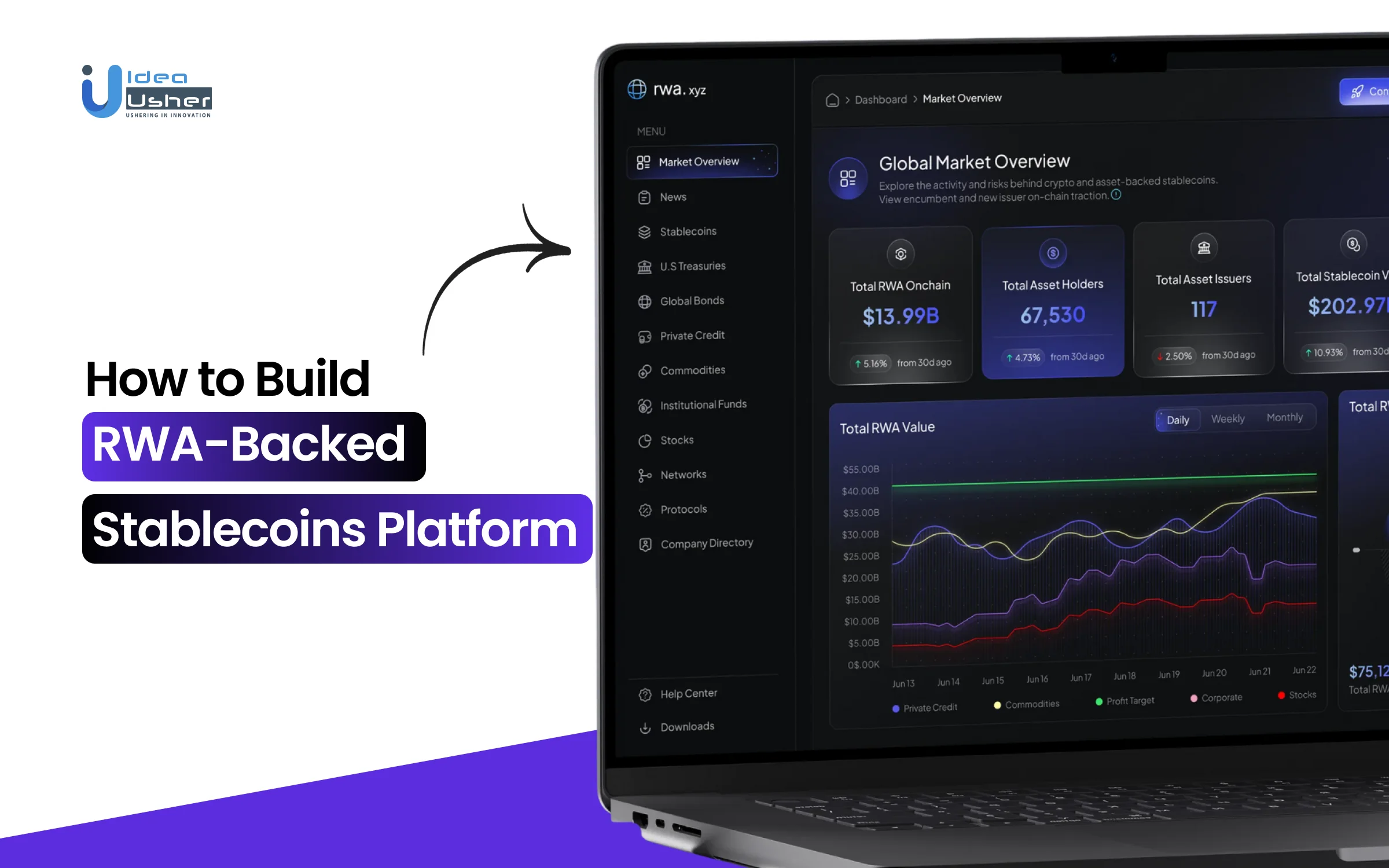
Stablecoins are vital in modern crypto markets, yet many still lack trust, transparency, and solid backing. Users increasingly want assets that hold value without relying on fragile algorithms or opaque reserves. This demand is driving interest in a security-backed stablecoin, where tokens are supported by real-world assets (RWAs) like bonds, treasury bills, or regulated securities to ensure stability and credibility.
RWA-backed stablecoins combine blockchain infrastructure with traditional finance assets, enabling issuers to create dependable, auditable tokens. Smart contracts manage reserves, redemptions, interest, and compliance, while secure custody protects assets. This model offers transparency for users and regulatory standards support for businesses seeking to issue trustworthy, scalable digital currencies within institutional frameworks.
In this guide, we’ll explore the steps to building stablecoins backed by verifiable assets, how RWA-backed stablecoins work, and the required regulations. IdeaUsher brings expertise in regulated token issuance, backed by experience launching multiple blockchain solutions across the market.

What Are RWA-Backed Stablecoins?
RWA-backed stablecoins are digital coins whose value is anchored to real-world assets (RWAs) such as cash, government bonds, real estate, or other tangible financial instruments. Unlike crypto-backed stablecoins, these tokens rely on off-chain assets to maintain stability and preserve their target price.
By blending the reliability of traditional assets with the speed and accessibility of blockchain, RWA-backed stablecoins aim to deliver lower volatility and higher confidence for users. They also introduce unique advantages, such as:
- Access to traditional asset exposure through digital tokens
- Potential for greater transparency via on-chain reporting and third-party attestations
- Improved capital efficiency for institutions using tokenized real-world collateral
- More resilient price stability due to backing from regulated, liquid assets
- Easier integration into compliance-focused financial products and payment rails
How RWA-Backed Stablecoins Maintain Their Value?
RWA-backed stablecoins maintain their value by tying each token to verifiable, yield-bearing real-world assets, ensuring price stability through transparent collateralization and regulated asset management.
1. Real-World Asset Backing & Reserve Collateral
RWA-backed stablecoins stay stable because every token in circulation corresponds to an equivalent amount of real-world collateral such as cash, Treasury bills, or high-quality bonds, held by the issuer.
Example: If a stablecoin targets $1, the issuer holds $1 in real assets for every token issued.
2. Reserve Management & Independent Audits
The backing assets are stored with regulated custodians or trust institutions, reducing operational risk. Issuers often publish regular attestations or audits to show that the value of the reserves matches the number of tokens in circulation, reinforcing user confidence.
3. Redemption Mechanisms & Price Stability
Stablecoins maintain their peg through the ability to redeem tokens for fiat or equivalent asset value.
- If the price dips below $1, arbitrageurs buy the token at a discount and redeem it for $1, pushing the market price back up.
- If the price rises above $1, new tokens are minted against fresh deposits, increasing supply and pulling the price back toward the peg.
4. Liquid Collateral for Long-Term Stability
Because reserves mainly involve liquid, low-volatility assets (like short-term government securities), the issuer can reliably meet redemption requests. This liquidity reassures the market, helping the stablecoin stay close to its value even during volatility.
RWA-Backed vs. Algorithmic vs. Crypto-Collateralized Stablecoins
Understanding how different stablecoin models work is essential for evaluating risk and stability. This quick comparison highlights what matters most to investors when choosing between leading stablecoin types.
| Stablecoin Type | What Backs It | Stability Strength | Key Risks | Investor Takeaways |
| RWA-Backed | Real-world assets (cash, T-bills, bonds) | Strong — value anchored to regulated, tangible assets | Custody concentration, regulatory changes | Viewed as the most stable and transparent option; appealing for risk-averse users and institutions. |
| Crypto-Collateralized | Other cryptocurrencies locked as collateral | Moderate — stability tied to crypto market conditions | Market volatility, collateral drawdowns | Attractive for decentralization-focused investors; less stable during crypto downturns. |
| Algorithmic | Algorithms + market incentives (no real collateral) | Weak to Moderate — depends on market confidence | Depegging events, liquidity spirals | Offers capital efficiency but carries higher uncertainty; suited only for investors with high risk tolerance. |
How RWA-Backed Stablecoins Work?
RWA-backed stablecoins are digital tokens pegged to fiat or commodities and fully collateralized by tangible assets in regulated custody. Unlike algorithmic models, they maintain stability through verifiable reserves across their lifecycle.
1. Asset Custody & Reserve Management
The issuer deposits real-world assets like Treasury bills, money market funds, bonds, cash, or commodities with regulated custodians in segregated accounts, where compliance is ensured through audits, insurance, and oversight.
Example:
“AssetStable” (RWA-backed stablecoin issuer) maintains reserves with Bank of New York Mellon and Coinbase Custody. Reserve allocation: 80% US Treasury bills (1-3 month maturity), 15% overnight reverse repos, 5% FDIC-insured cash.
Total reserves: $2.4B backing 2.4B tokens (1:1 ratio). Assets held in segregated trust accounts protected from issuer’s creditors. Custodians provide daily confirmations, monthly statements, quarterly audits by Grant Thornton ($180K annually).
2. Token Minting & Collateralization Logic
Authorized participants transfer fiat or approved assets to custodial accounts, triggering smart contracts to mint tokens 1:1. Only KYC/AML-verified entities can mint, ensuring supply never exceeds reserve value.
Example:
“GlobalPay” wires $10M to Bank of New York Mellon custodial account. Bank confirms receipt within 4 hours. AssetStable’s compliance team approves minting request (verifying KYC, AML, authorized participant status). Smart contract on Ethereum receives minting instruction signed by 3-of-5 multi-sig wallet.
Contract mints 10M tokens, transfers to GlobalPay’s wallet within 8 minutes. On-chain record links minting transaction to custodial deposit. Total supply increases from 2.4B to 2.41B tokens.
3. Peg Stability Mechanisms
The stablecoin maintains its peg through redemption guarantees and arbitrage: buy below $1 or mint above $1. Third-party attestations ensure reserves consistently match circulating supply.
Example:
When AssetStable trades at $0.985 on DEXs (1.5% below peg), arbitrageur “AlphaFund” buys 5M tokens for $4.925M. Submits redemption request—AssetStable verifies identity, processes within 24 hours (T+1 policy). Burns 5M tokens, transfers $5M from Treasury bill sales to AlphaFund’s bank.
AlphaFund profits $75K from arbitrage. Redemption pressure reduces supply, returning price to $1.00. When trading above peg at $1.012, participants mint at $1, sell at a premium, increasing supply until normalized. Monthly attestation shows $2.405B reserves backing 2.405B tokens (100.2% collateralization).
4. On-Chain Transparency & Reporting
The platform provides real-time proof-of-reserves via oracles, showing asset composition and custody data. Public dashboards detail holdings and maturities, while independent auditors perform regular attestations for transparency.
Example:
AssetStable’s dashboard updates hourly: $2.405B reserves, 2.405B tokens, 100.2% collateralization. Breakdown: $1.92B US Treasuries (CUSIP listed), $361M reverse repos, $124M cash. Chainlink oracles feed custody data every 60 minutes from Bank of New York Mellon’s API.
Smart contract stores merkle root of reserve data, verifiable via blockchain. Grant Thornton publishes monthly attestations within 15 days (last: “$2.381B reserves exceeded $2.375B liabilities”). Historical data access since launch builds trust and 0.15% premium over algorithmic competitors.
5. Redemption & Liquidity Management
Token holders redeem stablecoins through issuer verification, triggering asset liquidation and token burning for large withdrawals. Retail users trade on markets, institutions redeem directly, and issuers maintain reserves for demand spikes.
Example:
“RetailCorp” redeems 50M AssetStable tokens ($50M) for quarter-end cash via institutional portal. AssetStable verifies the signatory and KYC. Processes T+1 (24-hour settlement). Asset manager liquidates $50M Treasuries at 0.02% discount. Transfers $49.99M to bank (minus $10K fee).
Smart contract burns 50M tokens, updating supply from 2.405B to 2.355B. Retail user holding $5,000 swaps on Uniswap for USDC (0.05% fee), secondary market provides instant liquidity. AssetStable maintains $150M liquid buffer for redemption surges.
Why the $26B Stablecoin Boom Is a Major Opportunity for RWA-Backed Stablecoins?
The global stablecoins DeFi market was valued at US$2.52 billion in 2024 and is projected to reach US$34.3 billion by 2030, growing at a strong 54.5% CAGR. This rapid expansion shows that stablecoins are evolving into essential digital financial infrastructure.

Stablecoins are expected to save businesses $26 billion globally by 2028, with stablecoin payments projected to grow by 250%, accounting for 73% of all transaction values in the stablecoin ecosystem. This accelerating adoption highlights a prime opportunity for launching innovative, RWA-backed stablecoin products.
Why This Is a Prime Moment for RWA-Backed Stablecoins?
As global demand for efficient, cost-effective financial infrastructure grows, RWA-backed stablecoins emerge as a key product. They combine on-chain utility with real-world yield and trusted standards, appealing in a fast-growing market.
- The tokenized real-world asset market grew 308% in three years, reaching $24B, showing strong demand for on-chain, asset-backed instruments.
- Tokenized U.S. Treasuries increased 539%, from $800M to $5.5B, reflecting rising institutional appetite for stable, yield-generating RWAs.
- Nearly 70% of the asset tokenization market in 2024 came from institutional investors, strengthening overall market credibility.
- Stablecoin transfers reached $27.6T, surpassing Visa and Mastercard’s combined volume by 7.68%, proving real-world utility and usage.
How Market Momentum Is Creating Space for New RWA-Backed Stablecoins?
Early entrants in the RWA-backed stablecoin market can gain an edge before saturation as adoption grows in finance, real estate, and payments. The next phase will emphasize transparency, yield, compliance, and collateralization, making early entry crucial.
- Global stablecoin usage is accelerating, with transaction volume up 83% YoY to over $4T, expanding use across B2B, remittances, and fintech products.
- Real estate adoption is rising, with 58% of global real estate firms piloting or implementing tokenization and opening new high-value market channels.
- RWA-backed models deliver major efficiencies, as blockchain-based bond issuance can cut middle- and back-office costs by 85%, proving strong operational savings.
- Institutional-grade RWA markets are scaling fast, with tokenized U.S. Treasuries reaching $7.3B and increasing 256% YoY, showing rapid institutional adoption.
- Stablecoin remittances can reduce transfer costs by 50%, unlocking more than $41B in potential global savings.
Types of Real-World Assets Used to Back Stablecoins
Stablecoins rely on real-world asset (RWA) collateral to maintain value, stability, and investor trust across global markets. Understanding the different asset types used in these reserves helps identify how securely and efficiently each stablecoin is backed.

1. Short-Term Treasury Bills
Short-term treasury bills are highly liquid and backed by government credit, offering strong stability and low default risk. Their predictable yield makes them ideal for maintaining a stablecoin’s collateral strength and supporting consistent reserve value.
Example: USDC (Circle): Circle holds approximately 80% of USDC reserves in short-term U.S. Treasury bills, totaling over $28 billion in government securities, ensuring maximum stability and regulatory compliance for institutional adoption.
2. Corporate Bonds
High-grade corporate bonds provide stronger yield generation compared to government securities while maintaining moderate risk. Their steady interest returns help improve reserve performance, although liquidity varies by issuer and rating.
Example: TrueUSD (TUSD): Maintains a diversified reserve including investment-grade corporate bonds from Fortune 500 companies, balancing yield generation with capital preservation for its $2+ billion in circulation.
3. Cash Deposits
Cash deposits offer maximum liquidity and near-zero volatility, making them essential for meeting rapid redemption requests. While yields are typically lower, their stability keeps the reserve base highly secure.
Example: USDC (Circle): Maintains approximately 20% of reserves ($7+ billion) in cash deposits at regulated U.S. banks including BNY Mellon, Customers Bank, and Silvergate, ensuring immediate liquidity for redemptions.
4. Commodities such as Gold or Metals
Commodities like gold provide long-term value stability and act as an inflation hedge. Though less liquid than cash or T-bills, they strengthen reserve diversification and reduce exposure to traditional financial markets.
Example: Tether Gold (XAUt): Backed 1:1 by physical gold held in Swiss vaults, with each token representing one troy ounce. Over $600 million in gold reserves provide inflation-hedged stability for holders seeking commodity-backed digital assets.
5. Real-World Receivables or Invoices
Tokenized receivables deliver attractive yield potential through short-term repayments from verified borrowers. These assets introduce moderate risk but offer higher returns, making them suitable for balanced reserve portfolios seeking active yield generation.
Example: Ondo Finance USDY: Backs its yield-bearing stablecoin with tokenized short-duration U.S. Treasuries and investment-grade credit instruments including trade receivables, generating 4-5% APY for holders while maintaining stability.
6. Money Market Instruments
Money market products provide strong liquidity, low risk, and reliable yields, making them one of the most efficient collateral types. They offer an ideal combination of capital preservation and short-term income for stablecoin reserves.
Example: Franklin Templeton BENJI: The Franklin OnChain U.S. Government Money Fund (BENJI) with $400+ million AUM backs emerging stablecoins with diversified money market instruments, offering daily liquidity and government security.
Key Features Required in an RWA-Backed Stablecoin Platform
A robust RWA-backed stablecoin platform must combine secure asset management with transparent, on-chain verification to maintain trust and price stability. These features ensure reliable liquidity, regulatory readiness, and scalable real-world asset integration for global users.

1. Real-Time Asset Collateralization Dashboard
A real-time dashboard provides a transparent view of underlying RWA reserves, allowing users to track collateral ratios and asset composition. This builds trust by ensuring every token remains consistently supported by verified, high-quality off-chain assets.
2. Automated Reserve Management System
An automated reserve engine dynamically reallocates the RWA portfolio to maintain peg stability. It optimizes exposure to low-volatility instruments, ensuring sufficient liquidity for redemptions while enhancing operational efficiency through rules-based portfolio balancing.
3. On-Chain Proof of Reserves
On-chain proofs enable cryptographic verification of asset backing, supported by frequent attestations from trusted data sources. This reduces dependency on manual reporting and strengthens confidence in the platform’s verifiable collateral integrity.
4. Multi-Asset Collateral Framework
A multi-asset structure allows collateralization using diverse RWAs such as treasuries, bonds, commodities, or tokenized real estate. This diversification strengthens risk-adjusted stability, reducing exposure to any single asset class.
5. Algorithmic Peg Stabilization Mechanism
A controlled mint and burn mechanism maintains the 1:1 peg by reacting to supply and demand imbalances. This automated system enhances market-based stability, ensuring consistent pricing even during periods of elevated volatility.
6. Regulatory Compliance and Reporting Module
Integrated AML and KYC checks ensure compliant onboarding, while real-time transaction monitoring supports regulatory alignment. Automated reporting features help platforms meet jurisdictional requirements without slowing down user flows.
7. Instant Redemption Engine
An instant redemption model enables fast, predictable conversion between the stablecoin and the underlying RWA value. This improves liquidity assurance, especially for institutional users requiring timely settlement of large transactions.
8. Third-Party Audit Integration
Direct data feeds connect custodians and issuers with independent auditors, enabling seamless attestations. This enhances external oversight, ensuring the stablecoin’s collateralization claims remain credible and continually validated.
9. Yield Distribution System
A built-in distribution module shares returns generated by RWA reserves with eligible holders. This system supports transparent and programmable yield flows, enabling stablecoin ecosystems to offer competitive, regulated income opportunities.
10. Cross-Chain Bridge Infrastructure
A secure cross-chain bridge extends the stablecoin’s utility across multiple blockchains. This increases network-level liquidity, simplifies integrations, and accelerates adoption within both DeFi protocols and institutional settlement environments.
How to Build an RWA-Backed Stablecoins Platform?
Building an RWA-backed stablecoin platform requires combining secure asset tokenization, compliant financial infrastructure, and transparent on-chain mechanics. A strong foundation ensures price stability, regulatory readiness, and seamless integration with real-world assets.

1. Consultation
We begin with a strategic consultation to define project goals, asset types, regulatory expectations, and platform scope. This stage helps us understand the RWA collateral model and design a development roadmap aligned with investor needs and compliance requirements.
2. Technical Architecture Design
Our architects create the platform blueprint, outlining smart contract modules, reserve logic, oracle connections, and custody flows. The architecture ensures scalable tokenization, secure asset mapping, and efficient integration between blockchain components and licensed financial institutions.
3. Smart Contract Development
We develop secure smart contracts that handle minting, burning, collateral checks, and peg maintenance. Each contract is built with modular logic for audits, ensuring the stablecoin performs reliably under varying market conditions and supports transparent asset-backed issuance.
4. RWA Tokenization Layer Setup
We design the tokenization layer that represents real-world assets on-chain using compliant metadata and valuation rules. This ensures each token mirrors verified off-chain assets, creating a dependable link between traditional instruments and blockchain-based collateral systems.
5. Integration of Compliance Modules
Our system integrates AML, KYC, and continuous transaction monitoring to meet jurisdictional mandates. Automated reporting tools support regulatory transparency, enabling the platform to operate confidently across different markets and ensuring smooth approvals during audits or licensing reviews.
6. Custodian and Oracle Integration
We connect the platform with regulated custodians and trusted oracles to track collateral status and market prices. These integrations enable real-time verification of reserves and ensure accurate proofs of asset value backing every stablecoin issued.
7. Frontend and Dashboard Development
We build user dashboards that display collateral ratios, reserve composition, yield flows, and transaction activity. The interface offers clear real-time insights, allowing both retail and institutional users to monitor platform performance with high transparency.
8. Security Testing and Audits
Our team performs code audits, security testing, and penetration analysis to eliminate risks before launch. External auditors validate smart contracts and reserve logic, ensuring institutional-grade safety and readiness for public deployment.
9. Launch and Monitoring
We deploy the stablecoin platform and monitor performance, liquidity, and collateral health. Continuous optimization ensures stable peg behavior, timely redemptions, and smooth platform scaling as user activity and RWA reserves grow.
10. Cross-Chain Connectivity Development
To expand adoption, we integrate cross-chain bridges that allow the stablecoin to function across multiple networks. This increases ecosystem liquidity, enabling wider DeFi integration and broader institutional support as the platform matures.
Cost to Build a RWA-Back Stablecoin Platform
The cost to build an RWA-backed stablecoin platform depends on factors like asset tokenization complexity, compliance requirements, and custom feature development. A well-planned architecture ensures cost efficiency while delivering security, scalability, and long-term reliability.
| Development Phase | Description | Estimated Cost |
| Consultation & Planning | Initial scoping, regulatory mapping, and defining the asset model. | $4,000 – $8,000 |
| Technical Architecture Design | Designing core modules, custody flows, and the system blueprint. | $12,000 – $18,000 |
| Smart Contract Development | Coding contracts for minting, burning, peg logic, and collateral checks. | $14,000 – $26,000 |
| RWA Tokenization Layer Setup | Creating on-chain models for asset representation and valuation rules. | $13,000 – $20,000 |
| Compliance & KYC/AML Integration | Implementing KYC, AML, monitoring tools, and reporting workflows. | $9,000 – $12,000 |
| Custodian & Oracle Integration | Connecting licensed custodians and real-time price oracles. | $11,000 – $16,000 |
| Frontend & Dashboard Development | Building dashboards for reserve data, ratios, and user analytics. | $8,000 – $16,000 |
| Security Testing & Audits | Internal QA, contract audits, and security validation. | $8,000 – $15,000 |
| Launch, Deployment & Monitoring | Platform deployment, monitoring, and performance optimization. | $5,000 – $10,000 |
| Cross-Chain Connectivity Development | Enabling multi-chain support for broader liquidity. | $8,000 – $10,000 |
Total Estimated Cost: $62,000 – $124,000
Note: Actual costs depend on asset complexity, scope, oracle needs, custodian partnerships, and features. Enhancements like yield modules or dashboards could raise costs.
Consult with IdeaUsher to receive a tailored estimate and a complete roadmap for building a compliant, secure, and scalable RWA-backed stablecoin platform aligned with your business goals.
Factors That Influence the Development Cost
Several key technical, regulatory, and infrastructure factors determine the development cost of an RWA-backed stablecoin platform, shaping overall budget and scalability.
1. Asset Types and Tokenization Complexity
Different RWAs such as treasuries, real estate, or commodities require unique tokenization logic, valuation models, and custodian workflows. More diverse asset classes generally demand deeper engineering and higher development budgets.
2. Smart Contract Complexity
Advanced features like peg stabilization, dynamic collateral ratios, automated yield flows, and reserve rules require sophisticated smart contracts. Greater contract complexity often leads to higher development, testing, and auditing costs.
3. Custodian and Oracle Integrations
Costs increase when integrating regulated custodians, multi-source pricing oracles, and proof-of-reserve feeds. These integrations require secure infrastructure and additional validation layers to ensure accurate real-time asset data.
4. Cross-Chain Support
Supporting multiple blockchains requires additional bridging layers, testing, and integration work. Cross-chain functionality boosts ecosystem reach but also expands the development scope and cost.
5. Security and Audit Needs
Extensive security testing, internal QA, and third-party smart contract audits increase costs but are essential. High audit rigor ensures platform safety, especially when managing tokenized real-world assets.
Why are Regulatory & Compliance Requirements Necessary?
RWA-backed stablecoins must adhere to strict regulations to ensure transparency, investor protection, and stability. Understanding these rules is vital for assessing a platform’s credibility and safety.
A. Regulations
RWA-backed stablecoin platforms must operate under strict financial and operational guidelines to ensure transparency, investor protection, and lawful asset management. These regulatory frameworks build confidence, especially among institutional participants.
- Alignment with SEC, FINMA, MAS, and FCA regulatory standards
- Full AML and KYC verification for all users
- Adherence to the Travel Rule for compliant transfer of identity information
- Mandatory custodian licensing for entities holding real-world assets
- Clear disclosure practices governed by regional digital asset legislation
B. Compliance Responsibilities
Beyond regulation, platforms must uphold ongoing compliance duties that maintain the stablecoin’s credibility, protect investors, and support liquidity during market stress.
- Transparent proof-of-reserve reporting with verifiable on-chain or off-chain data
- Regular independent audits validating asset backing and internal controls
- Robust risk management covering collateral ratios, liquidity, and counterparty exposure
- Strong investor protection measures including clear redemption rights and disclosures
- Continuous monitoring for operational integrity and regulatory changes
C. Why Compliance Matters?
Non-compliance can lead to penalties, operational shutdowns, reputational damage, or even frozen assets. Partnering with expert development teams like IdeaUsher, who understand regulatory intricacies, helps ensure safety, credibility, and long-term viability, making the platform far more attractive to serious investors.
Challenges and How to Overcome?
Building an RWA-backed stablecoin platform involves technical, regulatory, and operational challenges that can affect security and scalability. Identifying these early and applying proven solutions ensures a compliant, resilient, and high-performing ecosystem.

1. Secure Custody of Real-World Assets
Challenge: Managing secure storage of RWAs such as cash, bonds, or commodities requires trusted custodians and strict operational oversight to avoid asset risks.
Solution: We build secure custody integration frameworks that support licensed custodians chosen by the client. Our system enables multi-approval workflows, automated reconciliation, and real-time custody monitoring so assets stay protected, validated, and accurately mirrored in the stablecoin ecosystem.
2. Accurate On-Chain Proof of Reserves
Challenge: Synchronizing off-chain custodian data with on-chain records can create transparency issues if updates are delayed or improperly validated.
Solution: We integrate trusted oracle providers and automated reserve attestation systems that pull verified data at frequent intervals. This ensures each reserve update is accurate, tamper-resistant, and visible to users in real time.
3. Maintaining Peg Stability
Challenge: Market volatility or liquidity imbalance can disrupt the stablecoin’s 1:1 value if collateral updates or redemption flows are not carefully managed.
Solution: We develop algorithmic mint-burn logic, dynamic collateral ratios, and liquidity buffers. These mechanisms enable the RWA-backed stablecoin to maintain predictable value and respond quickly to changing market conditions.
4. Asset Tokenization Complexity
Challenge: Tokenizing diverse RWAs requires unique valuation rules, compliance checks, and standardized models that accurately mirror off-chain asset performance.
Solution: We design a flexible tokenization framework with customizable metadata, valuation logic, and asset identifiers. This lets us support treasuries, commodities, or receivables without compromising accuracy or regulatory requirements.
Conclusion
Building RWA-backed stablecoins requires a clear strategy that blends strong asset management, transparent governance, and secure blockchain infrastructure. As you explore this space, the goal is to create a currency that holds real value and earns user trust through verifiable asset backing. With the right architecture, compliance structure, and risk controls, it becomes possible to design stablecoins that support broader financial access and efficiency. Taking a thoughtful approach to each development step ensures your stablecoin can operate reliably and deliver long-term stability for users and institutions.
Why Choose IdeaUsher for Your RWA-Backed Stablecoin Development?
Building RWA-backed stablecoins demands deep expertise in asset tokenization, secure smart contract engineering, and strong compliance foundations. Our team specializes in creating stablecoin ecosystems backed by real assets with transparent reserve monitoring, automated auditing layers, and high-performance blockchain architecture.
Why Work With Us?
- Proven Tokenization Experience: From SALVACoin to real-asset tokenization frameworks, we have delivered platforms that ensure secure value representation and scalable asset management.
- Robust Compliance Expertise: Our team builds stablecoin systems aligned with key regulations including KYC, AML, and asset custody rules.
- Full-Stack Development: We cover everything from token design and reserve mechanisms to smart contracts, user apps, and dashboards.
- Enterprise-Grade Architecture: We create platforms designed for institutional investors, ensuring stability, transparency, and long-term operational reliability.
Explore our portfolio to see how we help businesses launch powerful blockchain and tokenization products ready for global use.
Reach out for a free consultation and let us help you build a stablecoin supported by real-world value.


FAQs
RWA-backed stablecoins can be supported by assets such as government bonds, real estate, invoices, commodities, and regulated money market instruments. These assets improve stability, liquidity, and investor trust while ensuring the token’s value is tied to real, verifiable holdings recorded on-chain.
Transparency is achieved by using on-chain proofs, automated reporting, third-party audits, and asset verification systems. These methods help users confirm collateral quality, monitor reserves in real time, and maintain confidence in the stablecoin’s backing and long-term stability.
Tokenization transforms real-world assets into digital units that can be stored, traded, or collateralized. This enables faster settlement, programmable compliance, fractional ownership, and improved liquidity while making traditional assets globally accessible within decentralized financial ecosystems.
Key risks include regulatory compliance, collateral valuation accuracy, custody security, liquidity gaps, and counterparty exposure. Addressing these factors early ensures that the stablecoin remains trustworthy, properly backed, and functional across both institutional and retail financial environments.


