

Visa platforms operate at the critical intersection of global travel, legal compliance, and automated document processing. Understanding the visa app development timeline requires looking beyond basic features to the complex logic of embassy workflows and real-time verification. Because timelines are shaped by data security and jurisdictional rules, a strategic, phased approach is essential for success.
The development process is systematically organized into distinct stages, from user onboarding to complex third-party integrations. Each component, including document handling and status tracking, must be built and tested in a rigorous sequence to ensure total reliability. The total duration depends heavily on the level of automation and the number of regions supported.
In this blog, we break down how long it takes to build a visa app like Atlys by examining development phases, key system components, and the practical factors that influence project timelines from planning to launch.
Why Visa Apps Like Atlys Are Growing Fast in 2026?
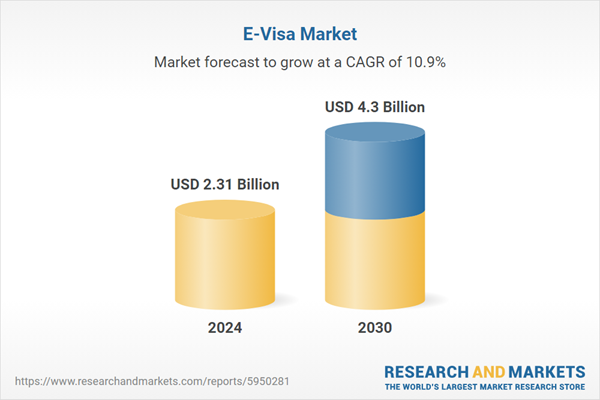
The global travel landscape has undergone a massive digital transformation. Modern travelers now prioritize efficiency, and specialized visa platforms are disrupting the market. This shift is driven by a rapidly expanding e-visa sector. It is projected to grow from USD 2.31 billion in 2024 to USD 4.30 billion by 2030 at a 10.92% CAGR.
Artificial Intelligence has transitioned from a buzzword to a core infrastructure component, specifically within the complex regulatory environment of immigration. Smart automation is now a baseline expectation for high-end digital consumers.
- Error Detection: Advanced machine learning algorithms scan applications for inconsistencies or missing data. This mimics the scrutiny of a human expert with much higher precision.
- Predictive Analytics: AI models analyze historical approval trends to give users an accurate probability of success. This data allows for better strategic travel planning decisions.
- 24/7 Support: Intelligent chatbots provide instant, accurate answers to complex regulatory questions. This reduces the need for costly human-led support while maintaining high satisfaction.
A. Shift from agents to digital visa platforms
Travelers are abandoning traditional brick-and-mortar agencies in favor of automated systems that offer real-time tracking and lower fees. This shift represents a fundamental change in how international mobility is managed today.
Digital platforms boost cost transparency, data security, and global accessibility. By replacing traditional agents with encrypted, upfront pricing models, they allow users to manage complex visa applications from anywhere securely.
B. How Speed and UX drive user adoption
A seamless user interface is vital in the high-stakes visa app. It is a prerequisite for success, not a luxury. Speed and simplicity drive this growth.
Simplified interfaces reduce friction through intelligent auto-complete and instant verification, minimizing errors. Meanwhile, mobile optimization ensures busy professionals can manage their travel documentation seamlessly and securely on the go.
What Defines a Visa App Like Atlys?
Developing a high-performance visa platform requires merging complex regulatory compliance with a frictionless user journey. Successful apps prioritize a lean, transparent architecture that removes the traditional anxiety associated with international government document submissions.
A. Core Platform Workflow From Apply to Approval
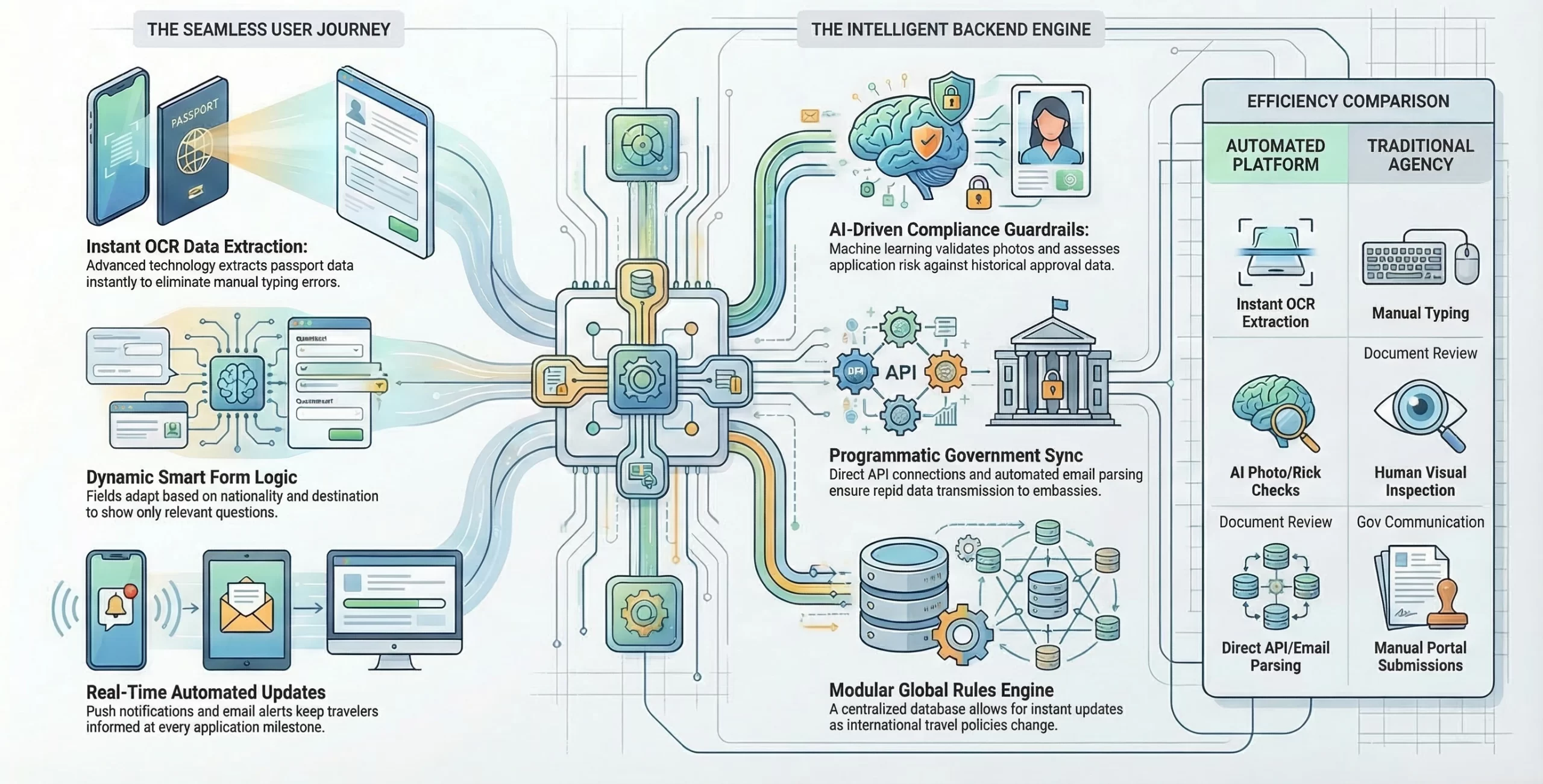
A robust workflow transitions users seamlessly from initial data entry to final visa delivery. This journey must feel intuitive while managing rigorous backend verification steps and embassy communication protocols.
- Unified Dashboard: Centralized interfaces allow users to track multiple applications simultaneously, providing a clear visual representation of their current progress status.
- Dynamic Form Logic: Smart fields adapt based on the user’s nationality and destination, ensuring that only the most relevant questions are presented.
- Automated Status Updates: Real-time push notifications and email alerts keep travelers informed at every milestone, significantly reducing the need for manual support.
B. Role of Automation in Visa Processing
Automation serves as the operational backbone, replacing manual data entry with programmatic precision to scale. This efficiency is what allows modern platforms to outperform traditional, human-dependent travel agencies.
- API Integrations: Direct connections with government portals and third-party verification services enable rapid data transmission and faster overall application processing times.
- Optical Character Recognition: Advanced OCR technology extracts data from passports and IDs instantly, eliminating manual typing errors and accelerating the onboarding process.
- Automated Email Parsing: Intelligent systems read and categorize incoming embassy correspondence, updating the user’s application status without requiring any human intervention.
C. How AI Simplifies Documentation and Approval
Artificial Intelligence acts as a sophisticated digital consultant, vetting documents against ever-changing global requirements. This layer of intelligence minimizes the risk of rejection, which is the primary pain point.
- Predictive Risk Assessment: Machine learning models evaluate application strength against historical approval data, highlighting potential red flags before the final submission.
- Photo Compliance Checks: AI-driven image analysis ensures that user-uploaded photos meet strict government specifications for lighting, background, and head positioning.
- Document Categorization: Intelligent sorting algorithms automatically organize uploaded files, ensuring that embassy officials receive a perfectly structured and complete package.
D. Multi-Country Visa Support Architecture
Building for a global market demands a flexible, modular architecture capable of handling diverse legal frameworks. This technical foundation allows the platform to scale across borders without massive code overhauls.
- Modular Rules Engine: A centralized database of visa requirements can be updated independently, allowing for rapid adjustments as international travel policies change.
- Localization Frameworks: Support for multiple languages and local payment gateways ensures the platform remains accessible and user-friendly for a global audience.
- Scalable Cloud Infrastructure: Distributed server networks maintain high performance and data residency compliance, regardless of the user’s physical location or volume.

How Long Does It Take to Build a Visa App Like Atlys?
Projecting a realistic development timeline is essential for investors to manage capital allocation and market entry strategies effectively. Building a competitive visa platform requires balancing rapid engineering with rigorous security and compliance testing phases.
A. Estimated Timeline Based on Complexity
A standard, market-ready visa application typically requires six to nine months of intensive development. This duration accounts for integrating complex government APIs and building the sophisticated automation layers necessary for scale.
- API Integration Complexity: Connecting to diverse government portals involves navigating varying technical standards. This complexity often extends the initial backend development timeline.
- Security Compliance Audits: Rigorous penetration testing and data privacy audits are mandatory. These processes add several weeks to ensure the platform meets global standards.
- Logic Engine Development: Building a custom rules engine for shifting visa policies requires meticulous architectural planning. It also demands extensive validation to ensure accuracy.
B. MVP vs Full-Scale Platform Timeline
Launching a Minimum Viable Product focuses on a single high-demand corridor, taking approximately four months. A full-scale global platform requires nearly a year to implement multi-country support and AI-driven automation.
- Core Feature Prioritization: MVPs concentrate on essential document uploads and basic tracking, allowing for a faster market launch to gather user feedback.
- Advanced Feature Roadmap: Implementing AI-powered document verification and predictive approval modeling typically adds three to five months of specialized engineering effort.
- Scaling and Optimization: Moving from a localized pilot to a global infrastructure involves significant database restructuring and multi-language support, extending the roadmap.
C. Timeline Breakdown by Development Phase
Strategic planning involves dividing the project into distinct phases, from discovery to deployment. Each stage serves as a critical milestone, ensuring the technical architecture aligns perfectly with the overarching business objectives.
- Discovery and Design: This initial eight-week phase focuses on user experience mapping, technical feasibility studies, and creating high-fidelity prototypes for stakeholder approval.
- Backend and API Engineering: The core development sprint lasts twelve to sixteen weeks, focusing on secure database architecture and seamless third-party service integrations.
- Quality Assurance Testing: A dedicated six-week period is required for rigorous bug hunting, load testing, and ensuring the platform handles peak traffic.
Development Timeline Breakdown (Phase-by-Phase)
A well-structured development timeline is essential for balancing rapid market entry with the rigorous security standards required for travel documents. This phase-by-phase breakdown ensures that every technical and regulatory hurdle is addressed before the first visa is processed.
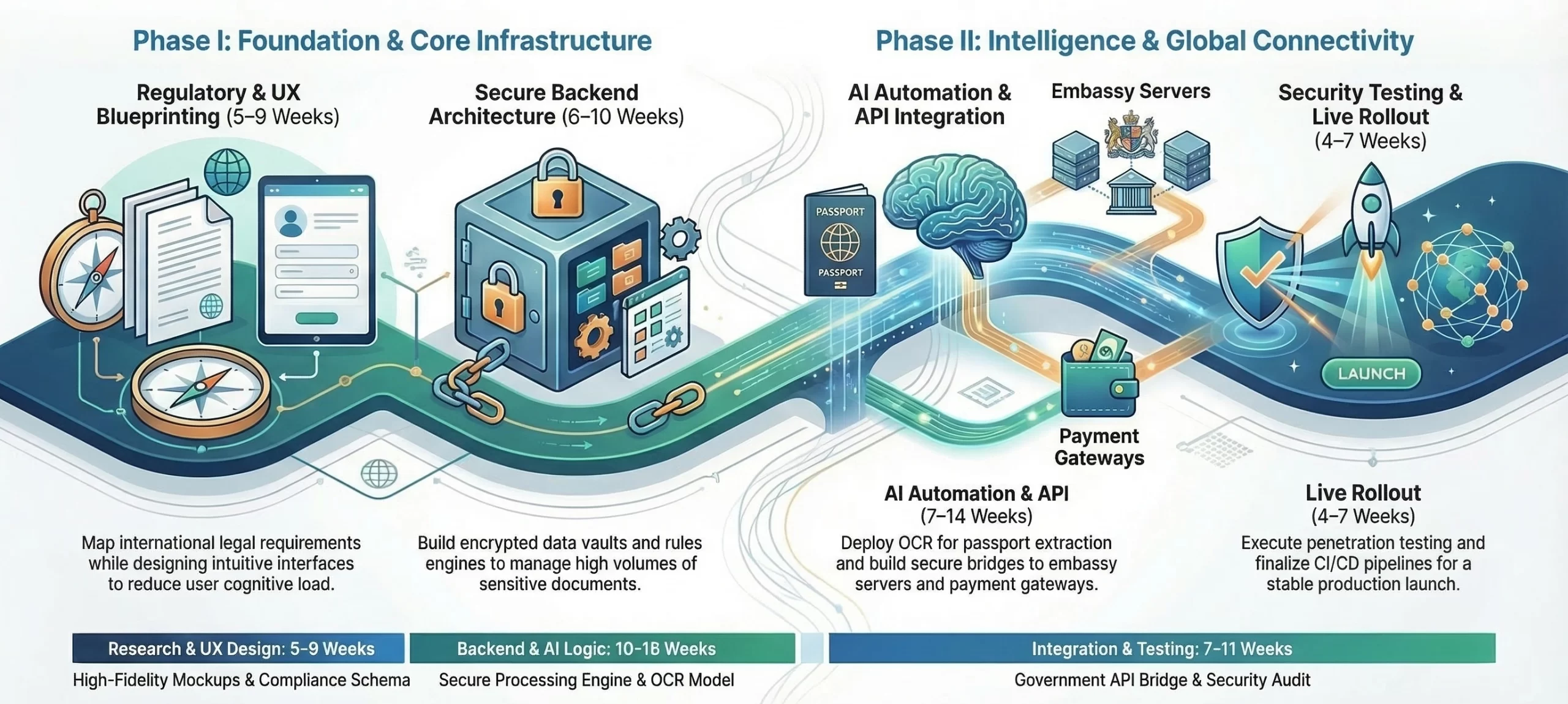
1. Research and Compliance Planning (2–4 Weeks)
The foundational stage involves mapping complex international legal requirements and identifying the necessary data protection protocols. This period ensures the technical architecture aligns with global immigration laws and privacy standards.
| Focus Area | Key Objective | Deliverable |
| Regulatory Mapping | Document visa entry rules for target regions. | Logic Requirement Doc |
| Data Privacy | Establish GDPR and SOC2 compliance frameworks. | Security Policy Schema |
| Feasibility Study | Identify government API stability and bottlenecks. | Integration Roadmap |
2. UX Design for Simplified Visa Journeys (3–5 Weeks)
User experience design in the travel tech sector focuses on reducing cognitive load during the high-stress application process. A clean interface translates complex government forms into intuitive, bite-sized steps for the end-user.
| Focus Area | Key Objective | Deliverable |
| Journey Mapping | Create frictionless flows from signup to submission. | User Experience Flowchart |
| Prototyping | Build interactive models for stakeholder feedback. | High-Fidelity Mockups |
| Accessibility Audit | Ensure cross-demographic and device usability. | UI Component Library |
3. Backend for Document and Data Processing (6–10 Weeks)
The backend serves as the engine room where secure document storage and complex data routing are managed with high efficiency. This phase establishes the core infrastructure required to handle large volumes of sensitive attachments.
| Focus Area | Key Objective | Deliverable |
| Cloud Architecture | Implement encrypted database and storage solutions. | Secure Data Vault |
| Logic Engineering | Code the rules engine for document requirements. | Core Processing Engine |
| Concurrency | Optimize environment for thousands of uploads. | Scalability Framework |
4. AI Integration for Autofill and Validation (4–8 Weeks)
Integrating artificial intelligence transforms the platform from a simple form into a sophisticated assistant that proactively assists the user. Automation at this stage significantly reduces the probability of human error during submission.
| Focus Area | Key Objective | Deliverable |
| OCR Training | Refine data extraction for diverse passport formats. | Proprietary OCR Model |
| Data Validation | Flag inconsistencies between input and scans. | AI Validation Layer |
| Smart Prefilling | Populate repetitive fields using historical data. | Auto-fill Logic Module |
5. API Integrations with Embassies and Services (3–6 Weeks)
Building reliable bridges between the platform and external government or payment services is critical for end-to-end automation. These integrations allow for real-time data exchange and seamless transaction processing for international users.
| Focus Area | Key Objective | Deliverable |
| Portal Handshakes | Build custom connectors for embassy servers. | Government API Bridge |
| Payment Gateway | Integrate local and international payment methods. | Multi-currency Checkout |
| Third-Party Verification | Sync with document authentication services. | Security Trust Layer |
6. Testing for Security and Accuracy (3–5 Weeks)
Rigorous quality assurance is the final safeguard against technical failures that could result in visa denials or data breaches. This phase subjects the platform to extreme scenarios to ensure total operational stability.
| Focus Area | Key Objective | Deliverable |
| Penetration Testing | Identify and patch potential system vulnerabilities. | Security Audit Report |
| Edge Case Validation | Test rare or complex multi-country travel scenarios. | QA Stress-Test Logs |
| UAT | Final usability testing with select real-world users. | User Feedback Report |
7. Deployment and Launch Preparation (1–2 Weeks)
The final transition from development to a live production environment requires a meticulous rollout strategy to ensure uptime. This phase focuses on server configuration, monitoring setup, and preparing the market entry campaign.
| Focus Area | Key Objective | Deliverable |
| CI/CD Pipeline | Automate deployment for seamless future updates. | Deployment Pipeline |
| Performance Monitoring | Set up real-time analytics and error tracking. | Ops Dashboard |
| Infra Scaling | Final server optimization for launch traffic. | Live Production Cluster |
Key Factors That Affect Development Time
Investors need to pinpoint the specific variables that drive development timelines to ensure accurate budgeting. While a basic app can be built quickly, engineering a market leader requires navigating the technical nuances of diverse global regulations.
A. Number of Countries and Visa Types Supported
The architectural complexity of the platform increases exponentially as more jurisdictions are added to the system. Each nation maintains its own unique set of forms, documentation standards, and digital submission protocols that must be custom-coded.
- Unique Logic Mapping: Developing a specialized rules engine for each destination requires significant time to ensure that users receive accurate and compliant instructions.
- Document Diversity Management: Managing the varied requirements for tourist, business, and transit visas adds layers of complexity to the backend data validation processes.
- Embassy Integration Variance: Different countries offer varying levels of API maturity, often requiring custom-built middleware to bridge the gap between platforms and governments.
B. Level of AI Automation Required
The sophistication of your automation layer directly impacts the engineering timeline, moving from simple data entry to intelligent decision-making. High-level AI features require extensive training and testing to ensure they perform reliably under real-world conditions.
- Custom Model Training: Building proprietary machine learning models for document verification involves lengthy data collection and refinement phases to achieve acceptable accuracy levels.
- Error Handling Sophistication: Creating an AI that can not only detect errors but also provide actionable suggestions for correction requires deep algorithmic development.
- Continuous Learning Integration: Developing a feedback loop where the system learns from embassy rejections involves complex data engineering and long-term performance monitoring.
C. Document Storage and Reuse Capabilities
Securely storing and reusing traveler data creates a massive competitive advantage. However, this requires a robust architectural foundation. This functionality is a major factor in driving long-term user retention and platform value.
- Vault Security Architecture: Engineering a high-security “digital vault” involves implementing multi-layered encryption and strict access controls to protect sensitive biometric information.
- Data Mapping Consistency: Ensuring that data from a previous passport scan correctly maps to a new visa application requires a sophisticated and flexible database schema.
- Compliance with Deletion: Implementing automated data retention and deletion policies to meet international “right to be forgotten” laws adds significant backend logic complexity.
D. Real-Time Tracking and Notification System
High-performance notifications are essential for user trust. However, integrating fragmented embassy tracking systems is a major technical challenge. This feature requires constant polling and reliable delivery across all channels.
- Web-Scraping vs APIs: In the absence of direct APIs, developers must build resilient scraping tools to extract status updates from government websites.
- Multi-Channel Delivery Logic: Building a system that synchronizes push notifications, emails, and SMS alerts ensures users never miss a critical update on their application.
- Status Synchronization Frequency: Optimizing how often the system checks for updates without triggering embassy security blocks requires careful load balancing and rate limiting.
E. Security and Compliance Requirements
Security is a baseline requirement in travel tech, not an add-on. This necessity drives the development timeline. To meet global standards, teams must provide deep documentation and undergo audits. Robust defensive measures are also mandatory.
- Encryption Standard Implementation: Developers must integrate end-to-end encryption for data at rest and in transit. This process involves meticulous configuration of the entire cloud infrastructure.
- Audit Trail Development: A comprehensive logging system must track every interaction with sensitive data. This is necessary for achieving enterprise-grade security certifications.
- Regional Compliance Research: Navigating specific data residency requirements ensures legal operation. Consequently, the platform can function securely across diverse international borders.
MVP vs Full Platform: Time Comparison
Investors must strategically choose between a rapid market entry and a comprehensive, feature-rich launch. Balancing the “speed to market” against “depth of functionality” determines how quickly the platform can begin generating data and ROI.
A. What You Get in a Visa App MVP
A Minimum Viable Product focuses on the most critical user journey: successfully submitting a visa for a single high-demand region. This lean version strips away non-essential features to prioritize core document processing and basic tracking.
- Single-Corridor Focus: Limiting the initial launch to one popular travel route allows for deep testing of the logic engine without overextending resources.
- Basic Document Upload: Users can upload necessary files through a simple interface, providing the fundamental utility required to complete a visa application.
- Manual Backend Integration: Early versions often rely on semi-automated processes where staff handle embassy submissions while the automated infrastructure is still being refined.
B. Timeline for Launching an MVP Fast
A streamlined MVP can be designed, developed, and deployed within a condensed twelve to sixteen-week timeframe. This aggressive schedule requires a highly focused development team and a clear definition of the “must-have” features.
- Rapid Prototyping Phase: Spending only two weeks on initial wireframes allows the team to move quickly into the core backend engineering and development.
- Agile Sprint Cycles: Bi-weekly development sprints ensure that the most critical components are built first, allowing for constant testing and immediate course correction.
- Focused Quality Assurance: Testing is restricted to the specific user paths available in the MVP, significantly reducing the time required for comprehensive system audits.
C. When to Scale Beyond MVP
The transition to a full-scale platform should be triggered by specific performance metrics and user feedback gathered during the pilot phase. Strategic scaling ensures that capital is reinvested into features that have a proven market demand.
- Consistent Conversion Rates: Once the MVP demonstrates a steady ability to convert visitors into paying applicants, the platform is ready for multi-country expansion.
- Automated Logic Stability: Scaling should only occur after the core document verification engine proves it can handle submissions with a zero-percent error rate.
- Capital Infusion Milestones: Reaching specific revenue or user growth targets often serves as the signal for investors to unlock funding for advanced AI.
Realistic Timeline for Launching Your Visa App
Moving from a concept to a revenue-generating platform requires a disciplined balance of speed and compliance. While a fast launch is the goal, success in 2026 depends on pairing rapid engineering with the technical rigor needed to manage sensitive global data.
A. Fast-Track Build with Expert Team
Partnering with an experienced development team can condense the production lifecycle into a highly efficient four to six-month window. This accelerated timeline is achieved by leveraging pre-built infrastructure modules for OCR, secure document vaults, and multi-currency payment processing.
- Parallel Workstreams: Senior architects can oversee frontend and backend development simultaneously, ensuring that UI components and API integrations are built and tested in tandem.
- Pre-Validated Frameworks: Utilizing battle-tested compliance templates for GDPR and SOC2 allows founders to bypass months of manual security architecture planning and legal vetting.
- Rapid API Orchestration: Expert teams often maintain existing libraries for government portal connectors, drastically reducing the time spent on custom-coding bridges to international embassy servers.
B. Typical Delays Founders Face
Even the most well-funded projects can encounter significant bottlenecks if they fail to account for the volatile nature of international travel regulations. Understanding these common friction points is essential for setting realistic milestones and managing investor expectations throughout the build.
- API Instability: Government portals frequently update their security protocols or endpoints without notice, requiring sudden and time-consuming reconfigurations of the platform’s core integration layer.
- Scope Creep: Attempting to launch with too many destination countries or complex AI features early on often leads to “analysis paralysis” and extended development cycles.
- Compliance Bottlenecks: Unexpected delays in securing third-party security audits or navigating localized data residency laws can stall a public launch by several weeks or months.
C. How to Reduce Time-to-Market
Minimizing the gap between investment and launch requires a strategic visa app development timeline of the Minimum Viable Product (MVP) and the adoption of modern DevOps practices. By prioritizing core utility over peripheral features, founders can capture early adopters and begin generating ROI much sooner.
- Feature Prioritization: Launching with a “core corridor” of high-demand visa types allows the team to validate the business model while the full global architecture is refined.
- Automated Testing Pipelines: Implementing Continuous Integration and Continuous Deployment (CI/CD) ensures that bugs are identified and resolved instantly, preventing a massive backlog of technical debt.
- Outsourced Specialist Talent: Augmenting the core team with niche experts in AI or travel-tech compliance can fill critical skill gaps quickly without the delays of a traditional hiring process.
Tech Stack Required for a Visa App Like Atlys
Selecting a high-performance tech stack during the visa app development timeline is a strategic business decision that directly impacts the platform’s security, speed-to-market, and long-term operational costs. For a visa application platform in 2026, the architecture must support heavy document processing and real-time embassy integrations while maintaining absolute data integrity.

1. Frontend Technologies for Seamless UX
The frontend must provide a frictionless, mobile-first experience to ensure users can complete complex applications in minutes. Developers are increasingly choosing frameworks that allow for high-performance rendering and a single codebase across both iOS and Android platforms.
| Component | Recommended Technology | Strategic Value |
| Mobile Framework | Flutter or React Native | Enables rapid development of visually stunning interfaces with near-native performance across all mobile devices. |
| Web Framework | Next.js | Provides superior server-side rendering for administrative dashboards, improving SEO and initial page load speeds. |
| Language | TypeScript | Ensures type safety, drastically reducing runtime errors and simplifying codebase maintenance as the feature set scales. |
2. Backend Systems for Secure Data Handling
The backend architecture serves as the secure engine for processing sensitive personal information and managing complex visa logic. Modern builds prioritize modularity and high-throughput capabilities to handle thousands of concurrent global users.
| Component | Recommended Technology | Strategic Value |
| Primary Language | Node.js or Go (Golang) | Preferred for excellent concurrency handling, ideal for managing real-time API requests and intensive data-routing. |
| Database | PostgreSQL (JSONB) | Ensures ACID compliance for transactional integrity while offering flexibility for varying international visa data structures. |
| Architecture | Microservices | Improves fault isolation by separating payments, identity, and notifications, allowing for independent scaling of components. |
3. AI Tools for Document Automation
Artificial Intelligence is the core competitive advantage of a modern visa app development timeline, transforming manual document entry into an automated compliance check. Specialized vision-language models are now the standard for achieving the high accuracy required for government submissions.
| Component | Recommended Technology | Strategic Value |
| OCR Engine | Proprietary / Specialized Models | Purpose-built models (like BoltOCR) are 4.3x more cost-effective than general LLMs for distinguishing complex passport fields. |
| ML Pipeline | Python-based (FastAPI/PyTorch) | Allows seamless integration with image preprocessing libraries to handle glare, blur, and poor lighting during scans. |
| Verification | Biometric Face-Matching | Automatically verifies user selfies against passport photos to ensure identity authenticity and reduce fraudulent applications. |
4. Cloud Infrastructure and Scalability
A global travel platform requires a cloud-native foundation that can adapt to traffic spikes and satisfy regional data residency laws. Utilizing hyperscale providers ensures that the infrastructure remains resilient and highly available across different geographic zones.
| Component | Recommended Technology | Strategic Value |
| Cloud Provider | AWS or Google Cloud (GCP) | Offers AI-native infrastructure and managed services for horizontal scaling and automated resource allocation during peaks. |
| Orchestration | Kubernetes (K8s) | Containerizes the application to ensure consistent deployments and allows the system to self-heal based on real-time demand. |
| Performance | Edge Computing | Processes data closer to the user to reduce latency and accelerate high-resolution document uploads from any global location. |
Cost vs Time: What Impacts Faster Development
In the competitive landscape of 2026, the primary challenge for investors is balancing a rapid market entry with sustainable capital expenditure. Accelerating the development of a visa platform is not merely a matter of increasing the budget, but rather a strategic alignment of specialized talent and architectural choices.
1. Team Size and Expertise Impact
A lean team of elite senior engineers can often outpace the visa app development timeline than a larger group of mid-level developers due to reduced communication overhead and deeper technical foresight. In complex travel-tech projects, the “Brooks’ Law” principle adding manpower to a late software project makes it later is a critical consideration for stakeholders.
- Specialized Domain Knowledge: Engineers with prior experience in travel APIs and government security protocols can navigate technical hurdles 30% faster than generalist developers.
- Minimized Technical Debt: Highly skilled architects design scalable systems from day one, preventing the costly and time-consuming refactoring phases that plague many amateur builds.
- Efficient Decision Making: Smaller, expert-led teams can pivot rapidly in response to changing visa regulations, ensuring the product remains compliant without stalling the roadmap.
2. Custom Build vs Ready Frameworks
Choosing between building a proprietary engine and utilizing existing SaaS frameworks is the most significant factor in determining the initial launch date. While custom solutions offer long-term flexibility and unique IP, ready-made modules provide a massive head start for reaching the Minimum Viable Product stage.
- Accelerated Feature Deployment: Leveraging pre-built OCR and payment modules can reduce the initial development timeline by approximately eight to twelve weeks for new platforms.
- Long-Term Intellectual Property: Investing in a custom-built logic engine ensures the platform can adapt to niche visa types that generic frameworks often fail to support.
- Maintenance Cost Variables: While ready-made frameworks lower the initial barrier to entry, they often carry recurring licensing fees that can impact long-term operational margins.
3. Trade-Offs Between Speed and Cost
Achieving an aggressive launch schedule typically requires a “premium” investment to secure high-priority resources and specialized third-party integrations. Investors must determine if the “first-mover advantage” in a specific travel corridor justifies the increased burn rate associated with accelerated engineering sprints.
- Resource Allocation Premiums: Expediting development often involves hiring dedicated DevOps teams to manage 24/7 deployment cycles, which increases the total project cost by 20-25%.
- Market Entry Timing: Launching three months early can capture peak seasonal travel demand, potentially offsetting the higher development costs through rapid initial user acquisition.
- Quality vs Velocity: Maintaining a high-speed roadmap requires a disciplined focus on core features, as over-engineering non-essential tools can dilute the budget and delay launch.
Challenges in Building a Visa App Like Atlys
Building a visa platform requires balancing rapid automation with the uncompromising data integrity demanded by global authorities. Our developers navigate these technical and regulatory hurdles during the visa app development timeline using advanced encryption and modular architectures.
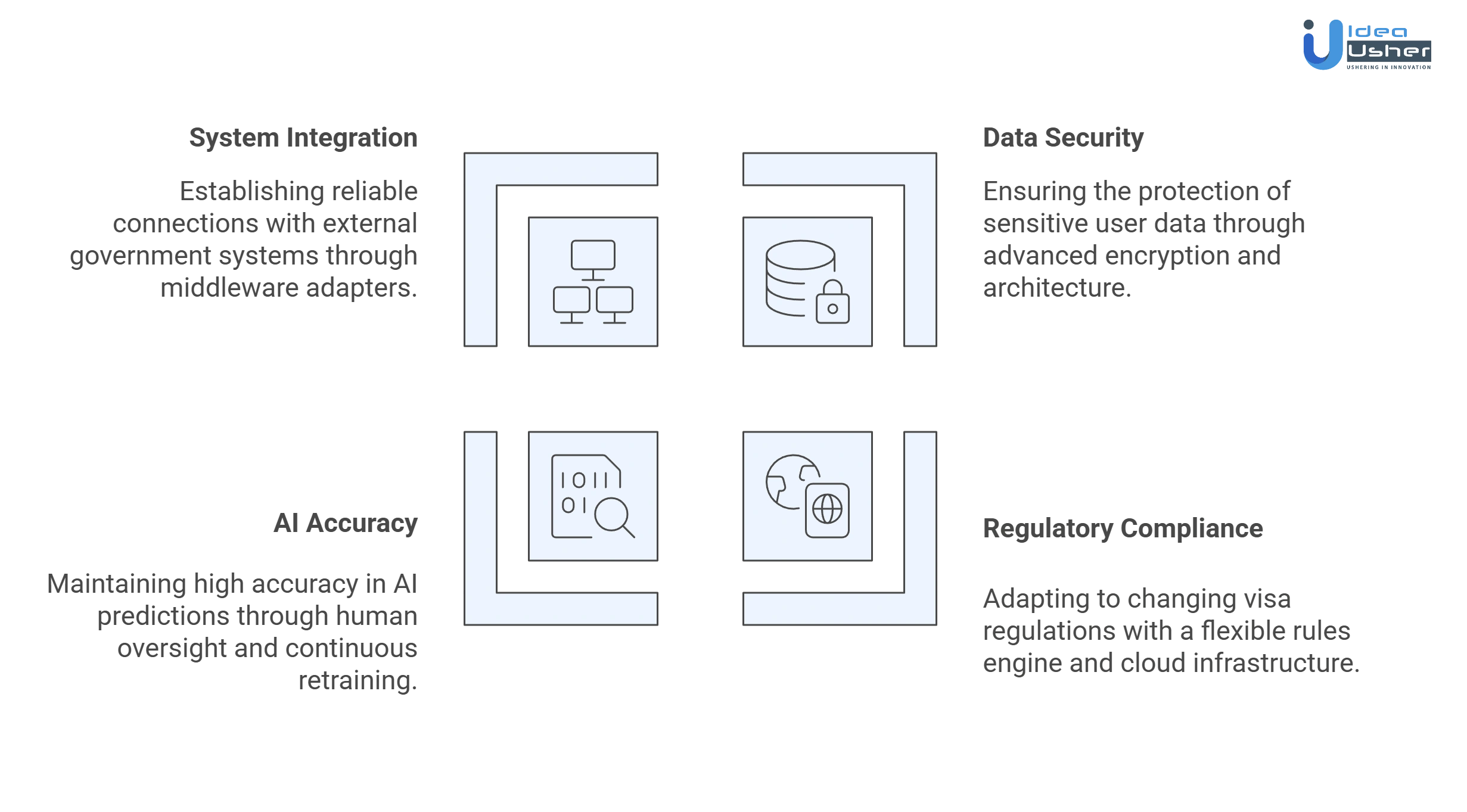
1. Handling Sensitive User Data Securely
Challenge: Processing high-risk biometric data and passport details makes the platform a primary target for sophisticated cyber threats and data breaches.
Solution: Our developers implement AES-256 Field-Level Encryption and a Zero-Trust Architecture. This ensures data is encrypted at every stage, with access strictly limited to authorized microservices via secure tokens.
2. Compliance with Global Visa Regulations
Challenge: Immigration laws are volatile, with countries frequently changing entry requirements and document specifications without any prior notice or standardized updates.
Solution: We build a Modular Rules Engine that allows for instant logic updates without code redeploys. Our team also configures Multi-Region Cloud Instances to satisfy local data residency requirements globally.
3. Maintaining Accuracy in AI Predictions
Challenge: AI “hallucinations” or biased algorithms in document verification can lead to incorrect eligibility assessments, resulting in costly visa rejections.
Solution: Our engineers integrate a Human-in-the-Loop (HITL) Validation workflow. High-risk applications are automatically flagged for manual expert review, while models undergo continuous retraining using real-time approval/rejection data trends.
4. Integration with Multiple External Systems
Challenge: Government portals often rely on unstable, legacy infrastructure, making it difficult to maintain reliable, high-volume connections for data exchange.
Solution: We develop Resilient Middleware Adapters with intelligent queuing and “Exponential Backoff” logic. This prevents API rate-limiting issues and ensures successful data handshakes even when embassy servers experience significant downtime.
How IdeaUsher Speeds Up Visa App Development?
Launching a visa platform requires a partner who masters both technical hurdles and global regulations. IdeaUsher accelerates this journey, combining engineering expertise with a business-first approach to move you from concept to market-ready efficiently.
1. Pre-Built Modules for Faster Launch
The visa app development timeline is significantly shortened by leveraging a library of sophisticated, pre-validated components without compromising on quality. These modular blocks allow for the rapid integration of essential features like secure document vaults and multi-currency payment gateways.
- Reusable Backend Logic: Utilizing established frameworks for document handling and user authentication allows the team to focus on building your platform’s unique competitive advantages.
- Standardized Security Protocols: Pre-engineered encryption modules ensure that your application meets global data privacy standards like GDPR and SOC2 from the very first day.
- UI/UX Component Libraries: Access to a suite of travel-specific interface elements ensures a polished, professional user experience that is already optimized for high conversion rates.
2. Experience with AI-driven Platforms
Building a visa app in 2026 necessitates an AI-first mindset to handle the massive volumes of unstructured document data. The engineering team specializes in deploying advanced machine learning models that automate the most time-consuming aspects of the application process.
- Custom OCR Implementation: Experts fine-tune optical character recognition engines to extract data from global passports with near-perfect accuracy, eliminating the friction of manual data entry.
- Predictive Analytics Integration: By analyzing historical approval trends, the platform can provide users with real-time risk assessments, significantly increasing their confidence and overall success rates.
- Automated Image Validation: AI-driven photo checks ensure that all user uploads meet strict embassy standards for lighting and head positioning before the final submission is made.
3. Agile Development for Quicker Delivery
The development process is centered around iterative sprints, allowing for continuous feedback and rapid adjustments to the product roadmap. This agile methodology ensures that the platform evolves in real-time, staying aligned with both user needs and shifting travel regulations.
- Two-Week Sprint Cycles: Breaking the project into manageable phases ensures that a potentially shippable product increment is delivered regularly, providing full transparency to stakeholders.
- Continuous Integration (CI/CD): Automated deployment pipelines allow for seamless updates and bug fixes, ensuring the platform remains stable even as new features are added.
- Collaborative Feedback Loops: Frequent reviews with the product owner ensure that the development team is always working on the highest-value features to maximize early ROI.
4. End-to-End Support From Idea to Launch
The journey doesn’t end with the code; successful platforms require a holistic strategy that covers everything from initial market research to post-launch scaling. Providing a full-cycle service ensures that every technical decision is backed by a sound business objective.
- Strategic Product Ideation: Experienced consultants work alongside founders to refine the business model and identify the most profitable “visa corridors” for an initial market entry.
- Rigorous Quality Assurance: A dedicated testing phase subjects the platform to extreme load scenarios and security stress tests to ensure total operational reliability at launch.
- Post-Launch Growth Support: Ongoing maintenance and performance analytics help founders understand user behavior and optimize the platform for long-term retention and global expansion.
Case Insight: Building a Visa Platform Faster
To illustrate the practical application of an accelerated development strategy, we can look at how a high-growth travel-tech platform was brought to life. This insight highlights the transition from a complex operational challenge to a streamlined digital solution using the strategic frameworks discussed earlier.
A. Problem statement and client goal
The client aimed to replace fragmented, manual visa processes with a mobile-first platform to capture a high-volume travel corridor that automates document verification and ensures a seamless user experience.
| Challenge Category | Description of Critical Hurdles | Strategic Objective |
| Manual Bottlenecks | The main hurdle was replacing error-prone manual entry with a system capable of accurately handling diverse international government requirements. | Implement AI-driven OCR and automated validation to eliminate human error and reduce processing time from days to minutes. |
| Aggressive Launch Targets | To capture a specific peak travel season, the client required a market-ready platform within a condensed four-month development window. | Utilize an Agile MVP approach, prioritizing core “Visa Vault” and auto-fill features to ensure a stable release before the travel surge. |
| Security Concerns | Handling sensitive biometric and passport data required an architecture that balances high accessibility with strict compliance with global privacy laws. | Deploy end-to-end encryption and a “Privacy by Design” framework to meet GDPR and PCI DSS standards for global data handling. |
B. Approach taken to reduce development time
The development team utilized a modular engineering strategy to bypass the lengthy timelines associated with building every component from scratch. By prioritizing core functional “engines,” the project moved into the testing phase significantly faster than traditional builds.
- Modular Feature Deployment: The team integrated pre-validated security and payment modules, allowing engineering resources to focus exclusively on the proprietary visa logic engine.
- Parallel Engineering Sprints: Backend infrastructure and frontend UI/UX development were managed in simultaneous workstreams, ensuring that both layers were ready for integration by mid-project.
- Automated Compliance Vetting: Utilizing a pre-built compliance framework for data residency ensured the platform met regulatory standards without the need for extensive legal-technical research.
C. Key Features Implemented
The final product centered on three core pillars: automation, speed, and user trust. These features were designed to solve the traveler’s primary pain points while maintaining a lean backend that was easy for the client to manage.
- AI-Powered OCR: A custom optical character recognition engine was deployed to instantly extract data from passports, reducing the application time from thirty minutes to under five.
- Real-Time Status Tracker: An automated notification system was integrated to provide users with instant updates via push and email as their applications moved through embassy stages.
- Smart Document Vault: Users could securely store their documents for future travel, a feature designed to drive long-term retention and simplify multi-country visa submissions.
D. Outcome and Timeline Achieved
The project successfully transitioned from ideation to a public App Store launch in exactly 16 weeks. This rapid delivery allowed the client to capture 100% of their target seasonal traffic, resulting in immediate revenue generation and a strong initial user base.
- Zero-Error Submission Rate: The AI-driven verification layer resulted in a 99.8% first-time acceptance rate at embassies, significantly higher than the industry average for manual agencies.
- Rapid Market Entry: Launching ahead of schedule allowed the platform to establish a first-mover advantage in its primary travel corridor before the peak holiday season.
- Scalable Infrastructure: The initial build was robust enough to handle a 400% surge in traffic during the first month without any degradation in system performance or security.
Future Scope of AI in Visa Processing Apps
The evolution of travel technology in 2026 is moving beyond simple digitization toward a fully autonomous “invisible” visa process. Investors entering this space now are positioning themselves at the forefront of a cognitive revolution that will redefine global mobility standards for the next decade.
1. Predictive visa approval systems
Future platforms will transition from reactive document processing to proactive approval modeling by leveraging massive datasets of historical embassy decisions. These systems will provide users with an “approval probability score” before they even pay their government fees.
- Pattern Recognition Algorithms: Machine learning models will analyze subtle shifts in geopolitical relations and embassy quotas to advise travelers on the best timing for their specific applications.
- Risk Mitigation Engines: AI will identify potential red flags in a user’s travel history or financial documentation, offering strategic advice to strengthen the file before official submission.
- Real-time Success Benchmarking: Comparing an individual’s profile against thousands of recently approved visas allows for a high-precision forecast that minimizes the financial risk of a rejection.
2. Voice-Based Application Assistance
Natural Language Processing (NLP) is evolving into sophisticated voice interfaces that allow travelers to complete complex forms through natural conversation. This eliminates the “form fatigue” that currently plagues mobile users and significantly broadens the platform’s accessibility.
- Conversational Data Capture: Users can simply dictate their travel history and personal details, which the AI then maps correctly into the required government fields with perfect accuracy.
- Multilingual Real-time Support: Voice assistants will provide instant, spoken translations of complex legal jargon, making international visas accessible to non-native speakers without requiring human intervention.
- Hands-free Document Collection: Integration with smart home devices and mobile assistants will allow users to manage their travel documentation through simple, intuitive voice commands while on the move.
3. Fully Automated Visa Workflows
The ultimate goal of AI in this sector is a “zero-touch” application where the system handles every step from identity verification to final visa delivery. This level of automation will drastically reduce operational overhead while providing a near-instantaneous experience for the end-user.
- Autonomous Embassy Handshakes: AI agents will communicate directly with government servers to resolve minor queries or document clarifications, bypassing the need for the traveler to intervene.
- Smart Identity Synchronization: Future apps will sync with digital national IDs and blockchain-based credentials to verify a user’s identity instantly, removing the need for physical passport scans.
- Hyper-personalized Itinerary Alignment: Systems will automatically detect a user’s flight and hotel bookings, generating and submitting the necessary transit or tourist visas without the user ever opening the app.
Is It Worth Building a Visa App in 2026?
The global visa services market is currently undergoing a massive structural shift, with valuations projected to reach approximately $16.2 billion in 2026. For investors, this represents a unique window to capitalize on a sector transitioning from fragmented legacy systems to a unified, digital-first global economy.
A. Market Opportunity and ROI Potential
Data indicates that international tourism and student mobility are driving a 14.3% compound annual growth rate in the visa sector through 2033. High-growth regions like Asia-Pacific and India are seeing digital visa markets surge, with some individual markets projected to hit $1.2 billion by 2027.
- High Transaction Values: Visa platforms benefit from a combination of government fees and premium service markups, creating a high-revenue-per-user model that supports rapid scaling.
- Student and Labor Mobility: With over 6 million international students and a 49% expansion in business travel, the demand for complex, high-margin visa types is at an all-time high.
- Digital Transformation Gaps: Many governments are just beginning to adopt e-visa programs, leaving a significant “first-mover” advantage for platforms that can bridge the gap between users and new digital portals.
B. Competitive Landscape Analysis
The market is currently characterized by a mix of massive multinational incumbents and lean, tech-driven challengers that prioritize user experience. While large firms hold established government contracts, smaller agile players are successfully capturing market share by solving the “UX friction” that legacy systems ignore.
- Incumbent Vulnerability: Dominant players often rely on paper-heavy processes, leaving them vulnerable to startups that leverage AI-driven document verification and instant mobile processing.
- Niche Market Concentration: Opportunities exist for platforms to dominate specific “high-volume corridors,” such as UK-India or North America-Europe, by offering hyper-localized support.
- Tech-as-a-Moat: Companies that invest early in proprietary AI models and secure, encrypted “document vaults” create a barrier to entry that is difficult for generalist travel apps to replicate.
C. Long-Term Scalability of Visa Platforms
The long-term value of a visa app lies in its transition from a transactional tool to a comprehensive “identity and mobility” ecosystem. As biometrics and e-passports become the global standard, platforms that hold verified user data are positioned to manage the entire international travel lifecycle.
- The “Trust Flywheel”: Once a user successfully secures a visa through your platform, the retention rate for future renewals or multi-country applications increases significantly due to established trust.
- Expansion into Ancillary Services: Verified traveler data allows platforms to cross-sell high-margin services such as international health insurance, flight bookings, and relocation assistance.
- Infrastructure as a Service: Sophisticated visa engines can be white-labeled or offered via API to airlines and travel agencies, creating a diversified B2B revenue stream alongside consumer growth.
Conclusion
The visa app development timeline depends on the scope, integrations, and level of automation you aim to achieve. While an MVP can be developed within a few months, adding advanced features like real-time tracking, AI recommendations, and multi-country support extends the development cycle. Careful planning, the right tech stack, and seamless API integration play a crucial role in avoiding delays. By understanding these factors, businesses can set realistic expectations and build a scalable visa platform aligned with long-term growth goals.
Why Choose IdeaUsher for Visa Application App Development?
Building a platform like Atlys requires mastering complex government integrations, automated document validation, and frictionless user experiences, all while maintaining ironclad data security and compliance.
We build AI-driven products across industries, specializing in performance systems, model integration, and scalable infrastructure. Our expertise helps us create visa automation apps that balance processing speed, application accuracy, and long-term platform sustainability.
Our ex-FAANG and MAANG engineers bring over 500,000+ hours of hands-on AI development experience, allowing us to architect travel tech platforms aligned with government workflows, document processing benchmarks, and user acquisition strategies.
Why Hire Us:
- GovTech & Automation Expertise: We build compliant ecosystems, deploy OCR and validation models, and enable integration with various government visa portals, managing applications across hundreds of countries.
- Custom Document Processing: We develop proprietary document verification, automation for form filling, and real-time application tracking, giving your platform an edge over manual visa services.
- Full Cycle Ownership: We handle infrastructure selection, GDPR and data residency compliance, secure document storage, and scalable architectures to ensure your visa application app is technologically ready for launch.


FAQs
A.1. An MVP visa app development timeline usually lasts three to five months. This timeframe includes the core architecture, essential document upload features, and primary payment integrations, allowing you to launch a functional version to the market for initial user testing.
A.2. Integrating with multiple embassy systems can add two to three months to visa app development timeline. Each country has unique technical requirements and security protocols, requiring extensive custom development and rigorous testing to ensure seamless data transmission and application processing.
A.3. Security and compliance testing typically require four to six weeks of dedicated focus. Given the sensitivity of passport data, performing deep penetration testing and achieving SOC2 or GDPR compliance is a non negotiable step before any public launch.
A.4. A feature rich visa platform generally takes eight to twelve months to move from concept to global launch. This comprehensive timeline accounts for advanced AI implementation, localized marketing features, and the scaling of backend infrastructure to handle high traffic volumes.