



Key Takeaways
- Users are moving from 2D apps to immersive 3D worlds, where real-time presence, avatars, and shared experiences drive deeper engagement.
- Platforms like Wilder World succeed through photorealistic environments, blockchain ownership (NFTs), and DAO governance, creating user-owned ecosystems.
- Core success factors include AAA visuals (Unreal Engine 5), persistent open worlds, creator-driven content, and strong social + gameplay loops.
- Building such platforms requires advanced tech stacks (UE5, blockchain, cloud, AI) and features like marketplaces, multiplayer systems, and scalable infrastructure.
- A sustainable model depends on token utility, NFT scarcity, and circular economies, while monetization comes from assets, marketplaces, and brand collaborations.
- Key challenges include performance at scale, security, retention, and regulatory compliance, making expert development crucial.
Why are users leaving traditional apps faster, yet spending hours inside virtual worlds? The problem is not content; it is a lack of presence. Most platforms are still built for passive consumption, while user behavior is shifting toward real-time interaction and digital identity.
Social metaverse platforms are capturing this shift by turning static interfaces into shared, immersive environments where users actively engage, not just observe. This creates a clear opportunity for businesses to move beyond flat apps and build spaces that drive deeper connection and retention.
The challenge is not entering the metaverse, but building it right. Here’s how to develop a platform users actually return to.
Why Are Social Metaverse Platforms Exploding?
According to Grand View Research, the global metaverse market was valued at USD 105.40 billion in 2024 and is projected to hit USD 936.57 billion by 2030, growing at a CAGR of 46.4%. Spatial technology lets users engage with digital content as if it is physical, blurring reality. For investors, this marks a shift from a click-based economy to a presence-based economy.

Source: Grand View Research
Hardware maturity and shifting digital values drive metaverse adoption. Investors now back ecosystems that solve the flat nature of traditional social media. As 2D market attention peaks, developers seek a deeper connection through spatial environments.
Strategic capital flows here due to diversified revenue models. Beyond ads, platforms leverage digital ownership and virtual services. The Sandbox illustrates this by letting users monetize assets and land. Lower hardware costs now make market entry highly viable.
From 2D to 3D Interaction
2D interfaces are windows to look through, but 3D interaction lets users step inside. This cognitive upgrade improves information retention and sense of place. For owners, this means longer sessions and lower churn.
Success requires moving from standard UI to spatial design. The priority shifts from clicks to intuitive navigation.
- Persistent Environments. 3D spaces stay consistent after logout. This permanence drives repeat visits.
- Depth and Context. Spatial positioning enables complex social cues. This is vital for virtual retail and collaboration.
Avatar-Based Communication
We are trading static profiles for expressive avatars. These serve as the primary vehicle for identity and agency. With real-time facial tracking, the avatar economy offers high-margin revenue. Avatar communication democratizes social interaction. VRChat pioneered this by building subcultures around custom digital expression.
- Identity Fluidity. Users spend heavily on skin ecosystems. They often value virtual appearance as much as physical looks.
- Non-Verbal Cues. Avatars mirror body language. This reduces video call fatigue and aids professional use.
Shared Digital Experiences
Consumers no longer separate gaming from socializing. Demand is high for live experiences like virtual concerts. These acts serve as anchor tenants that drive user acquisition and community gravity.
Entrepreneurs must facilitate these moments at scale. This requires a back-end built for high-concurrency events.
- Synchronous Interactivity. Real-time togetherness is the actual product.
- Co-Creation Tools. Top platforms let users shape their environment. This turns the user base into a growth engine.
Understanding the Wilder World Ecosystem Model
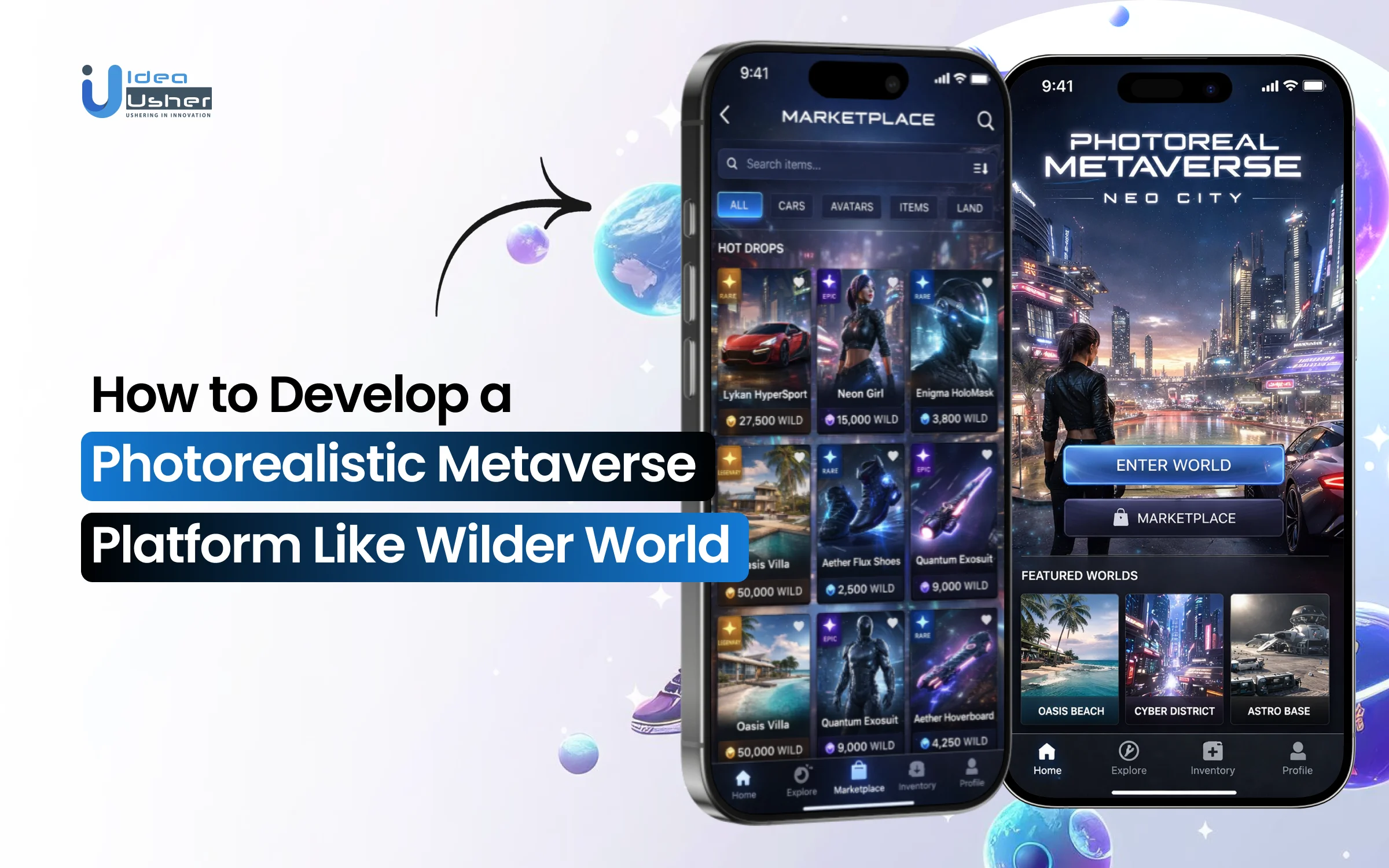
Wilder World departs from siloed gaming toward a community-owned Network State. Built on Unreal Engine 5, it focuses on photorealistic immersion through its Metropolis decentralized engine. This sovereign structure ensures that creators and users own the value they generate rather than a parent corporation.
Strategic components of the model include:
- True Digital Ownership. Assets like Wilder Wheels and Wilder Beasts are unique NFTs secured on the blockchain.
- Redistributed Profits. The platform redistributes ecosystem gains back to citizens via the Wilder DAO.
- Technological Stack. Combining Ethereum security with the Zero Protocol and Z Chain enables mass multiplayer scale and high transaction speeds.
1. Decentralized Virtual Nation
The vision is a Protopia focused on incremental progress and community control. This virtual nation-state aims to transcend digital boundaries through the ZERO ID system. Artists and developers use open protocols to build infrastructure, ensuring the platform evolves based on user demand rather than top-down mandates.
At its heart, the project seeks a future where values like kindness and responsibility are baked into the governance and financial incentives of the digital realm.
2. Wiami: The Persistent City
Wiami serves as the flagship metropolis within the ecosystem. It is a digital twin of Miami reimagined through a cyberpunk aesthetic. Unlike traditional game maps that reset, Wiami is a persistent environment. If you own a Wilder Crib in Wiami, it exists as a fixed coordinate within a larger evolving geography.
The city acts as the primary social and economic hub where:
- High Stakes Racing. Users engage in Wiami Wheels Alpha to race vehicles for pink slips.
- RPG Narratives. The city is a battleground for stories involving Wilder Wolves and the struggle against the FORUM.
- Social Hubs. Wiami provides a photorealistic backdrop for virtual retail and digital fashion like Wilder Kicks.
3. $WILD Token Economy
The $WILD token is the lifeblood of the ecosystem. It functions as both a utility and a governance tool. This ERC-20 token facilitates every layer of the economy to keep value within the community.
| Function | Description |
| Medium of Exchange | Used to buy and sell NFTs in the Wilder World Metaverse Market. |
| Governance | Holders vote on DAO proposals to direct the treasury. |
| Ecosystem Fuel | Powers in world transactions and resource generation. |
| Staking Rewards | Users lock tokens to secure the network and earn rewards. |
The tokenomics use deflationary mechanics through the Metropolis upgrade. A percentage of trade fees from assets like Wilder Pal and Wilder Moto are directed to the DAO treasury. For an investor, this creates a link between the growth of the virtual nation and the value of its native currency.
Core Pillars of a Wilder World–Like Platform
Investors must understand that building photorealistic metaverse platforms requires a strategic commitment to several non-negotiable pillars. These foundations distinguish a sovereign digital nation from legacy social apps by ensuring the platform is a self-sustaining economy with long-term growth potential.
1. AAA Photorealistic 3D Environments
High fidelity visuals drive user immersion and retention. By leveraging Unreal Engine 5, a platform that achieves photorealistic lighting and textures, that make the digital world feel tangible. This quality is essential for attracting luxury brands and serious investors who require a premium environment for virtual real estate.
Platforms like Star Atlas demonstrate this by using Unreal Engine 5 to create hyper-realistic space exploration environments that rival cinematic experiences.
2. Blockchain Ownership and NFT Assets
The backbone of a decentralized platform is true digital ownership. Every item within the ecosystem is a unique NFT, giving users the freedom to trade or lease property on open markets. This creates a liquid economy where users are financially incentivized to contribute to the growth of the virtual world.
Illuvium utilizes this pillar by allowing players to truly own and trade high-fidelity creatures as NFTs within its interoperable ecosystem.
3. DAO and Community Control
Moving power from a corporation to a Decentralized Autonomous Organization ensures that the platform evolves to meet user needs. Token holders vote on feature updates and treasury management. This democratic structure fosters deep community loyalty and protects the ecosystem from the pitfalls of centralized mismanagement.
Decentraland stands as a primary example where the DAO governs everything from naming conventions to land auctions and server maintenance.
4. Gameplay and Social Interaction
A persistent world needs gravity to keep users coming back. Whether it is high-stakes racing in Wiami or social gatherings in virtual lounges, these interactions create the social fabric of the platform. Blending gaming with social networking ensures constant activity and multiple touchpoints for monetization.
Somnium Space exemplifies this by offering a VR-first social world where users build persistent attractions that foster a highly active and synchronized social community.
Key Features You Must Build to Compete
To capture a share of the spatial computing market, your platform must move beyond simple social lobbies. Investors should look for architectures supporting high-fidelity world-building and complex economic loops. Developing photorealistic metaverse platforms requires these functional requirements to create worlds that users inhabit long-term.
1. Open World and Interaction
A competitive platform requires a seamless, persistent geography that users traverse without loading screens. This involves implementing advanced spatial partitioning so thousands of users can interact in the same environment simultaneously.
Everdome focuses on this by providing hyper-realistic Martian landscapes where every rock and shadow is rendered with AAA precision for a deep sense of presence.
2. Avatar Customization
Identity is the cornerstone of virtual retention. You must build systems for hyper-granular customization from skeletal proportions to real-time skin shaders. These avatars should support biometric mirroring where facial expressions map directly onto the 3D model.
Ready Player Me has set the standard by creating cross-platform identity systems that maintain a consistent look across hundreds of different virtual environments.
3. Asset Marketplace
A robust internal economy requires a marketplace that handles high-frequency trading with minimal latency. This system should support everything from virtual land deeds to functional items like vehicles.
Star Atlas uses a highly integrated marketplace where players trade complex ship components. This ensures every asset has a tangible market value and utility within the broader ecosystem.
4. Multiplayer Events and Combat
Static worlds die quickly, so your platform must include dynamic activity layers. This means building low-latency physics engines for racing or synchronized combat systems that feel as responsive as modern e-sports.
Illuvium has set a benchmark here by combining a photorealistic open world with complex battle mechanics and high-stakes rewards, recently even partnering with Lamborghini for luxury digital assets.
5. Creator Content Tools
The most scalable platforms act as engines for their users. You must provide intuitive tools that allow creators to build their own storefronts or mini games within your world.
NVIDIA Omniverse provides a glimpse into this future by offering professional-grade collaborative tools. These allow artists and engineers to build and simulate complex 3D assets in real time within a shared digital space.
What It Takes to Achieve True Photorealism in Metaverse Platforms?
Achieving cinematic fidelity in a massive multiplayer environment is a significant engineering hurdle. To build photorealistic metaverse platforms, investors must focus on the underlying rendering pipeline. True photorealism requires a synergy between hardware optimization and software to ensure the world feels lived in rather than sterile.
1. Unreal Engine 5 for High Fidelity
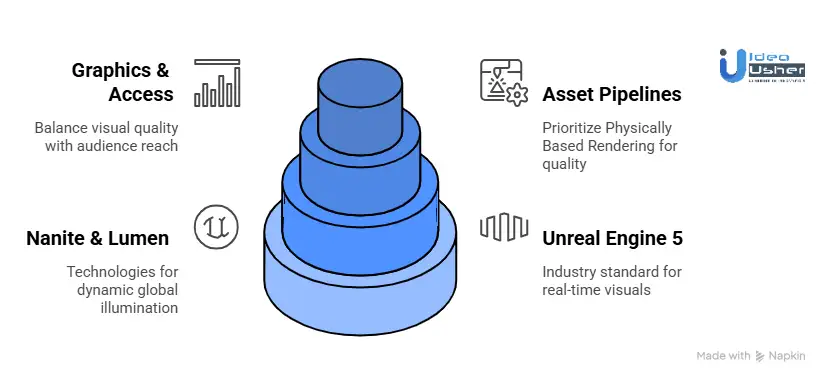
Unreal Engine 5 is the industry standard because it bridges film-quality visuals with real-time performance. For a platform owner, it provides a future-proof foundation that supports massive scale.
- World Partition. This allows expansive landscapes by loading only the necessary cells to save memory.
- Collaboration. Systems like One File Per Actor enable large teams to build environments simultaneously without conflicts.
2. Nanite and Lumen for Realism
The pillars of modern photorealism are Nanite and Lumen. These technologies eliminate traditional art production bottlenecks.
- Nanite. This lets artists use film-quality assets with millions of polygons. The system renders only what the eye sees to keep frame rates high.
- Lumen. This provides fully dynamic global illumination. If the sun sets in your world, every light bounce and reflection updates instantly.
Strategic Insight. Without Lumen, lighting is static. With it, your virtual world reacts to user actions in real time. Star Atlas uses these tools to create hyper-realistic space environments that rival modern cinema.
3. Asset Pipelines for Visual Quality
To maintain a premium feel, the pipeline must prioritize Physically Based Rendering. This ensures materials like chrome or leather react to light exactly as they do in the physical world.
- Photogrammetry. Using real-world scans to create assets with natural imperfections.
- Subsurface Scattering. A requirement for realistic skin and fabric that prevents the plastic look of older platforms.
4. Balancing Graphics and Access
The challenge is the trade-off between visual quality and reach. While high-end PCs render masterpieces, mobile devices have limits. A successful strategy involves Scalable Fidelity.
| Platform | Optimization | Experience |
| High End PC | Full Nanite/Lumen | Maximum immersion. |
| Consoles | Resolution scaling | High-speed racing. |
| Mobile/Web | Pixel Streaming | Streaming high-end graphics from the cloud. |
By utilizing Pixel Streaming, you can deliver a photorealistic experience to a smartphone by running the heavy processing on a remote server. This ensures your environment is accessible to the widest audience without compromising visual integrity. Everdome uses similar scaling to maintain its hyper-realistic Martian aesthetic across different hardware tiers.
How to Develop a Photorealistic Metaverse Platform Like Wilder World?
Developing photorealistic metaverse platforms requires a shift from traditional game design toward building a digital nation-state. You are not just creating a product but an environment that supports identity, property, and governance. Success depends on a modular approach where every layer from the visual engine to the blockchain is built for infinite scale.
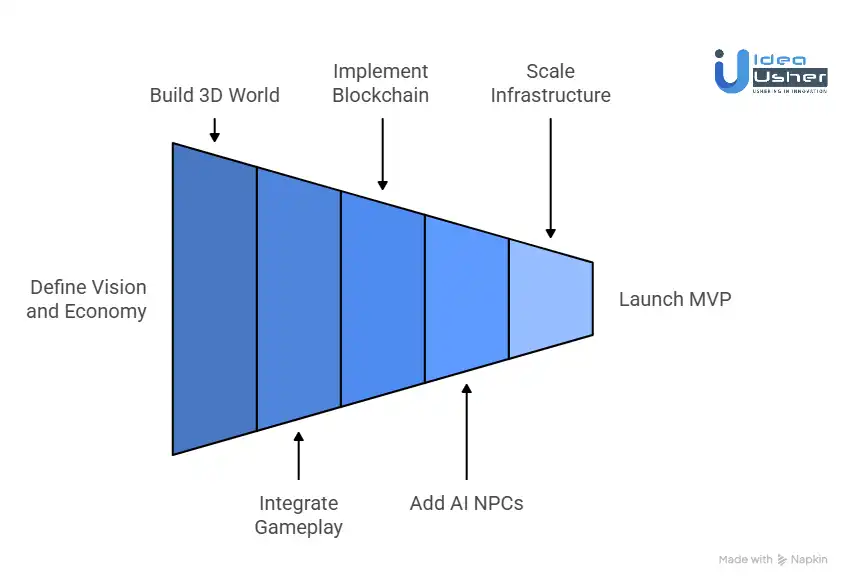
We’ve worked on high-fidelity metaverse platforms like Wilder World, and this is how we bring them to life.
1. Vision and Economy
We start by defining the purpose of your world and the incentives that drive it. We believe a platform without a clear social or economic loop will fail to retain users. We help you decide if your world is a social hub, a competitive arena, or a commerce center.
- Target Audience. We determine if you are catering to high-end VR users or a broader mobile audience.
- Economic Loop. We design how currency enters and exits the system.
- Monetization. We map out primary sales and secondary marketplace fees.
2. 3D World and Architecture
We choose powerful engines like Unreal Engine 5 to handle the heavy lifting of photorealism. We build your architecture to support persistent environments where user changes are saved in real time.
- Metropolis Engine. We use a decentralized engine approach to allow modular world-building.
- Spatial Partitioning. We divide your world into cells so the system only renders what is near the player.
- Visual Standards. We implement Physically Based Rendering so materials look real under any light.
3. Gameplay and Systems
We know the world needs activities to stay alive. We build responsive systems for movement, combat, or social interaction. For example, we look at how Wiami Wheels Alpha provides a high-fidelity racing loop that gives immediate utility to digital vehicle assets.
4. Blockchain and Contracts
We integrate a secure layer for ownership and transactions to turn your digital items into real-world property.
| Tech Layer | Our Choice | Role |
| Identity | ZERO ID | Universal user profile and login. |
| Network | Z Chain | High-speed transactions for international trades. |
| Assets | Wilder Wheels | Smart contracts for unique and functional items. |
5. AI-Driven NPC and Quest Logic
To ensure the world feels alive even when player counts fluctuate, we integrate advanced AI agents. We use Large Language Models, so these characters provide dynamic, unscripted interactions and personalized quests. We leverage tools like Inworld AI to create lifelike personalities that help maintain immersion and guide your new citizens.
6. Federated Server Infrastructure
We scale photorealistic worlds using a robust backend that handles massive concurrency. We use federated server clusters to distribute the computational load across multiple nodes. This ensures that a high-profile event, like a virtual concert in Somnium Space, does not crash the entire ecosystem for your other users.
7. Test and Launch MVP
We launch with a Minimum Viable Product that focuses on one core loop, like a social plaza or a racing circuit. This allows us to gather data and stress test your servers before a full-scale release.
- Stress Testing. We simulate thousands of concurrent users to find network bottlenecks.
- Community Beta. We invite early adopters to provide feedback on the economic balance.
- Scale Up. We gradually open new sectors of the world like expanding from a single city block to an entire metropolis. We follow the staggered approach used by Star Atlas to release browser-based mini games while the full AAA experience is under development.
Tech Stack for AAA Metaverse Platform Like Wilder World
Building photorealistic metaverse platforms requires a sophisticated fusion of game engine power, decentralized security, and massive cloud scale. When we architect these worlds for our clients, we utilize a modular stack that ensures high fidelity performance across devices.
This foundation allows a virtual nation to support thousands of concurrent users without losing visual integrity.
1. Photorealistic Game Engines
We rely on Unreal Engine 5 as the primary engine for any AAA metaverse project. It provides the necessary tools to achieve cinematic visuals in real time.
- Nanite. We use virtualized geometry to render billions of polygons, allowing us to use film-quality assets without performance drops.
- Lumen. This provides dynamic global illumination to ensure light bounces and reflections react instantly to world changes.
- MetaHuman. We leverage this to create hyper-realistic characters with complex bone structures and skin shaders.
2. Blockchain Asset Networks
To ensure true digital property rights, we integrate with high-performance blockchain layers. We follow the lead of Wilder World by using a multi-chain approach.
- Ethereum. We use this for high-value asset settlement and long-term security.
- Z Chain. We utilize this hyper-fast Layer 2 for recording high-frequency gameplay interactions and low-cost trades.
- Account Abstraction. We implement this so users play without managing complex wallet keys, making the blockchain layer invisible but secure.
3. Scalable Cloud Infrastructure
High-end graphics require more power than the average mobile device can provide. We solve this through Scalable Cloud Orchestration.
- Pixel Streaming. We host the engine on powerful GPU instances and stream the rendered pixels to the user’s browser. This allows a photorealistic experience on any device.
- Edge Computing. We deploy servers closer to the user to reduce latency for competitive racing or combat.
- Distributed Storage. We use IPFS to ensure that NFT metadata and 3D assets are stored permanently and cannot be deleted by a single entity.
4. AI and World Simulation
We use AI to transform static environments into living ecosystems. Our stack includes:
- LLM Integration. We integrate tools like Inworld AI to give NPCs memories, personalities, and the ability to hold unscripted conversations.
- Procedural Generation. We use AI to generate infinite variations of terrain and weather patterns so the world grows dynamically.
- Economic Agents. We deploy AI bots to monitor the marketplace and prevent hyperinflation or market manipulation.
5. Real-Time Networking
The social fabric of the metaverse depends on Massive Concurrency. This is the ability for thousands of people to see each other at once.
- Netcode. We implement advanced interest management where your client only receives data for things happening in your immediate virtual vicinity.
- WebRTC. We use this for low-latency voice and video chat between avatars to create a seamless social experience.
- Auto Scaling Servers. We utilize clusters that spin up new instances as the population in a specific virtual city or zone increases.
How to Architect a City-Scale Virtual World in Metaverse Platforms?
Architecting photorealistic metaverse platforms at the city scale requires a shift from level design to infrastructure engineering. Building a virtual metropolis like Wilder World Wiami demands a balance between visual fidelity and network stability.
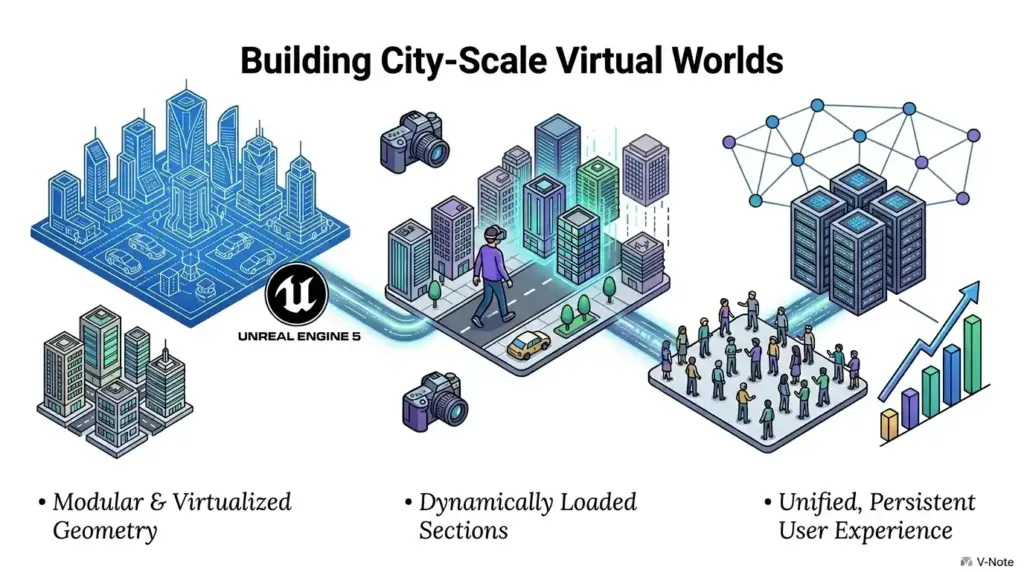
Advanced spatial systems ensure a user can look down from a skyscraper at a bustling street without the system collapsing under the data load.
1. Large Maps
The problem of infinite detail is solved by using virtualized geometry and modular building blocks. In traditional games, every object adds a heavy draw call to the processor. This bottleneck is eliminated by leveraging Unreal Engine 5 Nanite.
- Geometry Clusters. Nanite breaks assets into tiny clusters that scale detail based on distance. This allows the placement of millions of high-polygon objects without killing the frame rate.
- Modular Architecture. Designing cities using kits of optimized, reusable parts reduces unique memory data while allowing for unique skyscrapers and districts.
2. Real Time Streaming
Users never see a loading screen when a platform implements World Partition. This system breaks the city into a grid of cells that load and unload dynamically as the user moves.
- HLODs. When a player looks at a distant skyline, the engine does not render every window. Hierarchical Levels of Detail combine thousands of distant objects into a single low-memory proxy.
- Streaming Bubbles. Streaming sources attach to players. As they fly or drive, the world builds itself ahead of them and dissolves behind them to save resources.
- Data Layering. Keeping city logic like shop locations on a separate layer from high fidelity visuals allows the world to function even while textures are still loading.
Technical Insight. Prioritizing the visual horizon creates the illusion of a massive, solid world, while the hardware only processes the specific block the player currently occupies.
3. Thousands of Concurrent Users
The social fabric of the metaverse depends on massive concurrency. This is achieved through spatial partitioning and interest management.
| ScalingTechnique | Application | Benefit |
| Spatial Sharding | Splitting the city into different server instances. | Prevents a crowd in the center from lagging a user in the suburbs. |
| Interest Management | Sending data only for things the player can actually see. | Dramatically reduces bandwidth for thousands of players. |
| Edge Compute | Deploying city logic to servers closer to the user. | Essential for real time racing or combat interactions. |
Combining these layers creates worlds that feel like a single unified experience. Platforms like Everdome use these principles to render Martian colonies, ensuring scale never compromises performance. A city must be a living machine that scales automatically as the community grows.
Cost to Build a Photorealistic Metaverse Platform Like Wilder World
Building photorealistic metaverse platforms like Wilder World requires significant capital investment. The fusion of AAA gaming visuals, blockchain security, and cloud infrastructure moves the budget far beyond traditional app development. To succeed, investors must balance high-end art production with complex backend engineering to ensure the platform can scale.
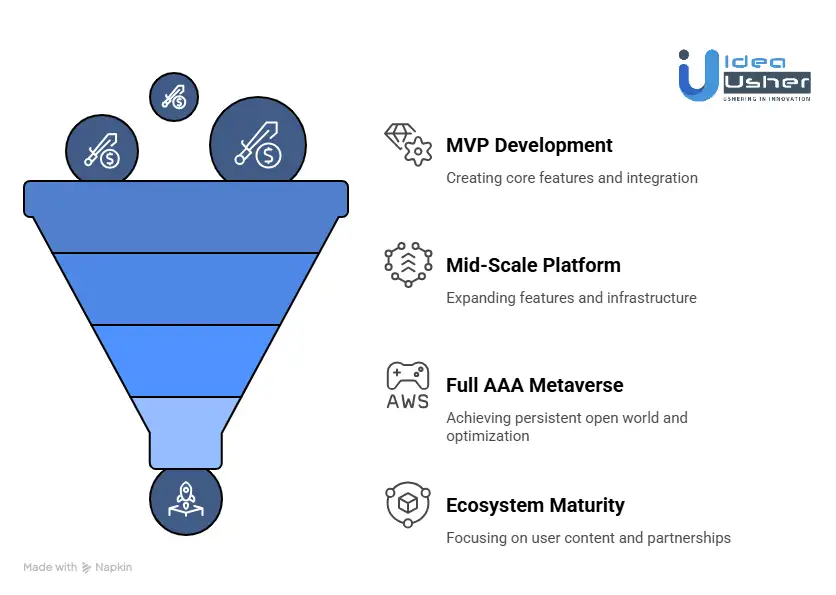
Feature and Scale Breakdown
Total costs vary based on the level of fidelity and the complexity of the economic systems. A high-fidelity world with custom assets and thousands of players generally falls into these tiers.
| Development Phase | Estimated Cost (USD) | Core Deliverables |
| Initial MVP | $500,000 – $1,500,000 | Core movement, one social zone, and basic wallet integration. |
| Mid-Scale Platform | $2,000,000 – $7,000,000 | Multiple city districts, vehicle physics, and NFT marketplace. |
| Full AAA Metaverse | $10,000,000+ | Persistent open world, AI NPCs, and cross-platform optimization. |
Budget Impact Factors
Several technical variables can cause the budget to fluctuate. The goal is to spend efficiently on the features that drive user retention and asset value.
- Asset Creation. Custom 3D modeling using photogrammetry is more expensive than using stock libraries but is required for true photorealism.
- Network Infrastructure. Supporting high concurrency requires expensive server clusters and spatial partitioning tech.
- Blockchain Complexity. Custom smart contracts for complex mechanics like asset leasing or DAO governance add to the security audit costs.
Economic Note. Security audits by firms like CertiK or Hacken are non-negotiable for high-capital platforms. Expect to spend $30,000 to $100,000 on audits alone to ensure the economy is safe from exploits.
Timeline: MVP to Full Scale
Developing a platform of this caliber is a marathon. A staggered release strategy allows for community building and capital generation while the full world is built.
- Months 1-6: Prototype and Architecture. Establishing the tech stack in Unreal Engine 5 and deploying the initial blockchain layer.
- Months 6-12: MVP Launch. Releasing a playable loop like Wilder World did with its racing or social modules.
- Months 12-24: Expansion. Adding new city sectors, expanding AI capabilities, and optimizing for mobile via cloud streaming.
- Beyond Month 24: Ecosystem Maturity. Focusing on user generated content tools and institutional partnerships.
Designing a Sustainable Player-Owned Economy
A sustainable economy is the difference between a short-lived trend and a multi-billion-dollar nation-state. In photorealistic metaverse platforms, the economy must be built on tangible utility and circular value flow. Investors should prioritize models where the platform earns from transaction volume and ecosystem health rather than just the initial sale of assets.
1. Token Utility Beyond Speculation
For a native token to survive, it must be a required tool for participation. If the token is only used to buy assets and then cashed out, the economy will collapse under sell pressure.
- Service Fees. Use tokens for in-world services like teleportation or repairs.
- Access Gating. Holding tokens can grant entry to premium social zones.
- Governance Weight. The token gives users a voice in the DAO to shape the world.
2. NFT Scarcity and Value
Value in a digital world is driven by a combination of utility and rarity. A platform must balance mass adoption with the need for high-value collector items.
The Golden Rule. If everyone owns a legendary item, no one does. Scarcity must be provable on the blockchain and visible in the world.
Wilder World serves as a prime example with Wilder Wheels. While many cars exist, certain models have performance stats and visual rarities that make them sought after for racing and status. Similarly, Star Atlas utilizes extreme scarcity for its high-tier spacecraft, ensuring that massive capital ships remain rare and prestigious assets within its galactic economy.
3. Digital Asset Monetization
Revenue in a photorealistic metaverse comes from the continuous movement of goods. By creating a high-fidelity environment, you invite high-margin digital fashion and luxury brands to participate.
| Revenue Stream | Description | Investor Benefit |
| Primary Sales | Selling initial land or skins. | Rapid capital injection. |
| Marketplace Fees | Taking a cut of peer-to-peer trades. | Sustainable passive income. |
| Leasing Models | Renting out assets to other players. | Increases asset utility. |
4. Avoiding Virtual Inflation
Hyper-inflation is the silent killer of virtual worlds. If tokens or assets are generated too quickly without being removed, their value will plummet.
To maintain health, developers must implement Sinks and Burns:
- Crafting Sinks. Requiring users to destroy lower-tier assets to create higher-tier ones.
- Transaction Burns. Permanently removing a portion of every transaction fee from the supply.
- Maintenance Costs. Charging fees for asset upkeep, like vehicle fuel, ensures currency flows back into the treasury.
By focusing on these circular mechanics, you ensure wealth remains stable. This attracts institutional investors who seek long-term security over short-term hype. Illuvium successfully manages this through its integrated vault system, which redistributes revenue to stakers, while Everdome uses land-based scarcity to drive long-term value for its Martian settlement assets.
Challenges in Building a Photorealistic Metaverse Platform
Developing photorealistic metaverse platforms involves navigating a complex landscape of technical and social hurdles. We solve the conflict between cinematic quality and the practicalities of global accessibility. Our team builds high-end rendering pipelines while simultaneously securing a trustless economy that can withstand regulatory scrutiny.
1. Performance Optimization at Scale
The Challenge: High-fidelity assets require massive computational power. This often alienates users with mid-range devices or causes lag during high-speed interactions like racing.
How We Tackle It: We implement Pixel Streaming to offload heavy rendering to powerful cloud GPUs. This allows a smartphone user to experience AAA graphics without overheating their device. We also use Hierarchical Levels of Detail (HLODs) to ensure the engine only processes what is visible to the player, maintaining high frame rates across all hardware tiers.
2. Blockchain and Security Risks
The Challenge: A single vulnerability in a smart contract can lead to the theft of user assets or a total drain of the platform treasury.
How We Tackle It: We prioritize a multi-layered security approach. This includes implementing multi-signature wallets for all treasury movements and undergoing rigorous third-party audits with firms like CertiK. We also build custom monitoring tools that flag suspicious on-chain activity in real time, allowing us to pause specific contracts before an exploit can escalate.
3. Maintaining User Retention
The Challenge: High-end graphics attract users for an initial visit, but a lack of meaningful activity leads to rapid churn and an empty world feeling.
How We Tackle It: We focus on Incentiveized Gameplay Loops that reward long-term participation. We integrate AI-driven NPCs to provide constant social density and dynamic questing. By giving users tools to create their own content and storefronts, we ensure the world evolves daily, mirroring the successful retention strategies used by platforms like Wilder World and Illuvium.
4. Regulatory and Legal Concerns
The Challenge: Global jurisdictions have vastly different views on tokens and NFTs. Navigating these moving targets is essential for long-term viability.
How We Tackle It: We design our virtual economies with Compliance by Design. This means we integrate modular KYC (Know Your Customer) systems that can be toggled based on the user’s region. We work closely with legal experts to ensure native tokens maintain clear utility, helping our clients avoid security classifications while staying ahead of international digital asset laws.
What Investors Look for in Metaverse Startups Like Wilder World?
Investors viewing photorealistic metaverse platforms such as Wilder World look beyond basic visuals to find evidence of a functioning digital society. In a market that has matured past pure speculation, capital flows toward platforms that prove they can sustain an economy and a community simultaneously.
High-fidelity graphics serve as the hook, but the underlying data structures and revenue stability are what secure the funding.
1. Metrics That Signal Growth
In the current landscape, simple user registration counts are considered vanity metrics. Investors now deep dive into behavioral data to determine if a world is truly alive.
- Net Revenue Retention. This tracks how much revenue is retained from existing users after accounting for churn. High retention suggests that once a user enters the ecosystem, they continue to spend on assets or services.
- Daily Active User Depth. Beyond just logging in, investors look at time spent per session. In a photorealistic world, longer sessions indicate higher immersion and better content quality.
- Transaction Velocity. The frequency at which NFTs are traded in the secondary marketplace indicates a healthy, liquid economy rather than a stagnant collection of digital items.
2. Funding Ready Revenue Models
Modern funding rounds favor hybrid models that combine traditional software as a service stability with decentralized marketplace dynamics.
| Model Type | Revenue Source | Investor Appeal |
| Marketplace Fees | Taking a 2% to 5% cut of every peer to peer trade. | Provides recurring income that scales with user activity. |
| Deflationary Design | Using platform revenue to burn or remove tokens from supply. | Increases scarcity and value of the native token for all holders. |
| Brand Partnerships | Collaborative drops like the Lamborghini and Wilder World integration. | Validates prestige and brings in external marketing capital. |
3. Long-Term Scalability
Scale is the ultimate hurdle for photorealism. Investors back teams that can bridge the gap between high-end hardware and mass market accessibility.
- Infrastructure Agnosticism. A platform must prove it can eventually move across chains or integrate with various cloud providers without a total rebuild.
- Modular Engine Design. Using a metropolis engine-style approach allows for the world to grow district by district. This prevents the platform from becoming a monolithic, unmanageable piece of software.
- Governance Maturity. Transitioning toward a Decentralized Autonomous Organization shows investors that the community is incentivized to maintain the world even if the original development team steps back.
Investor Insight. The golden era of pre-seed investing has shifted toward product-market fit. Startups must now show a playable loop like a racing module or a social hub before asking for significant Series A or B capital.
Wilder World successfully signaled this by launching Wiami Wheels Alpha, providing immediate utility for their vehicle assets while the broader city was still in production.
Why Choose IdeaUsher for Your Metaverse Project?
Choosing the right partner for photorealistic metaverse platforms is the difference between a static gallery and a thriving nation. At IdeaUsher, with over 500,000 hours of coding experience, our team of ex-MAANG/FAANG developers understands how to bridge the gap between blockchain architecture and AAA visual fidelity.
AAA App Scalability
The technical heavy lifting required for massive open worlds is our core competency. By leveraging Unreal Engine 5 and custom pixel streaming pipelines, we ensure your app delivers cinematic quality on high-end PCs and mobile devices alike.
- Modular Architecture: We build district by district, so your app expands without a total code rebuild.
- High Concurrency: Custom server sharding allows thousands of players to interact in a single zone.
- Asset Optimization: Automated pipelines ensure 8K textures do not crash the mobile experience.
ROI Driven App Strategy
We prioritize a product strategy focused on long-term economic health and investor appeal. By designing circular economies with meaningful token utility, we ensure your app generates value from the first download.
- Core Loops: We identify activities like racing or social gaming that drive daily active users.
- Marketplace Volume: We build systems that encourage secondary trading and recurring revenue.
- Monetization: Our apps integrate scalable payment gateways without gas fee spikes.
Custom Vision Engineering
We avoid the generic templates that plague the industry. Every app we ship is a bespoke creation tailored to your specific brand identity and user goals.
Our Technical Edge
We implement universal login via OAuth or Wallet to lower friction and increase sign-ups. Our team integrates Nanite and Lumen to set your app apart as a true AAA product. We also deploy dynamic NFT minting on the fly for seamless scaling.
Whether building a racing ecosystem like Wilder World or a settlement like Everdome, we provide the native optimization needed for a seamless user journey. Our dedicated infrastructure ensures your app stays online during high traffic events.
Conclusion
Building a world that rivals Wilder World requires a relentless focus on the intersection of high-fidelity art and decentralized systems. Success lies in launching a targeted, high-quality MVP that proves your economic model before expanding into a full-scale metropolis. By integrating powerful engines like Unreal Engine 5 with scalable blockchain layers, you create a persistent digital reality where users feel true ownership and immersion. Ultimately, a photorealistic platform is more than just a visual achievement; it is a living ecosystem that grows alongside its community.
FAQs
A1: Creating a social metaverse begins with defining the social loop and choosing a high-performance engine like Unreal Engine 5 for photorealism. Developers must integrate a robust networking layer to handle real-time interactions and a blockchain backend to manage user identities and digital assets. Launching with a focused social hub allows for community testing before expanding into a full-scale virtual world.
A2: These platforms generate revenue through a mix of primary asset sales, secondary marketplace transaction fees, and brand partnerships. Many worlds also utilize land sales where users purchase digital territory to host their own events or storefronts. Additional streams include premium subscriptions, in-world advertising, and service fees for specialized avatar customizations or tools.
A3: The metaverse is generally categorized into four quadrants based on its technological focus and user experience. These include Augmented Reality, which overlays digital data on the physical world, Lifelogging, which captures and streams real-world data, Mirror Worlds, which are digital twins of our physical environment, and Virtual Worlds, which are entirely simulated spaces designed for social or economic immersion.
A4: A successful social metaverse requires high-fidelity avatars with deep customization to allow for personal expression. Real-time communication tools like spatial audio and video chat are essential for creating an immersive sense of presence. Furthermore, the platform must offer persistent environments where user actions leave a lasting impact, and decentralized ownership systems that give players control over their digital property.