


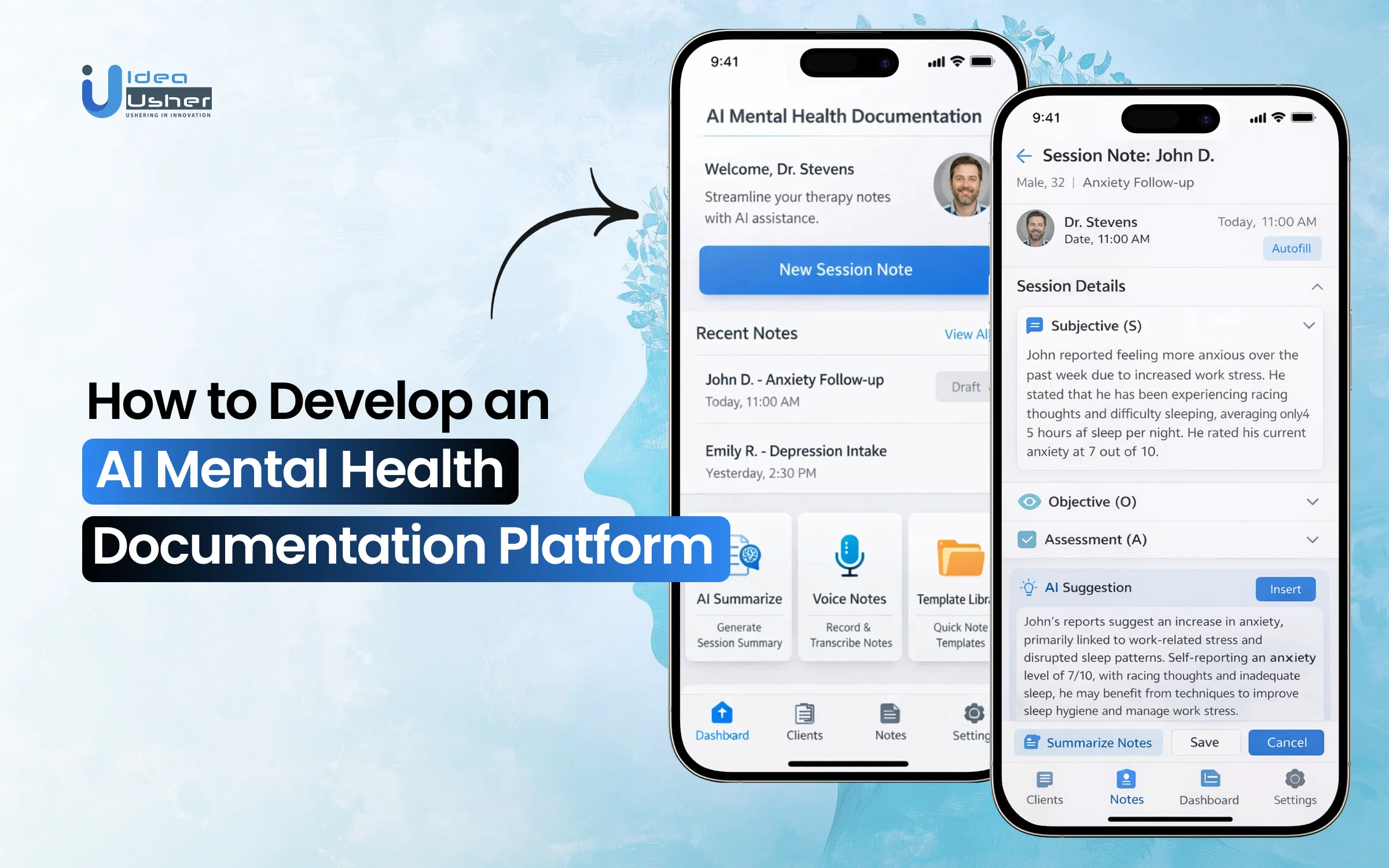
After a therapy session ends, the real workload often begins for clinicians. Notes must be accurate and compliant, but they depend on memory and limited time. This process can quickly become a serious operational burden in daily practice. As patient demand steadily grows, documentation standards also continue to rise.
Many people have started using AI mental health documentation platforms because they can automatically capture sessions and generate structured notes in real time. These systems may also improve consistency and reduce documentation errors. Clinicians can therefore focus more on care while maintaining efficient documentation workflows.
Over the years, we’ve developed numerous ambient AI systems and clinical natural language processing solutions. As we’ve built this expertise, we’re sharing this blog to discuss the steps to develop an AI mental health documentation platform.
Why Manual Therapy Notes Break at Scale Today?
According to Dataintelo, the global AI medical scribe software market was valued at $2.8 billion in 2025 and is projected to reach $14.6 billion by 2034, expanding at a CAGR of 20.2% during the forecast period 2026 to 2034. This growth is a response to the collapse of manual documentation models. In manual therapy, where practitioners rely on physical intuition and high patient turnover, the friction between clinical care and admin requirements has reached a breaking point.

Source: Data Intelo
Scale introduces a paradox: as a practice grows, the time for each patient decreases while regulatory demands for detail increase. In high-volume clinics, therapists see 12 to 18 patients daily. If each session requires 15 minutes of manual entry, the math becomes unsustainable. This is a massive operational bottleneck for investors.
The break occurs because manual systems are non-linear and prone to error under pressure. When documentation is a post-hoc chore, data quality suffers. This degradation affects everything from billing accuracy to patient outcomes. Scalability now requires shifting from human-dependent documentation to automated, ambient systems.
Hidden Revenue Loss
The most immediate financial drain is documentation lag. When therapists fall behind on notes, the revenue cycle stalls. Claims cannot be submitted without a signed note. Longer gaps between the date of service and submission increase the probability of timely filing denials.
Beyond delays, thin notes lead to under-coding. A therapist in a rush often defaults to lower-level codes to stay safe. Platforms like Freed AI have proven that automating this process can capture the full value of a visit. AI-driven precision ensures every billable unit is backed by evidence, capturing revenue without increasing audit risk.
Therapist Burnout
The manual medicine sector faces a retention crisis. Many clinicians cite emotional burnout as the reason for leaving traditional practice. The root cause is rarely patient care. It is the hours spent at home, after the clinic closes, finishing SOAP notes.
For an entrepreneur, solving burnout is a competitive advantage. High turnover is expensive, costing practices upwards of $150,000 per therapist in recruitment. Ambient AI tools like Berries, which is specifically tuned for the nuance of mental health and therapeutic dialogue, act as a digital assistant. This increases clinical capacity and improves long-term clinic value.
Legacy EHR Failures
Legacy EHRs were designed for billing, not for the hands-on workflow of a manual therapist. These systems require dozens of clicks to navigate a single note. This forces the clinician to choose between eye contact with the patient or staring at a screen.
Most legacy systems rely on rigid templates and copy-forward functionality. While this saves time, it creates cloned notes that suggest the patient’s condition hasn’t changed. This is a major red flag for auditors. Modern investors are moving toward ambient intelligence that extracts data automatically.

What Is an AI Mental Health Documentation Platform
An AI mental health documentation platform is a software layer between the therapist and the patient. It uses artificial intelligence to transform conversational audio into medical records.
Unlike standard transcription, these platforms use clinical logic. They interpret intent and emotional cues to create a professional clinical narrative.
For investors, the value is the shift to passive data capture. It turns a non billable chore into an automated background process. This ensures records are precise and reduces human memory bias.
Ambient to Structured Notes
Ambient listening captures dialogue through a microphone. The AI filters out small talk to focus on clinically significant data.
The transition follows a specific pipeline:
- Acoustic Processing: Converting voice to text with high accuracy.
- Clinical Filtering: Identifying indicators like mood and affect.
- Structural Synthesis: Organizing data into required medical headers.
This process ensures the final output is a summarized clinical document, not a raw transcript.
Auto-Generating SOAP and DAP
The platform uses machine learning trained on clinical interactions to categorize data. It recognizes where information belongs in SOAP or DAP formats.
The auto-generation logic works as follows:
- Subjective: The AI identifies reported symptoms and patient progress.
- Objective: It notes behaviors like tone of voice or restlessness.
- Assessment: The system synthesizes the therapist’s interpretation.
- Plan: The AI captures homework and the next appointment time.
Documentation Timing Models
Investors should recognize the two primary models in the current market:
| Feature | Real Time Generation | Post Session Generation |
| Delivery Speed | Instant; ready in seconds. | Delayed; takes 5 to 15 minutes. |
| Therapist Control | High; allows live editing. | Moderate; requires later review. |
| Processing Depth | Leaner models for speed. | Heavier models for complexity. |
| Ideal Use Case | High velocity clinics. | Detailed trauma or private work. |
NLP in Context Extraction
Natural Language Processing allows the platform to understand context. In mental health, meaning changes based on the conversation flow.
NLP performs several critical functions:
- Sentiment Analysis: Detecting emotional shifts that indicate breakthroughs.
- Entity Recognition: Identifying mentions of medications or dosages.
- Risk Detection: Flagging language related to self-harm.
- Action Item Extraction: Pulling out referrals and follow-up tasks.
By using NLP, these platforms become a layer of clinical intelligence. This supports better decision-making for the provider.
How AI Scribes Transform Therapy Workflows?
The adoption of AI mental health documentation platforms represents a fundamental shift toward patient-centered care. In traditional settings, therapists are often divided between the patient and the keyboard. This split attention creates a digital barrier that can stall therapeutic progress.
By automating clerical burdens, these platforms allow therapists to return to deep listening. For the business owner, this means higher-quality care delivered in less time. It transforms the session into a pure clinical interaction where documentation is a natural byproduct of the conversation.
Capturing Rapport-First Sessions
The therapeutic alliance is the strongest predictor of successful outcomes. When a therapist looks at a screen to type, that alliance is weakened. Ambient AI operates in the background, allowing for a completely hands-free experience.
Leading platforms like Upheal and Mentalyc specialize in this ambient approach. They tune audio capture specifically to the soft, nuanced dialogue of therapy.
Similarly, Ambience Healthcare and Suki provide robust ambient intelligence. These systems integrate into existing health records, ensuring the practitioner never has to break eye contact with the patient.
- Eye Contact: Practitioners maintain consistent engagement.
- Presence: Therapists pick up on subtle body language cues.
- Safety: Patients feel heard and validated rather than processed.
This non-intrusive capture ensures technology serves the relationship rather than distracting from it.
Detecting Clinical Markers
Modern AI does more than record; it analyzes. In a 50-minute session, a patient might drop dozens of subtle signals. AI platforms are trained to identify clinical markers that a fatigued human might overlook.
Key Detection Capabilities:
- Affective Shifts: Recognizing when a patient’s tone shifts from neutral to avoidant.
- Symptom Tracking: Identifying the frequency of issues like insomnia or panic attacks.
- Crisis Indicators: Alerting the provider to language that mirrors risk patterns.
This level of insight provides a second set of eyes on every case. It enhances the safety and depth of the clinical record without adding to the therapist’s cognitive load.
Automated Coding and Planning
The final minutes of a therapist’s hour are usually a rush to summarize. AI scribes handle this instantly. They translate conversational therapy into the formal language required by insurance payers.
Specialized tools like Eleos Health further enhance this by providing real-time clinical insights. They ensure that summaries align with evidence-based frameworks and medical necessity requirements.
- Summarization: Condensing a session into a concise narrative.
- Coding: Suggesting accurate ICD-10 or CPT codes based on session content.
- Treatment Alignment: Ensuring notes reflect goals in the long-term treatment plan.
This automation ensures every note is audit-ready the moment the session concludes. It removes guesswork from billing and speeds up the reimbursement cycle.
70% Less Documentation Time
The most compelling metric for an investor is the reduction in non-billable time. Industry data shows AI-integrated platforms can reduce time spent on notes by over 70%.
| Task | Manual Workflow | AI-Enhanced Workflow |
| Note Completion | 10 to 20 Minutes | 2 to 3 Minutes |
| Review & Sign-off | Manual Synthesis | AI Draft Review |
| Administrative Prep | High Stress | Low Friction |
| Weekly Admin Debt | 5 to 10 Hours | Under 2 Hours |
For a clinic with ten therapists, this recovery translates to hundreds of hours of capacity every month. This time can be redirected toward seeing more patients or preventing burnout.
By reclaiming these hours, practices can significantly increase their revenue per provider while lowering overhead costs related to administrative staffing and clinician turnover.
Key Features for AI Mental Health Documentation Platforms
When evaluating AI mental health documentation platforms, users look for features that boost clinical throughput and reliability. The market is shifting from generic transcription toward specialized systems that understand behavioral health nuances.
You should prioritize tools that function as clinical assistants rather than simple recorders. These features directly impact the ROI of a practice by reducing administrative overhead and improving the defensibility of clinical records.
1. Accurate Ambient Voice Capture
The system must capture dialogue clearly without requiring expensive external microphones. It needs to differentiate between the therapist and the patient while filtering background noise.
For example, Noted excels in real-time accuracy, allowing clinicians to highlight key themes during sessions. High accuracy ensures terminology and medications are transcribed correctly, even in emotional or whispered conversations.
2. Custom Therapy Templates
A universal approach fails because CBT requires different documentation than family therapy. Buyers seek modular platforms that allow switching between SOAP, DAP, or custom templates.
AutoNotes is a leader in this space, offering specialized templates built for behavioral health professionals. This flexibility ensures the output matches the therapist’s specific clinical reasoning and treatment goals.
3. EHR and Billing Integration
Scalable platforms must eliminate “copy-paste” workflows. Integration with major Electronic Health Records is a non-negotiable requirement for large practices.
Platforms like Supanote utilize technology to natively populate EHR fields, bypassing the friction of manual entry. API-first architectures allow the AI to push notes directly into patient charts, triggering billing cycles and improving cash flow.
4. Language and Accent Adaptability
Handling diverse accents and multiple languages is a major competitive advantage. Advanced platforms can transcribe sessions in various languages with high fidelity.
Nabla provides robust multilingual support, enabling high-fidelity transcription for providers working with non-English speaking populations. This ensures functionality for community health centers serving multicultural populations, expanding the platform’s total addressable market.
5. Secure, Audit-Ready Storage
Security is a primary barrier to entry. Buyers demand more than basic HIPAA compliance, seeking end-to-end encryption and SOC2 Type II certification.
Specialized tools like Medwriter offer enterprise-grade security with activity logs and configurable data deletion. Detailed audit logs must track access and edits, providing a defensible paper trail for legal or insurance reviews.
6. Real-Time Clinician Feedback
Advanced platforms allow clinicians to correct drafts while the AI learns from those edits. This feedback loop ensures the system evolves to match the therapist’s unique professional voice.
Heidi Health utilizes this feedback loop, allowing practitioners to customize default templates over time. This evolution ensures the system becomes more efficient, eventually reducing the review time needed for each document to just a few minutes.
Advanced Capabilities That Differentiate Platforms
Next-generation AI mental health documentation platforms are defined by clinical intelligence. These systems do not just record sessions; they analyze them to provide actionable insights.
By leveraging machine learning, these platforms transform documentation into a dynamic therapeutic tool. They help catch subtle details that a human might miss during a high-intensity session.
1. Behavioral Pattern Detection
Modern AI tracks subtle shifts in patient behavior across months of sessions. It analyzes linguistic markers to identify cycles of depression or anxiety that may not be obvious in a single visit.
Skriber is a leader here, flagging key themes and showing clinicians if anxiety mentions have increased session-over-session. This longitudinal view allows for data-driven adjustments to a patient’s treatment plan.
2. AI-assisted Treatment Suggestions
Developing measurable treatment plans is often the most time-consuming task for a therapist. Advanced platforms now use session content to suggest SMART goals and interventions.
Mentalyc offers an AI treatment planner that creates goal-focused plans in minutes. It captures insights directly from the session to ensure goals are clinically aligned and insurance-ready.
3. Risk Flagging for Crisis Indicators
Safety is the highest priority in mental healthcare. AI platforms now feature models designed to flag language associated with self-harm, ideation, or domestic risk.
Eleos Health utilizes specialized behavioral health machine learning to scan notes and flag trouble spots instantly. This acts as a safety net, ensuring crisis indicators are documented and addressed without delay.
4. Longitudinal Insight Dashboards
Documentation is often siloed, making it hard to see the big picture. Advanced platforms solve this by aggregating data into visual dashboards that show mood trends and symptom severity.
Upheal provides session analytics, such as talking ratios and progress metrics, to help clinicians understand session dynamics. These dashboards serve as a powerful tool for demonstrating patient progress over time.
5. Voice Biomarker Analysis
A cutting-edge frontier is the analysis of vocal biomarkers—acoustic features like pitch and speech pauses. These cues can indicate emotional shifts before they are verbalized.
Canary Speech pioneered this technology, providing a “Voice Score” that assesses stress and energy levels. By integrating this into documentation, clinicians gain an objective layer of data to inform more precise treatment decisions.
HIPAA Compliance and Data Security Architecture
In AI mental health documentation platforms, security is the foundation. Because therapy sessions contain sensitive Protected Health Information (PHI), architectures must use a Zero-Trust mindset. This ensures every access request is verified and patient confidentiality is maintained at a digital level.
Encryption And Secure Pipelines
Security begins the moment the microphone is activated. Platforms like Upheal and Nabla utilize TLS 1.3 for data in transit and AES-256 for data at rest.
- Transcription Tunnels: Audio streams through an encrypted pipeline directly to private cloud instances.
- Zero-Retention Policies: High-end providers like BastionGPT use volatile memory processing where raw audio is deleted immediately after note generation.
- Quantum-Ready Guardrails: Modern architectures incorporate post-quantum cryptography to protect records against future decryption threats.
Access And Audit Controls
A compliant platform ensures data is only visible to those who need it. Through Role-Based Access Control (RBAC), permissions are tiered so that billing staff see codes while only therapists see session narratives.
The Audit Trail:
Every interaction (viewing, editing, or exporting) is captured in an unalterable log. Platforms like Mentalyc and Medwriter provide audit-ready logs. These offer a timestamped history of who accessed data to protect the practice during regulatory reviews.
Storage And Anonymization
Data management requires a balance between clinical utility and patient privacy. Platforms follow strict retention laws while minimizing breach risks.
| Strategy | Technical Execution | Clinical Benefit |
| De-Identification | Redacts Names and SSNs from notes automatically. | Allows safe use in clinical supervision. |
| Tokenization | Replaces PHI with digital tokens during AI processing. | AI models never see the patient’s true identity. |
| Local Residency | Stores data on specific geographic servers (e.g., US-only). | Meets strict legal and data sovereignty laws. |
Compliance-First Design
For a clinician to adopt AI, they must trust that the Business Associate Agreement (BAA) is backed by technical reality. Compliance-first design means security was the first line of code written.
By achieving certifications like SOC2 Type II and HITRUST, platforms like Heidi Health and Lindy provide external validation of their security. This ensures that while the AI assists with documentation, it never compromises the sacred privacy of the therapeutic space.
How to Develop an AI Mental Health Documentation Platform?
Build an AI mental health documentation platform by capturing sessions in real time and converting speech into structured clinical notes using NLP models. It should securely process data and could consistently map outputs to formats like SOAP so clinicians can efficiently complete documentation.

We have developed several AI mental health documentation platforms, and this is how it is done.
1. Define Clinical Workflows
We map your unique clinical sequences to ensure the AI speaks your language. Whether your team relies on SOAP, DAP, or BIRP, we configure the system to capture the data required for your compliance. This ensures the AI identifies critical clinical markers, such as mental status exams, rather than just transcribing general conversation.
2. Select AI Models
Our technical core utilizes a specialized pipeline designed for the nuances of behavioral health. We fine-tune ASR to handle soft voices and medical jargon, paired with a clinical reasoning NLP engine. These models link dialogue to standardized codes for high-fidelity documentation that meets professional clinical standards.
3. Design Ambient Listening
We design the experience to be non-intrusive, allowing clinicians to focus on the patient. Our systems utilize advanced speaker diarization to distinguish between the therapist and the patient. We implement noise-filtration algorithms that scrub out background distractions, producing a high-accuracy transcript that requires minimal human correction.
4. Build Secure Pipelines
Security is the cornerstone of every platform. We implement a Zero-Trust architecture with end-to-end encryption for all data. Our pipelines include automated de-identification layers, redacting Protected Health Information (PHI) before processing to ensure your platform is HIPAA compliant from the very first day of deployment.
5. Integrate EHR Systems
To maximize ROI, we eliminate administrative friction by integrating directly with your Electronic Health Records. Using the FHIR R4 standard, we build secure API hooks that allow therapists to push finalized notes into patient charts with a single click. This automates code suggestions and bridges the gap between the session and the revenue cycle.
6. Iterate With Real Data
We enter a rigorous testing phase with your clinical team to refine the AI. We focus on eliminating “hallucinations” and ensuring the tone matches your professional standards. By analyzing how therapists interact with drafts, we continuously iterate to increase accuracy and build deep user trust across your entire organization.
Cost to Build an AI Mental Health Documentation Platform
Building a professional AI mental health documentation platform involves significant investment in engineering and high-security infrastructure. Costs extend beyond standard software development to include rigorous compliance audits and medical-grade AI fine-tuning.

MVP Vs Full-Scale Platform Costs
The financial path usually begins with a Minimum Viable Product (MVP) to validate clinical utility before scaling.
- MVP Development ($40,000 – $80,000): This covers core ambient listening, basic SOAP or DAP note generation, and a standalone web portal. It focuses on essential security and a single clinical modality.
- Full-Scale Platform ($150,000 – $400,000+): Enterprise-ready systems add multi-language support, real-time crisis flagging, and deep integrations with major EHR systems like Epic or Cerner.
Factors Affecting Development Cost
Several variables can swing the budget significantly depending on technical depth:
- AI Complexity: Using “off-the-shelf” APIs is cost-effective, but fine-tuning custom clinical models for specific disorders can add $100,000 in data science labor.
- Audio Quality: Software that accurately separates a therapist’s voice from a patient’s in a noisy room requires advanced digital signal processing.
- UI Design: Reducing click fatigue through intuitive dashboards requires extensive user testing with actual therapists, increasing design costs.
Cost Of AI Models, Infra, And Compliance
Expenses for healthcare AI are high due to the processing power and legal protections required.
- AI Infrastructure ($3,000 – $10,000/month): Hosting HIPAA-compliant GPU clusters for real-time transcription is a significant monthly overhead.
- Compliance & Security ($20,000 – $100,000 upfront): Achieving HIPAA and SOC2 Type II certifications involves legal fees, penetration testing, and specialized security software.
- Model Licensing: If utilizing premium models like GPT-5 or specialized medical LLMs via API, usage-based costs scale directly with session volume.
Ongoing Maintenance And Scaling Costs
Launching the platform is only the beginning. Keeping it clinically accurate and secure requires constant attention.
The 20% Rule: Annual maintenance typically costs 15% to 30% of the original build cost. If your platform cost $200,000 to build, expect to spend at least $40,000 annually on updates and security patches.
- Model Retraining: As clinical guidelines change, AI models must be re-aligned to ensure they do not produce outdated advice.
- Customer Support: Managing a technical help desk for medical clinics usually starts at $5,000 per month.
- Cloud Scaling: As your user base grows from 10 to 1,000 clinicians, data storage and processing costs will grow linearly.
How Ambient AI Captures Therapy Sessions Accurately?
Ambient AI acts as an invisible clinical observer, transforming audio into medical records without manual dictation. Using specialized acoustic models, platforms like Mentalyc and Supanote capture the “Golden Thread” of a session while the therapist remains fully engaged.
Speech Overlaps And Interruptions
In natural therapy, participants often speak at the same time. Ambient systems utilize Speaker Diarization to assign unique “voice fingerprints” to each person in the room.
- Channel Separation: Algorithms isolate overlapping audio, distinguishing soft-spoken disclosures from therapist affirmations.
- Contextual Re-Linking: If an interruption breaks a sentence, the AI uses clinical logic to reconnect fragments into a coherent narrative.
- Accurate Attribution: Platforms such as DeepCura ensure that observations in family sessions are correctly attributed to the specific speaker to prevent documentation errors.
Filtering Real-World Noise
Therapy happens in diverse environments, from quiet offices to busy community clinics. Ambient AI must filter out environmental noise that could otherwise degrade the transcription quality.
Digital Sound Scrubbing:
Modern platforms use Neural Noise Suppression to identify and remove non-human sounds like white noise machines, HVAC humming, or distant sirens. This ensures the “clinical signal” remains clear even in less-than-ideal recording environments.
Context Retention Across Sessions
A single session is only one piece of a patient’s history. Leading platforms use Longitudinal Contextualization to ensure today’s note reflects the broader treatment journey.
By recalling previous diagnoses and recurring themes, the AI flags if symptoms are improving or declining compared to previous visits. Systems like Heidi Health can track these shifts over time, allowing the platform to suggest updates to the treatment plan grounded in long-term data rather than just the last hour.
Clinical Accuracy Benchmarks
The threshold for clinical accuracy is significantly higher than general transcription. Clinicians expect platforms to achieve near-perfect scores across several key metrics to trust the output.
| Metric | Target Benchmark | Impact on Provider |
| Word Error Rate (WER) | < 5% | Minimizes manual typo corrections. |
| Entity Recognition | > 95% | Ensures medications and codes are caught. |
| Hallucination Rate | 0% | Guarantees the AI never invents a fact. |
| Review Time | < 2 Minutes | Allows for quick submission between sessions. |
By meeting these benchmarks, ambient AI moves from a simple recording tool to a reliable partner that eliminates hours of administrative labor.
Turning Conversations into Billable Clinical Notes
AI mental health documentation platforms bridge the gap between fluid conversation and rigid insurance requirements. These systems translate human emotions and therapeutic interventions into the structured language required by payers.

1. Mapping Dialogue To SOAP And DAP
The AI acts as a clinical translator, organizing session data into standardized formats like SOAP or DAP. This process extracts medical necessity directly from the dialogue.
- Subjective Data: Captures self-reported mood and primary complaints.
- Objective Observations: Platforms like Lindy and Upheal identify behavioral cues, such as “flat affect” or “tearful presentation.”
- Assessment & Plan: Synthesizes interventions and next steps into a professional narrative that justifies the level of care.
2. Automating ICD And CPT Suggestions
Manual coding errors lead to lost revenue. Modern platforms analyze session duration and complexity to suggest accurate billing codes automatically.
Smart Coding: If a session lasts 53 minutes with crisis elements, the AI identifies keywords to suggest CPT 90837 and relevant ICD-10 diagnoses. This ensures billing reflects the actual work without manual lookups.
3. Reducing Denials
Insurance often denies claims for “insufficient medical necessity.” Platforms like Eleos Health and Mentalyc mitigate this by ensuring every note contains the required justifications. By checking for progress markers and risk assessments, the AI flags missing info before finalization. This proactive step leads to cleaner submissions and faster reimbursement.
4. Ensuring Audit-Ready Documentation
In an audit, documentation is a provider’s only defense. AI ensures notes are consistent, legible, and chronologically sound.
- Timestamps: Logs exact session times to validate time-based codes.
- Version Control: Locks notes once signed to prevent unauthorized changes.
- Terminology: Uses consistent clinical language to reduce subjectivity flags.
Identifying Clinical Markers Using AI in Real Time
Advanced AI mental health platforms act as a clinical co-pilot, detecting subtle shifts in a patient’s state that are difficult to track manually. By capturing these markers, the system creates a rich, data-driven record rather than a basic summary.

Detecting Mood And Cues
The AI analyzes acoustic and linguistic signals to identify emotional patterns. This sentiment analysis focuses on the signals that define the patient’s current state.
- Vocal Prosody: Detects changes in pitch and speech rate that may indicate anxiety or depressive withdrawal.
- Sentiment Mapping: Platforms like Upheal categorize emotional valence, distinguishing between positive affect and agitated distress.
- Physiological Markers: By identifying phrases related to physical sensations, the AI documents stress indicators for the mental status exam.
Extracting Symptoms
Therapy is rarely linear, but notes must be. The AI pulls specific symptoms from unstructured or fragmented dialogue.
Clinical Entity Extraction:
While a patient describes their week, systems like TheraPulse automatically tag “Sleep Disturbance” or “Anhedonia.” The AI then organizes these into the Objective section of a SOAP note, saving the clinician from manual searching.
Tracking Patient Progress
A single session is just a snapshot; true insight comes from longitudinal data. Modern AI connects clinical dots across months of treatment.
| Data Point | Tracking Method | Clinical Value |
| Symptom Severity | Baseline comparison. | Visualizes improvement or decline. |
| Therapeutic Alliance | Rapport marker analysis. | Predicts potential dropout risks. |
| Goal Alignment | Treatment plan matching. | Ensures sessions remain goal-oriented. |
Systems like Mentalyc provide dashboards where clinicians can observe if a patient’s triggers have shifted since the initial intake.
Flagging Risk Indicators
Safety is the most critical function of any platform. AI models are trained to recognize “crisis language” that requires immediate intervention.
If a patient mentions specific plans for self-harm or expresses extreme hopelessness, the AI uses Crisis Detection to flag the note for high-priority review. Platforms such as Eleos Health utilize these safety nets to ensure risk factors are never buried in a long narrative. This allows clinicians to address concerns immediately, protecting both the patient and the practice.
Why Choose IdeaUsher for an AI Health Documentation Platform?
Choosing the right partner to develop your AI mental health documentation platform means finding a team that understands the intersection of medical ethics and high-performance engineering. At IdeaUsher, we bring the technical rigor required to build systems that are not only innovative but fundamentally safe for clinical use.
Compliant Clinical AI
With over 500,000 hours of coding experience, our team of ex-MAANG/FAANG developers builds HIPAA and SOC2-compliant systems. We architect secure pipelines that protect PHI with elite-level encryption from day one.
Custom Therapy Models
Generic AI often misses therapeutic nuance. We fine-tune custom models for workflows like CBT or EMDR. Our engines recognize specific clinical markers and interventions, ensuring notes feel like they were written by an expert.
Scalable End-to-End Build
We support your product from MVP to global scale. Our process includes deep EHR integrations and automated billing logic. We continuously iterate based on clinician feedback to keep your platform at the industry’s cutting edge.
Conclusion
Building a successful AI mental health documentation platform requires balancing cutting-edge automation with unwavering clinical safety. By prioritizing HIPAA-compliant architecture and seamless EHR integration, you can eliminate the administrative burden causing clinician burnout. Ultimately, the best platforms disappear into the background, allowing therapists to focus entirely on the human connection at the heart of mental healthcare.
FAQs
A1: Building a healthcare AI agent begins with defining a specific clinical use case and ensuring a HIPAA-compliant infrastructure. You must select a robust LLM, fine-tune it with medical datasets to ensure clinical accuracy, and integrate it with existing EHR via secure APIs. Rigorous testing for “hallucinations” and a focus on data privacy are essential before deploying the agent into a live medical environment.
A2: The cost generally ranges from $40,000 for a basic MVP to over $500,000 for a full-scale enterprise solution. Key price drivers include the complexity of the AI models, the depth of third-party integrations, and the level of security compliance required. Ongoing maintenance typically adds an annual cost of roughly 15% to 20% of the original development budget.
A3: AI is generally categorized into four stages based on capability: Reactive Machines (respond to immediate inputs without memory), Limited Memory (use past data to inform current decisions, like self-driving cars), Theory of Mind (understand human emotions and social cues), and Self-Awareness (possess consciousness and self-identity). Currently, most modern applications exist within the Limited Memory category.
A4: Yes, AI is highly effective for automating clinical and administrative documentation through ambient listening and natural language processing. These tools capture conversations in real time and format them into structured notes like SOAP or DAP reports. This technology significantly reduces the “pajama time” clinicians spend on paperwork, improving both accuracy and provider well-being.


