


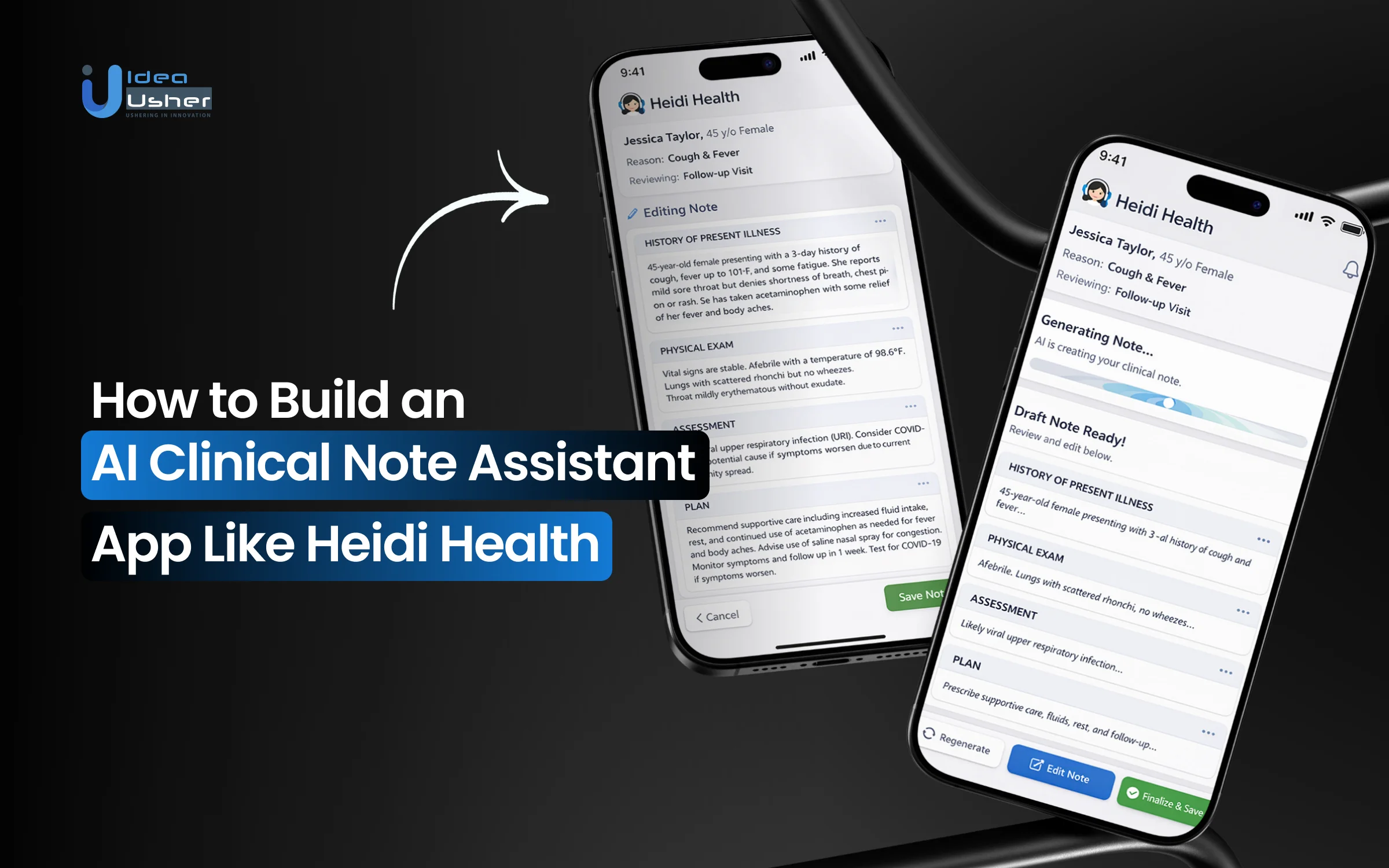
For many clinicians, the day should end after the last patient, yet documentation often extends it beyond working hours. Notes may remain incomplete, and summaries still need refinement. This ongoing backlog can gradually affect focus and work-life balance. Many clinics have started using AI clinical note-assistant apps to reduce after-hours work and improve documentation accuracy.
These systems can capture and structure information during the consultation itself. Clinicians could finish notes in real time and avoid delays. This shift is gradually helping teams maintain care quality while improving operational efficiency.
Over the years, we’ve built numerous AI clinical documentation solutions, powered by ambient voice intelligence and EHR integration frameworks. As IdeaUsher has this expertise, we’re sharing this blog to discuss the steps to develop an AI clinical note assistant app like Heidi Health.
Why Are Clinics Replacing Scribes with AI?
According to Grand View Research, the U.S. AI in medical scribing market was valued at USD 397.05 million in 2024 and is projected to reach USD 2,955.72 million by 2033, with a CAGR of 25.09%. This growth signals a capital migration from legacy staffing toward high-margin software. For investors, this represents a shift from variable labor costs to scalable technology.

Source: Grand View Research
Clinics are abandoning human scribes in favor of AI to improve operational efficiency. Traditional models rely on human intermediaries to bridge care and EHR data, an inherently unscalable process. Scribes require constant recruitment and training, leading to high overhead and turnover.
AI solutions offer a frictionless documentation layer. Unlike humans, AI avoids fatigue and deploys instantly across entire health systems. Platforms like DeepScribe showcase this by capturing specialty nuances in oncology or cardiology that humans often miss. This replaces high-friction costs with a fixed, scalable tech stack.
Cost of Manual Documentation
The real cost of manual documentation includes both direct expenses and massive opportunity costs. When physicians handle their own data entry, they perform clerical work at a specialist’s hourly rate. This causes burnout, costing facilities up to $1 million per physician in recruitment and lost revenue.
- Turnover: Human scribes are often students with short tenures, creating constant training cycles.
- Liability: Manual entry is prone to errors, leading to claim denials and audit risks.
- Space: AI operates via mobile devices, removing the need for a third person in the exam room.
AI and Interaction Quality
Ambient AI allows for face-to-face dialogue by moving technology into the background. Traditional documentation forces clinicians to focus on workstations, creating a digital curtain that lowers patient satisfaction. This is critical as satisfaction scores now directly impact reimbursement rates.
Apps like Freed prioritize clinician experience by learning a doctor’s specific style over time. By providing one-click EHR integration, the documentation becomes a byproduct of care rather than a distraction. This improves the clinic’s market fit, as patients feel heard while physicians increase their daily patient volume.
Failures in Current EHR Workflows
EHR systems were designed for billing rather than clinical ease. They are notorious for click fatigue, requiring dozens of manual entries for simple visits. This creates a gap for AI investment. While the EHR serves as the database, it lacks an intelligent, conversational interface.
- Data Silos: Valuable clinical insights often remain trapped in unstructured text or go unrecorded.
- Interoperability: Traditional workflows fail to synthesize patient history with new notes. AI bridges this in real time.
- Alert Fatigue: AI layers act as a filter, prioritizing critical data points and reducing notification overload.
The investment opportunity lies in moving beyond speech to text. The winners in this market will automate the entire administrative workflow that follows the patient conversation.

Overview of Heidi Health App
Heidi Health is a leader in ambient clinical intelligence that transforms how doctors document. Unlike manual tools, Heidi acts as a passive partner so clinicians can focus on patients. By converting consultations into medical prose, it eliminates “pajama time,” the late hours spent catching up on charts.
Heidi is an invisible, indispensable layer of intelligence. It supports the clinical day from the first intake to the final referral.
Solving the Documentation Crisis
Clinicians face a burnout crisis due to administrative overload. Doctors often spend two hours on paperwork for every hour with a patient. Heidi solves this through its Scribe engine by using ambient documentation to reduce charting time by up to 70%. This returns roughly 500 hours annually to clinicians while capturing nuances often lost in manual memory-based notes.
Daily Clinical Workflows
The platform is friction-free and adapts to the doctor. It ensures technology serves the workflow rather than complicating it.
The Heidi Remote:
For a hands-free experience, the Heidi Remote is dedicated hardware for clinical AI scribing. It allows clinicians to record offline and sync automatically. This ensures high-quality audio capture when a mobile device is not ideal.
Clinicians use Memory to provide feedback, helping the AI learn specific terminology over time. The Context feature allows doctors to record silent thoughts or use Linked Previous Sessions for a longitudinal view of patient history. This makes follow-up visits significantly more efficient for the entire care team.
Key Capabilities Driving Adoption
Heidi offers more than transcription by providing administrative automation and decision support. These tools drive rapid adoption across various medical settings.
| Feature | Impact on Practice |
| Ask Heidi | Generates referral letters or care plans instantly using natural language prompts. |
| Heidi Evidence | Provides citation-backed clinical answers at the point of care. |
| Heidi Comms | Manages AI-powered calls, bookings, reminders, and follow-up texts. |
| Template Community | Accesses thousands of specialty formats shared by global medical professionals. |
By combining these tools with Heidi Labs, where users test experimental features like AI coding, the platform serves over 200 specialties. It helps double healthcare capacity by clearing the path between the doctor and the patient.
Key Features That Define a Scalable AI Scribe App
A scalable AI scribe app must prioritize features that solve clinical bottlenecks while maintaining high technical standards. For investors, this means looking for a workflow engine rather than a simple recorder. The goal is to handle high-stakes data with precision across diverse medical environments.
1. Specialty Voice Capture
The app must offer high-fidelity ambient sensing that distinguishes between clinician and patient voices in noisy rooms. It needs pre-training on diverse lexicons from orthopedics to psychiatry to ensure specialized jargon is captured accurately.
Heidi AI excels here by offering an ambient listening tool that adapts to different specialties with minimal user input, ensuring high transcription accuracy without manual corrections.
2. Multilingual Clinical Engine
Modern platforms must be language agnostic, processing consultations in one language while generating structured notes in English. This eliminates the need for expensive third party translators and allows clinics to serve a broader demographic.
Sunoh.ai is a leader in this space, trusted for its seamless multilingual support that handles complex global accents and diverse medical terminology across various patient backgrounds.
3. Smart Note Templates
The platform should offer a library of dynamic templates, such as SOAP or DAP, that adapt to specific encounter types. AutoNotes demonstrates the power of this feature by allowing therapists and clinicians to generate structured progress notes, treatment plans, and session summaries in seconds. These templates can be customized to match any modality or practice need.
4. Referral and Summary Tools
High margin apps automate post-visit paperwork by drafting referral letters and patient friendly summaries. SteerNotes streamlines this by automatically generating After-Visit Summaries written in clear, accessible language.
This not only increases patient adherence but also drastically reduces the time staff spend on outbound coordination and administrative follow-ups.
5. Natural Language Commands
Scale is achieved when clinicians interact with the app via voice as if speaking to a colleague. DeepCura AI utilizes verbal commands to trigger secondary tasks like generating referrals or patient instructions on the fly.
These voice-activated edits allow for hands-free adjustments, keeping providers away from the keyboard and focused entirely on the patient encounter.
6. Meds and Coding Extraction
The most valuable feature for revenue cycles is the automatic extraction of ICD-10 and CPT billing codes. Scribeable AI focuses on this aspect of documentation, running clinical calculators and capturing codes that providers might otherwise miss.
By identifying medications and dosages in real-time, the app ensures billing accuracy and protects the clinic’s bottom line.
AI Models Powering Clinical Note Automation
The architecture of AI clinical note assistant apps relies on a hierarchy of machine learning. It is no longer enough to just convert audio to text. Value lies in the interplay between acoustic models and reasoning engines. These platforms transform raw dialogue into data that meets regulatory standards.
This stack determines if a tool creates work or automates it. Below is a breakdown of the model layers defining industry performance.
Speech Recognition vs Medical ASR
General speech engines fail in clinics due to a lack of medical training. A general engine might misinterpret “hyperkalemia” or “SOB.” Medical Automatic Speech Recognition (MedASR) is trained on thousands of hours of clinical dictation for better accuracy.
- Acoustic Precision: MedASR is optimized for noisy clinics and regional accents.
- Vocabulary Depth: Models recognize complex drug names and anatomy natively.
- Contextual Filtering: ASR differentiates between patient stories and clinician commands.
Suki AI is a prime example of this technical precision. It utilizes advanced ASR to handle the fast-paced dialogue of high-volume clinics, ensuring that specialized medical terminology is captured correctly even when clinicians speak naturally or quickly.
LLMs in Clinical Summarization
After audio becomes text, the Large Language Model acts as the brain. While ASR captures every word, the LLM determines what matters. It distills a 15-minute conversation into a concise, professional SOAP note.
The LLM performs semantic mapping. It identifies that “feeling like an elephant is sitting on my chest” should be summarized as “reports substernal chest pressure.” This transformation into medical prose is the core value proposition.
Fine-Tuning for Accuracy
Generic LLMs are masters of none. For a scribe app to be viable, it must undergo Supervised Fine-Tuning on curated medical datasets. This aligns output with ICD-10 coding and specialty guidelines.
Fine-tuning involves training models on gold-standard notes written by physicians. This allows the AI to adopt the specific tone and formatting preferred by specialists, whether for surgery or psychiatry. Augmedix leverages this by combining specialized models with clinical datasets to ensure that the final notes reflect the rigorous standards required by large health systems.
Reducing Clinical Hallucination
A major risk is hallucination, where a model generates incorrect details. To mitigate this, developers use Retrieval-Augmented Generation (RAG). The system grounds its output in the real-time transcript rather than internal memory.
- Citation Tracking: Apps provide source-linking to the exact audio timestamp.
- Self-Correction: Dual-model approaches use a secondary AI to audit the first summary.
- Confidence Scores: Models flag sections where the AI has low confidence for review.
How to Build an AI Clinical Note Assistant App Like Heidi Health?
To build an AI clinical note assistant app like Heidi Health, a system should securely capture conversations and convert them into structured notes using medical NLP. It can then integrate with EHR systems and gradually improve accuracy so it adapts well to real clinical workflows.

We have worked on many AI clinical note assistant apps inspired by Heidi Health, and here is how we usually build them.
1. Define Core Clinical Workflows
We start by mapping the specific clinical pathways your practice serves. A psychiatric intake requires a different data structure than an orthopedic consult. We build using modular architectures that handle diverse data types, from referrals to ward round lists. By defining these workflows early, we select an AI stack that supports specific specialty nuances rather than a one-size-fits-all model.
2. Design Ambient Voice Capture
The biggest failure point in medical apps is poor audio in high-pressure rooms. We engineer capture layers to handle background noise, muffled speech from masks, and multiple speakers. Our ambient design runs passively, eliminating the need for manual commands. We integrate sophisticated speaker diarization to accurately distinguish between the clinician, the patient, and family members.
3. Build Medical-Grade ASR
General speech tools are insufficient for the phonetic complexity of healthcare. We leverage specialized Medical Automatic Speech Recognition (MedASR) engines pre-trained on millions of hours of medical dictation. This ensures the system accurately transcribes complex drug names like pembrolizumab or anatomical jargon that would baffle a standard consumer-grade engine.
4. Structure Data for EHRs
The transcript is only the starting point; the value lies in structured medical prose. We utilize Natural Language Processing (NLP) to perform semantic mapping, extracting symptoms and assessments into standardized SOAP or H&P formats. We use JSON-based document models to ensure data can be easily parsed, edited, and synced with legacy EHR systems without losing its clinical meaning.
5. Implement “Ask AI” Features
The Ask AI feature transforms a passive note-taker into an active clinical partner. This layer allows physicians to query their notes using natural language to retrieve specific insights instantly. By implementing Retrieval-Augmented Generation (RAG), we reduce the time spent on clinical audits and follow-ups, making the tool an indispensable part of the daily medical workflow.
6. Clinical Testing and Iteration
The final stage is a rigorous, iterative feedback loop with practicing medical professionals. We conduct in situ testing in real clinical settings to identify where the AI might struggle with regional accents or complex multi-topic visits. Continuous iteration based on clinician sign-off data is how we build the trust necessary for enterprise adoption and safe, reliable performance.
Cost Breakdown to Build an AI Scribe App
Investing in an AI clinical note assistant app transitions a practice from high variable labor costs to a front-loaded technology investment. When we build these solutions for our clients, we focus on immediate development capital and long-term operational overhead. This ensures the shift from human scribes to digital assistants delivers a measurable ROI quickly.

The following estimates reflect the current market for clinical-grade software, where security and precision drive the price point.
Development Cost by Complexity
Costs are primarily driven by how deeply the app integrates with clinical workflows. A standalone recorder is significantly cheaper than a fully integrated workflow engine.
| Complexity Level | Features Included | Estimated Cost (USD) |
| MVP | Ambient recording, basic ASR, generic SOAP notes. | $50,000 – $80,000 |
| Mid-Market | Specialty templates, multi-device sync, EHR integration. | $150,000 – $250,000 |
| Enterprise | Bidirectional FHIR integration, Ask AI, custom security. | $400,000 – $600,000+ |
AI Model and API Expenses
The engine of your app carries both fixed setup costs and variable monthly fees. We generally recommend a hybrid approach to balance performance with budget.
- Medical ASR: Specialized APIs like Google Medical Conversation cost roughly $0.078 per minute. For a busy clinic, this can reach $1,000 per provider monthly.
- LLM Processing: Using advanced models like GPT-4o for clinical reasoning typically costs $0.01 to $0.03 per visit in token usage.
- Model Fine-Tuning: Training a custom model on specific clinic data to improve accuracy involves a one-time setup of $20,000 to $50,000.
Infrastructure and Processing
Healthcare apps require HIPAA-compliant cloud environments, which command a premium over standard hosting.
Budget Note: HIPAA-compliant hosting on AWS or Azure typically costs 20% to 30% more than standard hosting. Budget $1,000 to $5,000 monthly for a mid-sized deployment to cover secure databases and encrypted storage.
Maintenance and Scaling
Software is never truly finished. To keep an AI scribe at peak accuracy, we plan for continuous technical oversight.
- Annual Maintenance: Allocate 15% to 20% of the original development cost (e.g., $30,000 to $50,000 yearly) for bugs and updates.
- Compliance Audits: Annual SOC2 or HIPAA audits and penetration testing usually cost $15,000 to $30,000 to maintain trust.
- Model Monitoring: Setting aside $1,000 to $2,000 monthly for a machine learning engineer to tune prompts and monitor outputs is critical for clinical safety.
While the upfront cost for a robust app is significant, it stands in contrast to human scribes, who can cost over $50,000 per physician yearly. For a 10-physician practice, the AI app often pays for itself in months.
Building Custom Workflows for Every Clinician
A one-size-fits-all approach is the fastest way to lose clinician trust. When we develop AI clinical note assistant apps for our clients, we treat every specialty as its own distinct product ecosystem. The goal is to move past generic summaries and create a system that reflects the unique clinical voice of each provider, ensuring the AI-generated note looks and feels as if the physician typed it themselves.

The value of an AI clinical note assistant lies in its flexibility. By creating a modular documentation engine, we allow practices to scale without forcing doctors to change how they talk to patients.
Individual Documentation Styles
Every physician has a signature way of documenting. Some prefer concise, bulleted lists, while others want narrative-heavy descriptions. We implement machine learning layers that learn these preferences over time.
- Style Mirroring: The AI analyzes past gold-standard notes to replicate the specific tone and vocabulary of the user.
- Macro Integration: We build systems that recognize when a doctor wants to insert a standard normal exam block via simple voice commands.
- Interactive Learning: If a doctor consistently moves the Social History section, the app learns to place it there automatically in the next session.
Freed is a standout in this area, utilizing self-learning technology that adapts to a clinician’s specific formatting preferences and phrasing, the more it is used, making it an ideal choice for mid-sized clinics.
SOAP, DAP, and Custom Formats
Clinical documentation is not a monolith. While a GP might live by the SOAP note, a behavioral health specialist often requires the DAP (Data, Assessment, Plan) format. Our development process ensures the back-end architecture is format-agnostic.
We use a dynamic schema-on-read approach. This means the AI captures the raw conversation once but can output it into any format, SOAP, DAP, or a completely custom clinic template, at the push of a button.
This flexibility is vital for multi-specialty groups where different providers share one platform but require distinct document structures. Upheal specializes in this for mental health, offering highly tailored templates that specifically address the nuances of therapy and psychiatric progress notes.
Personalizing for Specialty Needs
A good note in oncology is a bad note in urgent care. Oncology requires deep longitudinal data and medication tracking, while urgent care demands speed and focused symptom assessment. We personalize the output by layering specialty-specific rulesets over the core AI.
| Specialty | Key Customization Focus | Data Requirement |
| Pediatrics | Development milestones and growth tracking. | High conversational nuances from parents. |
| Cardiology | Medication dosages and specific lab values. | Precision in numerical data and trends. |
| Psychiatry | Mental status exams and behavioral cues. | Detection of emotional affect and subtle phrasing. |
By building these tailored guardrails, we ensure that the app is not just a transcriber, but a specialized assistant that understands the high-stakes priorities of each unique medical field.
Designing “Ask AI” for Clinical Note Interaction
The “Ask AI” interface is where a static document becomes a dynamic clinical partner. By implementing this layer, we move beyond simple transcription and into the realm of clinical intelligence. For a physician, this means less time hunting for data and more time synthesizing it. We build these features to act as a bridge between the raw conversation and the final, polished record.

At its core, “Ask AI” is a conversational layer built atop the patient’s medical data. It allows for a fluid, iterative documentation process that adapts to the clinician’s immediate needs.
Natural Language Note Queries
We utilize Retrieval-Augmented Generation to allow clinicians to treat their notes like a searchable database. Instead of scrolling through pages of text, a provider can simply ask a question.
- “What were the patient’s exact symptoms last Tuesday?”
- “Summarize the cardiovascular findings from today’s exam.”
- “Did the patient mention any history of allergies to penicillin?”
By indexing the transcript and structured notes in a vector database, the AI provides instant, grounded answers. Suki AI has paved the way here, allowing doctors to use voice commands to pull up specific patient facts during the visit, significantly reducing the cognitive load required to recall previous details.
AI-Powered Note Refinement
The first draft of an AI note is rarely the final one. We design the interface to allow for rapid, prompt-based refinements. Clinicians can highlight a section and give a “directive” rather than manually retyping the text.
User Prompt: “Make the assessment section more concise and move the physical exam findings to a bulleted list.”
AI Action: The system re-parses the selected text, applies the formatting logic, and updates the note in real-time while maintaining clinical accuracy.
This conversational editing approach ensures that the “final sign-off” happens in seconds, not minutes.
Extracting History from Files
A comprehensive note often requires context from outside the current encounter. We build pipelines that allow clinicians to upload PDFs, scan old charts, or import laboratory results directly into the “Ask AI” context.
- OCR Processing: The system converts images and PDFs into machine-readable text.
- Entity Extraction: The AI identifies key metrics, past diagnoses, and medication lists.
- Synthesis: The extracted data is merged with the current visit transcript to create a holistic view of the patient’s journey.
Heidi Health excels in this area by allowing providers to upload historical documents and asking the AI to “Compare today’s results with the previous blood work.” This capability transforms the app from a simple scribe into a centralized hub for clinical decision support.
Why Choose IdeaUsher for AI Clinical Note Assistant Apps?
Choosing the right partner for AI clinical note assistant apps requires a team that understands the intersection of medicine and technology. At IdeaUsher, we bring a specialized focus to healthcare software, ensuring your platform is reliable for daily clinical use.
We provide the technical foundation and industry expertise needed to turn complex AI concepts into market-ready healthcare solutions.
Proven Healthcare Delivery
With over 500,000 hours of coding experience, our team of ex-MAANG/FAANG developers has a track record of delivering high-performance healthcare platforms. We have navigated the complexities of medical software, from ambient sensing to large-scale data engines. This deep experience allows us to anticipate technical challenges, ensuring your app functions flawlessly in demanding clinical environments.
Compliance and Scalability
Security is the cornerstone of any medical application. We build every product with a security-first mindset, ensuring full compliance with HIPAA and GDPR. Our architecture scales alongside your growth, utilizing robust cloud infrastructures that handle thousands of concurrent users. By choosing us, you invest in a platform built to protect patient data while supporting long-term expansion.
Faster Go-to-Market
In the rapidly evolving world of AI, speed is a competitive advantage. Our expert teams use streamlined development cycles and pre-built clinical modules to reduce your time to market. We combine our 500,000 hours of coding experience with agile methodologies to move from concept to deployment rapidly. This efficiency allows our clients to capture market share while staying ahead of AI innovation.
Conclusion
Building AI clinical note assistant apps like Heidi Health requires a blend of medical-grade speech recognition, specialized LLMs, and a deep understanding of physician workflows. By prioritizing ambient voice capture, structured data output, and rigorous HIPAA compliance, we create tools that do more than just record. They think alongside the clinician. At IdeaUsher, we leverage our extensive coding experience to help you bridge the gap between complex AI architecture and a seamless clinical experience that drives ROI.
FAQs
A1: Yes, AI is now a standard tool for transforming patient conversations into structured medical records. Modern AI clinical note assistant apps use ambient sensing to listen to consultations and automatically generate SOAP notes or other clinical formats. This technology allows physicians to focus entirely on the patient while the AI handles the administrative burden of documentation.
A2: Core features include medical-grade speech recognition, speaker diarization to distinguish between doctor and patient, and automated formatting into standard templates. Advanced platforms also offer EHR integration, “Ask AI” natural language querying, and multi-language support. These tools are built with robust encryption to ensure that all data processing remains fully HIPAA compliant.
A3: Development starts with building a secure, HIPAA-compliant cloud infrastructure and integrating specialized medical ASR engines. You must then layer LLMs that are prompt-engineered for clinical accuracy and establish secure APIs for EHR synchronization. The process concludes with rigorous testing by medical professionals to ensure the AI correctly interprets complex medical terminology and nuanced clinical scenarios.
A4: The cost typically ranges from $50,000 for a basic MVP to over $400,000 for an enterprise-grade platform with deep EHR integrations. Ongoing expenses include specialized API usage fees, HIPAA-compliant hosting, and regular maintenance for security audits. Investing in a custom solution often pays for itself quickly by significantly reducing the high costs associated with manual scribing services.


