


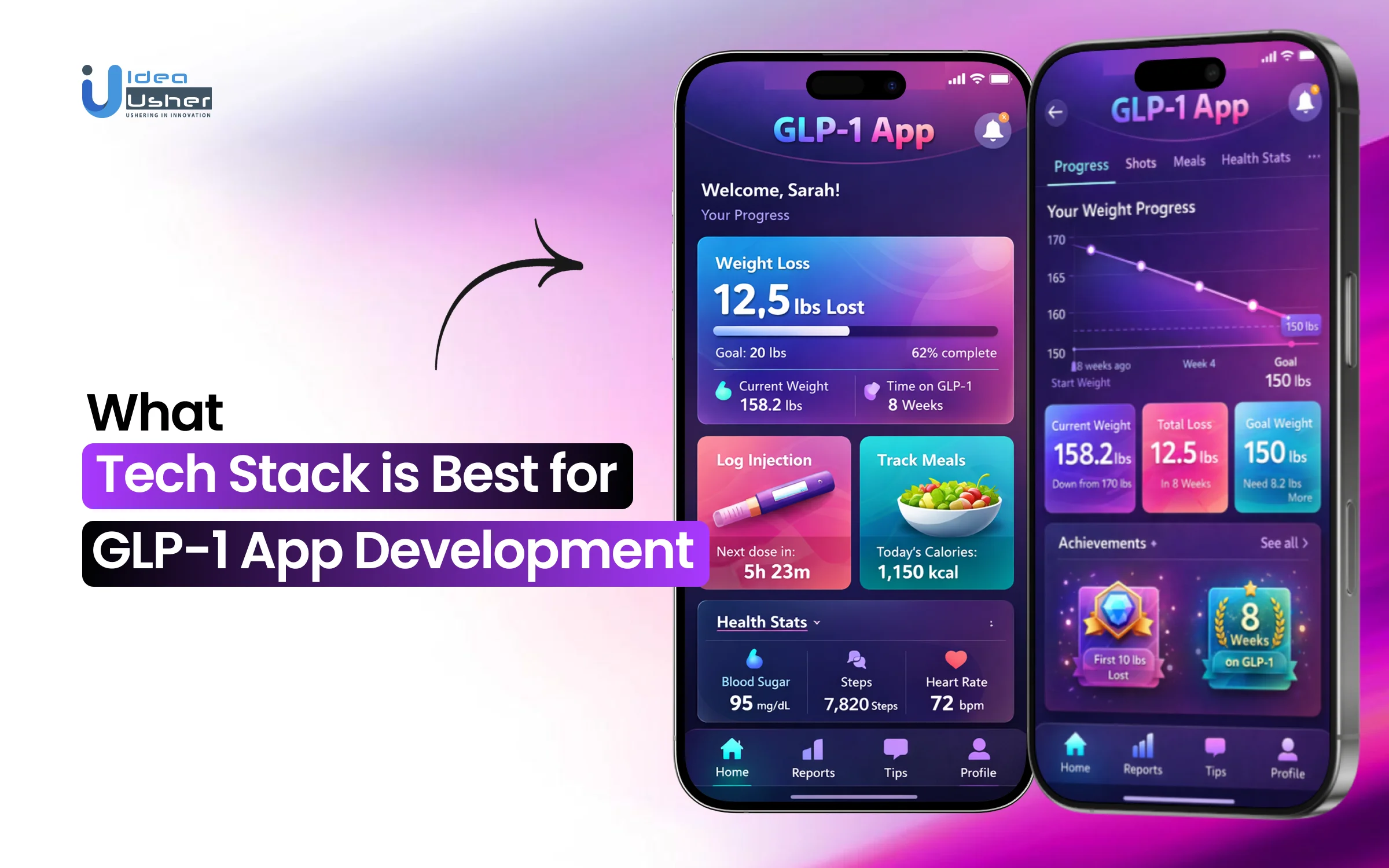
Managing weight has never been just about willpower. It has often meant navigating a fragmented system with little continuity. Many people have started relying on GLP-1 apps because they can offer consistent medical guidance and easier access to prescriptions.
They can also help track progress in a more structured way. Real-time monitoring may improve adherence and outcomes. As adoption grows, these platforms must support secure consults and tight integrations with pharmacies and insurers.
We’ve worked on numerous GLP-1 applications powered by clinical AI and remote patient monitoring technologies. As IdeaUsher has this expertise, we’re sharing this blog to discuss the tech stacks required to develop a GLP-1 app.
What’s Driving Demand for GLP-1 Apps Right Now?

Source: Precedence Research
This explosive financial trajectory is being mirrored by a fundamental shift in how patients access care. The traditional “waiting room” model is being replaced by agile, digital-first ecosystems. Here is what is driving that demand right now:
Surge in Telehealth Programs
The gold rush for GLP-1 medications has outpaced the capacity of traditional primary care offices. Telehealth-first programs have stepped in to fill the void, offering specialized workflows that general practitioners often lack. These programs aren’t just “video calls”; they are comprehensive clinical engines that handle:
- Rapid Metabolic Screening: Digital intakes that use AI-driven triage to identify eligible candidates in minutes.
- Automated Prior-Authorization (PA): Specialized teams or software dedicated to navigating the complex insurance landscape for drugs like Wegovy and Zepbound.
- Compounding Partnerships: To combat the ongoing global shortages, many apps connect patients directly with 503A/503B compounding pharmacies to ensure continuity of care.
Shift to Remote Care
Patients are moving away from the “episodic” nature of traditional medicine toward a “continuous” care model. Several factors make remote care the preferred choice for GLP-1 therapy:
- Discretion and Privacy: Weight management remains a sensitive topic; many users prefer the privacy of their home for consultations and self-injection training.
- Management of Side Effects: GLP-1s often cause gastrointestinal issues (nausea affects ~44% of users). Apps provide asynchronous coaching, allowing patients to message a provider at 10:00 PM for nausea relief rather than waiting for an appointment.
- Data-Driven Feedback: Integration with Bluetooth-enabled scales and wearable devices allows patients to see their “weight loss velocity” in real-time, which significantly increases long-term adherence.
Scalable Investor Interest
Venture capital and private equity firms are pivoting toward “metabolic SaaS” because of its high recurring revenue and scalability.
- The “Stickiness” Factor: Since GLP-1s are often long-term (or even lifelong) medications, these apps provide a subscription-based revenue model that is highly attractive to investors.
- Shift from Drugs to Outcomes: Investors are funding platforms that offer more than just a prescription. They are looking for “full-stack” solutions that integrate nutritional therapy, muscle-mass preservation, and “off-ramp” protocols to help patients maintain weight loss if they stop the medication.
- B2B Expansion: There is a massive trend of these platforms selling directly to self-insured employers who want to manage the rising cost of GLP-1s within their workforce while improving overall employee health.

What Makes GLP-1 Apps Technically Complex?
Building successful GLP-1 apps requires more than a sleek interface; it demands a robust medical infrastructure. These platforms must navigate a high-stakes environment where clinical safety, insurance bureaucracy, and strict federal regulations intersect.
Sync vs. Async Workflows
Telehealth platforms must bridge two worlds. Live video is essential for initial identity verification and clinical screenings. However, the true scale happens in the asynchronous lane.
The Friction: Developers must build “state-aware” triage. If a user texts about severe pain, the system must recognize the urgency and escalate it to a doctor instantly, rather than letting it sit in a general support queue.
Insurance and Pharmacy Logic
The backend is a complex web of third-party dependencies. To make the user experience feel seamless, the app must integrate with:
- PBMs: For real-time insurance eligibility checks.
- PA Engines: Automating the paperwork required for drug approvals.
- Inventory Tracking: Dynamically routing orders based on which pharmacies actually have stock.
HIPAA Data Security
Security isn’t just a feature; it is the foundation. Every interaction with Protected Health Information must be traceable and locked down.
| Security Layer | Requirement |
| Encryption | AES-256 for data at rest; TLS 1.2+ for data in transit. |
| Access Control | Role-based permissions to limit data exposure. |
| Audit Trails | Permanent logs of every file access or modification. |
The challenge lies in maintaining a smooth user experience while enforcing strict multi-factor authentication and session timeouts. A scalable platform is ultimately a logistics and security engine disguised as a weight loss app.
Core Features That Define Your Tech Stack Needs
Building competitive GLP-1 apps requires a tech stack that balances real-time medical intervention with automated logistics. To move from a prototype to a scalable clinical platform, your architecture must support these specific core pillars.
1. Consults and Messaging
The foundation of any telehealth platform is the communication layer. You need a HIPAA-compliant infrastructure that supports both high-definition video for initial doctor visits and low-latency chat for ongoing support.
- WebRTC Integration: For secure, peer-to-peer video streaming.
- Socket-based Chat: To handle real-time messaging, file sharing for insurance cards, and automated bot-triage.
2. Dosage Tracking
GLP-1 medications require precise titration, starting at a low dose and increasing monthly. Your backend must include a robust logic engine to manage these schedules.
- Dosage Logic: Automated alerts that prompt both the patient and provider when it is time to increase a dose.
- Adherence Logs: A user-facing interface to log injection dates, injection sites (to prevent tissue issues), and skipped doses.
3. Lab Data Integration
Before a prescription is issued, metabolic health must be verified. This requires a seamless flow of data from external diagnostic providers.
- HL7/FHIR Standards: To securely ingest lab results (like A1C or lipid panels) from providers like Labcorp or Quest.
- Structured Data Parsing: Converting PDF lab reports into actionable data points that populate the clinician’s dashboard.
4. IoT Remote Monitoring
Modern GLP-1 therapy relies on real-time feedback to prevent muscle loss and track progress. Integrating with the broader health ecosystem is essential.
- Wearable APIs: Syncing with Apple Health, Google Fit, or Oura to track activity levels.
- Smart Scale Integration: Using Bluetooth/Cellular scales that push weight data directly to the cloud, allowing providers to spot “plateaus” instantly.
5. Clinical Dashboards
The “Command Center” is where your clinical team manages thousands of patients. This interface must be optimized for speed and clinical safety.
- Patient Triage: A dashboard that flags “high-risk” patients based on reported side effects or sudden data changes.
- Task Automation: One-click tools for approving refills, generating lab orders, and sending pre-formatted educational content.
Essential Frontend Tech Stack for GLP-1 Apps
Choosing a frontend stack for GLP-1 apps is about more than UI. It is about ensuring clinical safety, regulatory compliance, and long-term maintainability. Your choice dictates how quickly you can integrate with health hardware and how easily your clinicians can manage patient data.

Native vs. Cross-Platform
For the patient mobile app, the debate centers on performance versus development speed. Modern leaders in the space, like WeightWatchers Clinic and Mochi Health, utilize these technologies to bridge the gap between medical prescriptions and daily habit tracking.
- Swift (Native iOS): This is the gold standard for security and hardware access. Swift provides the smoothest integration with Apple HealthKit and biometric authentication. If your roadmap includes a watchOS app for tracking, Swift is the best path.
- Cross-Platform: This is ideal for startups needing to launch on both iOS and Android simultaneously with a unified team and code.
React Native vs. Flutter
If you choose the cross-platform route, these two frameworks dominate the medical landscape:
| Feature | React Native | Flutter |
| Ecosystem | Massive library support for HIPAA-compliant auth. | Excellent for high-performance, custom-branded UIs. |
| Developer Pool | Larger; easy to transition web developers to mobile. | Requires learning Dart; offers high rendering speed. |
| Health Sync | Relies on community bridges for HealthKit. | Uses a dedicated engine for near-native smoothness. |
Dashboards for Care Teams
While patients live in mobile apps like Form Health or PlushCare, doctors and admins need a high-density web environment.
- React + Next.js: The industry favorite for medical “command centers.” Its modular architecture allows data to update in real-time without page refreshes.
- Angular: Often preferred by larger enterprises. Its rigid structure and built-in TypeScript support make it easier to maintain massive healthcare projects over many years.
UX for Healthcare Engagement
The success of GLP-1 therapy is measured by patient adherence. Your UX framework must go beyond aesthetics to drive behavior change.
- Behavioral Design: Use the “nudge” theory to remind patients of injections or protein intake without causing notification fatigue.
- Data Visualization: Use libraries like D3.js to turn complex metabolic data into simple, encouraging progress charts for the user.
- Accessibility: High-contrast modes and screen-reader compatibility are often regulatory requirements for healthcare software.
Backend Architecture for Scalable GLP-1 Apps
A robust backend for GLP-1 apps acts as the clinical brain. It must orchestrate complex titration schedules, pharmacy inventory, and real-time patient monitoring while maintaining absolute data integrity.

1. Monolith vs. Microservices
The choice of architecture depends on your stage of growth and the complexity of your clinical operations. Major players like Calibrate often start with integrated systems to ensure that a prescription is only generated after a lab report is successfully verified and paid for.
- The Pragmatic Monolith: For startups, a unified codebase simplifies end-to-end testing and makes it easier to manage atomic transactions.
- The Microservices Pivot: As you scale to handle millions of patients, breaking the app into independent services, such as an Insurance Auth Service or a Pharmacy Inventory Service, prevents a failure in one area from taking down the entire clinic.
2. Choosing the Language
Each backend language offers distinct advantages for healthcare-specific logic:
| Language | Best For | Why It Matters for GLP-1s |
| Node.js | Real-time I/O | Perfect for high-concurrency chat and live notifications for dose reminders. |
| Python | Clinical Logic | The gold standard for data science; ideal for platforms like Join LiveWell to predict weight loss plateaus. |
| Java | Enterprise Scale | Offers the Type Safety and multi-threading needed for massive, stable medical systems. |
3. Designing APIs for Health Data
Interoperability is the biggest hurdle in telehealth. Your APIs should not just send JSON; they should follow the HL7 FHIR standard.
By treating data points like Patient, MedicationRequest, and Observation as standardized resources, your app can talk directly to external systems like Quest Diagnostics or national pharmacy chains. This reduces manual data entry and speeds up the time-to-medication for the patient.
4. Handling High Concurrency
When a new supply of medication drops or a celebrity mentions a specific drug, GLP-1 apps often see massive traffic spikes. To prevent crashes, your backend must be built for elasticity.
Scaling Strategy: Implement a Message Queue (like RabbitMQ or Kafka). When thousands of patients request a refill at once, the app should not try to process them all instantly. Instead, it places them in a queue, allowing the Prescription Service to process them steadily without overwhelming the database.
Database and Storage Choices for Health Data in GLP-1 Apps
The database is the most critical layer of GLP-1 apps, serving as the legal source of truth for patient safety and clinical history. Designing this layer requires balancing the rigid requirements of medical records with the flexibility needed for real-time tracking.
SQL vs. NoSQL for Patient Records
For core clinical data, PostgreSQL is the industry standard. Its relational nature ensures that a prescription is always strictly linked to a verified provider and a specific lab result. This structure prevents the data errors that can occur in less organized environments.
However, NoSQL databases like MongoDB are vital for modern features. Platforms like Ro and Mochi Health often use non-relational storage for:
- Asynchronous Chat Logs: Storing long threads of unstructured provider messages.
- Activity Streams: Ingesting massive amounts of telemetry data from wearables.
- Schema Flexibility: Adding new side-effect tracking fields without complex database migrations.
Managing Data Types
Your storage architecture must distinguish between structured clinical facts and unstructured behavioral data. Structured data includes dosage levels, weight entries, and blood glucose levels, which are stored in indexed tables for fast clinical reporting.
Unstructured data, such as photo uploads of insurance cards and PDF lab results, is stored in Secure Blob Storage like AWS S3. Only the file metadata resides in the primary database to keep the system fast and searchable.
Secure Storage for Medical Histories
Under HIPAA, medical data must be logically separated from personally identifiable information. High-security platforms often use a Vault Strategy where the main application database stores a randomized User ID, while sensitive PII like names and social security numbers are stored in a separate, more restricted database. This minimizes the risk in the event of a security breach.
Data Backup and Recovery
In healthcare, data loss can lead to life-threatening clinical errors. A robust disaster recovery plan requires three layers of protection:
- Point-in-Time Recovery: This allows the app to rewind to a specific second every 5 to 15 minutes if data is corrupted.
- Cross-Region Replication: This ensures that if a primary data center goes offline, the clinic stays live by pulling from a real-time copy in another location.
- Air-Gapped Backups: These protect against ransomware by keeping a copy of the data entirely offline and inaccessible from the main network.
Video and Messaging Stack for GLP-1 Virtual Clinics Apps
The communication layer in GLP-1 apps serves as the digital exam room. It must be as reliable as a physical office visit while maintaining the high-speed convenience of a modern consumer app.

WebRTC vs. Third-Party APIs
Building your own video infrastructure using WebRTC offers the most control over security and branding. However, it requires a specialized engineering team to manage STUN and TURN servers while handling complex network traversal.
Most successful platforms like Noom Med and Found opt for medical-grade APIs such as Twilio Video, Agora, or Zoom for Developers. These services offer:
- Native HIPAA Compliance: Business Associate Agreements (BAAs) are ready out of the box.
- Adaptive Bitrate: They automatically adjust video quality based on the patient’s cellular or Wi-Fi signal.
- Encrypted Archiving: Securely storing consultations for clinical audit trails.
HIPAA-Compliant Chat Systems
In GLP-1 apps, chat is where the majority of care happens. This includes reporting side effects or requesting refills. A compliant system must go beyond simple encryption.
- Encryption Standards: Messages must be encrypted at rest and in transit using TLS 1.2 or higher.
- Privacy-First Notifications: The backend should never send sensitive data in a standard push notification. Instead, it sends a generic “New medical message” alert, requiring the user to authenticate before viewing.
- Session Management: The chat interface must automatically lock after a period of inactivity to prevent unauthorized access if a device is left unattended.
Latency and Reliability
High latency in a clinical setting is a barrier to care. If a doctor cannot clearly see a patient’s injection site due to lag, the consultation is compromised.
To ensure reliability, your stack should implement Global Accelerator services. These route video traffic over an optimized network backbone rather than the public internet. Implementing Fallback Logic where the app automatically switches from video to a high-quality VoIP call if bandwidth drops ensures the medical appointment is never fully disconnected.
Scaling Across Regions
As your clinic grows, you must manage regional regulations and server proximity. Platforms like Ro and Sequence handle this by utilizing:
- Data Residency: Ensuring medical video data stays within specific geographic borders to meet local laws.
- Edge Computing: Placing the connection logic closer to the user to reduce the time it takes for a doctor and patient to connect, regardless of their physical distance.
Integrations That Define GLP-1 App Capabilities
To move beyond a simple storefront, GLP-1 apps must function as integrated clinical hubs. The value of the platform lies in its ability to orchestrate data across different medical and financial ecosystems seamlessly.
1. EHR and EMR Systems
Electronic Health Records (EHR) are the backbone of clinical documentation. For a weight loss platform to scale, it must talk to these systems to ensure clinicians have a full picture of patient history.
- FHIR APIs: Using the Fast Healthcare Interoperability Resources standard allows your app to pull real-time data from major vendors like Epic, Oracle Cerner, and Athenahealth.
- Interoperability Layers: Many developers use platforms like Redox to create a single integration point that translates data across hundreds of different hospital systems.
- Clinical Documentation: Automated syncing ensures that when a provider updates a titration plan in your app, the record is legally mirrored in the underlying EMR.
2. Payment and Insurance APIs
GLP-1 medications are expensive, making insurance verification a primary friction point. Your tech stack must handle complex financial workflows before a single dose is shipped.
- Eligibility Verification: Tools like Availity or pVerify allow for real-time checks to see if a patient’s plan covers weight loss drugs.
- Medical Payments: Standard gateways like Stripe are often augmented with healthcare-specific processors like Chase InstaMed to handle HSA or FSA debit cards.
- Prior Authorization: Integrating with CoverMyMeds automates the paperwork required to prove medical necessity to insurance payers, reducing manual admin work significantly.
3. Pharmacy and Prescription APIs
Because of global supply fluctuations, your app cannot rely on a single source. It must integrate with a network of fulfillment centers.
- e-Prescribing: Integrating with Surescripts or DoseSpot allows doctors to send digital prescriptions directly to any retail pharmacy.
- DTC Fulfillment: Working with APIs from Truepill enables the white-label experience where medication is shipped in your brand’s packaging directly to the patient’s door.
- Inventory Awareness: Real-time hooks into pharmacy stock levels allow the app to pivot between brand-name pens and compounded alternatives based on what is currently available.
4. Wearables and Health Tracking
Success in GLP-1 therapy is about more than the needle; it is about metabolic change. Connecting to the patient’s physical world provides the data needed for personalized care.
- Unified Health APIs: Rather than building separate code for every device, developers use Terra API or Rook to aggregate data from Apple Health, Garmin, and Oura into a single format.
- Cellular Smart Scales: For patients who struggle with tech, cellular-integrated scales push weight data directly to your backend via the cellular network, bypassing the need for Bluetooth pairing.
- Biometric Alerts: If a wearable detects an abnormally high resting heart rate, the system can trigger an automated check-in message from the care team.
Security and Compliance Tech Stack Decisions for GLP-1 Apps
Building GLP-1 apps requires a security-first architecture where compliance is a core product feature rather than a legal afterthought. Given the sensitive nature of metabolic and weight loss data, your stack must be designed to withstand both regulatory scrutiny and evolving cyber threats.
1. Infrastructure-Level Compliance
HIPAA compliance begins at the data center. You cannot host protected health information on standard consumer-grade servers. Established platforms like Teladoc and Lark Health prioritize these infrastructure safeguards to maintain patient trust at scale.
- Business Associate Agreements: Your cloud provider must sign a BAA, which legally binds them to HIPAA standards.
- Physical Isolation: Use dedicated instances or isolated Virtual Private Clou) to ensure your health data does not sit on shared hardware.
- Zero Trust Networking: Implement a verify everything model where internal services must authenticate with each other before exchanging patient data.
2. Encryption and Access Control
Encryption is the primary technical safeguard for medical records. It must be applied at every stage of the data lifecycle.
- Data at Rest: All databases and file storage must use AES-256 encryption. This ensures that even if a physical disk is compromised, the patient records remain unreadable.
- Data in Transit: Use TLS 1.3 for all communications between the app and the server. Standard “http” is never an option for medical traffic.
- Identity Management: Multi-factor authentication should be mandatory for all users. For clinical staff, implement Role-Based Access Control to ensure a health coach can see progress charts, but only a licensed physician can edit prescription history.
3. Audit Logs and Monitoring
In the event of a security inquiry, you must be able to prove who accessed what data and when.
- Immutable Logs: Your system should record every Create, Read, Update, Delete action performed on PHI. These logs should be stored in a separate, append-only bucket where they cannot be edited or deleted for at least six years.
- Real-time Threat Detection: Use tools like AWS GuardDuty or Azure Sentinel to scan for anomalous behavior, such as a bulk export of patient data or a login from an unrecognized geographic location.
4. Cloud Compliance
Each major cloud provider offers a robust suite of HIPAA-eligible services, but their strengths differ based on your product focus.
| Provider | Core Strength for GLP-1s |
| AWS | Offers the most extensive catalog of HIPAA-eligible services and a deep ecosystem of healthcare-focused partners. |
| Google Cloud (GCP) | The leader for AI-driven platforms. Its Healthcare API makes it easy to stream FHIR data directly into BigQuery for research. |
| Microsoft Azure | Ideal for hybrid environments. If your app needs to sync with legacy hospital systems, Azure’s integration with Microsoft 365 is seamless. |
The Bottom Line: Security for GLP-1 apps is not a static setup but a continuous process. A robust compliance stack does not just protect your patients; it builds the institutional trust required to partner with insurance payers and major health systems.
AI and Data Layer for Smarter GLP-1 Apps
The integration of Artificial Intelligence transforms a GLP-1 app from a simple logging tool into a predictive health partner. By leveraging machine learning at the data layer, platforms can move beyond reactive care to proactive intervention.
Adherence Tracking
Consistency is the single biggest factor in GLP-1 success, yet many patients struggle with “needle anxiety” or forgetfulness. AI-driven adherence tools solve this by analyzing behavioral patterns.
- Computer Vision: Apps like Dose AI allow patients to snap a photo of their injection pen or the injection site. AI confirms the dosage and automatically logs the site rotation, ensuring the patient does not develop tissue issues from injecting in the same spot too often.
- Smart Reminders: Rather than static alarms, reinforcement learning models analyze when a patient is most likely to engage with their phone. If a patient typically logs their weight at 8:00 AM, the AI pushes the “Dose Day” reminder at 7:55 AM to catch them while they are already focused on their health routine.
Weight Loss Analytics
The clinical journey for GLP-1s is rarely linear. Weight loss plateaus are common and often lead to patients quitting the medication prematurely.
- Plateau Prediction: By analyzing historical data from thousands of similar profiles, AI models can predict when a patient is likely to hit a stalled week. The app can then preemptively send educational content to manage expectations.
- Titration Forecasting: Predictive engines help doctors decide when to increase a dose. Instead of a standard 4-week ramp-up, the AI looks at side-effect intensity and weight velocity to suggest a custom titration schedule that maximizes progress while minimizing nausea.
NLP for Clinical Documentation
For providers, the administrative burden of telehealth can be overwhelming. Natural Language Processing acts as a digital scribe during and after consultations.
- Ambient Scribing: During a video call, NLP tools or custom LLM-based systems transcribe the conversation, extracting key medical entities like “nausea,” “0.5mg dose,” or “increased protein intake.”
- Auto-Summarization: After a chat interaction, the AI generates a clinical note in SOAP (Subjective, Objective, Assessment, Plan) format. This allows the doctor to review and sign off on a consultation in seconds, drastically increasing the clinic’s throughput.
Personalization Engines for Care Plans
No two metabolic profiles are identical. AI allows for precision medicine at scale, tailoring every aspect of the app experience to the individual.
- Dynamic Nutrition: Platforms like MeAgain use AI to scan food photos and provide real-time macro-adjustments. If the AI detects a patient is not hitting their protein targets, it suggests high-protein recipes for the next meal.
- Content Tailoring: If a patient’s logs show high levels of fatigue, the AI personalization engine shifts the daily content feed from high-intensity workouts to managing hydration and energy, ensuring the advice remains relevant.
Integrating Devices, Labs, and Nutrition Data in GLP-1 Apps
To provide a complete metabolic picture, GLP-1 apps must aggregate data from fragmented sources. Converting raw numbers from a scale or a lab PDF into a clear clinical narrative is what separates a basic tracker from a high-performance health platform.

1. Scales and Wearables
The physical connection to the patient happens through hardware. Integration should be invisible to the user to maintain high engagement.
- Cellular over Bluetooth: Leading platforms like WeightWatchers Clinic often provide cellular-connected scales. These sync data directly to the cloud the moment a patient steps off the scale, removing the friction of manual app syncing.
- The Unified API Approach: Developers use aggregators like Terra or Rook to pull data from Apple Health, Oura, and Garmin. This provides a single stream of heart rate, sleep, and activity data without building dozens of individual native integrations.
- Biometric Guardrails: If a wearable detects a spike in resting heart rate, a known side effect of some GLP-1 medications, the system can automatically trigger a check in flow for the patient.
2. Lab Report Syncing
Labs are the gatekeepers for GLP-1 eligibility. Moving this data from a diagnostic center to a provider dashboard requires high precision.
Data Pipeline:
- Order: Provider triggers a lab request via an API like Quest or Labcorp.
- Ingest: The app receives a digital result, ideally in HL7 FHIR format.
- Parse: A logic engine extracts key markers like HbA1c, TSH, and Creatinine.
- Visualize: The patient sees a simplified “Green/Yellow/Red” status on their dashboard, while the provider sees the raw clinical values.
3. Actionable Nutrition
Standard calorie counting is often insufficient for GLP-1 patients. The focus must shift to protein density and hydration to prevent muscle loss and manage side effects.
Protein Tracking
AI-powered logging tools, like those used by Noom Med and Everlywell, help patients ensure they are meeting high protein targets. If the log shows a deficit, the app can suggest a high-protein snack for that evening.
Hydration Alerts
GLP-1s can suppress thirst signals. Smart tracking can correlate water intake with reports of headaches or fatigue, offering actionable advice such as telling a patient their energy is low and they have only logged 20oz of water.
Meal Context
Instead of just asking what a patient ate, the app asks how they feel 30 minutes later. This builds a personalized database of which foods trigger nausea for that specific patient.
What Differentiates Top GLP-1 Apps Technically?
In a market flooded with telehealth options, the technical gap between a basic prescription portal and market-leading GLP-1 apps is immense. Top platforms move beyond the simple pharmacy transaction to build a comprehensive clinical ecosystem that sustains long-term metabolic health and prevents patient churn.
Features for Real Engagement
Engagement in these platforms is driven by reducing the cognitive load of chronic disease management. While many apps offer basic tracking, the best ones automate the user experience to ensure clinical protocols are followed.
| Feature Category | Market Leader Example | Technical Implementation |
| Smart Titration | Shotsy | Uses interactive logs to track injection site rotation (e.g., Left Thigh vs. Abdomen) to prevent tissue irritation. |
| Symptom Logic | Noom Med | A Nausea Navigator that offers real-time behavioral advice based on side-effect severity. |
| Medication Levels | Pep Tracker | Employs pharmacokinetic modeling to visualize estimated medication levels in the bloodstream. |
| AI Nutrition | Dose AI | Computer vision APIs to confirm dosages from pen photos and log macros from meal images. |
Infrastructure for Retention
Retention is a byproduct of a frictionless technical experience. If a patient has to jump through hoops to get a refill or wait days for a support response, they will likely churn.
- Auto-Refill Orchestration: The backend monitors medication levels and automatically triggers a provider review several days before the patient runs out.
- Insurance Lifecycle Automation: Systems in apps like Ro or MeAgain automatically re-verify insurance eligibility to catch coverage changes before they cause a shipment delay.
- High-Availability Chat: Ensuring that medical questions are answered quickly via a load-balanced messaging architecture keeps patients feeling supported and safe.
Why Platforms Fail to Scale
Scaling a GLP-1 clinic is a high-stakes technical challenge. Platforms that treat medical care like standard e-commerce often face critical failures as their user base grows.
- Database Contention: As the patient base grows, the write-heavy nature of real-time health logging can slow down the entire system. Platforms fail when they do not implement database sharding to handle the load.
- Manual Bottlenecks: If your prior authorization process requires a human to copy and paste data from a PDF, your platform will stall at a few thousand users. Success requires robotic process automation or direct API integrations with payers.
- Compliance Fragility: Some startups build on top of non-compliant off-the-shelf tools to save time. As they scale, the technical debt of migrating to a fully HIPAA-hardened infrastructure can be fatal to the business.
Why Choose IdeaUsher for GLP-1 App Development?
IdeaUsher can help you build market-leading GLP-1 apps that combine clinical precision with elite engineering. With over 500,000 hours of coding experience, our team of ex-MAANG/FAANG developers understands that these platforms are more than just software; they are vital medical tools that require absolute reliability.
Rapid Launch Frameworks
We utilize battle-tested architectural blueprints specifically designed for the GLP-1 journey. By leveraging our pre-built modules for titration logic, lab syncing, and pharmacy workflows, we reduce your time to market by up to 40% without compromising on the custom features that make your brand unique.
Telehealth Compliance
Our developers are specialists in the healthcare compliance stack, ensuring your app meets HIPAA, GDPR, and HL7 FHIR standards from day one. We build secure environments that protect sensitive patient data through advanced encryption, multi-factor authentication, and immutable audit logs that satisfy the strictest regulatory requirements.
Strategic Customization
Whether you are building a direct-to-consumer pharmacy or an enterprise-grade metabolic clinic, we align our technology with your specific revenue model. From integrating complex insurance verification APIs to building custom AI-driven adherence engines, we ensure your technical infrastructure is a catalyst for your business growth.
Conclusion
The optimal stack for GLP-1 apps combines high-performance mobile frameworks with a security-first backend. Industry leaders prioritize cross-platform development for a seamless iOS and Android experience from a single codebase. This is paired with a robust infrastructure capable of handling complex medical APIs and HIPAA-eligible cloud storage, ensuring your platform scales securely while meeting strict regulatory standards.
FAQs
A1: The optimal stack for GLP-1 apps combines high-performance mobile frameworks with a security-first backend. Industry leaders prioritize cross-platform development for a seamless iOS and Android experience from a single codebase. This is paired with a robust infrastructure capable of handling medical APIs and HIPAA-eligible cloud storage to ensure secure scaling.
A2: Core features include smart titration logs, AI-driven adherence reminders, and integrated telehealth for consultations. High-performing apps also incorporate side-effect management tools, automated insurance verification, and syncing with cellular scales. These features work together to create a frictionless experience that supports long-term metabolic health.
A3: Investment depends on the complexity of clinical integrations and the level of AI automation required. A basic MVP focusing on prescriptions carries a lower entry cost, while a comprehensive platform with predictive analytics and automated pharmacy workflows requires a larger budget. Regulatory compliance and security audits also influence the final development cost.
A4: Most platforms generate revenue through monthly subscription fees for clinical care and coaching. Additional streams include margins on medication, lab testing fees, and tiered memberships for premium features like 1-on-1 nutritionist access. Some apps also partner with insurance payers or employers to offer weight management as a covered benefit.


