


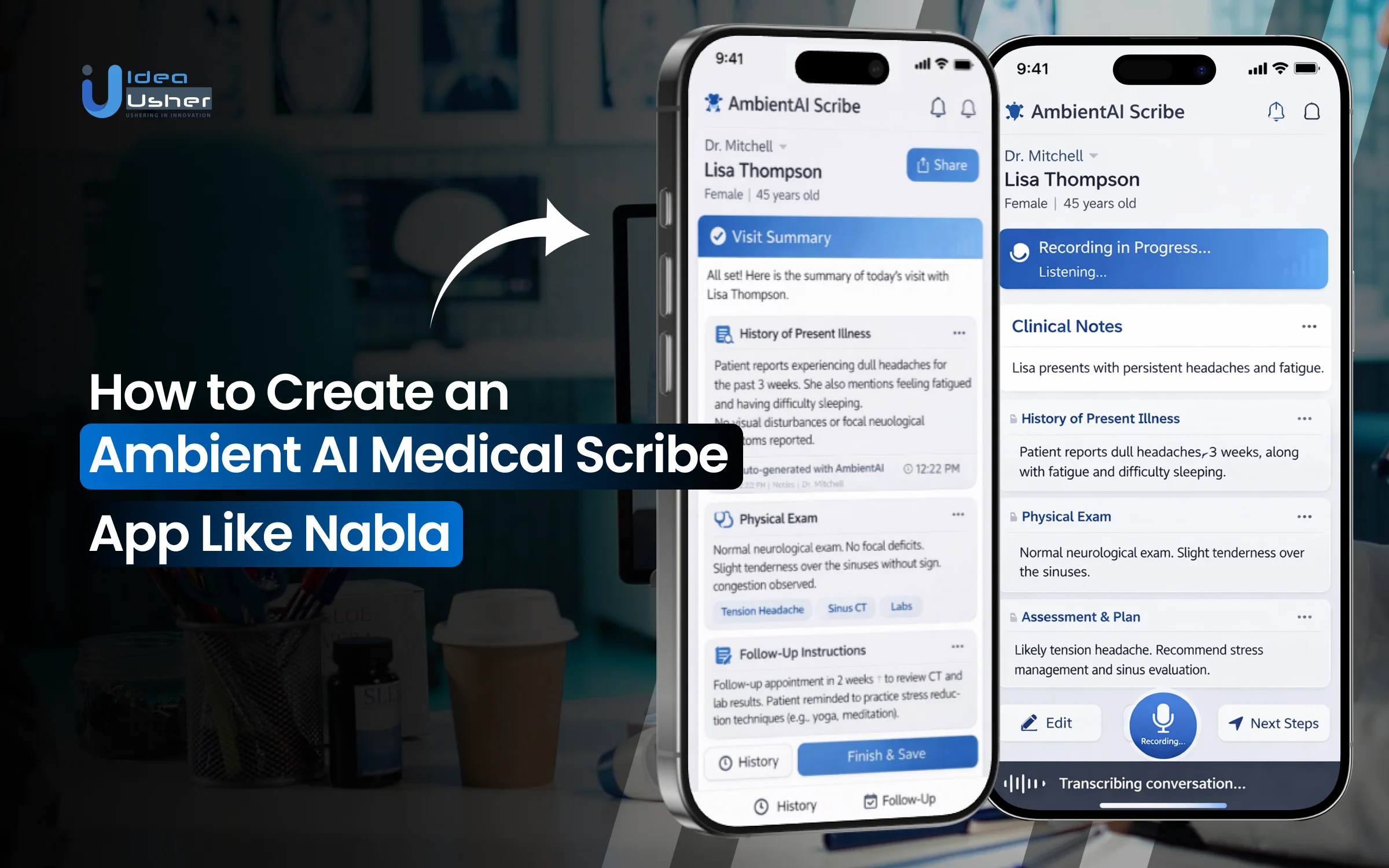
Clinical documentation often happens alongside patient conversations, requiring clinicians to capture detailed notes without interrupting the flow of care. Managing this balance can increase cognitive load and reduce time spent on direct patient interaction, driving interest in Nabla ambient scribe app development where AI systems listen passively, understand context and generate structured clinical notes in the background.
The seamless capture of conversations without disrupting care requires tightly coordinated systems working in real time including speech recognition, natural language understanding, medical context mapping, summarization and EHR integration which must all operate together within a secure and compliant environment.
In this blog, we explain how to create an ambient AI medical scribe app like Nabla by examining core features, system architecture and practical considerations involved in building scalable and reliable AI-driven documentation solutions for healthcare.
Why Ambient AI Scribes Are Transforming Clinics?
The healthcare sector is currently pivoting toward a documentation model that prioritizes the patient-provider interaction over data entry, a shift reflected in a market projected to grow from $1.39 billion in 2025 to $8.93 billion by 2035 at a CAGR of 20.48% as ambient AI scribes act as a passive layer.

These systems capture clinical dialogue in real time without requiring the physician to engage with a screen or keyboard. Clinicians using ambient AI spent 8.5% less total time in the Electronic Health Record (EHR) and saw a 15% drop specifically in time spent composing notes
A. The Hidden Cost of Manual Clinical Documentation
Manual documentation creates a significant financial and operational drain on modern medical practices. When clinicians are forced to spend a large portion of their day on administrative tasks, the entire healthcare delivery model suffers from hidden inefficiencies.
| Impact Area | Consequences of Manual Entry |
| Revenue Loss | Reduced patient throughput as physicians spend hours on notes instead of consultations. |
| Clinician Welfare | High rates of burnout and “pajama time” due to documentation backlogs. |
| Data Integrity | Risk of memory decay and errors when notes are written hours after the patient visit. |
| Compliance | Potential for incomplete records which can lead to billing audits or legal vulnerabilities. |
B. Rise of Ambient Clinical Intelligence Platforms
The shift from standard transcription to Ambient Clinical Intelligence (ACI) represents a leap in how machine learning understands medical context. These platforms do not just record audio; they interpret the clinical significance of the conversation.
- Passive Listening: High-sensitivity microphone arrays capture dialogue from anywhere in the room, allowing for natural movement.
- Contextual Filtering: The AI distinguishes between social pleasantries and relevant medical symptoms or history.
- Structured Output: Systems automatically format data into SOAP notes or specialty-specific templates.
- EHR Synchronization: Seamless data transfer via SMART on FHIR ensures that the information populates the correct fields in the electronic health record.
The technical complexity involved in Nabla ambient scribe app development focuses on this ability to create a “hands-free” environment where the technology becomes an invisible but highly accurate assistant.
C. Why Startups Are Investing in AI Scribes in 2026
The surge in development for these platforms is driven by a clear and immediate return on investment. As healthcare systems look for ways to scale without increasing headcount, AI-driven documentation offers a scalable solution that improves both the bottom line and the quality of care.
- Proven Monetization: Unlike speculative AI tools, ambient scribes have a direct value proposition based on time saved and increased billing accuracy.
- Market Gap: Many legacy record systems lack native, high-performance ambient features, leaving a massive opening for specialized third-party applications.
- Specialization Potential: There is a growing demand for “niche” AI that understands the specific terminology of fields like cardiology, neurology or mental health.
- Decision Support Foundation: Building an ambient scribe is the first step toward creating more advanced clinical copilots that can eventually suggest diagnoses or treatment plans based on the captured data.
What Makes Nabla a Benchmark in AI Scribing?
Nabla has set a high standard in the digital health space by moving beyond simple transcription toward true clinical companionship. The platform excels because it minimizes the friction between the physical consultation and the digital record, ensuring that the technology assists rather than distracts. Its success is defined by a combination of high-speed processing, medical accuracy and a strict adherence to security protocols that healthcare institutions demand.

A. Real-Time Passive Listening and Note Creation
The core of the Nabla ambient scribe app development philosophy is the ability to operate invisibly in the background. Unlike older tools that required a “push-to-talk” interface, this system uses ambient sensing to capture natural dialogue.
- Zero-Latency Processing: Audio is processed in real-time streams, allowing the AI to generate a draft almost immediately after the encounter ends.
- Speaker Diarization: The system accurately identifies and separates the voices of the clinician, the patient and any family members present.
- Acoustic Robustness: The algorithms are trained to filter out environmental noise, such as medical equipment hums or hallway activity, focusing strictly on the clinical exchange.
B. Context-Aware SOAP and Clinical Summaries
Nabla distinguishes itself by its ability to understand the “why” behind a conversation. It does not just transcribe words; it categorizes them into a structured medical format that is ready for a physician’s review.
| Feature | Clinical Functionality |
| Logic-Based Extraction | Automatically places symptoms in “Subjective” and physical findings in “Objective” sections. |
| Specialty Customization | Adjusts the summary style based on whether the visit is for primary care orthopedics or psychiatry. |
| Implicit Detail Capture | Recognizes when a doctor confirms a negative (e.g., “no chest pain”) and logs it correctly as a pertinent negative. |
| Actionable Plans | Distills complex treatment discussions into clear, bulleted “Assessment and Plan” sections. |
C. Privacy-First Architecture Without Audio Storage
Trust is the primary currency in the medical world. Nabla built its reputation by implementing a “privacy-by-design” approach that addresses the legal and ethical concerns of recording patient visits.
- Ephemeral Processing: Audio is transcribed and analyzed in memory, with many configurations ensuring that the raw audio file is deleted immediately after the note is generated.
- No Human-in-the-Loop: Unlike some competitors that use human editors to “clean up” notes, the process is fully automated to prevent unauthorized access to sensitive data.
- Local Compliance: The architecture is built to satisfy HIPAA in the US and GDPR in Europe, ensuring that data residency and encryption standards are strictly met.
- De-identification: The system can be configured to automatically redact personally identifiable information (PII) before the data even hits the processing layer.
D. Seamless SMART on FHIR EHR Integration
A standalone app is a burden; an integrated workflow is a solution. Nabla leverages modern interoperability standards to ensure that the AI-generated notes flow directly into the existing infrastructure of a clinic.
- SMART on FHIR Standards: This allows the app to run as a native-feeling window within major EHRs like Epic or Cerner, eliminating the need for clinicians to toggle between screens.
- Bidirectional Data Sync: The system can pull patient context (like current medications) from the EHR to improve the accuracy of the new note.
- One-Click Injection: Once the clinician reviews and approves the AI-generated summary, it is injected into the appropriate fields of the patient’s record with a single click.
- Cross-Platform Accessibility: Whether using a desktop, tablet or mobile device, the integration remains consistent, supporting the physician regardless of their physical location in the clinic.

How Ambient AI Scribe Apps Actually Work?
The technical architecture of an ambient scribe is a sophisticated pipeline converting acoustic energy into structured clinical intelligence. Functioning as an active processing engine, the system filters and categorizes information in real time to ensure data organization is complete by the consultation’s end.

1. Audio Input and Speech Recognition Pipeline
The process begins with high-fidelity audio capture, often utilizing multi-channel microphone arrays to ensure every word is registered regardless of the speaker’s position. This raw data is fed into a specialized Speech-to-Text (STT) engine trained specifically on medical lexicons.
- Acoustic Processing: The system uses beamforming and noise suppression to isolate the conversation from background hospital sounds.
- Medical STT: Unlike general-purpose voice assistants, the Nabla ambient scribe app development focus remains on recognizing complex pharmaceutical names, anatomical terms and rare disease states.
- Speaker Diarization: The pipeline assigns unique identifiers to each voice, ensuring the transcript clearly distinguishes between the patient’s symptoms and the doctor’s instructions.
2. Clinical Context Extraction Using LLMs
Once a transcript is generated, the system moves from recognition to understanding. Large Language Models (LLMs) act as the brain of the operation, scanning the text for clinical intent and medical relevance.
| Extraction Layer | Function |
| Semantic Analysis | Identifies the relationship between symptoms (e.g., “headache”) and modifiers (e.g., “throbbing, started yesterday”). |
| Named Entity Recognition (NER) | Flags specific entities like medications, dosages and procedure codes. |
| Noise Filtering | Intelligently discards non-clinical dialogue, such as social pleasantries or unrelated side conversations. |
| Logic Inference | Infers implied information, such as recognizing that a discussion about a “fast heartbeat” should be categorized under cardiovascular observations. |
3. Structured Note Generation and Formatting
The final phase of the process involves converting the filtered clinical data into a professional document that mirrors a physician’s specific charting style. The AI takes the raw, unstructured insights and organizes them into a logical medical framework that is ready for immediate review.
- Standardized SOAP Mapping: The engine automatically categorizes information into Subjective, Objective, Assessment and Plan sections to maintain clinical consistency.
- Narrative Synthesis: The system does not just list facts; it crafts a coherent narrative that describes the patient’s history and the progression of the current visit.
- Specialty-Specific Syntax: For Nabla ambient scribe app development, the output is adjusted to use the specific terminology and shorthand preferred by different medical branches.
- Evidence-Based Inclusion: Every generated note includes the context or the “reasoning” behind a clinical entry, ensuring the physician can verify the source of the data within the transcript.
4. Real-Time Sync with EHR Systems
The true utility of an ambient scribe is realized when it integrates directly with the Electronic Health Record (EHR). This stage involves a secure handshake between the AI platform and the hospital’s existing database.
- Interoperability Standards: Utilizing SMART on FHIR and HL7 protocols, the app maintains a secure and standardized connection to platforms like Epic or Cerner.
- Automated Injection: Once the clinician reviews the draft, a single command pushes the structured text into the specific fields of the patient’s chart.
- Data Consistency: The sync ensures that any updates made during the encounter such as a changed dosage are reflected across all relevant modules of the EHR simultaneously, maintaining a single source of truth for patient care.
Core Features Your AI Scribe App Must Have
The Nabla ambient scribe app development requires a foundation of reliability and deep integration. The platform must move beyond basic recording to offer a sophisticated suite of features that handle the complexities of medical environments while ensuring absolute data security and workflow efficiency.

1. Ambient Voice Capture with Noise Handling
The application must utilize far-field microphone technology to capture clear dialogue from any position in the room. This ensures that the clinician can focus entirely on the patient interaction.
Advanced noise-cancellation algorithms are essential to filter out clinical background sounds. The system must maintain high-fidelity audio input even in busy hospital environments or rooms with active medical equipment.
2. Real-Time Transcription with Medical Accuracy
Leveraging specialized medical speech-to-text engines is critical for recognizing complex terminology. The system should distinguish between drug names and anatomical terms that sound similar to ensure a high-quality transcript.
High-accuracy speaker diarization ensures that the conversation is correctly attributed to the doctor or patient. This real-time processing allows for immediate draft generation, significantly reducing the clinician’s post-visit administrative workload.
3. LLM-Based Clinical Note Structuring Engine
Modern Nabla ambient scribe app development relies on Large Language Models to transform raw text into structured data. The engine must intelligently categorize information into the standard SOAP note format.
The AI should possess clinical reasoning capabilities to identify pertinent negatives and treatment plans. This ensures the final output is not just a summary, but a professionally structured medical document.
4. Multi-Specialty Templates and Custom Workflows
A versatile app must provide specialty-specific templates tailored for different fields such as cardiology or pediatrics. These templates allow the AI to prioritize the unique documentation requirements of each discipline.
Users should have the ability to customize clinical workflows to match their specific charting habits. This flexibility ensures the platform adapts to the physician rather than forcing a rigid structure.
5. EHR Integration and Data Sync Capabilities
Achieving seamless interoperability requires using SMART on FHIR protocols for direct data exchange. This allows the AI scribe to function as a native extension of the existing Electronic Health Record.
The system must support bi-directional synchronization to pull patient history and push completed notes. This eliminates the need for manual data entry and ensures the patient record is always current.
6. Audit Trails and Compliance Monitoring Tools
Security is maintained through comprehensive audit trails that track every access and modification of patient data. This transparency is vital for maintaining accountability and meeting strict enterprise-grade security standards.
Built-in compliance monitoring tools automatically flag potential privacy risks or documentation gaps. This proactive approach ensures the platform consistently adheres to HIPAA and SOC 2 Type II regulatory requirements.
Nabla Ambient Scribe App Development Process
The creation of a high-performance clinical copilot requires a systematic approach that balances engineering precision with medical necessity. This structured lifecycle ensures the final product is both technically robust and clinically relevant.

1. Define Clinical Workflows and Target Users
A comprehensive mapping of specific interaction patterns between doctors and patients across various medical environments is the first priority. Deep understanding of how specialists document findings allows for the creation of customized logic that fits naturally into existing clinic routines.
2. Build Speech and NLP Model Architecture
The development team must engineer a sophisticated processing pipeline that utilizes state-of-the-art medical speech recognition and large language models. This engine is designed to handle the linguistic nuances of healthcare conversations while maintaining a high level of clinical accuracy.
3. Design UX for Zero-Interaction Experience
An effective user interface strategy prioritizes an invisible technology layer where the clinician rarely needs to touch a device during a patient encounter. The design focus remains on clear status indicators and simple review mechanisms that do not disrupt the physical consultation.
4. Integrate with EHR Using SMART on FHIR
The implementation of modern interoperability standards is essential for the secure exchange of health data between the app and existing hospital records. Using this protocol ensures that Nabla ambient scribe app development results in a truly integrated software solution.
5. Test for Accuracy, Latency and Compliance
Rigorous evaluation involves measuring the system’s performance against diverse accents, noisy environments and complex medical scenarios. Continuous testing ensures that the generated notes are clinically safe and that the platform adheres to all data privacy regulations.
6. Deploy with Scalable Cloud Infrastructure
A secure cloud environment capable of handling high volumes of real-time audio data with minimal latency is required for the final rollout. This infrastructure must be architected to support rapid scaling while maintaining the strict encryption standards required for protected health information.
Nabla Ambient Scribe App Development Cost Breakdown
The Nabla ambient scribe app development cost varies significantly based on the intended scale of the platform and the depth of its clinical capabilities. While an MVP focuses on core transcription and basic note structuring, an enterprise-grade solution involves complex integrations and a high degree of specialty-specific intelligence.
| Development Phase | MVP Level | Enterprise Level | Key Deliverables |
| Discovery & Architecture | $10,000 – $15,000 | $25,000 – $40,000 | Technical specs, compliance roadmap and system design. |
| Medical NLP & AI Engine | $40,000 – $70,000 | $150,000 – $250,000 | Fine-tuned LLM models and proprietary clinical extraction. |
| UI/UX Design | $8,000 – $15,000 | $30,000 – $55,000 | Low-friction interfaces and clinician review dashboards. |
| EHR Interoperability | $15,000 – $25,000 | $80,000 – $120,000 | SMART on FHIR integration and bidirectional data sync. |
| Security & Compliance | $12,000 – $20,000 | $40,000 – $75,000 | HIPAA/SOC 2 certifications and end-to-end encryption. |
| Total Estimated Cost | $85,000 – $145,000 | $325,000 – $540,000+ | A market-ready, scalable clinical intelligence platform. |
Key Cost-Affecting Factors During Development
The total investment is influenced by technical choices that impact both the upfront build and the long-term operational overhead. Strategic decisions regarding model selection and integration depth are the primary drivers of the final budget.
- Model Training and Fine-Tuning: While Whisper-v3 reduces initial outlay, fine-tuning a proprietary LLM for medical specialties can increase budgets by 30% to 50% due to high-quality data requirements.
- API and Token Usage: Real-time processing via third-party providers creates recurring costs scaling with volume, potentially reaching $500 to $5,000 monthly infrastructure fees depending on active clinician counts.
- EHR Integration Complexity: Standard APIs are cost-effective, yet custom legacy EHR integrations can add $20,000 to $50,000 per individual hospital system implementation.
- Compliance and Certification: Enterprise-grade status requires rigorous audits, with HIPAA and SOC 2 Type II compliance costing $15,000 to $30,000 initially plus annual maintenance fees.
- Multi-Language Support: Supporting 35+ languages complicates the speech pipeline, typically increasing development hours by 15% to 20% to ensure clinical accuracy across diverse dialects.
Timeline to Build an Ambient AI Scribe App
The development cycle for a clinical intelligence tool depends on the complexity of the AI pipeline and the depth of EHR integration. A phased approach ensures market entry with core functionality.
A. MVP Development Timeline Breakdown
Launching a Minimum Viable Product focuses on core transcription and basic note structuring to validate the technology in a clinical setting. This phase typically spans three to five months of intensive engineering.
| Phase | Duration | Primary Focus |
| Discovery | 2-3 Weeks | Workflow mapping and technical architecture. |
| AI Core Build | 6-8 Weeks | STT pipeline and basic SOAP note generation. |
| UI/UX Development | 4-5 Weeks | Clinician dashboard and mobile interface. |
| Compliance/QA | 3-4 Weeks | Initial HIPAA security testing and accuracy audits. |
B. Full-Scale Platform Development Timeline
Building a comprehensive, enterprise-grade solution requires extensive refinement and specialized features. This expanded timeline covers deep integrations and advanced medical reasoning capabilities over an eight to twelve month period.
| Phase | Duration | Primary Focus |
| Specialty Tuning | 8-12 Weeks | Customizing LLMs for specific medical disciplines. |
| Deep EHR Sync | 10-14 Weeks | Advanced SMART on FHIR bidirectional integration. |
| Enterprise Security | 6-8 Weeks | SOC 2 Type II audit and multi-tenant architecture. |
| Pilot Scaling | 4-6 Weeks | Multi-facility stress testing and performance tuning. |
C. Factors That Can Delay or Speed Up Launch
Strategic decisions regarding technical debt and regulatory preparedness directly influence the speed of deployment. Efficient project management and clear technical requirements are essential to maintaining the projected development schedule.
- API Readiness: Utilizing mature third-party medical AI APIs can reduce development time by 4 to 6 weeks compared to building proprietary models from scratch.
- Regulatory Roadblocks: Delays in obtaining SOC 2 Type II certification or specific hospital-level security approvals can extend the launch window by several months.
- EHR Partner Cooperation: The responsiveness of Electronic Health Record vendors during the integration phase is a major variable that often dictates the speed of the final rollout.
- Scope Creep: Adding complex features like real-time clinical decision support or multi-language support early in the build can increase the timeline by 25% to 40%.
- Data Availability: Quick access to high-quality, de-identified clinical datasets for model testing allows for faster accuracy tuning and a more reliable product launch.
MVP vs Full-Scale AI Scribe Platform Strategy
A phased development approach allows for immediate market validation while building toward a comprehensive enterprise ecosystem. This strategy balances the need for rapid deployment with the long-term goal of total clinical workflow automation.
A. What to Include in a Lean MVP Version
An MVP focuses on the essential utility of ambient listening to prove value quickly. It strips away complex integrations to prioritize the core “listen and summarize” loop that provides immediate relief to clinicians.
- Core AI Engine: Implementation of a high-accuracy medical speech-to-text pipeline and basic LLM-driven SOAP note generation.
- Essential Security: Deployment of a HIPAA-compliant infrastructure including end-to-end encryption and a signed Business Associate Agreement (BAA).
- Simplified Interface: A lightweight web or mobile dashboard that allows doctors to record, review and manually copy notes.
- Basic Template Support: A small selection of general-purpose medical templates to cater to primary care or internal medicine users.
B. When to Scale to Enterprise Features
Transitioning to a full-scale platform is triggered by the need for institutional-wide adoption. Enterprise features focus on deep ecosystem immersion, ensuring the tool works across diverse departments and administrative layers.
- EHR Interoperability: Scaling is necessary once you move from individual users to clinics requiring native SMART on FHIR integrations and automated data write-back.
- Specialty Optimization: Developing deep-tier intelligence for fields like oncology or cardiology requires specialized fine-tuning and unique clinical decision support tools.
- Organization Governance: Institutional clients require Single Sign-On (SSO), centralized user management and advanced analytics for monitoring clinician efficiency.
- Medical Coding: Moving beyond notes to include automated ICD-10, CPT and HCC coding suggestions is a hallmark of an enterprise-ready solution.
C. Trade-offs Between Speed and Accuracy
Balancing the time-to-market with the precision of clinical output is a primary engineering challenge. While a faster launch captures market share, medical errors can lead to immediate churn and liability issues.
| Trade-off Area | Focus on Speed | Focus on Accuracy |
| Model Choice | Using general APIs (like GPT-4o) allows for deployment in weeks but may lead to higher hallucination rates. | Fine-tuning proprietary medical LLMs takes months but significantly improves clinical nuance and detail. |
| Note Review | Fully automated systems generate notes in seconds but require intensive clinician proofreading to catch errors. | Hybrid models with a “human-in-the-loop” layer offer near-perfect notes but delay delivery by several minutes. |
| Processing Style | Streaming audio in 2-second chunks provides real-time feedback but often lacks the broader context of the visit. | Processing the entire encounter after it ends takes longer but ensures a more coherent and logical SOAP structure. |
| EHR Data Sync | Simple copy-paste functionality is fast to build but creates a “clunky” experience that slows down the doctor. | Deep bidirectional synchronization requires complex engineering but creates a seamless, one-click workflow for the user. |
Tech Stack Needed for AI Medical Scribe Apps
Selecting the right technology stack is a critical decision for Nabla ambient scribe app development that impacts the scalability, security and clinical accuracy of your platform. The architecture must support high-concurrency audio streaming while maintaining rigorous data protection standards required by international healthcare regulations.
| Component | Recommended Stack | Purpose |
| Speech Recognition and Audio Processing | Deepgram, OpenAI Whisper-v3, AssemblyAI, PyAudioAnalysis | Converts raw clinical dialogue into text with high precision and handles speaker diarization. |
| LLMs for Clinical Language Understanding | GPT-4o, Med-PaLM 2, Claude 3.5 Sonnet, Mistral Large | Extracts medical intent and structures unstructured transcripts into professional SOAP notes. |
| Backend and Database Infrastructure | Node.js (TypeScript), Python (FastAPI), PostgreSQL, Redis | Manages application logic, high-speed data caching and secure storage of structured clinical records. |
| Cloud, Security and Compliance Stack | AWS HealthLake, Google Cloud Healthcare API, Azure, Vanta | Provides HIPAA-compliant hosting, end-to-end encryption and automated compliance monitoring. |
| EHR APIs and Healthcare Integrations | Health Gorilla, Redox, SMART on FHIR, HL7 v2/FHIR | Enables seamless interoperability and data synchronization with major hospital electronic health records. |
Compliance Beyond HIPAA You Must Consider
While HIPAA is the baseline for healthcare data in the United States, scaling an ambient AI platform requires meeting a broader set of international and industry-specific standards. Navigating these requirements is essential for securing large hospital contracts and operating across global markets without legal or financial repercussions.
1. SOC 2 and Enterprise Security Requirements
A SOC 2 Type II certification is often a non-negotiable requirement for enterprise-level healthcare organizations. It provides independent verification that your platform manages data based on five trust service principles: security, availability, processing integrity, confidentiality and privacy.
- Audit Depth: Unlike self-reported HIPAA compliance, SOC 2 requires a multi-month audit period to prove that security controls are consistently operational.
- Access Control: Implementation of sophisticated role-based access controls (RBAC) and multi-factor authentication (MFA) is mandatory to prevent unauthorized data exposure.
- Continuous Monitoring: Developers must integrate automated tools to monitor infrastructure health and security events in real time, ensuring that the Nabla ambient scribe app development process remains audit-ready.
2. GDPR and Data Residency Considerations
For platforms expanding into the European market, the General Data Protection Regulation (GDPR) introduces strict rules on how personal data is processed and stored. This includes the right to erasure and the requirement for explicit patient consent for data processing.
- Data Sovereignty: GDPR often mandates that sensitive medical data belonging to EU citizens must stay within EU borders, requiring a multi-region cloud strategy.
- Processing Transparency: Your system must provide clear documentation and technical mechanisms that allow users to manage their data footprints, including the deletion of transcripts.
- Technical Safeguards: Implementation of “Privacy by Design” means that data minimization is a core feature, ensuring that only the absolute necessary data is processed to generate the clinical note.
3. FDA Risks in Clinical Decision Support
A critical boundary exists between an administrative tool and a medical device. If your AI scribe moves from merely summarizing notes to suggesting diagnoses or recommending specific treatments, it may fall under the jurisdiction of the FDA as Software as a Medical Device (SaMD).
- Functionality Threshold: Tools that provide passive documentation are generally exempt, but those offering real-time diagnostic alerts or treatment recommendations may require 510(k) clearance.
- Physician Oversight: The system must be designed so that the clinician remains the final decision-maker, ensuring the AI acts as a support tool rather than a diagnostic authority.
- Transparency and Explainability: Regulatory standards require that any AI-driven clinical suggestion must be “explainable,” meaning the software should cite the specific clinical data used to reach its conclusion.
- Liability and Risk Mitigation: Moving into the decision-support space increases the platform’s risk profile, necessitating rigorous clinical validation and a more intensive “locked” algorithm approach to satisfy safety standards.
Key Challenges in Building Ambient AI Scribes
The nabla ambient scribe app development involves overcoming significant technical and regulatory hurdles that go beyond standard AI applications. Our engineering approach focuses on solving these “edge cases” to ensure the platform remains accurate and secure in high-pressure clinical environments.

1. Achieving High Accuracy in Noisy Environments
Challenge: Background medical equipment alarms, overlapping conversations from staff and environmental noise can corrupt audio inputs, leading to critical transcription errors.
Solution: Our developers implement multi-channel beamforming and advanced noise-suppression layers. By utilizing far-field microphone arrays and digital signal processing, we isolate the primary speakers and filter out non-clinical interference.
2. Handling Complex Medical Terminology
Challenge: General-purpose AI models often struggle with specialized pharmaceutical names, anatomical terms and diverse physician accents, potentially causing “clinical hallucinations” or omissions.
Solution: We utilize medical-grade speech-to-text engines fine-tuned on vast healthcare corpora. Our team implements custom phonetic mapping and vocabulary expansion to ensure the AI recognizes even the most obscure clinical lexicons.
3. Ensuring Real-Time Performance at Scale
Challenge: Processing high-resolution audio for hundreds of simultaneous consultations requires massive computational power and can lead to high latency during note generation.
Solution: Our architecture leverages auto-scaling GPU clusters and efficient WebSocket streaming. We optimize the inference pipeline to ensure that structured notes are generated in under ten seconds once the encounter ends.
4. Maintaining HIPAA and SOC 2 Compliance
Challenge: Healthcare data requires rigorous administrative and technical safeguards to prevent unauthorized access and ensure the integrity of Protected Health Information (PHI).
Solution: We build using HIPAA-aligned cloud infrastructure with end-to-end AES-256 encryption. Our developers incorporate automated audit logging and role-based access controls to meet strict SOC 2 Type II audit requirements.
5. Avoiding Data Storage and Privacy Risks
Challenge: Storing raw audio files creates significant liability and privacy risks for both the provider and the technology vendor if a breach occurs.
Solution: We implement a stateless processing architecture where audio is transcribed in memory and immediately deleted. By never storing the original recording, we eliminate the primary risk surface for data exfiltration.
How IdeaUsher Builds AI Healthcare Platforms?
Our approach merges deep technical proficiency with an intimate understanding of clinical workflows. We specialize in engineering high-performance, medical-grade solutions that prioritize reliability, security and user adoption.
A. Our Experience in AI and Healthcare Solutions
We possess a proven track record in deploying sophisticated AI models tailored for the medical domain. Our team understands the nuance required for high-accuracy medical speech recognition and clinical language understanding.
B. End-to-End Development from Idea to Scale
The development lifecycle we provide covers everything from initial workflow consulting to full-scale deployment. We ensure that your platform is architected for high concurrency and long-term stability in busy clinics.
C. Expertise in EHR and Telehealth Integration
Our engineers excel in bridging the gap between new AI tools and legacy healthcare infrastructure. We utilize SMART on FHIR and HL7 protocols to ensure seamless data flow across EHR systems.
D. Focus on Compliance and Scalable Architecture
Security is the cornerstone of our development process, ensuring every product meets HIPAA and SOC 2 standards. We build on elastic cloud infrastructure to support your growth from MVP to enterprise.
Case Study: Building a Real-Time AI Scribe
Applying ambient intelligence within mental health requires a higher degree of sensitivity and structural nuance than general medicine. At IdeaUsher, we leveraged these principles through our project Kamelion, an AI-powered mental health platform designed to handle the complexities of therapeutic dialogue and emotional data with clinical precision.
A. Problem Statement and Client Requirements
The objective for Kamelion was to alleviate the intensive administrative burden on mental health professionals, who must document subtle behavioral shifts and complex emotional narratives while maintaining a deep human connection.
- Emotional Context Extraction: The platform required an engine capable of moving beyond literal transcription to identify emotional cues and non-verbal sentiment expressed during therapy.
- Zero-Touch Operation: The system required a completely passive “ambient” experience where the software functions without manual start or stop triggers during the patient encounter.
- Long-Form Session Management: Unlike short primary care visits, the system had to maintain high accuracy and context throughout sessions lasting 45 to 60 minutes.
- Strict Privacy Framework: Given the sensitive nature of psychiatric data, the client demanded a “zero-retention” audio policy and enterprise-grade encryption for all session summaries.
- Behavioral Tracking: A core requirement was the ability to track longitudinal progress, identifying changes in mood or symptom severity across multiple sessions.
- Clinician-First Design: The interface had to provide a summary that the therapist could review and edit in seconds, ensuring the final record remained under their professional authority.
- Direct EHR Integration: The solution had to synchronize seamlessly with their existing electronic records system to allow for one-click note approval and instant data injection.
B. Architecture and AI Model Approach
Our engineering team deployed a sophisticated “Ambient Clinical Intelligence” layer built on top of a specialized speech-to-text and NLP pipeline. This architecture was designed to handle the unpredictable nature of real-time clinical dialogue.
- Audio Intelligence: We utilized Whisper-large-v3 fine-tuned with a medical lexicon to ensure 98%+ accuracy on complex pharmaceutical and anatomical terms.
- Contextual Structuring: A proprietary LLM layer was implemented to perform Abstractive Summarization, turning “patient says her head hurts since Tuesday” into professional HPI (History of Present Illness) formatting.
- Stateless Processing: To eliminate privacy risks, we built a memory-only processing stream where audio data was discarded immediately after the note was successfully pushed to the EHR.
- Smart Injections: Using SMART on FHIR, we enabled the system to “inject” finished notes directly into the correct fields of the client’s existing Epic EHR system with a single clinician approval.
C. Outcomes in Accuracy and Time Savings
The deployment resulted in a measurable shift in both clinical efficiency and provider satisfaction. By automating the administrative layer of the encounter, the clinic was able to recapture lost revenue and significantly reduce the burden on their medical staff.
| Metric | Pre-Implementation | Post-Implementation | Improvement |
| Documentation Time | 12-15 mins per patient | 2-3 mins (Review only) | ~80% Reduction |
| Note Accuracy | Varied (Memory dependent) | 99% (Verbatim accuracy) | Significant Gain |
| Daily Patient Capacity | 18 Patients / Day | 22 Patients / Day | +4 Patients / Day |
| Clinician Burnout | High (Reported “Pajama Time”) | Low (Notes finished in-office) | Major Quality of Life |
This case study serves as a blueprint for how Nabla ambient scribe app development can be executed to achieve immediate ROI like our AI mental health app, Kamelion. By focusing on the intersection of medical accuracy and invisible technology, we help healthcare organizations return their focus to the patient.
Real Use Cases Across Healthcare Settings
The versatility of ambient intelligence allows it to adapt to diverse clinical environments, from high-volume clinics to complex surgical consultations. These applications ensure that documentation remains accurate regardless of the setting.

1. Primary Care and General Consultations
Ambient tools excel in primary care by capturing long-form patient narratives and converting them into structured SOAP notes. This allows physicians to maintain eye contact and build trust during routine examinations.
Actual Real-World Example: The Permanente Medical Group (Kaiser Permanente) deployed ambient AI technology to over 10,000 physicians, resulting in a documented reduction of administrative tasks by 1 hour per day per doctor.
2. Specialty Clinics and Complex Workflows
Specialized medical fields require terminology and templates unique to their practice. AI scribes adapt by recognizing specific procedural language and high-level clinical reasoning common in areas like orthopedics or cardiology.
Actual Real-World Example: Mankato Clinic, a multi-specialty group, integrated ambient AI to handle complex patient histories, allowing specialists to see two additional patients per day while maintaining high-fidelity documentation.
3. Telehealth and Virtual Care Environments
Virtual consultations benefit from AI integration by capturing high-quality digital audio directly from the video stream. This eliminates the need for doctors to toggle between video calls and record systems.
Actual Real-World Example: Moderna’s virtual health initiatives and platforms like Teladoc have utilized AI-driven transcription layers to ensure that remote consultations are instantly converted into searchable, structured clinical data for longitudinal tracking.
4. Hospital Systems and Enterprise Deployments
Large-scale healthcare systems use ambient intelligence to standardize documentation across hundreds of providers. This ensures data consistency and simplifies the administrative oversight of clinical quality across an entire health network.
Actual Real-World Example: WellSpan Health implemented an enterprise-wide ambient AI solution across its hospitals, reporting that 94% of their physicians found the AI-generated notes to be more accurate and thorough than their manual entries.
Why Founders Choose IdeaUsher for AI Scribes?
Our team specializes in bridging the gap between sophisticated artificial intelligence and practical healthcare applications. We deliver market-ready solutions that prioritize clinical precision, technical scalability and absolute data integrity.
A. Proven Expertise in AI Product Development
Leveraging our team of ex-FAANG/MAANG developers, we bring elite engineering standards to every project. With over 500,000+ hours of development experience, we build high-performance AI engines tailored for complex medical environments.
B. Deep Understanding of Clinical Workflows
We design systems that respect the intricate nature of patient-provider interactions. Our expertise ensures that Nabla ambient scribe app development results in a tool that integrates naturally into existing physician routines.
C. Flexible Engagement and Long-Term Support
Our partnership extends beyond the initial launch to provide continuous optimization and scaling. We offer agile engagement models that adapt to your growth, ensuring your platform remains at the technological forefront.
Conclusion
The rise of ambient clinical intelligence marks a definitive shift toward physician-led, patient-centric care. By automating the most taxing administrative burdens, these systems restore the joy of practice while ensuring clinical accuracy and enterprise-grade security. Navigating the Nabla ambient scribe app development landscape requires a deep understanding of AI pipelines, EHR integration and strict compliance standards. As the technology matures, platforms that prioritize a zero-interaction experience will lead the market, allowing providers to focus entirely on their patients rather than their screens.
FAQs
A.1. Development costs generally range from $85,000 to $450,000+. This budget covers HIPAA-compliant cloud infrastructure, LLM fine-tuning for medical accuracy, EHR integration through SMART on FHIR and rigorous SOC 2 security audits.
A.2. While Whisper-v3 is excellent for speech-to-text, fine-tuned models like Med-PaLM or GPT-4o often handle summarization. Proprietary fine-tuning is usually necessary to ensure the AI understands complex clinical terminology and diverse dialects.
A.3. A robust stack typically includes Python for backend AI logic, Whisper-v3 or Deepgram for speech-to-text and React Native for cross-platform mobile access. Scalable PostgreSQL or MongoDB handles HIPAA-compliant data storage efficiently.
A.4. The biggest risks involve unauthorized data access and improper storage of audio files. Developers must implement end-to-end encryption and automatic audio deletion to maintain strict HIPAA and SOC 2 compliance.


