

Key Take Aways
- GLP-1 apps are becoming essential healthcare infrastructure
- The rapid growth of GLP-1 medications has created a strong demand for digital companion apps that support adherence, monitoring, and long-term patient outcomes. High-performance apps go beyond tracking to clinical-grade systems
- Successful platforms integrate titration logic, protein-focused nutrition, side-effect management, and behavioral coaching to ensure both safety and retention. Development cost is driven by medical complexity and integrations
- Features like wearable sync, telehealth, AI analytics, and HIPAA-compliant infrastructure significantly increase costs, making GLP-1 apps more complex than standard fitness apps. A lean MVP strategy is critical for cost efficiency and validation
- Starting with core features like dose tracking, nutrition logging, and symptom monitoring helps reduce risk, validate demand, and optimize future investments. Long-term value lies in data, personalization, and retention
- Apps that leverage AI, biometric data, and behavioral systems create strong user retention, higher lifetime value, and defensible data moats for businesses.
Starting a GLP-1 plan is straightforward, but sustaining it often becomes difficult in daily routines. Many people have started using GLP-1 apps because they need better adherence support and clearer visibility into how their body responds. Most users may initially follow prescriptions, but consistency usually drops without structured guidance.
These platforms can integrate wearable signals and symptom inputs to generate context-aware feedback. Users often need timely nudges that could improve consistency and metabolic response over time. Businesses are now building systems that should align more closely with real user behavior than with static care models.
Over the years, we’ve developed numerous GLP-1 companion apps powered by predictive health analytics and remote patient monitoring frameworks. Since IdeaUsher has this expertise, we’re sharing this blog to discuss estimating the GLP-1 app’s cost and feature scope.
Why GLP-1 Apps Are Becoming a Priority?
According to RootsAnalysis, the GLP-1 nutritional support market is forecast to reach USD 13 billion by 2035, up from USD 4.1 billion in 2025, advancing at a 12.2% CAGR. This growth signals a fundamental restructuring of metabolic health. For investors, these figures represent a massive gap between medication supply and the digital infrastructure required to manage patients at scale.
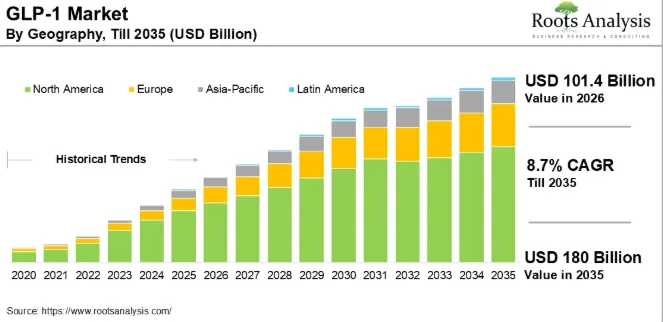
Source: Roots Analysis
Medications like Semaglutide have created a secondary gold rush in software. While drugs handle biology, they require digital support for monitoring and nutrition. Traditional healthcare is ill-equipped for this oversight, making companion software a mandatory component of the ecosystem.
Investors recognize that medication alone is an incomplete solution. Platforms like Shotsy have validated this demand by focusing on injection tracking and dosage clarity. Without such digital intervention, risks like muscle loss can hurt a provider’s reputation. Proprietary platforms are now a prerequisite for market entry.
Rising Demand for Digital Care
The surge is driven by patients requiring high clinical oversight. These users need medical-grade platforms rather than basic fitness trackers.
- Biological Monitoring: Users must track protein to prevent muscle loss and monitor hydration.
- Automated Adherence: Apps automate dosing schedules and ensure compliance.
- Business Scalability: Automation allows one clinician to oversee a larger patient panel efficiently.
From Clinics to Continuous Apps
We are seeing a shift from episodic to continuous care. In GLP-1 therapy, the time between doctor visits is when critical interventions happen. A clinic-only model is reactive, while a digital model is proactive.
High-value patients expect a concierge experience. This is why players like Noom have pivoted toward Noom Med, integrating psychological tracking with clinical prescriptions. This shift creates a resilient business model based on recurring subscriptions rather than one-off fees.
Why Startups are Investing Now
The window for early-mover advantage is closing. Entrepreneurs are moving aggressively to secure market share for strategic reasons.
- Expanding TAM: As insurance coverage grows, the market will include millions of new users.
- High Lifetime Value: This therapy is often a multi-year commitment, leading to higher LTV.
- Data Moats: Capturing real-world evidence on patient responses creates a valuable asset.
- Regulatory Barriers: Building HIPAA-compliant platforms takes time, creating a defensive moat.

What Defines a High-Performance GLP-1 Companion App?
Investing in GLP-1 apps requires moving beyond simple tracking. High-performance apps act as digital therapeutics, managing risks like muscle loss and GI distress. For investors, value is found in clinical outcomes and long-term user retention.
These apps must handle complex titration schedules and lean mass metrics. Success is defined by biological feedback that protects metabolic health, rather than basic calorie counting.
Existing leaders like Shotsy have already validated this demand, amassing over a million downloads by focusing on clean, medication-specific data visualization.
Bridging Meds and Behavior
The gap between suppressed hunger and old habits is the biggest hurdle. High-performance apps must transition from passive logs to active behavioral engines.
- Titration Mapping: Syncing with injections helps predict side-effect windows, allowing the app to offer preemptive hydration and dietary tips.
- Cognitive Reframing: The app uses “quieted food noise” to build micro-habits, ensuring weight maintenance if the user eventually stops medication.
- Adherence Logic: Smart notifications detect when a user is under-eating, triggering safety-first interventions to prevent malnutrition.
Platforms like Noom have pioneered this by integrating psychology-based coaching specifically for the GLP-1 cohort.
Protein and Muscle Retention
Muscle wasting (sarcopenia) is a major clinical risk. A standard app is insufficient; the architecture must be Protein-First to protect the user’s metabolic rate and strength.
- Amino Acid Density: Algorithms prioritize protein quality, guiding users toward 1.2g–1.5g per kg to ensure the body spares muscle while burning fat.
- Nutritional Efficiency: Because users feel full quickly, the app focuses on nutrient-dense, low-volume foods to maximize limited caloric intake.
- Deficiency Alerts: Automated analysis flags gaps in B12 or Magnesium, which are often depleted during rapid weight loss phases.
Wearable and Symptom Loops
To become an essential tool, the platform must integrate with wearables and CGMs. This provides objective data that manual logs simply cannot match.
- Biometric Correlation: The app cross-references heart rate and HRV with medication cycles to flag potential adverse reactions for clinical review.
- Symptom Synergy: If a user logs fatigue, the app analyzes sleep and glucose data to suggest immediate fixes, like electrolyte adjustments.
- Data Moat: Correlating dosages with activity creates proprietary datasets. This makes the platform a prime candidate for pharmaceutical partnerships and research.
Core Features That Impact GLP-1 App Development Cost
Investing in a GLP-1 app requires precision. Unlike generic fitness tools, costs are driven by medical logic and data security. For entrepreneurs, these cost centers determine the platform’s ROI.
Developing these features requires a specialized tech stack. You are paying for the algorithmic backbone that prevents muscle loss and ensures medication safety.
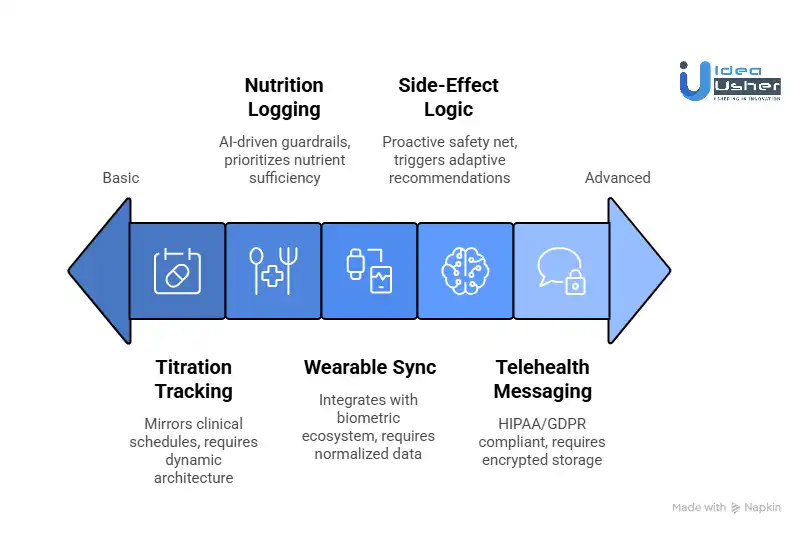
1. Titration and Dose Tracking
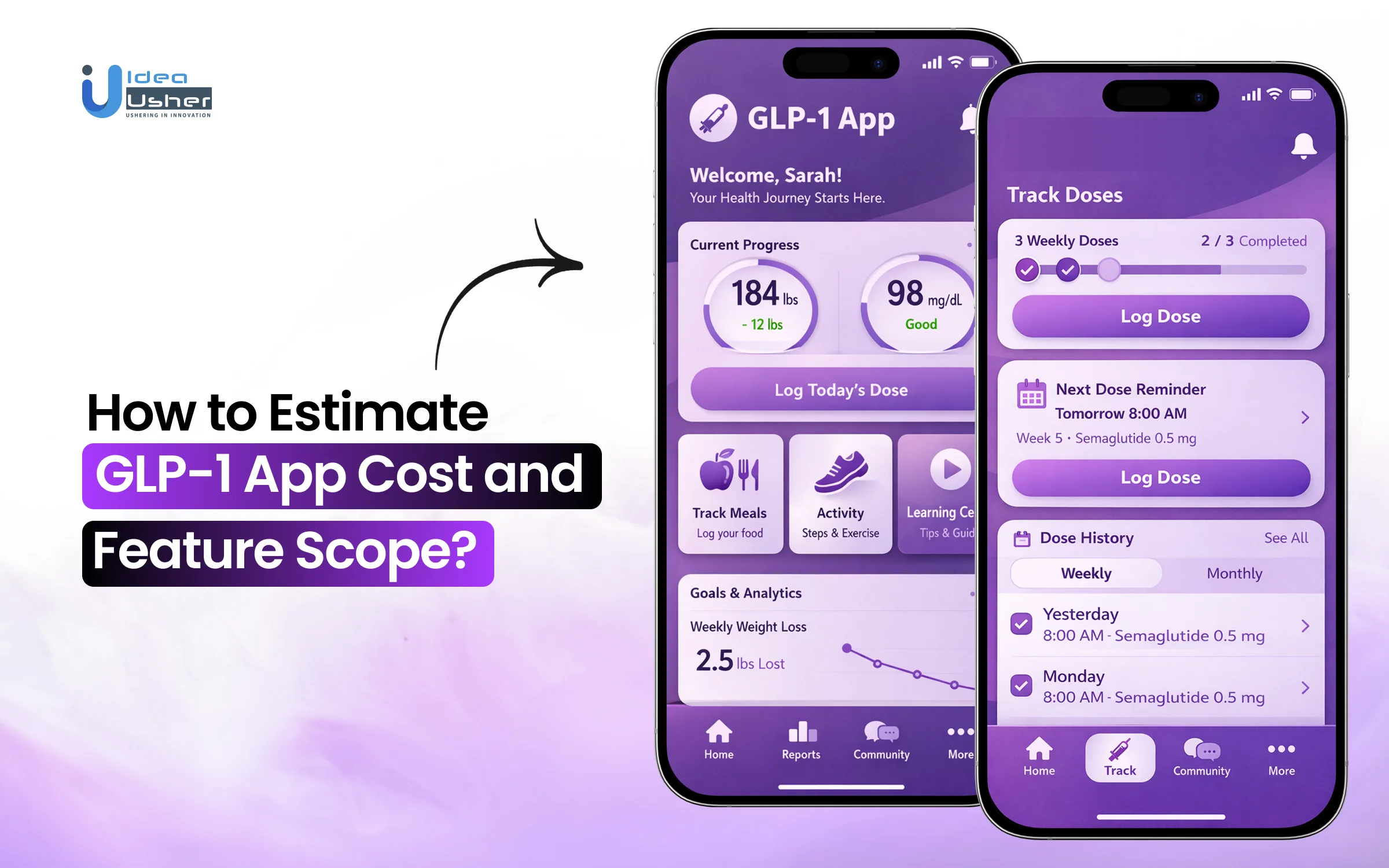
Injection tracking is complex. A basic calendar will not suffice; you need a system that mirrors clinical titration schedules.
Technical Complexity: Backends must support variable dosing. This requires dynamic architecture to adjust alerts based on specific medications like Semaglutide or Tirzepatide.
- Site Rotation: The app needs a visual body map to track injection sites and prevent tissue issues.
- Medication Levels: Premium apps like Shotsy chart estimated levels in the bloodstream. This requires integrating pharmacokinetic curves into the data layer.
2. Nutrition and AI Logging
GLP-1 apps must focus on nutrient sufficiency rather than just deficits. Development shifts from simple databases to AI-driven nutritional guardrails.
| Feature | Strategic Importance | Cost Driver |
| Protein Logic | Prevents muscle wasting | Algorithms prioritizing amino acid density |
| AI Scanning | Reduces logging friction | Computer Vision API integrations |
| Fiber Tracking | Mitigates GI side effects | Automated nudges based on clinical thresholds |
AI “Snap and Log” features are now a baseline expectation. They minimize friction for users who find logging food mentally taxing due to suppressed appetite.
3. Wearable and Biometric Sync
To command premium pricing or insurance reimbursement, the app must live within the user biometric ecosystem.
Integration is an ongoing effort. Connecting to Apple HealthKit or Oura requires normalized data processing. If a wearable detects a heart rate spike after a dose, the app must flag it.
The “Build vs. Buy” decision is critical. Custom integration layers offer more control over proprietary Health Scores, which increases your business exit value.
4. Side-Effect Logic Engines
This is where the app becomes a Digital Therapeutic. Side-effect monitoring is a proactive safety net, not just a checklist.
- The Logic: If a user logs nausea, the app triggers an Adaptive Recommendation Engine.
- The Output: The system suggests hydration protocols or bland diets, or prompts provider contact.
- The Investment: Coding these decision trees requires collaboration between software architects and clinical advisors.
5. Secure Telehealth and Messaging
Building a full-stack experience like Noom or Ro requires HIPAA/GDPR compliance from day one.
Asynchronous messaging is more scalable than live video. It allows clinicians to manage larger patient pools efficiently. The infrastructure must include encrypted storage and audit-ready logs.
Building this in-house is expensive. Many investors use white-label Telehealth APIs to reduce time-to-market while maintaining medical-grade security.
Advanced Features That Increase Cost but Drive ROI
Investing in GLP-1 apps requires a strategic shift from simple utility to high-value infrastructure. To capture market share, an app must do more than track weight; it must solve the logistical and biological hurdles that cause patient churn.
For entrepreneurs, high-performance features create defensible moats and unlock institutional revenue streams, transforming a basic tool into a high-valuation digital therapeutic asset.
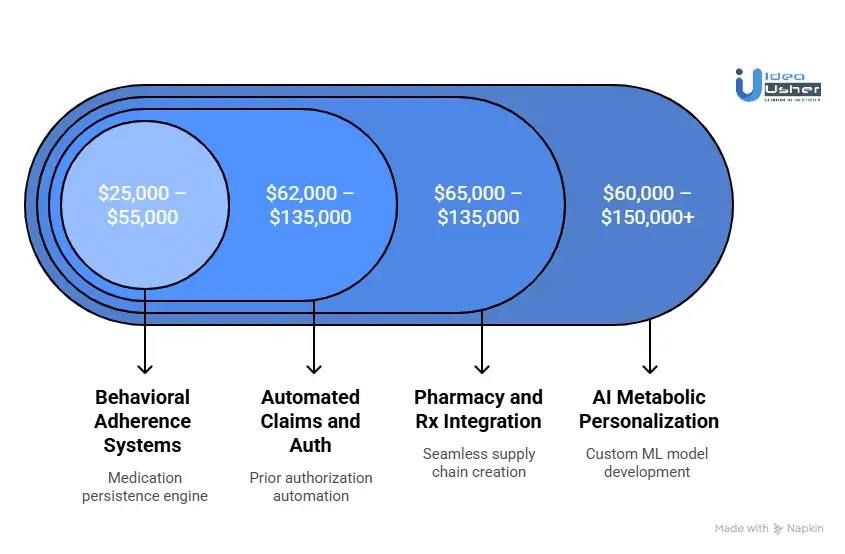
1. AI Metabolic Personalization
Elite apps move beyond tracking to interpretation. By utilizing machine learning to analyze the intersection of dosage, biometrics, and nutrition, the platform can provide “Metabolic Pathing” to predict and bypass weight plateaus.
- Business Value: Personalized insights drive Daily Active Usage (DAU). When a user feels the platform understands their unique biology, retention becomes a long-term certainty.
- The Logic: AI models cross-reference data to identify the exact protein-to-carb ratios that minimize fatigue for a specific user during their injection peak.
- Estimated Cost: $60,000 – $150,000+ for custom ML model development and predictive dashboards.
2. Pharmacy and Rx Integration
Scaling requires removing the friction of medication procurement. Deep-linking with Pharmacy Benefit Managers (PBMs) and retail APIs like SureScripts creates a seamless supply chain within the app.
Strategic Edge: Integrating pharmacy data allows the app to confirm prescription readiness and facilitate refills automatically. This creates a “sticky” ecosystem where the user manages their entire therapy lifecycle in one place.
Investment Breakdown:
- Pharmacy API Integration: $20,000 – $45,000
- Rx Management Logic: $15,000 – $30,000
- EHR/EMR Data Sync: $30,000 – $60,000 for secure data exchange.
3. Automated Claims and Auth
Prior Authorization is the primary barrier to GLP-1 therapy. Automating this workflow via digital integration is a massive value-add for clinicians and users alike.
| Feature | Business Impact | Estimated Cost |
| Eligibility Checks | Instant coverage confirmation | $12,000 – $25,000 |
| Auto-PA Submission | Eliminates clinician paperwork | $40,000 – $90,000 |
| Status Tracking | Reduces user churn/anxiety | $10,000 – $20,000 |
By digitizing this traditionally manual process, the platform reduces “time-to-medication” from weeks to days, making it a high-value tool for medical practices.
4. Behavioral Adherence Systems
Data shows over 50% of GLP-1 patients stop therapy prematurely. An “Adherence Engine” uses behavioral science to ensure medication persistence and long-term success.
- Variable Rewards: Gamified milestones, such as “Muscle Preservation Streaks,” maintain engagement when scale progress plateaus.
- Nudge Architecture: Science-backed “Micro-habits” prompted at optimal times can improve 12-month persistence by over 30%.
- The Investment: Budget $25,000 – $55,000 for a rules-based engine that reacts to user inactivity or missed logs with empathetic, clinical interventions.
How to Accurately Estimate GLP-1 App Cost and Feature Scope?
Developing GLP-1 apps requires shifting from standard software budgeting to clinical-grade planning. For investors, the goal is to align capital with the medical needs of users on high-stakes medication. Precise estimation prevents “scope creep,” ensuring the platform doesn’t fail by trying to be a general fitness tool and a clinical asset simultaneously.
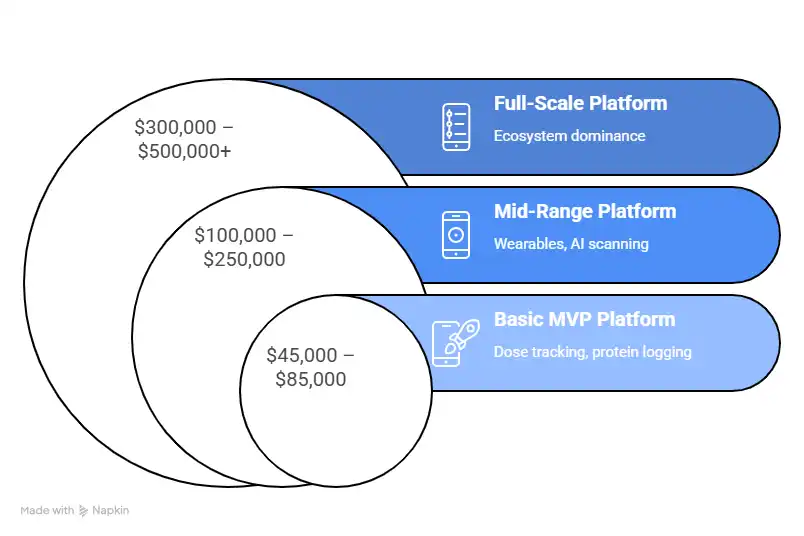
Professional estimates must account for pharmacokinetic tracking, safety protocols for side-effect management, and the high cost of medical data security.
Clinical Workflow Definition
Before coding, clinical logic must be finalized. This phase dictates 40% of backend complexity.
- Titration Logic: Costs depend on whether the schedule is fixed or dynamic (physician-adjusted).
- Side-Effect Triaging: Building a system to differentiate mild nausea from acute medical issues requires medical-grade decision trees.
- Investment: Expect $8,000 – $15,000 for clinical consulting to ensure the tech architecture follows medical best practices.
MVP vs. Full-Scale Budgets
An MVP focuses on adherence, while a full-scale platform targets ecosystem dominance.
| Phase | Core Focus | Budget Range |
| Basic MVP | Dose tracking, protein logging, HIPAA | $45,000 – $85,000 |
| Mid-Range | Wearables, AI scanning, pharmacy alerts | $100,000 – $250,000 |
| Full-Scale | Telehealth, EHR, AI metabolic pathing | $300,000 – $500,000+ |
Launching an MVP allows for real-world data collection, vital for raising subsequent rounds or proving concepts to pharma partners.
Integration and Data Costs
The primary cost driver in healthcare tech is the “connective tissue” between systems.
- EHR Integration: Syncing with systems like Epic via HL7 FHIR typically adds $25,000 – $40,000.
- Pharmacy Networks: Connecting to SureScripts for real-time status costs $12,000 – $25,000 in dev and licensing.
- Wearable Normalization: Aggregating data from Apple and Oura through a unified layer costs $10,000 – $20,000.
Compliance and Security
Security is the foundation, not a feature. Cutting corners creates massive liabilities and destroys investor confidence.
The “Security Tax”: HIPAA-compliant architecture, including data encryption, audit logs, and MFA, typically adds 20% to 30% to total development costs.
Budget $15,000 – $40,000 specifically for security audits, penetration testing, and legal compliance documentation (BAAs) to ensure the platform is enterprise-ready.
Design, Dev, and Testing
A balanced budget distributes resources across three pillars:
- UX/UI Design ($15,000 – $35,000): Focus on low-friction interfaces for users experiencing medication-induced fatigue.
- Backend & DevOps ($40,000 – $100,000): Building scalable infrastructure for real-time biometrics and encrypted records.
- QA & Clinical Validation ($15,000 – $30,000): Testing ensures titration logic is 100% accurate; a calculation mistake here is a medical error, not just a bug.
Real-World Benchmarks
Benchmarks provide the reality check needed for long-term runway planning.
- Developer Rates: US teams range from $120–$200/hr, while top-tier offshore teams range from $50–$90/hr.
- Maintenance: Budget 15% to 25% of the initial build cost annually for updates and security patches.
- Timeline: A high-quality MVP takes 4 to 6 months. An enterprise platform requires 10 to 14 months before full market launch.
Estimating Cost by Feature: What Actually Drives Your Budget?
When building a GLP-1 app, many founders assume that user interface design or brand aesthetics consume the majority of their capital. In reality, the true financial driver is backend architecture complexity. Building a healthcare application requires specialized security protocols and real-time data linkages that standard consumer applications do not need. Understanding how specific features impact your budget allows you to invest your resources strategically.
1. Patient Registration & Onboarding
This module manages your digital entry door, allowing users to create accounts, confirm their contact numbers, and complete standard identity checks.
- Estimated Cost Range: $8,000 to $15,000
- Development Timeline: 3 to 4 weeks
- Business Impact: This is your primary customer intake point. We design this flow to handle multi-factor login steps smoothly, keeping your drop-off rates low while securing patient data.
2. Health Assessment & Eligibility Screening
An interactive, responsive medical questionnaire designed to capture weight history, pre-existing conditions, and metabolic baselines safely.
- Estimated Cost Range: $10,000 to $18,000
- Development Timeline: 4 to 5 weeks
- Business Impact: This layout evaluates patient candidacy before a live appointment. Our engineers design these forms with built-in safety rules that instantly flag high-risk conditions, protecting your providers’ time.
3. Telemedicine Consultations
The real-time communications hub where patients connect with medical providers over encrypted video links or messaging screens.
- Estimated Cost Range: $15,000 to $30,000
- Development Timeline: 5 to 7 weeks
- Business Impact: This functions as the core of your care model. We build adaptive video setups that adjust stream quality automatically based on cell signals, lowering missed appointments and ensuring clear doctor-patient communication.
4. Prescription Management
A secure portal that allows physicians to review patient profiles, generate new orders, and route weight-loss medication details straight to partner pharmacies.
- Estimated Cost Range: $12,000 to $22,000
- Development Timeline: 4 to 6 weeks
- Business Impact: Eliminates manual data entry errors. We build tracking boards that let clinicians view current doses and titration schedules instantly, improving overall care safety.
5. Medication Tracking
A patient-facing logging tool with automated push reminders that help users track their weekly injection schedules and report common side effects.
- Estimated Cost Range: $7,000 to $12,000
- Development Timeline: 3 to 4 weeks
- Business Impact: Directly drives long-term customer retention. Regular mobile reminders encourage patients to stay consistent with their therapy plans, improving health outcomes and subscription length.
6. Weight Loss Progress Monitoring
An interactive visual dashboard where patients can view their progress metrics, track waist dimensions, and upload lifestyle updates.
- Estimated Cost Range: $8,000 to $14,000
- Development Timeline: 3 to 5 weeks
- Business Impact: Visualizing progress builds strong user motivation. We connect these charts to smart database logic that allows providers to review weight trends before follow-up calls.
7. Secure Messaging
A fully compliant chat window that allows patients to message care teams directly regarding side effects or supply requests.
- Estimated Cost Range: $10,000 to $18,000
- Development Timeline: 4 to 5 weeks
- Business Impact: Relieves strain on your call centers. We build secure text frameworks that keep patients connected without exposing personal phone numbers or unencrypted communication channels.
8. Provider Dashboard
The central work environment for your clinical team, organizing incoming patient files, chart history, and scheduled appointments.
- Estimated Cost Range: $15,000 to $25,000
- Development Timeline: 5 to 7 weeks
- Business Impact: Directly impacts clinical efficiency. We build organized layouts that let nurses and doctors process intake charts quickly, maximizing daily patient volume.
Advanced Features That Increase Cost
As your GLP-1 platform grows, managing every process manually becomes increasingly difficult. Automation can help streamline routine tasks, improve operational efficiency, and free up care teams to focus on patient support. This not only supports business growth but also helps deliver a more consistent experience for patients over time.
| Advanced Feature | Average Cost Addition | Primary Operational ROI |
| Insurance Verification Engine | $15,000 to $30,000 | Checks commercial coverage rules automatically, reducing billing errors. |
| Prior Authorization Automation | $20,000 to $45,000 | Replaces manual paperwork with instant, automated electronic payer submissions. |
| Pharmacy Integrations | $18,000 to $35,000 | Routes medication orders directly to compound and retail dispensing queues. |
| Lab Integrations | $15,000 to $30,000 | Pulls metabolic diagnostic results back from networks like Labcorp automatically. |
| AI Intake Assistant | $25,000 to $50,000 | Uses conversational AI to organize unstructured medical histories for review. |
| AI Adherence Monitoring | $20,000 to $40,000 | Flags subtle changes in tracking data to help teams prevent customer churn. |
| Virtual Pet Engagement | $15,000 to $35,000 | Pairs clinical habit logging with fun rewards to maximize daily user interactions. |
| Employer Wellness Board | $25,000 to $60,000 | Generates anonymized health trend reports to unlock high-margin B2B business channels. |
How We Help You Optimize Your Scope
Building a GLP-1 virtual clinic does not require launching every feature on day one. We help businesses identify the features that matter most, create a practical development roadmap, and build a platform that can grow alongside their operations. This helps control early costs while creating a strong foundation for future expansion.
Our team handles the technical complexities so you can focus on building your brand and attracting patients. We also develop engaging user experiences that encourage long-term participation, helping businesses improve retention and create a more rewarding healthcare journey for their users.
Interactive GLP-1 App Cost Estimator
When launching a GLP-1 app, budgeting requires a clear understanding of how each technical requirement impacts your total engineering capital. Software development costs are determined by architectural complexity, compliance protocols, and third-party data connections. Use this interactive breakdown to evaluate your project scope and visualize your resource allocation.
Step 1: Select Your Core Features
These are the essential features needed to launch a working GLP-1 platform and begin serving patients. They support the core care journey, from patient onboarding and virtual consultations to prescription management and progress tracking. Starting with these fundamentals helps create a reliable foundation that can be expanded as your business grows.
| Feature Module | Estimated Cost | Operational Role |
| Patient App (Onboarding & Profiles) | $8,000 – $15,000 | Manages identity verification, multi-factor authentication, and basic patient account setup. |
| Provider Dashboard | $15,000 – $25,000 | Provides doctors and nurses with an organized workspace to review incoming medical files and charts. |
| Telehealth Video Module | $15,000 – $30,000 | Powers end-to-end encrypted video rooms directly inside the application interface. |
| Prescription Management Portal | $12,000 – $22,000 | Allows clinicians to track dosage levels, manage titration schedules, and authorize prescription refills. |
| Progress Tracking Dashboard | $8,000 – $14,000 | Enables patients to log weight trends and report side effects visually. |
Step 2: Select Advanced Features
These features help reduce the amount of manual work required to operate a GLP-1 clinic. By automating repetitive processes such as insurance checks, pharmacy coordination, and clinical documentation, care teams can spend more time supporting patients. This creates a smoother experience for both providers and users while improving operational efficiency..
| Feature Module | Estimated Cost | Operational Role |
| Insurance Verification Engine | $15,000 – $30,000 | Checks commercial health coverage and copay rules automatically. |
| Prior Authorization Automation | $20,000 – $45,000 | Generates and submits electronic authorization forms directly to medical insurance payers. |
| Pharmacy Network Integrations | $18,000 – $35,000 | Routes medication orders automatically to partner compounding and mail-order pharmacies. |
| Lab Provider Integrations | $15,000 – $30,000 | Syncs directly with networks like Labcorp to pull diagnostic blood panels back into patient files. |
| AI Charting Assistant | $25,000 – $50,000 | Uses secure conversational processing to summarize clinical consultation audio for medical records. |
| Virtual Pet Engagement System | $15,000 – $35,000 | Drives retention by pairing injection logging with interactive reward systems. |
Step 3: Select Growth Features
These features are designed for businesses that plan to grow beyond a single clinic or local market. They support larger patient populations, enterprise partnerships, and new revenue opportunities as the platform expands. Investing in these capabilities can help create a stronger foundation for long-term growth and scalability.
| Feature Module | Estimated Cost | Operational Role |
| Multi-State Registry Engine | $12,000 – $25,000 | Dynamically matches incoming patient locations with provider medical licensing restrictions. |
| Employer Wellness Portal | $25,000 – $60,000 | Provides corporate clients with anonymized health trend reports to open up high-margin sales channels. |
| Advanced Data Analytics Hub | $10,000 – $22,000 | Monitors patient retention rates and pinpoints exact drop-off moments in your care funnel. |
| White-Label Infrastructure Support | $20,000 – $45,000 | Restructures your core platform code so it can be rebranded and licensed to external clinical groups. |
Recommended Build Path Based on Budget
Your budget plays a major role in determining which features should be built first. Rather than trying to launch everything at once, it is often more effective to prioritize the capabilities that deliver the most immediate business value. A phased approach helps control costs, reduce development risks, and create a stronger foundation for future expansion.
Budget Level: $45,000 to $85,000
Focus strictly on a Lean Minimum Viable Product. Avoid building custom automation networks or advanced AI tools immediately. Use your capital to engineer a highly secure front-end application, an end-to-end encrypted video consult room, and a basic provider tracking dashboard to validate early market demand.
Budget Level: $90,000 to $180,000
Transition into a growth-stage platform. At this stage, your primary scaling bottleneck is manual administrative work. Invest your development budget into native FHIR lab integrations and pharmacy connections to handle large influxes of patients without expanding your administrative staff.
Budget Level: $200,000+
Deploy an enterprise-grade medical infrastructure. Implement secure ambient clinical scribes to streamline charting workflows, build robust employer benefits portals to support large-scale partnerships, and launch cross-platform mobile apps designed for nationwide growth. At this stage, the focus shifts from validating the business model to optimizing operations, expanding reach, and supporting high patient volumes efficiently.
How We Help You Protect Your Technology Investment
Building a successful GLP-1 platform requires more than adding features. The right foundation helps you stay compliant, control development costs, and scale your operations as patient demand grows. We work closely with businesses to identify the most important requirements first and create a roadmap that supports long-term growth.
Our team handles the technical side of development so you can focus on building your brand and serving patients. We also create engaging experiences that encourage long-term participation, helping improve retention and make your platform stand out in a competitive market.
How to Reduce GLP-1 App Development Costs Smartly?
Developing GLP-1 apps is capital-intensive, but reckless spending on low-impact features is the fastest way to burn runway. Smart cost reduction is about strategic allocation rather than cutting corners on safety. For an investor, the goal is to reach “Proof of Concept” with minimal waste to increase platform valuation.
Adopting a lean engineering mindset allows you to build a high-performance product while maintaining a manageable burn rate.
Platforms like WeightWatchers have successfully integrated GLP-1 tracks by focusing on these high-impact features instead of rebuilding legacy systems from scratch.
Tightly Scoped MVP
The “everything-at-once” approach causes most budget overruns. Your MVP should solve the most painful problems for the GLP-1 user: adherence and side-effect management.
- The Must-Haves: Accurate dose tracking, protein-to-calorie ratios, and a basic symptom logger.
- The Wait-List: Social communities, advanced recipe AI, and custom video workout libraries.
- The Strategy: Focus on the medication companion aspect first. Once you have a retained user base, use their data to justify the cost of secondary features.
API vs. Custom Build
In the early stages, buying is almost always cheaper than building. Custom-coding a food database or a wearable integration engine can cost upwards of $50,000 and months of time.
Investor Tip: Utilize specialized middleware. Instead of building individual connections for every wearable, use a service like Terra or Rook. For food logging, integrate the Nutritionix or FatSecret APIs. This reduces initial development costs to roughly $5,000 to $10,000 and slashes time-to-market.
High-ROI Revenue Features
To make the app self-sustaining, prioritize features that facilitate monetization. Focus on the provider dashboard for B2B models or premium metabolic insights for B2C.
| High-ROI Feature | Development Cost | Revenue Potential |
| Provider Dashboard | $20,000 to $40,000 | High (SaaS fees) |
| Premium AI Reports | $15,000 to $30,000 | Medium (Subscriptions) |
| Pharmacy Lead Gen | $10,000 to $20,000 | High (Referral fees) |
Focusing on the Provider Dashboard early allows you to sell the platform to doctors overwhelmed with GLP-1 patient inquiries. This is a strategy used by Mochi Health, which combines a patient app with clinician tools to scale their practice efficiently.
Modular Scaling Architecture
The most expensive mistake is rebuilding a backend because it was not designed to scale. A modular, or “Microservices,” architecture allows you to add features like Telehealth later without breaking existing tracking logic.
How it saves money:
- Isolation: If one module needs an update, the rest of the app stays online.
- Parallel Dev: Multiple teams can work on different features simultaneously.
- Scalability: You only pay for the cloud resources you actually use, ensuring infrastructure costs scale linearly.
Investing in solid DevOps and Cloud Architecture (approx. $15,000 to $25,000) during the initial build prevents massive technical debt payments down the road.
Understanding ROI: Which Features Deliver the Highest Return?
When engineering a GLP-1 app, it is easy to fall into the trap of wanting to build every feature simultaneously. However, not all software functionalities generate the same business value. To maximize your development budget, you must prioritize features that directly drive patient acquisition, lower manual administrative burdens, and extend subscriber lifetimes. Splitting your features into precise ROI tiers ensures your capital goes exactly where it can generate the highest impact.
1. Highest ROI Features
These are often the first features businesses prioritize because they address common operational challenges and support a smoother patient experience. By reducing manual work and improving efficiency, they can create value early while helping the platform scale more effectively as patient volume grows.
Insurance Verification
Many patients seeking medical weight-loss solutions want to know if their commercial benefits cover expensive brand-name medications. Building an automated eligibility verification tool directly into your intake flow removes the need for phone calls. The system checks coverage and calculates patient copays instantly, driving conversion rates higher during user onboarding.
Automated Prior Authorization
Manual prior authorization paperwork is one of the largest bottlenecks in modern healthcare administration. By engineering an automated digital submission system, we eliminate the need for manual faxing and phone follow-ups. The software compiles patient charts, pulls relevant diagnosis codes, and routes requests to insurance providers automatically. This slashes approval turnaround times and reduces chart write-offs significantly.
Medication Adherence Tools
GLP-1 treatment plans rely on consistent, long-term adherence across multiple months. Building automated injection trackers with smart push notifications directly counters patient forgetfulness. When your platform actively encourages users to log their doses and monitor side effects, you improve treatment success rates and extend subscriber lifetime value.
AI Patient Support
Answering routine questions about medication storage or minor side effects can quickly overwhelm a manual help desk. Deploying a secure, trained AI support assistant allows your platform to resolve basic inquiries instantly around the clock. This layout handles high-volume questions smoothly, freeing up your clinical staff to focus on complex patient care.
2. Medium ROI Features
These features are valuable additions that help expand your operational reach and support business growth once your core platform is stable. They are often introduced after the foundation of the platform is in place and key workflows are running smoothly. While they may not deliver immediate results, they can create new opportunities for growth and help support larger patient populations over time.
Advanced Analytics
Implementing custom data dashboards allows you to monitor clinical metrics and spot exact moments when users drop out of your care funnel. While this visibility is excellent for refining your long-term product strategy, its direct impact on monthly revenue depends on how quickly your marketing teams act on those insights.
Employer Portals
Building dedicated portals allows your business to market your weight-loss platform directly to self-insured employers as a workplace benefit. This infrastructure enables human resource managers to review anonymized health improvement reports for their staff. This feature unlocks high-margin, high-volume enterprise sales channels, though it requires an established sales team to close the deals.
Care Team Collaboration
Creating secure, internal chat spaces allows nutritionists, health coaches, and physicians to co-manage patient files easily. This internal layout improves clinical coordination, but it primarily optimizes backend efficiency rather than directly bringing in new patients.
3. Premium Differentiation Features
These specialized features help your brand stand out in a competitive market, transforming standard, repetitive medical tracking into an engaging user experience. They can help strengthen patient engagement and encourage long-term participation throughout the treatment journey.
Virtual Pet Gamification
To keep patient engagement high over long treatment plans, we can pair habit logging with interactive reward mechanics. For example, syncing a user’s daily hydration, protein intake, or injection logs with an evolving virtual progress companion creates an enjoyable incentive structure. This unique feature boosts brand loyalty and directly prevents long-term subscriber churn.
AI Health Coaching
Integrating conversational AI tools allows your app to deliver personalized nutritional feedback and movement reminders based on a user’s logged metrics. This ongoing, automated support keeps patients active and motivated between their formal provider appointments.
Personalized Treatment Engines
Building intelligent algorithms that analyze patient data trends allows your system to suggest specific behavioral adjustments or lifestyle modules automatically. This capability positions your platform as a highly sophisticated, data-driven wellness solution.
Feature ROI Comparison Table
Not every feature contributes equally to the success of a GLP-1 platform. Some capabilities help drive revenue and improve operational efficiency, while others focus more on patient engagement and long-term retention. The comparison below provides a simple way to evaluate which features are likely to deliver the greatest return on your development investment.
| Feature Name | Development Cost | Revenue Impact | Retention Impact | Overall ROI Score |
| Insurance Verification | Moderate | High | Moderate | High |
| Automated Prior Auth | High | High | High | High |
| Adherence Reminders | Low | Moderate | High | High |
| AI Support Assistant | Moderate | Moderate | Moderate | High |
| Employer Portals | High | High | Moderate | Medium |
| Advanced Analytics | Moderate | Low | Moderate | Medium |
| Care Team Chat | Low | Low | Moderate | Medium |
| Virtual Pet System | Moderate | Moderate | High | Premium Asset |
| AI Health Coaching | High | Moderate | High | Premium Asset |
How We Help You Maximize Your Returns
We help businesses focus on the features that create the most value in the early stages of development. By prioritizing the right capabilities first, you can control costs, improve operational efficiency, and build a stronger foundation for future growth. Our team manages the technical side of development so you can stay focused on growing your business.
Beyond core functionality, we also create engaging user experiences that help improve patient retention and long-term participation. Features that make progress tracking more interactive can encourage consistent engagement and help your platform stand out in a competitive market.
The Hidden Costs of Building a GLP-1 App
When establishing a virtual obesity management clinic, it is easy to assume that your initial software engineering invoice represents the total cost of launching your product. However, building modern GLP-1 apps requires managing ongoing, hidden technical expenses that can surprise unprepared founders.
To run a secure, scalable telehealth platform, your post-launch operational budget must account for continuous regulatory compliance, secure server hosting, and specialized third-party medical integrations.
1. Compliance Costs
Maintaining a healthcare platform requires a continuous financial commitment to federal data privacy regulations. Compliance is an ongoing responsibility that extends well beyond the initial development phase. Regular security reviews, monitoring, and policy updates help ensure patient information remains protected as the platform evolves. These investments can also reduce risks and support long-term operational stability.
| Cost Category | Annual Investment | Operational Value |
| HIPAA Audits | $15,000 – $40,000 | Supports independent security assessments and compliance reviews to help ensure patient data is protected and healthcare workflows meet regulatory requirements. |
| Security Monitoring | $12,000 – $30,000 | Covers ongoing threat detection, system monitoring, and audit logging to identify security issues early and maintain a secure operating environment. |
| Compliance Documentation | $5,000 – $15,000 | Includes the legal and administrative work required to manage Business Associate Agreements (BAAs) and other compliance-related documentation as the platform grows. |
2. Infrastructure Costs
Because standard consumer servers are not legally allowed to hold protected health information, running a telemedicine portal requires premium, specialized cloud environments. These platforms provide the security, reliability, and compliance controls needed to support healthcare operations safely. Investing in the right infrastructure from the start can also make it easier to scale your platform as patient demand increases.
| Cost Category | Monthly Expense | Operational Value |
| Cloud Hosting | $5,000 – $25,000 | Provides secure healthcare cloud infrastructure with automated backups, protected environments, and tools designed to support compliance and data security. |
| Data Storage | $500 – $2,500 | Supports the secure storage of patient records, intake documents, verification images, and historical health data using encrypted cloud systems. |
| Telehealth Services | $1,500 – $4,500 | Covers the infrastructure and licensing costs required to power secure virtual consultations and real-time communication between patients and providers. |
Third-Party Healthcare Services
A virtual clinic relies on a web of external medical service networks to fulfill prescriptions and process blood tests, and each connection introduces its own monthly transaction or access fees. These integrations play an important role in keeping patient care workflows connected and efficient. As your platform grows, these recurring costs should be factored into your long-term operational budget to avoid unexpected expenses.
| Integration Type | Average Monthly Access Cost | Primary Functional Purpose |
| EHR Networks | $2,500 to $6,000 | Keeps your patient charts synced smoothly with major electronic medical record registries. |
| Pharmacy Links | $1,500 to $4,000 | Routes medication orders automatically to regional compounding and mail-order pharmacies. |
| Lab Providers | $1,200 to $3,500 | Transmits diagnostic metabolic blood results back into your primary provider dashboard. |
| Insurance Clearinghouses | $2,000 to $5,000 | Runs instant commercial benefit eligibility checks and automates electronic prior authorizations. |
Team Costs
Once your platform is live, you need a specialized technical support structure to keep your digital clinic running smoothly around the clock. As patient volume grows, ongoing maintenance becomes essential for maintaining performance, security, and a reliable user experience. Investing in the right support resources can also help reduce downtime and ensure critical healthcare services remain available when patients need them most.
- Maintenance Developers: Budgeting $8,000 to $15,000 per month for dedicated engineering support ensures that mobile operating system updates never break your video consultation or appointment scheduling paths.
- Support Engineers: Allocating $4,000 to $8,000 monthly allows a technical help desk to resolve common user issues, such as account recovery or password resets, keeping your customer drop-off rates low.
- Compliance Specialists: Spending $5,000 to $10,000 annually on ongoing training ensures that your entire staff stays up to date on secure data-handling protocols, preventing accidental data leaks.
Wearable Integration Costs in GLP-1 Applications
For investors, wearable integration is a data strategy. GLP-1 therapy is metabolic, and manual logs are unreliable for physiological tracking. Biometric data provides the evidence needed for insurance reimbursement or pharma partnerships.
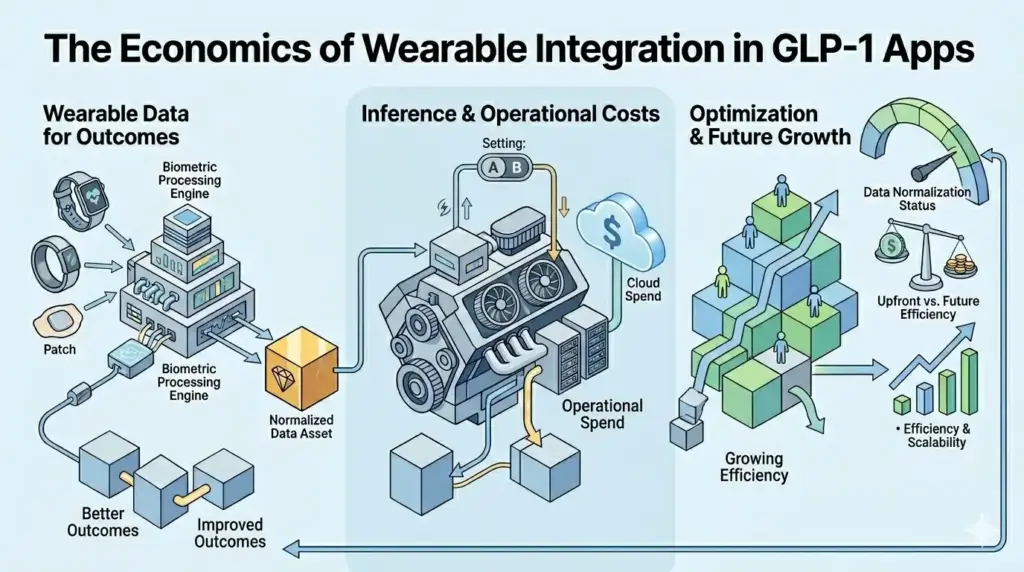
The cost depends on data depth. Pulling historical step counts is cheap; real-time monitoring for heart rate spikes or glucose drops requires a sophisticated backend. Platforms like Vera and Levels utilize this real-time data to create “safety loops” for users.
Basic Sync vs. Real-Time Data
Financial commitment is determined by data “freshness” and granularity.
- Basic Sync ($10,000 to $30,000): Pulls historical data (sleep, steps) once or twice daily. It uses standard API calls and puts minimal strain on your server.
- Real-Time Data ($40,000 to $75,000+): Required for Continuous Glucose Monitors (CGMs). This uses “Webhook” architecture to push data instantly.
- The Infrastructure Gap: Real-time data requires higher cloud costs (AWS/Azure) to process constant streams. This enables immediate alerts—like hydration reminders if heart rate rises, distinguishing premium apps.
Device Compatibility Costs
The fragmented wearable market is a major cost driver. Manufacturers like Apple, Garmin, and Oura all use different data formats.
- Middleware vs. Native: Native builds for each brand cost roughly $15,000 per device. Smart developers use middleware like Terra or Rook, costing $8,000 to $12,000 for setup plus a monthly fee for instant access to hundreds of devices.
- Data Normalization: This is a hidden cost. An Oura “readiness” score differs from an Apple “activity” ring. Engineers must normalize these into a proprietary “Metabolic Health Score.”
- Maintenance: Budget 15% to 20% of initial costs annually. Wearable APIs change frequently; an update to the Apple Watch shouldn’t break your app. Popular trackers like Pep often use these integrations to visualize estimated medication levels alongside biometric data.
Hidden Costs of Creating a Personalized GLP-1 App Experience
Personalization drives retention in GLP-1 apps, but it creates technical debt that generic trackers avoid. Moving from static templates to “living” experiences requires backends that recalculate recommendations in real-time. For investors, these hidden costs are the price of a defensible, habit-forming product.
Leaders like Noom and MyFitnessPal invest heavily in these logic layers to ensure advice feels bespoke rather than generic.
Behavioral Adaptation Costs
Building an engine that “learns” from user inputs is a major engineering task. Adaptive apps must evolve with the user’s biological journey.
- Logic Branching ($25,000 to $50,000): If a user logs fatigue every “day two” post-dose, the app must auto-adjust its nudge schedule.
- Dynamic Content: You must build a library that serves specific tips based on dose, weight velocity, and reported side effects.
- Psychological Framework ($10,000 to $20,000): High-quality nudges require behavioral psychologists to ensure the app’s “voice” actually drives clinical results.
Infrastructure and Data Load
Processing continuous biometric streams is significantly more expensive than hosting simple databases. This is the “utility bill” of health tech.
- Computational Load: Running AI models for glucose or HRV analysis requires high-performance cloud instances, increasing server bills by 30% to 50%.
- Storage and Security: Medical data is “heavy” and requires encrypted, high-availability environments. Annual overhead for HIPAA-compliant monitoring and data breach protection adds $15,000 to $30,000.
Platforms like Found and Ro leverage this infrastructure to provide a full-stack experience, justifying higher operational costs through increased user lifetime value.
AI vs Rule-Based Systems: Cost Tradeoffs Explained
Choosing between AI and Rule-Based logic determines both launch speed and long-term costs. For GLP-1 apps, this is a tradeoff between Precision and Predictability. Rule-based systems use fixed “if-then” logic set by clinicians, while AI learns from datasets to predict individual patient responses.
Investors must decide if the goal is a highly auditable clinical tool or a predictive, adaptive therapeutic. Combining both, using AI for pattern recognition and Rules for clinical guardrails, is often the most cost-effective path to a high valuation.
AI Costs for High-Stakes Insights
AI requires significant investment in data science and model training, but for specific features, the ROI justifies the price.
- Predictive Modeling ($60,000 to $120,000+): AI analyzes biometrics to predict which users will respond best to specific molecules, reducing drug switching and improving outcomes.
- Unstructured Data ($40,000 to $90,000): If an app must read physician notes or analyze food photos, AI (NLP and Computer Vision) is mandatory to reduce user friction.
- Churn Prediction: Machine Learning identifies subtle patterns, like shifted logging times, that signal a user is about to quit. Preventing 10% of churn saves thousands in recurring revenue.
Low-Cost Structured Logic
For many core functions, AI is overkill. Structured rules offer 90% of the value at 20% of the cost, especially for regulated workflows.
The Auditability Advantage: Rule-based systems are deterministic. If a user is prompted to contact a doctor, a clinician can trace that decision to a specific line of code. This transparency is vital for HIPAA and FDA certifications.
Where to use Rules to save money:
- Titration Schedules ($5,000 to $10,000): Fixed medical protocols (e.g., increase dose every 4 weeks) are best handled by simple logic.
- Safety Guardrails: Standard alerts for severe side effects do not require AI. These are reliable and cheap to code.
- Basic Goal Setting: Calculating protein targets based on weight is a simple formula; using AI adds unnecessary complexity.
Building the foundation with Rule-Based logic and applying AI only to high-value predictive features can save $50,000 to $100,000 over a pure AI-first platform. This hybrid approach is common in successful platforms like Calibrate and WeightWatchers (WW) to balance medical safety with modern tech.
Understanding the Total Cost of Ownership of GLP-1 Apps
Many founders look only at the initial engineering invoice when building GLP-1 apps. While the upfront coding phase requires a clear capital investment, the true financial picture unfolds across the entire lifecycle of your application. By calculating your total cost of ownership over a multi-year horizon, you can protect your cash flow and scale your virtual clinic safely without unexpected infrastructure bills.
What Is TCO?
Total Cost of Ownership represents the complete financial investment required to design, build, run, and scale your healthcare platform. It includes the initial engineering sprint as well as recurring expenses like regulatory compliance monitoring, API transactional fees, server maintenance, and system feature enhancements.
Year 1 Costs: The Foundation Phase
The initial year centers on product design, architecture building, compliance certification, and entering the marketplace.
- Development: Expect to invest $50,000 to $120,000 to build your initial product version. This covers a secure patient mobile application, a HIPAA-compliant data storage setup, and an optimized doctor review dashboard.
- Compliance: Budget $15,000 to $30,000 for setting up your legal foundation. This covers penetration testing, formal vulnerability scans, and executing formal Business Associate Agreements.
- Infrastructure: Allocating $12,000 to $24,000 annually covers the premium costs of secure cloud hosting services and dedicated end-to-end encrypted video consult rooms.
- Support: Plan for $20,000 to $40,000 for standard engineering maintenance. This ensures your software stays compatible with automatic mobile operating system updates.
Year 2 Costs: The Growth Phase
Once the foundation of your GLP-1 platform is in place, the next priority is improving efficiency and keeping patients engaged over the long term. This is the stage where automation, retention tools, and operational enhancements can have the greatest impact. Investing in these capabilities can help support growth without requiring a proportional increase in administrative effort.
Growth Infrastructure
As your patient volume climbs from hundreds to thousands, your baseline database demands shift. This stage requires investing $15,000 to $35,000 to transition into auto-scaling, containerized cloud instances that can handle massive traffic surges during peak consultation hours without platform lag.
Feature Expansion
To cut down on manual administrative labor, expect to spend $25,000 to $50,000 integrating automated pipelines. This involves connecting with national laboratory feeds to parse patient blood panels automatically and linking with compounding pharmacy networks to route prescription orders instantly.
Security Enhancements
Allocating $10,000 to $25,000 allows you to perform thorough third-party security audits and update data logs. This step protects your expanding platform from evolving data privacy risks and keeps your systems fully audit-ready.
Year 3 Costs: The Scale Phase
The third year centers on nationwide market expansion, enterprise commercial partnerships, and advanced automation.
- Multi-State Scaling: Investing $15,000 to $30,000 integrates intelligent routing frameworks. This logic dynamically verifies medical provider licensing rules across multiple states during patient registration.
- Enterprise Features: Budgeting $30,000 to $65,000 opens up profitable B2B channels. This capital builds secure, custom employer wellness portals that generate anonymized health progress reports for corporate insurance clients.
- AI Enhancements: Spending $25,000 to $50,000 implements advanced machine learning tools. This covers secure ambient clinical scribes that draft chart notes automatically from video consultations, lowering doctor burnout.
Monthly Operating Cost Breakdown
Operating a telehealth platform involves more than maintaining the application itself. Ongoing expenses often include cloud infrastructure, communication services, and healthcare integrations that support day-to-day operations. Understanding these recurring costs early can help businesses plan more effectively and avoid unexpected challenges as the platform grows.
| Expense Category | Monthly Cost Range | Primary Operational Purpose |
| Cloud Hosting | $800 to $3,500 | Dedicated, secure servers that isolate patient medical files. |
| HIPAA Monitoring | $500 to $1,500 | Real-time intrusion detection and unalterable access logs. |
| Telehealth APIs | $400 to $1,200 | End-to-end encrypted video channels and private patient text boxes. |
| AI Services | $600 to $2,500 | Automated chart notes and secure around-the-clock patient assistance. |
| Insurance Tools | $1,000 to $3,000 | Automated eligibility checks and electronic prior authorizations. |
| Pharmacy Networks | $500 to $1,800 | Direct data lines to route prescription orders to dispensing hubs. |
| Technical Support | $2,500 to $6,000 | Ongoing software optimization and operating system upgrades. |
Sample Annual TCO Scenarios
Understanding the total cost of ownership is important when planning a GLP-1 platform. Development is only one part of the investment, and ongoing expenses can vary based on your feature set, infrastructure needs, and support requirements. The examples below provide a realistic view of what different operating scenarios may look like during the first year after launch.
Startup Clinic
This model is designed for businesses that want to launch quickly and validate demand within a specific market. By focusing on a smaller patient base and a limited geographic area, founders can keep costs manageable while refining their care workflows. It also provides an opportunity to gather real-world feedback before expanding into larger markets or adding advanced features.
| Cost Category | Estimated Cost |
| Core Telehealth Build | $55,000 |
| Baseline Security & BAA Signing | $15,000 |
| Annual Hosting & API Connections | $14,400 |
| Standard Post-Launch Support | $24,000 |
| Total Year 1 Capital Required | $108,400 |
Growth-Stage Company
An expanding telehealth network operating across multiple regions with automated lab connections and intermediate patient tracking tools.
- Upfront Feature Engineering: $95,000
- Automated FHIR Lab/Pharmacy Links: $35,000
- Advanced Compliance & Pen Testing: $25,000
- Scalable Cloud Hosting & Telehealth Video APIs: $38,000
- Dedicated Ongoing Engineering Maintenance: $48,000
- Total Year 1 Capital Required: $241,000
Enterprise Healthcare Organization
A comprehensive clinical network featuring full insurance integration, smart AI charting tools, and corporate benefits dashboards.
- Enterprise Software Engineering Sprint: $180,000
- Prior Authorization & Insurance Automations: $45,000
- Ambient AI Scribe Modules: $30,000
- Comprehensive Security & Enterprise BAA Assurances: $40,000
- High-Volume Cloud Server Infrastructure & Network Controls: $72,000
- Full-Scale Technical Support Contracts: $90,000
- Total Year 1 Capital Required: $457,000
Why GLP-1 Apps Go Over Budget?
Building a digital weight-loss clinic is a complex engineering task. While many founders enter the development phase with a fixed price estimate, healthcare applications are highly susceptible to scope creep. When software requirements expand unexpectedly mid-build, budgets inflate and launch dates slip. Understanding exactly where these hidden complexities hide allows you to protect your capital and maintain your project timeline.
1. EHR Integration Complexity
Connecting a patient-facing mobile application to an existing Electronic Health Record (EHR) system is a common point of failure for inexperienced development teams.
- What Founders Expect: They assume connecting to networks like Epic, Cerner, or Athenahealth is as simple as plugging in a standard web API, similar to adding a payment gateway.
- The Reality: Legacy EHR networks use highly customized, non-standardized data formats. Testing, mapping data fields, and gaining authorized production API keys from major health networks involves strict vendor gatekeeping and unexpected platform licensing fees.
- How to Avoid It: We prevent these bottlenecks by utilizing open standards like Fast Healthcare Interoperability Resources (FHIR) from day one. By mapping your core database structure to universal healthcare standards early, we ensure smooth data translation and avoid expensive code rewrites later.
2. Pharmacy & Prescription Workflows
Managing medication fulfillment involves more than sending a prescription to a pharmacy. The process often includes eligibility checks, prescription routing, inventory coordination, and ongoing patient communication. Building reliable workflows for these steps can help reduce delays, improve the patient experience, and support smoother clinic operations as the platform grows.
Hidden Challenges
A generic software agency often designs a basic checkout funnel that looks like a standard retail shop. However, GLP-1 therapy requires managing moving dosage titration schedules, automatic refill boundaries, and direct state-by-state routing to specific compounding or mail-order pharmacies.
Budget Impact
If your developers do not build automated verification checks into the prescription engine, your medical staff will have to spend hours manually correcting errors. Rebuilding a broken medication order workflow after launch can cost thousands in structural database alterations.
3. HIPAA Compliance Requirements
Many businesses think about compliance only after development has already started. In reality, privacy and security requirements influence everything from database design to system architecture. Addressing these considerations early can help avoid expensive rework later and create a stronger foundation for long-term growth.
Unexpected Costs
True data compliance requires completely isolating protected health information (PHI) from basic analytics trackers and application marketing scripts. If an unvetted vendor accidentally mixes patient medical intake histories with standard consumer tracking codes, fixing the leak requires completely rebuilding your cloud infrastructure.
Planning Recommendations
When we architect your platform, we implement clear data isolation from the start. We route all sensitive clinical details into secure, heavily encrypted cloud vaults while keeping your marketing and billing metrics completely separate. This keeps your system fully secure and ensures you are always ready for a formal compliance audit.
4. Insurance Verification & Prior Authorization
Automating commercial insurance checks is an exceptionally difficult engineering process that frequently delays product launches.
- Technical Complexity: Every medical insurance payer operates under different approval guidelines for weight-loss coverage. Building a tool that parses these diverse policy configurations requires deep integration experience with national insurance clearinghouses.
- Timeline Risks: If your engineering team does not understand how to map these electronic clearinghouse feeds, your development timeline can easily stall for months while trying to resolve data connection drops.
5. Expanding Feature Requests
As a platform begins to grow, new feature ideas often emerge from patients, providers, and internal teams. While innovation is important, adding too many features too quickly can increase costs and slow development progress. Prioritizing the features that deliver the most business value helps keep the project focused and ensures resources are invested where they can have the greatest impact.
Why It Happens
During review sessions, stakeholders often suggest add-ons, such as advanced nutritional logs, community chat boards, or personalized fitness engines. While these ideas are valuable, adding them mid-build disrupts your core database configuration and stretches your development resources thin.
How to Control Scope
We manage this risk by guiding you through a strict product roadmap. We help you prioritize necessary, high-ROI features first, ensuring you launch a secure, functional Minimum Viable Product on time and within your target budget.
Scope Creep Prevention Framework
To keep your project moving forward without unexpected expenses, we follow a highly structured development workflow. We establish a clear technical framework before any code is written, ensuring every milestone matches your exact operational goals. This approach removes guesswork, allowing us to build an incredibly engaging user experience, such as linking interactive virtual pet progress companions directly with daily patient habit logs, right alongside secure, encrypted healthcare windows. By balancing backend compliance with top-tier product management,
How to Build the Right Scope for Your Budget?
Launching a virtual weight-loss platform requires balancing your available capital with the technical demands of medical software. Trying to build every feature at once can dilute your resources and delay your launch. By structuring your development in phases, you can enter the market quickly, validate your care model, and expand your technical architecture as your patient volume grows.
If Your Budget Is Under $75K
A lean budget means focusing strictly on a Minimum Viable Product.The goal here is to establish a secure, compliant care channel that allows clinicians to safely evaluate patients and issue prescriptions without manual overhead.
Recommended Features
- HIPAA-Compliant Patient Intake: Interactive web or mobile forms that capture weight baselines, medical histories, and contraindications securely.
- Basic Provider Queue: An organized workspace where licensed clinicians can review intake summaries and message patients.
- Secure Telehealth Communication: End-to-end encrypted messaging or basic video rooms to conduct mandatory clinical evaluations.
- Essential E-Prescribing: Manual or basic API-driven routing to push verified medication orders directly to your primary compounding pharmacy partner.
Features to Delay
- Custom AI Assistants: Avoid expensive machine learning models for intake or coaching. Use clear form logic instead.
- Deep EHR Syncing: Do not spend early capital trying to integrate with massive health networks like Epic or Cerner. Keep records centralized inside your app’s secure database.
- Automated Insurance Pipelines: Focus on a cash-pay, subscription-based business model early on to skip the complex development work required for commercial insurance clearinghouses.
If Your Budget Is $75K–$150K
This budget range allows you to transition from a manual clinic into an automated growth platform. At this tier, development capital is used to eliminate operational bottlenecks, allowing your business to scale up user volume without needing to hire a massive administrative support staff.
Recommended Features
- Native Lab Integrations: Automated data pipelines that connect directly with diagnostic networks like Labcorp to pull metabolic blood panels straight into patient profiles.
- Direct Pharmacy API Links: Two-way integrations with fulfillment hubs to track order statuses, dispensing confirmation, and medication shipping updates in real time.
- Automated Side-Effect & Titration Tracking: Patient-facing logging tools that prompt users to record weekly injection details and flag adverse symptoms automatically for clinical review.
- Multi-State Provider Routing: Dynamic calendar and registry logic that matches incoming patient locations with specific physician medical licenses automatically.
Features to Delay
- Enterprise B2B Portals: Delay building customized benefits frameworks designed for self-insured corporate HR departments until your consumer brand is fully established.
- Ambient AI Charting Scribes: Stick to optimized macro-templates and structured clinical checkboxes for your doctors rather than deploying real-time audio-to-text summaries.
If Your Budget Is $150K+
An enterprise-grade budget lets you deploy a highly optimized, comprehensive chronic care ecosystem. This tier focuses on maximizing clinical efficiency through advanced automation, establishing B2B commercial pipelines, and using premium engagement tools to drive long-term patient retention.
Recommended Features
- Automated Prior Authorization Engine: Intelligent software linkages that compile patient charts, match insurance policy rules, and submit electronic clearance requests directly to payers to reduce manual paperwork.
- Ambient AI Scribes: Secure, trained natural language processing tools that securely monitor consultation audio and draft complete, structured chart notes automatically for provider approval.
- Gamified Lifestyle Tracking Infrastructure: Highly interactive front-end tools, such as syncing custom lifestyle habit trackers with a gamified progression companion, to keep patient motivation high across multi-month treatment plans.
Enterprise Additions
- Employer Wellness Dashboards: Custom-branded portals that allow corporate clients to review anonymized weight-loss metrics and health improvement trends across their workforce.
- White-Label Infrastructure Architecture: A highly flexible, modular codebase designed to let you easily rebrand, license, and deploy your core platform for external healthcare systems or large clinic groups.
Why Founders Trust IdeaUsher for GLP-1 App Development
Founders in obesity medicine choose IdeaUsher to bridge the gap between lifestyle tech and clinical infrastructure. GLP-1 apps are not standard trackers; they are medical companions managing high-cost prescriptions and sensitive data. With over 500,000 hours of coding experience, our team of ex-MAANG/FAANG developers provides the precision needed for institutional due diligence.
Clinically Aligned Experience
Clinical validation is the currency of health tech. Our process focuses on the Provider-Patient loop to ensure data flow between EMRs and wearables is medically useful. Like Form Health, our architecture supports long-term supervision to prevent muscle loss and maintain safety during rapid weight loss.
Workflow and Compliance Mastery
Regulations are a minefield for the uninitiated. We provide a Security-First framework, building every platform to HIPAA and SOC2 standards. Our specialized logic includes automated titration engines and insurance automation, letting you focus on growth while we handle secure medical data management.
Scalable Revenue-Driven Focus
We prioritize the metrics that matter: LTV and Retention. By using modular microservices, we help you launch fast and scale without technical debt. This approach, utilized by leaders like Ro and Sequence, ensures your product is high-performance, medically sound, and positioned for a significant market exit.
Conclusion
Ultimately, the overall investment is determined by the depth of clinical automation and the complexity of the integrated healthcare ecosystem. By focusing on a lean initial version that prioritizes patient safety and core adherence features, stakeholders can effectively manage development resources while delivering a high-quality medical experience.
FAQs
A1: For the end-user, subscription costs typically cover medical consultations and insurance coordination, often starting at a modest entry rate for the first month before adjusting to a standard monthly fee. These costs generally exclude the price of the medication itself, though some premium memberships include access to specialized care teams and integrated pharmacy services.
A2: The investment required to build a GLP-1 platform varies based on complexity, ranging from a basic functional version to a highly advanced ecosystem with custom integrations. Factors like custom UI/UX design, backend security, and advanced doctor-patient dashboards influence the final budget, with many stakeholders choosing to start with an essential version and scaling over time.
A3: A comprehensive application includes injection and dosage tracking, side-effect logging, and secure telehealth portals for clinician check-ins. To support long-term success, these platforms often integrate nutritional tools focused on protein and hydration, body composition analytics, and automated reminders to maintain strict adherence to the weekly medication schedule.
A4: Development begins with a strategic planning phase to define the clinical workflow, followed by the design of a HIPAA-compliant architecture. The process involves building a patient-facing mobile interface, a provider management panel, and a secure backend, culminating in rigorous testing and a phased launch to ensure patient data remains protected and the user experience is seamless